Act I
The bundle of firewood had barely touched the wrong porch before everything spiraled out of control.
The thirteen-year-old boy immediately realized his mistake.
His cheeks flushed red beneath the bitter winter air as he hurried toward the expensive house, his red knit gloves trembling while he bent to lift the bundle back onto his small hand cart. Thin snow crunched beneath his worn boots as he whispered apology after apology.
“I’m sorry, sir… I brought it to the wrong house.”
The wealthy homeowner wasn’t interested in apologies.
Instead, he held something far more valuable in his hand.
The folded bills the boy had just earned after spending the afternoon hauling heavy bundles through icy roads.
It wasn’t much.
Just enough for a teenager to feel proud after helping his widowed mother earn a few extra dollars before another freezing night settled over the countryside.
The homeowner slowly slipped the money into his own coat pocket.
The boy looked up in confusion.
He didn’t understand.
“I’ll fix it.”
“You already made the mistake.”
Neighbors watched quietly through frosted windows.
No one came outside.
Everyone knew the man living in the large house at the end of the dirt road.
He was wealthy.
Powerful.
And notorious for treating anyone poorer than himself as if they were invisible.
The boy clasped his frozen hands together.
He didn’t ask for sympathy.
He only asked for what he had earned.
The man’s eyes filled with contempt.
“Trash. You don’t get paid for mistakes.”
The words echoed across the silent road.
And somehow…
They hurt more than the cold.
But humiliation was only the beginning.
Act II
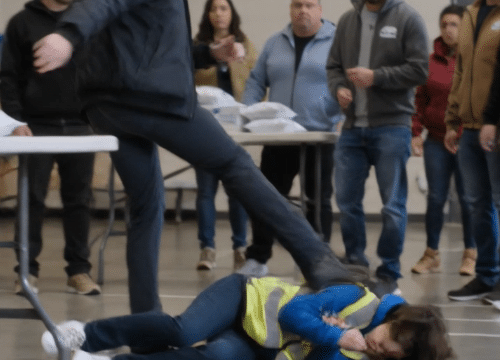
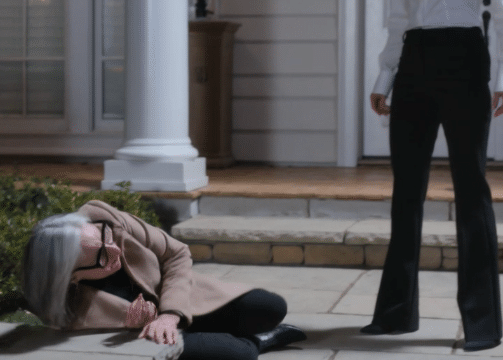
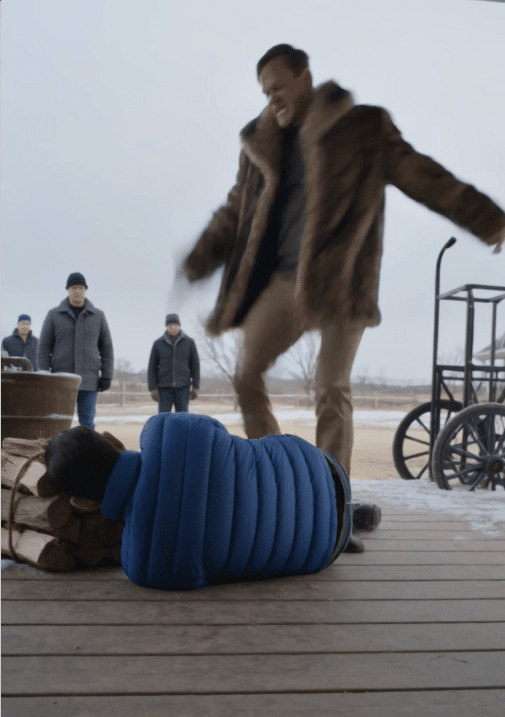
The homeowner suddenly drove a powerful kick into the boy’s chest.
The child flew backward onto the wooden porch beside the firewood bundle.
The rope snapped loose.
Small logs scattered across the weathered planks, rolling toward the thin layer of snow below.
His elbow struck the sharp edge of a wooden board.
A tiny streak of blood appeared.
Nothing severe.
Just enough to remind everyone watching that this wasn’t an accident anymore.
It was cruelty.
The boy gasped for air.
He wasn’t crying because of the pain.
His eyes searched desperately for only one thing.
His pay.
That money wasn’t for toys.
It wasn’t spending money.
His mother depended on every delivery they completed together. Ever since his father passed away in a logging accident four years earlier, every winter had become a battle against unpaid bills, empty cupboards, and heating costs that climbed higher each year.
When school ended each afternoon, he helped tie firewood bundles while his mother loaded them onto the cart.
Together they knocked on neighbors’ doors until sunset.
Some customers tipped.
Most didn’t.
Still, they were grateful for every dollar.
The homeowner stepped closer.
Without hesitation, he delivered two more vicious kicks into the boy’s back and side.
The child curled instinctively, protecting himself as the logs lay scattered around him.
The road fell silent.
Adults watched from porches.
No one moved.
Then the man looked down at him with absolute disgust.
“Go cry to your mother.”
The insult landed like ice.
Not because it embarrassed the boy.
Because his mother had spent years teaching him one lesson.
No matter how difficult life became…
Never beg.
The boy lowered his eyes.
He had tried to keep that promise.
Then a door opened across the road.
And every person standing outside suddenly forgot to breathe.
Act III
The opposite neighbor’s wooden door swung open with surprising force.
An older man stepped outside.
His gray hair peeked from beneath a wool hat, and a dark luxury coat hung neatly over his shoulders despite the falling snow.
He wasn’t loud.
He didn’t rush.
He simply walked into the middle of the road.
One slow step at a time.
The atmosphere changed immediately.
Residents who had remained frozen moments earlier quietly lowered their heads.
Several instinctively stepped aside.
The wealthy homeowner noticed.
For the first time that afternoon…
His confidence flickered.
The elderly man had lived in the community longer than almost anyone else. Decades earlier, he had helped organize relief efforts after devastating winter storms, funded scholarships for local children, and quietly loaned money to struggling families without asking for recognition.
People didn’t respect him because he was rich.
They respected him because he had never forgotten where he came from.
His eyes settled first on the injured boy.
Then on the scattered firewood.
Finally…
On the folded bills hidden inside the homeowner’s pocket.
He stopped directly between the child and the man.
His voice was calm.
Steady.
Impossible to ignore.
“Hand him the money.”
Nothing else.
No threats.
No shouting.
Just four words.
Yet they carried more authority than any argument ever could.
The homeowner laughed nervously.
He tried to dismiss the interruption.
“This isn’t your business.”
The older man didn’t blink.
Around them, more neighbors quietly emerged from their homes.
Not because someone had called them.
Because everyone understood what was happening.
And everyone understood who had just arrived.
The homeowner suddenly realized something terrifying.
For once…
He wasn’t the most influential man on the street.
But the older man’s connection to the boy ran much deeper than anyone imagined.
Act IV
Years earlier, before the boy was even born, the elderly neighbor and the boy’s late father had worked together in the forests surrounding the village.
They had survived brutal winters.
Dangerous logging seasons.
Near-fatal accidents.
When tragedy claimed the young father’s life, the older man made himself a silent promise.
If the family ever truly needed him…
He would be there.
Not with speeches.
With action.
He knelt beside the injured boy.
“You’ve done nothing wrong.”
The child lowered his head.
“I delivered it to the wrong house.”
“And you corrected it.”
The older man smiled gently.
“Honest mistakes don’t erase honest work.”
Those words reached every neighbor standing nearby.
The silence became uncomfortable.
Not because of fear.
Because people realized how easily they had watched injustice unfold.
The older man stood again and faced the homeowner.
His expression remained composed.
“You withheld a child’s earnings.”
No accusation sounded louder than that simple truth.
The homeowner’s face paled.
He slowly removed the folded bills.
His hands no longer looked confident.
The money suddenly felt heavier than it ever should have.
He handed it back.
The elderly man placed it into the boy’s trembling hands.
Then he turned toward the watching neighbors.
“If we teach children that hard work deserves humiliation, we shouldn’t be surprised when kindness disappears from our community.”
No one answered.
No one needed to.
The lesson had already settled over the snowy road.
The wealthy homeowner glanced around desperately.
Every familiar face avoided his eyes.
The power he had relied upon for years had vanished in less than a minute.
Only shame remained.
Act V
The winter wind carried away the last loose flakes of snow as neighbors quietly helped gather the scattered firewood.
One woman repaired the broken rope.
Another offered the boy a warm scarf.
Someone brought his hand cart upright again.
No one spoke loudly.
Acts of kindness rarely needed an audience.
The elderly neighbor walked beside the boy toward his mother’s small cottage at the end of the road.
When she saw the scrape on her son’s elbow, tears immediately filled her eyes.
Before she could apologize for what had happened, the older man gently stopped her.
“You raised an honest son.”
There was pride in his voice.
“Never let anyone convince him honesty is weakness.”
The mother held her son tightly while he slipped the recovered pay into her hands.
It wasn’t a fortune.
But to them, it meant another week of food, another load of firewood, another chance to keep moving forward.
Across the road, the wealthy homeowner remained frozen on his porch.
The expensive coat, polished boots, and grand house suddenly looked meaningless against the weight of his own behavior.
He stared toward the older man, finally understanding why the entire neighborhood had fallen silent the moment that door opened.
His arrogance dissolved into uncertainty.
His voice barely escaped above the cold wind.
“You’re involved?”
The older man never answered.
He simply placed a reassuring hand on the boy’s shoulder and continued walking home.
Sometimes the strongest people never announce their power.
They simply appear the moment someone without a voice needs one.