Act I
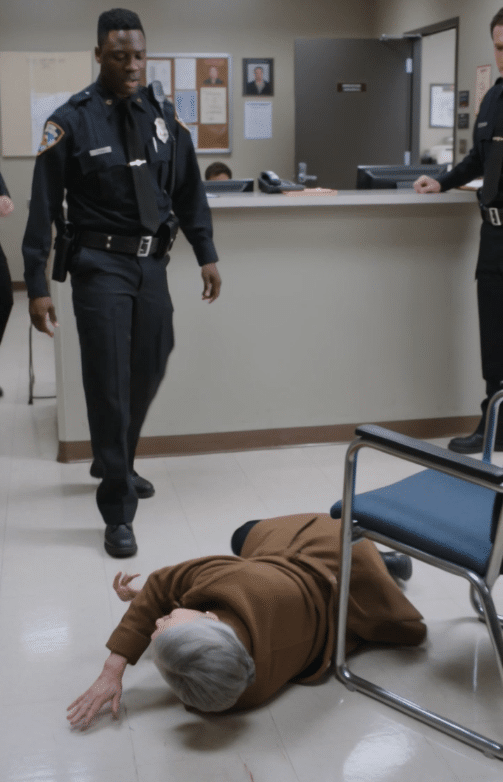
The police station lobby was busy enough that most people barely looked up when the elderly woman stepped to the front desk.
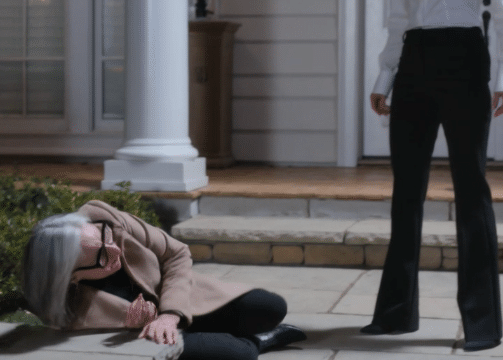
Her brown coat looked decades old. Her hands shook as she clutched a faded photograph.
She took a slow breath before asking the only question that had consumed her for days.
“Any news about my grandson?”
The officer behind the counter barely glanced at the file.
His expression hardened with irritation instead of concern.
Without asking another question or checking the report properly, he dismissed her as if she were another inconvenience interrupting his shift.
“Trash. Stop bothering this desk.”
The words echoed through the waiting area.
The woman lowered her eyes, stunned more by the cruelty than by the rejection itself. She tried to steady herself as nearby visitors exchanged uncomfortable looks, unsure whether to intervene.
For a moment, it seemed no one intended to stop what was happening.
Then a door deep inside the station opened.
Act II
Most people waiting in the lobby knew nothing about the elderly woman.
They saw only tired eyes, worn clothes, and trembling hands.
They didn’t know she had already spent three sleepless nights searching hospitals, shelters, and neighborhoods for her missing grandson.
They certainly didn’t know the history she carried.
Years earlier, her only son had worn the same badge displayed proudly throughout the station.
He had served with quiet dedication until the day he lost his life protecting strangers during a dangerous call.
The department had honored him.
His photograph still hung inside the building.
But time had passed.
Many younger officers had never met him.
Some no longer recognized the family that had sacrificed everything for the badge they now wore.
The woman never mentioned any of it.
She believed respect should never have to be demanded.
She simply wanted help finding the only family she had left.
The footsteps coming from the hallway grew louder.
Act III
The inner office door swung open.
The police chief emerged with several senior officers, preparing for another meeting.
Then he saw her.
Everything else disappeared.
He crossed the lobby immediately, kneeling beside the elderly woman before asking a single question.
“Mrs. Harris… are you alright?”
The station fell silent.
He helped her carefully into a chair before noticing the photograph still clutched tightly in her hands.
His face changed.
Not with anger alone.
With heartbreak.
He had stood beside her decades earlier at her son’s memorial service.
He remembered the folded flag.
He remembered the promise the department had made to never forget the family of a fallen officer.
Slowly, he turned toward the front desk.
His voice remained calm.
But every officer in the building recognized its weight.
“She is the mother of an officer who died for this badge.”
Silence filled the lobby.
No one moved.
Act IV
The atmosphere shifted instantly.
The chief ordered supervisors to reopen the missing-person investigation personally and requested every available update before the hour was over.
Experienced detectives gathered around the elderly woman, asking careful questions that should have been asked from the beginning.
Other officers lowered their heads.
Some recognized the photograph hanging on the station’s memorial wall only after hearing the chief speak.
The desk officer stood frozen.
Moments earlier he had seen only an elderly woman in old clothes.
Now he understood he had failed someone whose family had given more to the department than he ever realized.
The chief wasn’t angry because of rank.
He was disappointed because compassion should never depend on knowing someone’s name.
A badge, he reminded everyone, carries the duty to serve every person with dignity.
Especially those who arrive carrying fear instead of power.
Act V
Later that afternoon, the missing-person case received every available resource.
Investigators reviewed surveillance footage.
Patrol units expanded the search.
Detectives contacted neighboring jurisdictions.
The elderly woman finally felt something she had almost lost.
Hope.
Before returning to work, the chief quietly stopped beside the memorial honoring officers who had died in the line of duty.
His eyes rested briefly on the photograph of the woman’s son.
Some promises, he realized, must be renewed by every generation.
Across the lobby, the desk officer remained motionless, replaying the encounter in his mind.
His confidence had vanished.
His voice barely escaped as he looked toward the memorial wall.
“His mother…?”
No one answered.
The answer surrounded him—in the badge on his uniform, the memorial on the wall, and the quiet courage of the elderly woman who had asked for nothing more than help finding her grandson.
True honor is measured not by authority, but by how we treat those who come to us in their most desperate moments.