Act I
The tour brochures scattered across the dirt before anyone realized how quickly the afternoon had turned ugly.
Rows of perfectly cultivated grapevines stretched across the hillside, where visitors laughed, sampled wine, and admired the peaceful landscape. At the edge of the private vineyard, a young ticket attendant hurried toward a man who had stepped beyond the marked path and begun picking grapes directly from a reserved cultivation row.
“Sir, please don’t pick the grapes,” she said politely.
The man didn’t even look embarrassed.
Instead, he slowly turned, sunglasses hiding his eyes, a VIP wristband wrapped proudly around his wrist.
“So you’re telling me what I can do?” he scoffed.
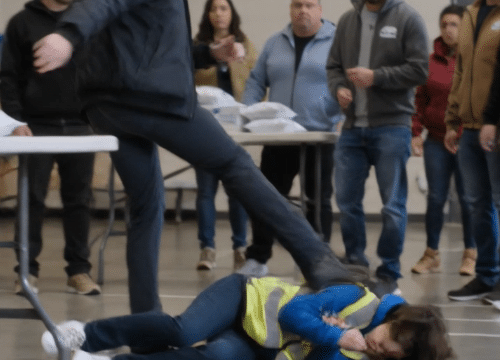
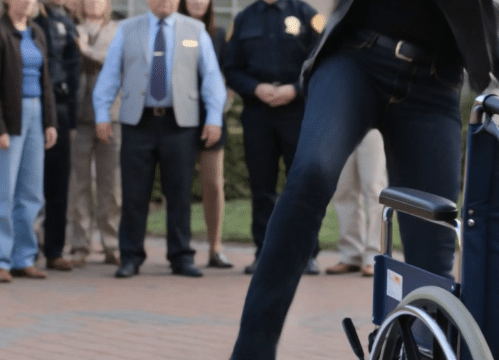
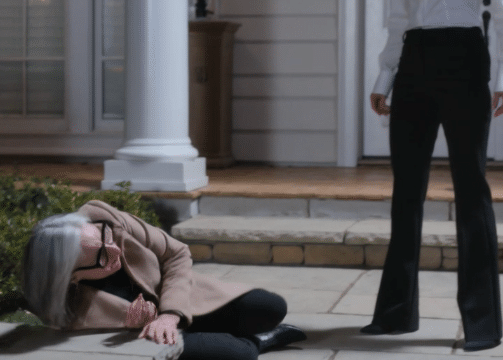
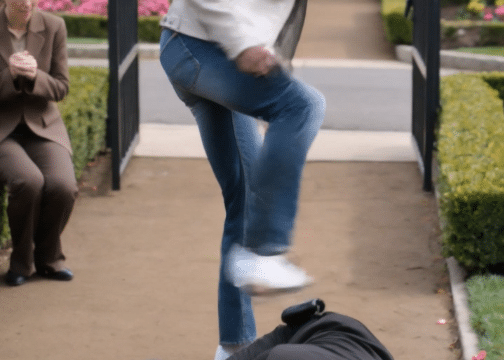
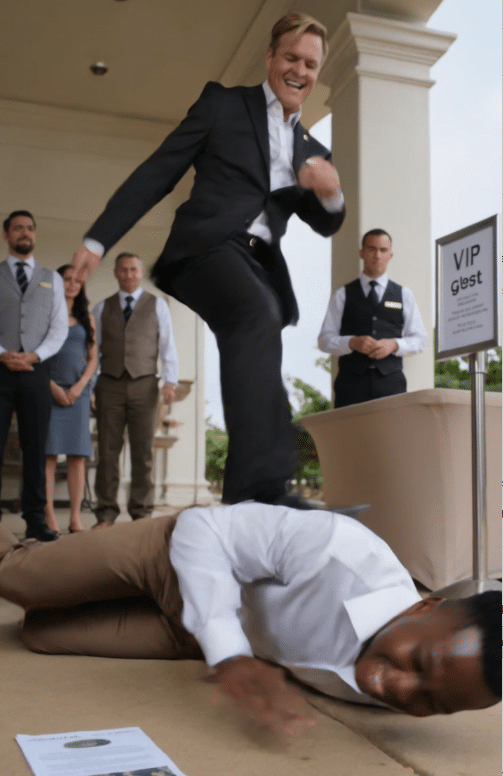
Before anyone could react, he lashed out, knocking her backward into the edge of the ticket table. The table tipped, flyers fluttered into the air, and she fell onto the packed earth with a light scrape across her forehead.
A stunned silence spread through the tour group.
The young woman remained remarkably composed despite the shock.
She didn’t yell.
She didn’t insult him.
She simply tried to steady herself.
The man stood over her with the confidence of someone convinced that money placed him above everyone else.
“Trash,” he sneered. “I paid for VIP.”
The surrounding guests exchanged uneasy glances but hesitated to interfere.
Then came another cruel remark.
“Serve the tour from the dirt.”
He believed he’d just humiliated an ordinary employee.
He had no idea the owner was only moments away.
Act II
Emily Warren had spent the last six months working every position at the vineyard.
She sold tickets.
She guided tours.
She cleaned tasting tables after closing.
Visitors assumed she was another seasonal employee trying to earn extra income.
Emily never corrected them.
The vineyard had belonged to her family for decades, and her father believed that no one should inherit a business without first understanding every job that kept it alive.
“If you ever expect people to respect you,” he often told her, “you have to respect the work they do.”
So Emily wore the same uniform as everyone else.
She parked in the employee lot.
She took lunch breaks with the seasonal staff.
Only the vineyard manager knew who she really was.
Most guests treated her with kindness.
Some never noticed her at all.
But every now and then, someone confused courtesy with weakness.
The man wearing the VIP wristband was exactly that kind of person.
To him, paying extra meant the rules no longer applied.
Private vineyard?
Those signs were for other people.
Employees?
They existed to obey.
He smiled smugly as he brushed dust from his expensive blazer.
Certain he’d already won.
Then the sound of an approaching golf cart echoed through the vines.
Act III
The golf cart stopped so abruptly that gravel crunched beneath its tires.
A distinguished older man stepped out first.
Behind him came the vineyard manager and two members of the estate’s security team.
The manager’s face changed the instant he saw Emily sitting on the ground.
The vineyard owner didn’t waste a second.
He hurried straight to her side.
“Emily.”
There was unmistakable concern in his voice.
He carefully helped her to her feet, gently checking the scrape on her forehead before asking if she was alright.
Only after she nodded did he slowly turn toward the guest.
Around them, the crowd fell completely silent.
The VIP guest frowned.
He still hadn’t recognized the older man.
But he noticed something else.
The vineyard manager lowered his head respectfully.
The security team positioned themselves beside the owner without waiting for instructions.
For the first time that afternoon, uncertainty crept across the guest’s face.
Act IV
The owner’s expression remained calm.
That somehow made the moment even more intimidating.
He looked directly at the guest.
“Who kicked my daughter in my vineyard?”
The sentence seemed to stop time.
Several visitors gasped.
Others instinctively stepped backward.
The guest stared at Emily.
Then at the owner.
Then toward the entrance sign proudly displaying the family name that he had ignored when he arrived.
Pieces began fitting together with painful clarity.
The ticket attendant…
The manager’s deference…
The private vineyard…
It all suddenly made sense.
“I… I didn’t know…”
The vineyard owner raised a hand, stopping the excuse before it could begin.
“You didn’t need to know who she was.”
His voice remained measured.
“You only needed to remember how to treat another human being.”
Nearby visitors quietly confirmed what they had witnessed.
Several admitted they had recorded portions of the confrontation on their phones.
The confidence that had fueled the guest’s arrogance dissolved almost instantly.
His VIP wristband suddenly looked meaningless.
Act V
The remainder of the afternoon’s tours continued without interruption.
The guests who had witnessed the confrontation spoke less about the argument itself than about the lesson it carried.
Emily insisted on returning to the ticket table after her forehead had been cleaned.
She smiled at arriving visitors just as she always had.
Nothing about her kindness changed.
Her father watched from a distance with unmistakable pride.
Not because she was his daughter.
But because even after being humiliated, she had refused to surrender her dignity.
Later, when staff members asked whether the incident had made her reconsider working anonymously, Emily simply shook her head.
“If people only respect me because of my family,” she said softly, “they never respected me in the first place.”
The vineyard remained as peaceful as ever.
The vines continued growing.
The tours resumed.
But no one who had witnessed that afternoon would ever forget the expression on the VIP guest’s face when he finally understood the truth.
He hadn’t insulted an ordinary employee.
He had publicly humiliated the owner’s own daughter—inside the very vineyard whose hospitality he believed he could buy.
And as the weight of that realization settled over him, the only words he could manage were barely louder than a whisper.
“Your vineyard…?”