Act I
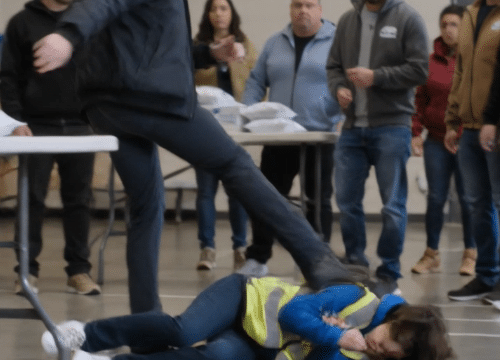
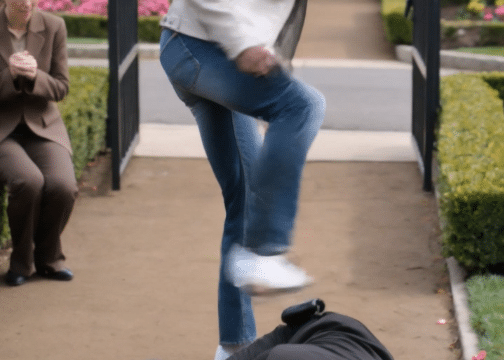
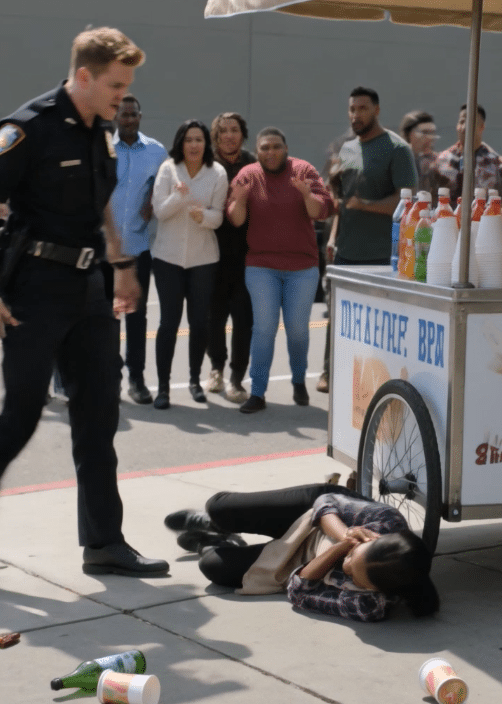
The bottles hit the sidewalk before she did.
Plastic water bottles rolled toward the curb, paper cups scattered across the concrete, and the small drink cart tipped onto one wheel as if it were trying to stand back up after the blow.
The woman caught herself with one hand, scraping her cheek against the pavement as nearby pedestrians froze.
She didn’t scream.
She only looked at the ruined cart—the only thing that had kept food on her table for years.
“Please,” she said quietly. “Just a few more minutes.”
The officer didn’t even hesitate.
He stared down through mirrored sunglasses as though she weren’t a person at all.
“Trash,” he said coldly. “Move when I tell you.”
A few people reached for their phones but nobody stepped forward.
Everyone knew the same thing.
Arguing with a uniform could become tomorrow’s problem.
The officer leaned closer.
“Sell from the gutter.”
He thought the story would end there.
It had barely begun.
Act II
Every morning before sunrise, Margaret Dawson pushed the faded blue drink cart three blocks from her apartment to the busiest corner in the neighborhood.
She wasn’t trying to build a business.
She was trying to survive.
The cart sold bottled water, sports drinks, and homemade lemonade during the summer heat. Some days she earned enough to buy groceries.
Some days she barely covered the ice.
People in the neighborhood knew her as the woman who always smiled first.
Children received free water on hot afternoons.
Construction workers often paid extra without saying why.
Margaret always thanked them.
No one realized she had once lived a very different life.
Years earlier, after their parents died, Margaret had practically raised her younger brother while working two jobs.
She helped him finish school.
She encouraged him when everyone else doubted him.
When he graduated from the police academy, she cried harder than he did.
Then life pulled them apart.
He climbed through the ranks.
She quietly disappeared into ordinary life after her husband passed away and medical bills consumed everything she owned.
She never asked her brother for money.
She refused to become anyone’s burden.
Most people who walked past her cart saw only an exhausted street vendor.
They never knew whose family she belonged to.
Least of all the officer standing over her.
But fate has a strange way of arriving without warning.
Act III
As Margaret struggled to gather the scattered bottles, the officer remained convinced he was untouchable.
The witnesses looked away.
No supervisor was nearby.
No consequences seemed possible.
Then tires screeched.
Every head turned toward the street.
A black police command vehicle stopped hard beside the sidewalk.
Two officers stepped out first.
Then a man wearing the insignia of the city’s police chief emerged.
The atmosphere changed instantly.
Conversations died.
Even traffic seemed quieter.
The chief ignored everyone else.
He saw only the woman sitting on the pavement beside the overturned cart.
He crossed the sidewalk at a run.
“Margaret!”
His voice carried something no one expected.
Fear.
He knelt beside her, helping her carefully to her feet before checking the scrape on her cheek.
Only after he knew she was standing safely did he slowly turn toward the patrol officer.
His expression had changed completely.
The officer suddenly felt very small.
And then the chief noticed the nearby security camera mounted above the intersection.
Everything had been recorded.
Act IV
The chief pointed toward the traffic camera.
His voice was calm.
Too calm.
“Who kicked my sister?”
Silence swept across the entire sidewalk.
The words landed harder than any shout.
The patrol officer blinked.
His confidence disappeared almost instantly.
“S-sir…”
The chief didn’t respond.
Two accompanying officers quietly stepped between Margaret and the patrolman.
Nearby pedestrians, who moments earlier had been afraid to interfere, now began speaking all at once.
“I saw everything.”
“He never gave her a chance.”
“He knocked over the cart.”
Another witness held up a phone.
“I recorded part of it.”
The officer looked from the police chief…
…to the witnesses…
…to the traffic camera above.
Every direction held another piece of evidence.
There was nowhere left to hide.
Margaret gently rested one hand on her brother’s sleeve.
“Please,” she whispered.
“Don’t do this because I’m your sister.”
The chief looked at her with quiet pride.
“I’m doing this because no officer has the right to treat anyone this way.”
The sidewalk had become a courtroom before the investigation had even begun.
Justice no longer depended on rank.
It depended on truth.
Act V
Within hours, investigators collected every available recording.
Traffic camera footage.
Cell phone videos.
Body camera files.
Witness statements.
Each one told the same story.
Not of a dangerous suspect.
Not of a violent confrontation.
But of an ordinary woman trying to earn an honest living.
Margaret never celebrated what happened afterward.
She rebuilt her cart.
She returned to the same corner weeks later.
When neighbors asked why, she simply smiled.
“This is still my community.”
As for the chief, he never spoke publicly about family.
Instead, he reminded every officer under his command that authority exists to protect people—not to humiliate them.
The lesson spread farther than any press conference could have.
Because everyone remembered the image that mattered most.
Not the overturned cart.
Not the scattered bottles.
Not even the flashing police vehicles.
They remembered one officer whose certainty vanished the moment he realized the woman he had dismissed as “trash” was simply a citizen who deserved dignity all along.
And in the final seconds of that unforgettable afternoon, the only sound left was his trembling whisper.
“Your sister…?”