Act I
Morning rush hour in the city was always loud.
Car horns echoed between office buildings, pedestrians hurried toward work, and traffic crawled through the streets surrounding City Hall. Everyone seemed focused on one thing—getting somewhere as quickly as possible.
Except for one elderly man.
At seventy-six years old, Harold Brooks no longer moved with the speed the world demanded. Leaning on a worn wooden cane, he waited patiently for the pedestrian signal to turn green before stepping into the crosswalk.
Every step was careful.
Every movement deliberate.
Drivers watched with mild impatience, but no one complained. The signal was clearly in his favor.
Everyone understood…
Except the man behind the wheel of a bright orange supercar.
The expensive engine growled as the driver slammed on the brakes just before the crosswalk.
The businessman struck the steering wheel in frustration.
“You’ve got to be kidding me.”
People glanced toward the luxury vehicle.
Most expected him to sigh, wait a few seconds, and continue once the crossing cleared.
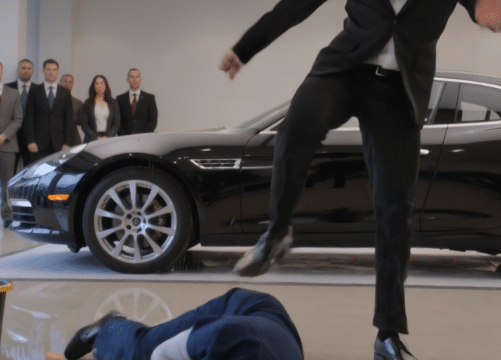
Instead, the driver’s door flew open.
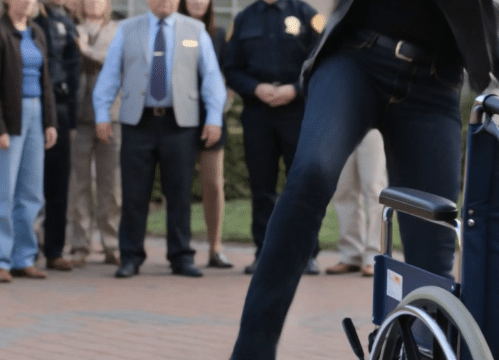
He stormed across the pavement with fury written across his face.
Harold barely had time to turn.
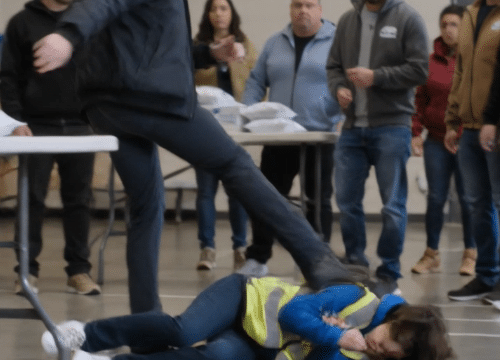
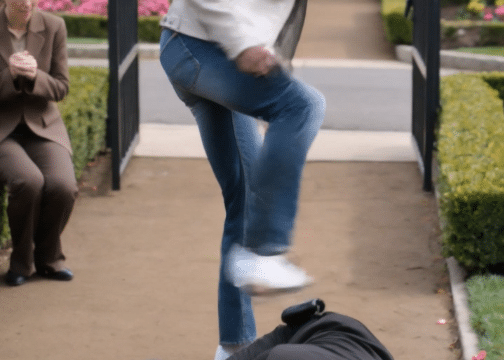
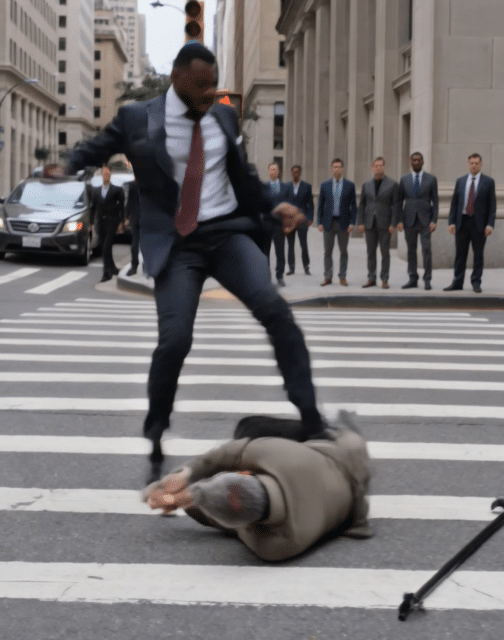
A violent kick slammed into his chest.
The old man was thrown backward onto the asphalt.
His cane spun through the air before skidding across the white crosswalk stripes.
The impact stole the breath from his lungs.
Pedestrians screamed.
Traffic stopped.
Yet the businessman showed no sign of regret.
He stood over the elderly man with cold contempt.
“Trash,” he snapped.
“You made me stop my car.”
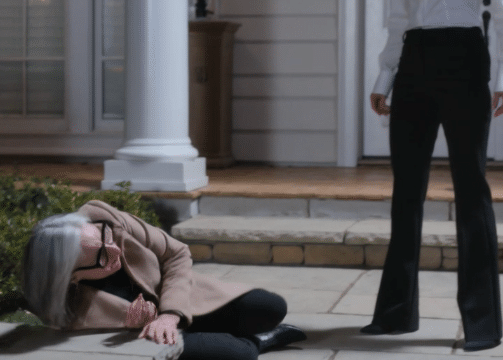
Harold struggled to breathe, one trembling hand pressed against his chest.
He wasn’t arguing.
He wasn’t fighting back.
He simply tried to reach for his cane.
Before his fingers could touch it, another kick struck his stomach.
Then another into his side.
The businessman pointed toward the opposite curb.
“Cross faster next time.”
Silence swept across the intersection.
No one moved.
No one knew what to do.
Then, from the direction of City Hall…
Motorcycle sirens shattered the stillness.
No one realized they were about to witness a moment that would change everything.
The person arriving wasn’t just another city official.
Act II
Harold Brooks had lived in the city for nearly five decades.
Most people who passed him each morning had no idea who he was.
To them, he looked like an ordinary retiree.
Simple jacket.
Comfortable shoes.
A weathered cane polished smooth by years of use.
He never spoke about his past.
He never mentioned the sacrifices he had made raising a child alone after losing his wife.
While others chased promotions and wealth, Harold worked double shifts to make sure his child could attend good schools.
He skipped vacations.
Worked weekends.
Sold his own truck when tuition bills became overwhelming.
Whenever people praised his child’s success, Harold always gave the same answer.
“I just did what every parent hopes to do.”
That humility never changed.
Even after his child entered public service.
Even after election victories.
Even after cameras began following their every move.
Harold preferred walking through the city unnoticed.
He enjoyed buying coffee from neighborhood cafés and greeting crossing guards by name.
Power had never interested him.
Kindness had.
The businessman who attacked him believed something entirely different.
To him, expensive possessions proved superiority.
Owning a supercar meant people should move aside.
Waiting even a few seconds felt like an insult.
He had built his reputation through aggressive deals and relentless ambition.
People often tolerated his arrogance because of his wealth.
That morning, he assumed the elderly stranger was simply another powerless obstacle.
He couldn’t have been more wrong.
Because the approaching motorcycles weren’t escorting a visiting dignitary.
They were escorting someone whose first priority had suddenly become family.
By the time the official convoy stopped, the businessman had already lost control of his own future.
Act III
Motorcycle officers swept into position around the intersection.
Traffic halted instantly.
An official black vehicle rolled to a stop in front of City Hall.
The rear door opened.
The city’s mayor stepped out.
Staff members hurried behind.
Security moved to create a path.
Then everything changed.
The mayor’s eyes landed on the elderly man lying in the crosswalk.
Time seemed to stop.
Without waiting for security…
Without acknowledging reporters…
Without speaking to city officials…
The mayor ran.
People instinctively stepped aside.
Harold slowly lifted his head.
For the first time since the assault, relief appeared on his face.
The mayor dropped to both knees beside him.
“Dad!”
The single word echoed through the silent intersection.
“I’m here.”
Carefully supporting Harold’s shoulders, the mayor helped him sit upright while an officer retrieved the fallen cane.
Harold managed a faint smile despite the pain.
“I’m alright…”
But the mayor could already see the bruises forming.
The trembling hands.
The struggle to breathe.
A calm expression settled across the mayor’s face.
The kind of calm that often comes just before a storm.
Then came the question.
“Who did this?”
Every witness looked toward the businessman.
Some pointed.
Others silently nodded.
Several drivers immediately offered dashboard camera footage.
One cyclist had recorded the entire assault.
There was no uncertainty.
No confusion.
The businessman felt every eye in the intersection turn toward him.
His confidence disappeared.
Only moments earlier, he had believed he controlled the situation.
Now…
He couldn’t even control his own breathing.
What happened next had nothing to do with political power—and everything to do with accountability.
Act IV
The mayor never raised a voice.
That surprised everyone.
Instead, the mayor remained focused on Harold.
Medical responders examined him while escort officers quietly secured the area.
The businessman finally tried to speak.
“It was… just an accident.”
A witness immediately answered.
“No, it wasn’t.”
Another stepped forward.
“You got out of your car.”
“You kicked him.”
“Twice.”
A delivery driver raised his phone.
“I filmed everything.”
Then another voice.
“My dashcam caught the whole thing.”
Within seconds, multiple recordings existed from different angles.
The businessman looked toward his supercar.
Only minutes earlier, it had represented success.
Now it looked like evidence.
His expensive suit suddenly felt too tight.
His luxury watch could not buy silence.
His status could not erase dozens of eyewitnesses.
The mayor finally stood.
Not to threaten.
Not to argue.
Only to face the man responsible.
“My father obeyed the law,” the mayor said quietly.
“He crossed when the signal allowed.”
The intersection remained completely silent.
The businessman lowered his eyes.
For perhaps the first time in years…
He felt genuinely ashamed.
Not because the victim was connected to someone powerful.
But because everyone around him had witnessed exactly who he truly was.
Then came the realization that would haunt him long after the sirens disappeared.
Act V
As officers escorted the businessman toward a waiting patrol vehicle, he looked once more at Harold Brooks.
The elderly man wasn’t angry.
He wasn’t demanding revenge.
Instead, he thanked the paramedics for helping him stand.
He even apologized for delaying traffic.
That simple kindness hit harder than any punishment.
The businessman suddenly understood something he had ignored his entire life.
Respect isn’t measured by the price of a car.
Character isn’t revealed when life is convenient.
It appears in the moments when patience is required.
Harold had done nothing more than cross a street exactly as the law permitted.
The businessman had chosen violence because a few seconds felt more valuable than another person’s safety.
Now every second seemed painfully slow.
His lips trembled.
“…Dad?”
The word escaped almost as a whisper.
The mayor never answered.
Instead, the mayor gently placed Harold’s cane back into his hand and walked beside him toward City Hall.
Not as the city’s highest elected official.
But simply as a devoted child helping an aging parent.
Around them, morning traffic slowly resumed.
People drove away carrying a story they would tell for years.
Some remembered the supercar.
Others remembered the flashing escort motorcycles.
But most remembered something far more important.
The richest man at the intersection believed wealth made him untouchable.
The oldest man crossing the street possessed something money could never purchase.
The quiet dignity of a life built on sacrifice, humility, and love.
And in the end, that was the only status that truly mattered.