Act I
The first apple hit the dirt before anyone realized what had happened.
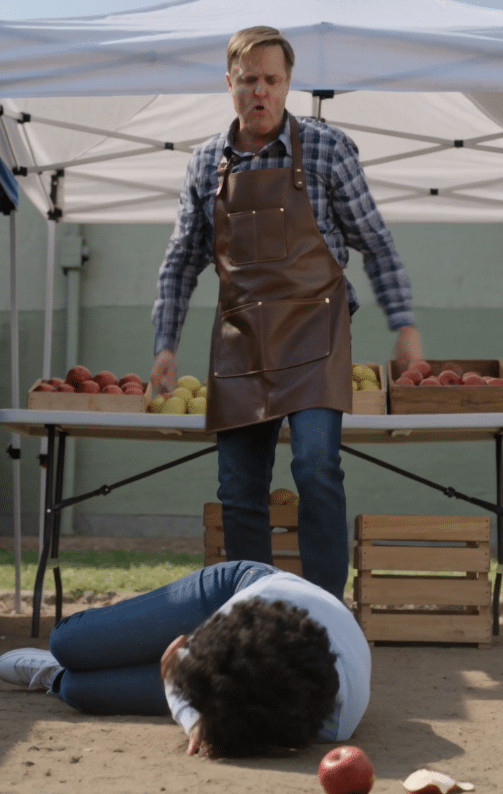
A woman had barely brushed past a fruit display when several apples rolled from a wooden crate, bouncing across the dusty path of the weekend farmers market. It was a simple accident—one that most vendors would have shrugged off with an annoyed sigh.
But this wasn’t most vendors.
The owner of the stand exploded with rage.
He stormed toward her, his face twisted with contempt, shouting loud enough for every shopper beneath the white canopies to hear. The scattered apples suddenly became an excuse for something much uglier than frustration.
“Trash. You can’t even walk past good food.”
The crowd froze.
No one expected a grown man to humiliate a stranger over a few pieces of fruit, yet no one stepped forward either. The woman stumbled as he shoved the broken crate aside, leaving her on the dusty ground with dirt covering her clothes and a small cut along her hairline from the chaos.
She inhaled sharply from the pain but refused to plead.
That only seemed to make him angrier.
“Pick them up with your face.”
Laughter didn’t come.
Only silence.
Because everyone watching knew they were witnessing something profoundly wrong.
What none of them knew was that they were only seconds away from learning who the woman really was.
Act II
Her name was Emily Carter.
Most visitors recognized the smiling volunteers who organized the farmers market every weekend, but very few recognized the organizer’s daughter. Emily preferred it that way.
She never asked vendors for favors.
She never introduced herself using her father’s position.
Instead, she spent weekends helping elderly shoppers carry groceries, buying produce from small family farms, and quietly supporting local businesses.
That morning she had arrived alone after visiting a nearby food pantry.
She wasn’t dressed like someone connected to the people running the market. Her jeans were dusty from unloading donation boxes, and her old jacket had faded after years of volunteer work.
To the fruit stand owner, appearances told the entire story.
He saw worn clothes.
He saw someone he assumed couldn’t fight back.
He saw an easy target.
Years of success had filled him with the dangerous belief that money gave him ownership over everyone standing near his stand.
He had humiliated employees before.
He had screamed at teenagers.
He had frightened customers into paying for fruit they never damaged.
No one had seriously challenged him.
Until today.
Because while Emily slowly pushed herself back onto one knee, a familiar engine echoed through the market entrance.
Heads turned.
Conversations stopped.
The sound grew louder.
Then a black pickup rolled through the entrance and stopped with unmistakable authority.
Act III
The market organizer stepped out before the engine had even gone quiet.
Robert Carter had overseen the community market for nearly twenty years. Farmers respected him because he protected small businesses. Families trusted him because he believed every customer deserved dignity.
Two security officers followed close behind.
Robert wasn’t looking for trouble.
He had simply received frantic calls that someone had been attacked near the apple stand.
Then he saw the woman sitting on the ground.
Time seemed to stop.
“Dad…”
Emily’s voice was barely above a whisper.
Robert reached her in seconds.
He ignored everyone else.
Ignoring the stunned crowd, he knelt beside his daughter, carefully helping her to her feet while checking the cut on her forehead. His expression wasn’t loud.
It was worse.
It was controlled.
Years of leadership had taught him that the quietest anger was often the most dangerous.
Only after making sure Emily could stand did he slowly turn toward the fruit stand owner.
The vendor suddenly looked much smaller than he had only moments earlier.
Every arrogant word he had shouted now echoed back through the silent market.
Robert’s voice carried across every stall.
“Who humiliated my daughter?”
Nobody answered.
Nobody needed to.
Dozens of witnesses were already pointing toward the same man.
Act IV
The owner’s confidence disappeared almost instantly.
His shoulders stiffened.
His mouth opened, but no explanation came.
Only moments earlier he had stood over a woman he believed had no power.
Now he realized he had publicly humiliated the daughter of the very man responsible for overseeing every vendor operating in the market.
Security officers began speaking with witnesses.
One by one, shoppers described exactly what they had seen.
The insults.
The intimidation.
The needless cruelty.
Several vendors quietly admitted this wasn’t the first complaint against the fruit seller.
Others confessed they had stayed silent because they feared retaliation.
Emily never interrupted.
She never demanded revenge.
She simply stood beside her father, breathing through the pain while maintaining a calm dignity that contrasted sharply with the panic spreading across the bully’s face.
The balance of power had completely reversed.
The crowd that had once stood frozen now stood behind her.
The man who had enjoyed humiliating others suddenly found himself alone.
Act V
Before leaving the market that afternoon, Robert addressed every vendor gathered beneath the white canopies.
“This market was built so families could support one another,” he said. “No business succeeds by destroying another person’s dignity.”
An internal investigation began immediately.
Witness statements were collected.
The fruit stand owner’s permit was suspended pending review, while multiple earlier complaints resurfaced for formal consideration.
For the first time in years, people who had once remained silent felt safe enough to speak.
Emily never celebrated his downfall.
She accepted help cleaning the dust from her jacket, thanked the strangers who finally found the courage to come forward, and quietly reminded them that respect should never depend on someone’s clothes, income, or appearance.
As the afternoon sun settled over the rows of apple stands, shoppers slowly returned to their conversations.
Business resumed.
Children laughed again.
The market looked exactly as it had that morning.
Yet everyone knew something fundamental had changed.
Because the loudest person in the crowd had discovered that true authority isn’t measured by wealth or arrogance.
It’s revealed by how you treat someone when you believe no one important is watching.
And on that day, everyone learned that the woman he dismissed as “trash” had never needed power to possess dignity.
She already had it.