Act I
The elegant Sunday brunch came to a halt with a single violent act.
Guests dressed in designer golf attire barely looked up from their champagne until an elderly gardener carrying a bouquet of freshly cut flowers wandered too close to the VIP tables. Before anyone could react, a wealthy club member stormed toward her, her face twisted with contempt.
“You don’t belong here.”
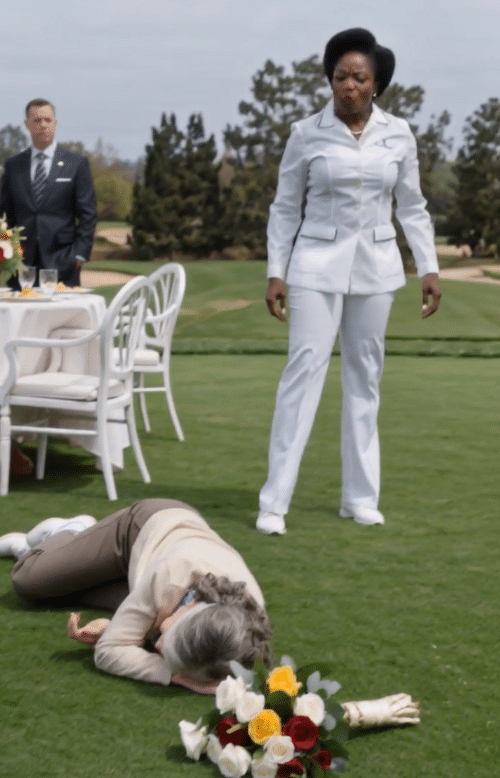
She stepped back, gathered momentum, and drove a hard kick into the old woman’s back.
The seventy-year-old pitched forward across the perfectly manicured lawn, her bouquet flying from her hands as white lilies and red roses scattered across the grass. She landed face-first beside a beautifully decorated brunch table, clutching her ribs as she struggled to breathe. Her weathered hands trembled against the ground, but she never cried out.
Instead of offering help, the woman standing over her sneered with unmistakable disgust.
“Move, trash.”
The lawn fell strangely quiet.
Some members exchanged uncomfortable glances. A few staff rushed forward before stopping, uncertain whether they should intervene against one of the club’s wealthiest patrons. Others simply pretended not to notice, choosing comfort over courage.
The old gardener slowly reached for a flower lying only inches away.
Before she could touch it, another cruel voice cut through the silence.
“People like you work behind the hedges.”
No one knew those words had just destroyed a reputation that had taken decades to build.
Act II
Everyone at Whitmore Country Club knew the elderly woman as the gardener.
She arrived before sunrise, quietly trimming roses, planting seasonal flowers, and making sure every path looked perfect before members arrived. Children often waved to her. New employees thanked her for teaching them which flowers bloomed best in every season.
Yet almost no one knew her name.
She never corrected anyone who assumed she was just another groundskeeper. She wore faded gardening clothes by choice, carried old gloves stitched together more than once, and always insisted that respect should be earned through character rather than status.
Years earlier, after her husband built the club into one of the most prestigious private golf communities in the state, she had refused every luxury he offered.
“I don’t need people bowing to my family,” she once told him. “I’d rather know who they really are.”
After he passed away, their son inherited the chairmanship. He begged his mother to stop working in the gardens.
She smiled every time.
“The flowers still need someone who loves them.”
That morning she had cut the bouquet herself, planning to decorate the memorial table honoring her late husband.
She never expected to become the target of public humiliation instead.
Act III
The wealthy member folded her arms proudly, convinced she had restored order to the exclusive gathering.
Around her, nobody dared challenge someone whose donations, social influence, and powerful friendships made her seem untouchable.
Then the sound of screeching tires shattered the morning calm.
A black SUV stopped abruptly beside the golf lawn.
The rear door opened before the vehicle had fully settled.
The club president stepped out, followed immediately by the general manager and two senior staff members. Their expressions changed from confusion to horror the instant they saw the elderly woman struggling to breathe on the grass.
Without acknowledging a single guest, the president hurried across the lawn and knelt beside her.
One employee carefully gathered the scattered flowers while another removed his jacket and placed it beneath her shoulders.
The president gently helped the old woman sit upright, his voice filled with genuine concern.
Only then did he slowly stand and face the stunned crowd.
His eyes locked onto the woman who had delivered the kick.
In a calm voice that somehow carried across the entire lawn, he said,
“Mrs. Whitmore… please forgive us.”
A pause.
Then came the sentence that seemed to stop time itself.
“No one touches the chairman’s mother.”
A wave of disbelief swept through the country club.
Act IV
The arrogant smile disappeared from the wealthy member’s face almost instantly.
Color drained from her cheeks as dozens of guests turned toward her with expressions that had transformed from admiration into shock. Conversations ended. Champagne glasses remained untouched. Even the musicians stopped playing.
She had believed she was protecting the prestige of the club.
Instead, she had publicly assaulted the woman whose family had built it.
The president looked at the scattered flowers lying across the lawn.
“They were for my father’s memorial,” he said quietly.
The words struck harder than any accusation.
Those flowers had never been weeds collected by a gardener.
They were a widow’s tribute to the man who had founded the institution everyone there claimed to respect.
Security approached without hesitation this time.
For the first time in years, the wealthy member realized that influence disappears the moment character is exposed.
Act V
Mrs. Whitmore accepted her son’s hand and slowly stood despite the pain in her ribs.
She never demanded revenge.
She never shouted.
Instead, she carefully picked up one surviving white rose from the grass, brushed away the dirt, and held it against her chest with quiet dignity.
Around her, employees continued gathering every scattered flower as though repairing something far greater than a ruined bouquet.
The woman who had called her “trash” now stood completely alone.
No friends stepped beside her.
No members defended her.
The respect she had spent years buying vanished in a matter of seconds.
Her lips trembled as she stared at the elderly woman she had dismissed as worthless.
“Chairman’s… mother?”
But the answer no longer mattered.
Because real status is never measured by pearls, memberships, or reserved tables.
It is revealed in the way people treat those they believe have nothing to offer them.
And on that quiet Sunday morning, the wealthiest person on the lawn turned out to be the one wearing worn gardening gloves, while the poorest soul was the woman who had mistaken privilege for superiority.