Act I
The chain snapped tight so hard it sounded like a gunshot.
The Rottweiler lunged from the shadow of the barn, black-and-tan body surging forward, paws tearing through dirt, teeth flashing in the gold light of sunset. The metal collar jerked against his neck. The old fence trembled behind him.
And five-year-old Lily Hart did not move.
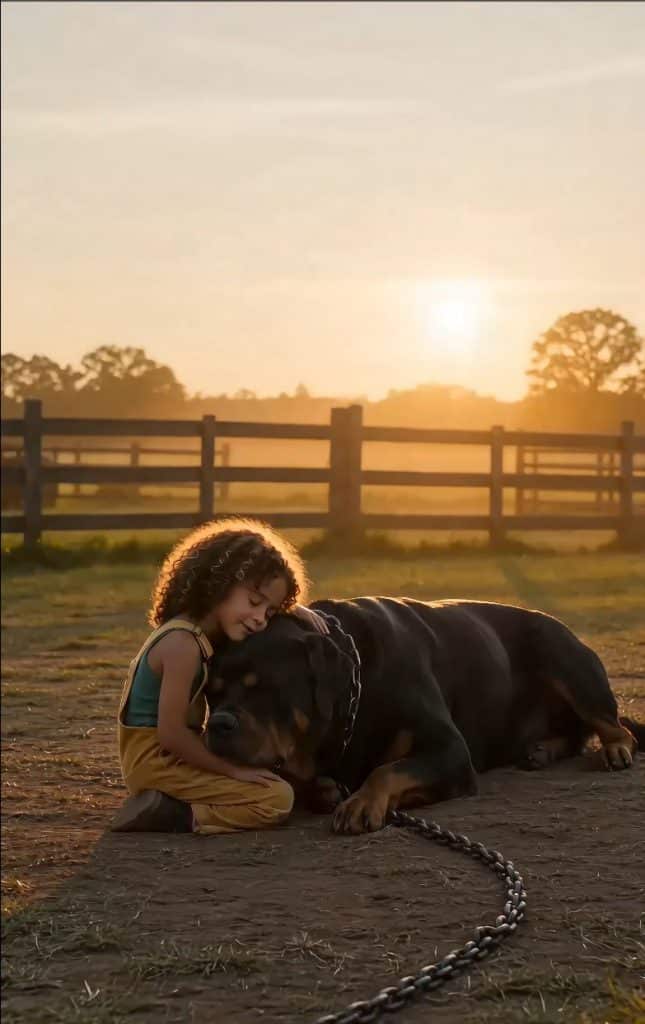
She stood inches beyond the end of the chain in yellow corduroy overalls and a dark green tank top, her curly brown hair glowing like a halo in the dying sun. Her hands hung loose at her sides. Her face was calm in a way no child’s face should have been with a hundred-pound dog snarling in front of her.
“Lily!” her father screamed.
Caleb Hart came running from the porch, boots slipping in the dirt, denim jacket flying open over his plaid shirt. His heart slammed so hard he could feel it in his throat.
“Stay away from him!” he shouted. “Mike, don’t!”
The dog barked again, deep and violent, the kind of bark that made birds lift from trees and horses shift nervously in stalls. The chain rattled across the yard. Dust kicked up around his paws.
Lily only looked into his eyes.
Not at his teeth.
Not at the chain.
At him.
The Rottweiler’s lips pulled back. His chest heaved. His muscles strained against the metal links, and for one terrible second Caleb imagined the collar breaking, the chain flying free, his daughter disappearing beneath a storm of fear and fur.
He was too far away.
He would not reach her in time.
“Lily, back up!” he cried.
But she leaned closer.
Then she smiled.
“Hey, big fella,” she sang softly. “You don’t have to fight.”
The barking stopped.
Caleb froze mid-step.
The yard went suddenly quiet except for the wind moving through the trees and the last few links of the chain settling against the dirt.
Lily’s voice floated through the golden light, small and gentle, almost too soft to belong in a moment that had just been full of danger.
“I’m right here,” she sang. “It’s alright.”
Mike’s mouth closed.
His head lowered.
The furious tension drained from his shoulders as if someone had cut invisible strings inside him. He stared at the little girl, breathing heavily, but no longer lunging. No longer snapping. No longer fighting the chain.
Caleb could not understand what he was seeing.
Lily slowly bent her knees and sat down in the dirt.
“No,” Caleb whispered.
But the dog did not attack.
He stepped forward until the chain lay loose behind him. Then the massive Rottweiler lowered his head and rested his chin in Lily’s lap.
Her tiny hands stroked the top of his skull.
“I’m sitting low,” she sang. “I’m staying today. You can rest your head. It’s okay now.”
Mike closed his eyes.
Caleb stood several yards away, chest rising and falling, unable to move.
Because he knew that song.
He had not heard it in six years.
Not since the night his wife vanished.
Act II
Caleb Hart had once believed there were two kinds of silence on a farm.
There was peaceful silence, the kind that came after chores were done, when the animals settled and the sun burned low over the fields.
And then there was the other kind.
The kind that came after loss.
For six years, the Hart farm had been full of that second silence.
It lived in the empty chair at the kitchen table. It lived in the bedroom drawer Caleb never opened. It lived in the old red truck parked behind the barn, the one his wife Nora used to drive into town every Thursday morning.
The same truck that came back without her.
The police had called it a disappearance.
Caleb had called it a wound.
Nora Hart had been the kind of woman animals trusted before people did. Horses calmed when she touched their necks. Stray cats followed her home. Injured birds stopped thrashing in her hands.
And Mike, the Rottweiler everyone else had been afraid of, had loved her like she was the center of the world.
He had not always been chained.
Before Nora disappeared, Mike slept by the porch steps. He followed Caleb through the pasture. He carried Lily’s old stuffed bear in his mouth before Lily was even born, as if practicing how to be gentle.
But after Nora vanished, he changed.
He waited at the end of the driveway for three days.
On the fourth, he stopped eating.
On the seventh, he bit the sheriff’s deputy who tried to search Nora’s greenhouse without Caleb present.
After that, people called him dangerous.
Caleb called him broken.
He tried trainers. He tried medication. He tried patience. But Mike never became the dog he had been. Every stranger was a threat. Every raised voice set him off. Every child running too fast near the yard made him lunge so hard the chain carved a line through the dirt.
So Caleb kept him away from Lily.
Always.
Lily knew him only as the dog behind the barn, the one she was never supposed to approach. Caleb had told her a hundred times.
“Mike gets scared,” he said. “And scared dogs can hurt people.”
Lily would nod seriously, as if she understood.
But children hear more than rules.
They hear sadness beneath them.
She knew Caleb never said Mike’s name angrily. She knew he brought the dog food himself every morning and stayed long after the bowl was full. She knew he sometimes sat on an overturned bucket near the barn, talking to Mike in a low voice that sounded nothing like the voice he used with anyone else.
And she knew about the song.
Or at least Caleb thought she couldn’t.
That was impossible.
Nora had written it before Lily was born, back when the nursery walls were still bare and Caleb was still learning how frightened a man could be of becoming a father.
One night, during a thunderstorm, Mike had panicked at the sound of lightning and clawed at the bedroom door until Nora climbed out of bed, seven months pregnant, and sat with him on the kitchen floor.
Caleb had found them there at midnight.
Nora’s bare feet tucked beneath her. Mike’s huge head in her lap. Her hand moving slowly over his ears.
And that song.
Not a real lullaby. Not something from the radio. Just Nora’s own little melody, made of soft nonsense and promises.
I’m sitting low. I’m staying today. You can rest your head. It’s okay now.
Caleb had laughed quietly from the doorway.
“You wrote a lullaby for the dog?”
Nora looked up at him and smiled.
“No,” she said, placing one hand over her belly. “For anyone who needs one.”
After Lily was born, Nora sang it to her too.
Only twice.
Maybe three times.
Lily had been just a baby then. Too small to remember words. Too young to remember her mother’s voice.
Then Nora disappeared before Lily’s first birthday.
And Caleb never sang the song again.
He could not.
Some memories were not gentle when they came back.
They arrived with teeth.
So when he stood in the sunset and heard Lily sing that exact line to the dog he had chained because grief had made him dangerous, Caleb felt the world tilt beneath his boots.
Mike’s head rested in Lily’s lap.
His breathing slowed.
The chain lay slack in the dirt.
And Lily kept stroking his fur as if she had known him forever.
Caleb’s voice came out broken.
“How do you know that song?”
Lily looked up at him.
The light caught her eyes.
“Mommy sings it when I dream,” she said.
And that was when Caleb understood the past was not finished with them.
Act III
Caleb did not sleep that night.
He sat at the kitchen table long after Lily had gone to bed, staring at the hallway as if the answer might walk out of the darkness wearing Nora’s face.
Mommy sings it when I dream.
Children said strange things. Caleb knew that. They mixed memory with imagination, old photographs with bedtime stories, longing with truth.
But Lily had never heard that song from him.
He was sure of it.
At least, he wanted to be sure.
The next morning, he did what he had avoided for six years.
He opened Nora’s drawer.
The room still smelled faintly of cedar and dust. Inside the drawer were folded scarves, a silver hair clip, a cracked leather notebook, and a stack of letters tied with twine.
Caleb’s hands shook when he touched them.
He had searched this drawer after she vanished. The police had too. Nothing had mattered then. Nothing had explained why Nora’s truck was found abandoned near Miller’s Creek with one door open, her purse still on the seat, and no sign of her anywhere.
But grief made people careless.
So did certainty.
Caleb had been so certain Nora was gone that he had stopped looking for any truth that wasn’t death.
He opened the leather notebook first.
Most of it was ordinary. Feed schedules. Vet appointments. Notes about seedlings. A recipe for apple cake with too much cinnamon because Nora liked to ruin dessert with confidence.
Then, near the back, he found a page he had never seen.
Mike knows the song when I sing the second line. He lowers his head before I finish. Funny thing—Lily kicks when I sing it too. Maybe they both know something Caleb and I don’t.
Caleb pressed his thumb to the paper.
Below that, written weeks later, was another note.
If anything ever happens, ask Ruth about the clinic. Don’t let Daniel near the farm records.
Caleb stopped breathing.
Daniel.
Nora’s older brother.
The man who had stood beside Caleb after the disappearance, jaw tight, hand on his shoulder, saying, “You need to accept that she’s gone.”
The man who helped organize the search parties.
The man who handled Nora’s side of the family when Caleb could barely remember how to stand.
The man who had insisted, again and again, that selling the farm would help Caleb heal.
Caleb had refused.
Daniel never forgave him for it.
With slow hands, Caleb untied the stack of letters.
Most were from Nora’s aunt Ruth, who had lived two counties away and died the year after Nora vanished. Caleb had met her only once. A sharp-eyed woman with white hair and a voice that made people stand straighter.
One envelope was unopened.
Caleb frowned.
It was addressed to him.
The postmark was from a week before Ruth’s death.
He tore it open.
Dear Caleb,
If this reaches you, it means I waited too long, and for that I am sorry. Nora came to me frightened two days before she disappeared. She believed Daniel was moving money through the farm account using forged paperwork. She had copies. She said if she confronted him openly, he would destroy her before anyone believed her.
She left something with me. A safety deposit key. A note for Lily. And a recording.
Daniel came here asking questions after she vanished.
I lied.
I told him Nora brought me nothing.
He believed me, but he won’t forever.
Caleb, I do not know if my niece is alive. But I know she did not run from you. She was trying to protect you and that baby.
The room blurred.
Caleb read the letter twice. Then a third time. Each time, the same sentence tore through him.
She did not run from you.
For six years, that fear had lived beneath every other grief.
That Nora had left.
That motherhood had frightened her. That the farm had trapped her. That Caleb had missed some private misery so deep she chose disappearance over goodbye.
He had hated himself for that possibility.
Now the letter sat in his hands like a match.
By noon, Caleb was driving to the old bank in Fairmont with Lily asleep in the back seat and Mike riding loose for the first time in years, his huge head resting against the rear window.
Caleb had almost left him home.
Lily refused.
“He has to come,” she said.
“Why?”
“Because he remembers Mommy better than we do.”
Caleb had no answer for that.
At the bank, the manager recognized Nora’s name immediately. Her expression changed when Caleb showed the key and Ruth’s letter.
The safety deposit box had not been opened in six years.
Inside were three things.
A sealed envelope addressed to Lily.
A flash drive.
And a small yellow ribbon from the collar Mike had worn before everything went wrong.
Caleb touched the ribbon and felt the room slip away.
Nora had kept proof.
And somehow, she had left a trail only love could follow.
Act IV
The recording began with Nora breathing hard.
Not crying.
Running.
Caleb sat in the bank office with Lily on his lap and Mike lying at their feet, while the manager stood quietly near the door. The old computer hummed as Nora’s voice filled the room.
“Caleb,” she said. “If you find this, I’m sorry. I wanted to tell you everything, but Daniel found out I copied the documents.”
Lily turned very still.
Caleb wrapped one arm around her.
Nora continued.
“He’s been using the farm to move money. Loans, shell invoices, equipment purchases that never happened. Dad’s old accounts, my signature, your name. I confronted him this morning. He laughed. He said no one would believe a tired new mother over him.”
Caleb closed his eyes.
Daniel had stood in his kitchen after Nora vanished and washed dishes like family.
All while Caleb’s life burned.
Nora’s voice cracked, but only slightly.
“I’m taking the copies to Ruth. If I don’t come home, it wasn’t because I left you. I would never leave you. I would never leave Lily.”
Caleb bent forward.
For a moment, grief took the shape of sound and almost escaped him.
Then Mike lifted his head.
A low whine rose from the dog’s chest.
On the recording, there was a thud.
Nora gasped.
Then another voice.
Daniel.
“You should’ve stayed out of this.”
The bank manager covered her mouth.
The audio shifted. A struggle. A car door. Nora’s voice, farther away now, sharp with fear but still fighting.
Then she sang.
Softly.
Not for herself.
For Mike.
Caleb realized it all at once.
Mike had been there.
The dog had seen something.
The police report said he had been found two miles from the truck, frantic and muddy, his collar missing. No one understood why he became violent after that.
But Mike knew.
He had chased the car. Lost Nora. Failed to bring her home. And every stranger afterward became Daniel in his mind.
The recording ended with Nora whispering one final line.
“Tell Lily the song was always hers.”
Lily began to cry without making a sound.
Caleb held her tightly, staring at the frozen screen.
The proof was not complete, but it was enough to reopen everything.
By sunset, Sheriff Walters was at the farm.
By nightfall, state investigators had Nora’s files, the recording, and copies of the forged documents from the flash drive. Daniel’s name ran through all of them like a stain.
And Mike, who had spent six years chained behind the barn, stood at Caleb’s side without pulling, without barking, without fear.
When the sheriff asked where the dog had been the day Nora disappeared, Caleb looked down at him.
“He was with her,” he said.
Sheriff Walters crouched slowly, careful not to startle him.
Mike stared back.
Then Lily knelt beside the dog and placed both arms around his neck.
“He tried to save her,” she said.
No one spoke after that.
Three days later, Daniel Hart was arrested at his lakeside house before dawn.
He denied everything.
Then he saw the recording transcript.
After that, he asked for a lawyer.
The search for Nora began again, not as a missing wife who might have walked away, but as a woman who had tried to expose a crime and paid for it. The creek beds were searched. Old properties were examined. Daniel’s storage units were opened one by one.
Caleb wanted an answer.
He feared it too.
But the biggest answer came from a place no one expected.
A rural clinic outside Fairmont called the sheriff after seeing Nora’s photograph on the local news. An older nurse remembered a woman brought in years earlier after an accident near Miller’s Creek. No identification. Head injury. Severe confusion. Transferred later to a long-term care facility under the name Jane Miller because no one knew who she was.
Caleb read the report standing in his kitchen.
The paper shook in his hand.
Lily stood beside Mike, one small hand buried in his fur.
“Daddy?” she whispered.
Caleb looked at the sheriff.
“Is she alive?”
Sheriff Walters removed his hat.
“We think she might be.”
Act V
The facility was forty-eight miles from the farm.
Caleb drove there with both hands locked on the wheel, Lily buckled in the back seat, and Mike lying across the folded blanket beside her. The dog was not supposed to come inside. Caleb knew that.
But when they arrived, Lily would not get out without him.
“She needs to hear him too,” she said.
At the front desk, the nurse almost refused.
Then Mike sat down, calm as stone, and rested his head against Lily’s leg.
Something in the nurse’s face softened.
“Five minutes,” she said.
Nora Hart was sitting near a window when they entered.
Her hair was shorter. Thinner. Streaked with gray that had not been there before. Her face was older in a way that made Caleb’s chest ache, not because she had aged, but because he had not been there to see it happen.
She looked at them politely.
Like strangers.
Caleb stopped just inside the door.
For six years, he had imagined finding her a thousand ways. Running into his arms. Crying his name. Explaining everything. Ending the nightmare with one embrace.
But real miracles are rarely that clean.
Nora looked at Lily first.
Then at Caleb.
Then at the dog.
Mike stood frozen.
His ears lifted.
A sound came from him so soft Caleb almost missed it.
Not a bark.
Not a growl.
A broken, trembling whine.
Nora’s fingers tightened around the blanket in her lap.
Lily stepped forward.
Caleb almost stopped her, then did not.
His daughter walked slowly across the room, her yellow overalls bright against the pale walls. Mike followed at her side, each step careful, as if he understood that one wrong movement could frighten the past away.
Lily stopped in front of Nora.
For a long moment, nobody moved.
Then Lily began to sing.
“Hey, big fella,” she whispered, though her eyes were on her mother now. “You don’t have to fight.”
Nora’s lips parted.
Caleb gripped the doorframe.
“I’m right here,” Lily sang. “It’s alright.”
Nora looked down at Mike.
The old Rottweiler lowered his head into her lap.
Just like he had done with Lily in the yard.
Just like he had done six years earlier on the kitchen floor during a thunderstorm.
Nora’s hand hovered over him, trembling.
Then she touched the scar beneath his collar.
Her breath caught.
“Mike,” she whispered.
Caleb broke.
He crossed the room and fell to his knees beside her chair, not grabbing, not demanding, only placing himself where she could see him.
“Nora,” he said.
She looked at him.
For one terrible second, there was nothing.
Then her eyes filled.
“Caleb?”
His name came out uncertain, fragile, barely there.
But it was his name.
Lily began crying then, small shoulders shaking, and Nora turned toward the sound. She stared at the little girl’s curls, her eyes, the shape of her mouth.
“My baby,” Nora whispered.
Caleb could not speak.
He lifted Lily gently, and Nora reached for her with hands that remembered before her mind fully could. Mother and daughter folded into each other beside the window while Mike pressed his head against both of them, breathing slowly, finally home in a room no chain could reach.
The recovery was not instant.
Nora did not remember everything at once. Some days she knew Caleb clearly. Some days she searched his face as if reading a letter damaged by rain. Lily learned to be patient. Mike did too.
But the song helped.
Every evening at the farm, after Nora came home, Lily sat beside her on the porch steps with Mike stretched across their feet. The barn glowed red in the sunset. The low fence cast long shadows over the dirt. The chain behind the shed rusted unused, curled in the weeds like an old lie no one needed anymore.
Daniel went to prison after the trial.
His crimes filled files. Fraud. Forgery. Obstruction. The attack that had left Nora lost to her own life. The courtroom heard the recording. The bank records. The clinic report. The testimony of a sheriff who admitted the first investigation had failed because everyone believed the easiest story.
But the moment that stayed with people was not legal.
It was Lily on the witness stand, small feet not touching the floor, explaining why she walked toward the chained Rottweiler.
The lawyer asked, gently, “Were you afraid?”
Lily looked at Caleb, then at Nora, then down at her hands.
“No,” she said. “He wasn’t bad. He was sad.”
That answer went through the courtroom like wind through tall grass.
Afterward, Caleb carried Lily outside, and reporters shouted questions from behind the barricade.
How did she know the song?
Was it a memory?
Was it something her mother sang before the accident?
Was it a miracle?
Caleb gave them no grand answer.
He had stopped trying to explain everything love could do.
That evening, he found Lily in the yard where it had all begun. The sun was low again. The barn was gold. Nora stood near the porch, one hand over her heart, watching their daughter brush Mike’s fur with serious concentration.
The dog’s eyes were half closed.
His head rested in Lily’s lap.
Caleb walked over and sat beside them in the dirt.
For a while, no one said anything.
Then Lily looked up at him.
“Daddy?”
“Yeah, bug?”
“Mike knew Mommy would come home.”
Caleb looked at the old dog.
Mike opened one eye, sighed, and settled deeper into Lily’s lap.
Caleb smiled through the ache in his chest.
“Maybe he did.”
Lily leaned down and kissed the dog between the ears.
The sunset slipped lower, soft orange light washing across the farm that had survived silence, lies, grief, and waiting.
Behind them, Nora began humming.
Not loudly.
Not perfectly.
But enough.
Mike’s ears twitched.
Lily smiled.
Caleb closed his eyes.
For six years, he had thought the song belonged to the past.
But now it moved through the warm evening air, over the porch, across the yard, around the old barn, and into every broken place that had waited to be found.
I’m sitting low.
I’m staying today.
You can rest your head.
It’s okay now.