Act I
The hospital doors opened before anyone touched them.
A woman ran through with a child in her arms, her shoes skidding against the polished floor, her breath breaking into sharp, desperate gasps.
“Please,” she cried. “Please, help him!”
The boy hung limp against her chest.
He was small, maybe six or seven, dressed in a gray T-shirt and green pants. His head rested unnaturally against her shoulder, one arm dangling loose as she stumbled toward the reception desk.
Behind the desk, Nurse Diane stopped typing.
For one suspended second, the clean white emergency room remained too normal. Phones rang softly. A printer hummed. A man in the waiting area looked up from his paperwork.
Then the woman sobbed again.
“Somebody help my son!”
Diane moved instantly. “Ma’am, over here. What happened?”
The mother shook her head, too panicked to form the whole story. Her olive-green shirt was wrinkled and damp from clutching the child. Tears streaked her face. Her hands were locked so tightly around the boy that it looked as if fear itself was holding him together.
“He just dropped,” she said. “He was talking to me, and then he—he just dropped.”
Diane reached for the emergency alert button.
At that moment, Dr. Samuel Hayes stepped out from the corridor holding a clipboard.
He was used to panic.
In fifteen years of emergency medicine, he had learned how to walk toward fear without letting it enter his hands. Car accidents. collapsed strangers. crying parents. He had trained his face to remain steady because people in terror needed someone who looked like an answer.
But when he saw the boy, his steps slowed.
Then stopped.
The clipboard lowered in his hand.
Diane turned. “Doctor?”
The mother looked at him with wild, pleading eyes. “Please. Please, he’s all I have.”
Samuel moved toward them.
“Put him on the bed,” he said, but his voice had changed.
Diane noticed.
So did the mother.
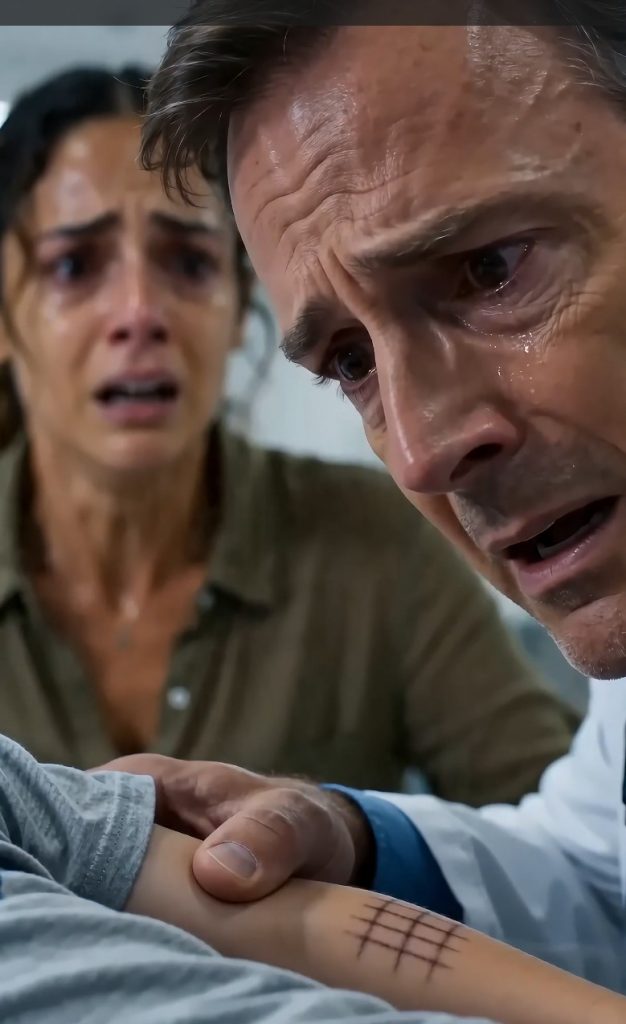
Samuel reached for the boy’s wrist to check him, but his fingers froze halfway there.
His eyes had landed on the child’s forearm.
There, just below the elbow, was a strange pattern of small dark marks.
Twelve tiny vertical lines.
Four rows of three.
Samuel’s face drained of color.
“Show me his hand,” he whispered.
The mother stared at him, confused. “What?”
His voice dropped even lower.
“Please.”
She turned the boy’s arm outward.
Samuel touched the marks with shaking fingers.
The busy emergency room seemed to disappear around him. The noise faded. The fluorescent lights blurred. For the first time in years, Dr. Samuel Hayes looked less like a doctor and more like a man standing in front of a ghost.
Then he looked at the boy’s face.
His mouth trembled.
“My son,” he whispered.
And the woman holding the child stopped breathing.
Act II
Her name was Nora Ellis, and until that moment, she had believed she knew every truth that mattered about the boy in her arms.
His name was Caleb.
He hated peas unless they were hidden in soup. He slept with one sock on and one sock off. He could name every planet but still tied his shoes into impossible knots. He asked too many questions before bedtime and apologized to bugs before moving them off the sidewalk.
He was her son.
Not because she had carried him under her heart, but because she had carried him through every fever, every nightmare, every school morning, every lonely birthday party when only two children came.
Nora had never lied to herself about the beginning.
Caleb came to her when he was three months old.
Her older sister, Elise, had arrived at Nora’s apartment one winter night with a baby wrapped in a blue blanket and terror in her eyes. Elise said the child needed safety. She said there was no time. She said if anyone asked, Nora had to say he was hers.
The next morning, Elise vanished.
No note. No call. No return.
Just a baby, a bag of formula, and a folder of papers that looked official enough to fool a young woman too frightened and too broke to question them.
For years, Nora told herself she had done the right thing.
She had loved Caleb when no one else came for him.
She had worked double shifts at a diner, cleaned offices after midnight, and learned how to stretch groceries until payday. When Caleb got sick, she sat upright all night with his head in her lap. When he asked why he did not have a father, she said families came in different shapes, and theirs was still whole.
But she never told him about Elise.
She never told him about the first night.
She never told him about the mark.
The twelve little lines on his forearm had always been there. Nora had noticed them the first time she bathed him. At first, she thought they were bruises, then a rash, then maybe some harmless birthmark. Doctors at small clinics shrugged. One nurse said some children simply carried strange patterns on their skin.
Nora accepted that answer because she needed it to be true.
Now, in the emergency room, a stranger in a white coat had looked at those marks and called Caleb his son.
Nora stepped back, still clutching the boy.
“No,” she said. “No, you don’t get to say that.”
Samuel looked up, shock fighting with professional instinct.
“We need to treat him first,” he said.
“You just called him your son.”
“And if I’m right,” Samuel said, voice breaking, “I have been looking for him for almost seven years.”
Nora’s grip tightened.
Diane stepped between them carefully. “Doctor, the child needs help.”
That brought Samuel back.
He blinked hard, then became a physician again by force.
“Trauma bay two,” he ordered. “Full evaluation. Call pediatrics. Keep him monitored. Nora, come with us.”
She flinched at her name.
“I didn’t tell you my name.”
Samuel looked at her.
The answer came from Diane, who held the intake form Nora had started to fill with a shaking hand.
But the fear in Nora’s eyes did not fade.
As they wheeled Caleb through the bright corridor, Samuel walked beside him, one hand hovering near the boy’s arm, not touching now, as if touch had become too dangerous.
Nora followed, terrified of the machines, terrified of the doctor, and most of all terrified that saving Caleb’s life might cost her the only family she had left.
But Samuel was not the only one who had recognized the twelve marks.
Act III
Two floors above the emergency room, a retired hospital administrator named Margaret Voss was giving a speech in the conference hall.
She had been invited back for the hospital’s anniversary week, honored as a woman who had “modernized patient care.” Her picture hung near the main elevators. Younger staff knew her name even if they had never worked under her.
Samuel knew it too.
He had once trusted her.
Years earlier, Margaret had been the administrator on duty the night Samuel’s newborn son disappeared.
The official story was clean and devastating.
A fire alarm. A temporary evacuation. A missing infant. A grieving mother who never recovered from the shock. A hospital investigation that ended with apologies, settlements, and sealed reports.
Samuel’s wife, Lena, died two years later.
Not all at once.
Grief simply hollowed her out until the woman who used to sing in the kitchen could no longer bear the sound of morning.
Their son’s name had been Noah.
He had been born with a rare family birthmark on his forearm, twelve tiny dark lines arranged like a grid. Samuel had the same pattern near his shoulder. His father had carried it too.
The night Noah disappeared, Samuel had given the police one detail over and over.
The marks. Look for the marks.
No one found him.
Eventually, people stopped saying “missing” and began saying “gone.”
Samuel never did.
He kept the nursery door closed but not locked. He kept the tiny hospital bracelet in a box beside Lena’s photograph. He kept one copy of the missing child report folded in the back of his desk drawer, the paper worn at the crease where the birthmark description appeared.
Now a boy lay in trauma bay two with that same mark on his arm.
And Nora Ellis stood outside the glass, trembling like a woman who had been running from a truth that had finally found her.
Samuel stepped into the hallway.
“He’s stable for now,” he said. “We’re still checking what caused the collapse, but he’s breathing on his own.”
Nora covered her mouth.
Tears came fast and silent.
“Can I see him?”
“In a minute.”
Her eyes sharpened. “You’re going to take him from me.”
Samuel did not answer quickly enough.
Nora backed away.
“I didn’t steal him,” she whispered. “I didn’t. I swear I didn’t.”
Samuel’s expression changed.
“What do you mean?”
She looked toward the trauma bay window. Caleb looked impossibly small under the hospital lights.
“My sister brought him to me,” Nora said. “She said he needed to disappear.”
Samuel went still.
“What was your sister’s name?”
“Elise.”
“Elise what?”
Nora swallowed.
“Elise Voss.”
The name struck him harder than he expected.
Voss.
Samuel turned slowly toward the elevator lobby, where a framed poster announced the anniversary ceremony upstairs.
Margaret Voss.
Former hospital administrator.
Mother of Elise Voss.
The woman who had controlled every report the night his son disappeared.
The woman currently being applauded two floors above them.
Act IV
Samuel did not storm upstairs.
He wanted to.
Every father in him wanted to tear through the hospital and demand seven stolen years back from the woman who might have buried them.
But Caleb was still in a hospital bed.
And Nora was still shaking.
So Samuel did the thing grief had never let him do before.
He acted carefully.
He called hospital security. Then the legal department. Then Detective Rowe, the only person from the original investigation who had ever believed him when he said something about Noah’s disappearance felt staged.
Within twenty minutes, the cheerful anniversary event upstairs began to fracture.
Margaret Voss was escorted quietly from the conference hall before dessert was served. She arrived outside trauma bay two wearing a pearl-gray suit and an expression of controlled irritation.
Then she saw Nora.
All color left her face.
“Nora,” Margaret said.
Nora stepped back. “You knew?”
Margaret’s eyes moved to Samuel, then to the boy behind the glass.
Her silence answered first.
Samuel’s voice was low. “Is that my son?”
Margaret looked through the window.
Caleb’s forearm rested beside him, the twelve marks visible beneath the clinical light.
For a moment, the powerful old administrator looked small.
“I was trying to protect everyone,” she said.
Samuel almost laughed.
The sound never fully came out.
“From what?”
Margaret’s mouth tightened. “From scandal. From lawsuits. From a mistake that would have destroyed this hospital.”
Detective Rowe arrived just in time to hear it.
“What mistake?” he asked.
Margaret closed her eyes.
The truth came out in pieces.
Elise Voss had worked temporarily in the maternity ward the night Noah disappeared. She was struggling, frightened, and under pressure from people Margaret refused to name. There had been an illegal adoption scheme tied to wealthy families who wanted infants no questions asked. Elise had panicked after being ordered to move one child.
Noah.
But instead of handing him over, Elise took him and ran.
Margaret found out hours later.
She could have called the police.
She could have saved Samuel and Lena years of agony.
Instead, she buried the evidence to protect herself, her daughter, and the hospital’s reputation. She altered logs. Redirected suspicion. Sealed reports. Let a grieving couple believe their baby had vanished into nothing.
“And Elise?” Samuel asked.
Margaret’s face trembled. “She came to me months later. She said she had left the baby with Nora. I told her to stay gone.”
Nora pressed both hands to her mouth.
“You let me raise him in fear,” she said. “You let me think someone dangerous was coming.”
Margaret looked at her, and for the first time there was something like shame in her eyes.
“Someone was.”
Samuel stepped closer.
“Me?” he asked.
Margaret could not look at him.
Nora turned toward Samuel, desperate. “I didn’t know. I swear on my life, I didn’t know he had parents looking for him.”
“I know,” Samuel said.
The words surprised them both.
But he did know.
He had seen Nora run through those doors. He had heard her beg. He had watched her hands refuse to let Caleb fall even when terror made her knees weak.
That was not the grip of a thief.
That was the grip of a mother.
Just then, Caleb stirred behind the glass.
Nora turned instantly.
Samuel did too.
And for one impossible second, both of them reached for the same door.
Act V
Caleb woke up to white lights and two strangers crying quietly near his bed.
Except one of them was not a stranger.
“Mom?” he whispered.
Nora rushed to his side, taking his hand carefully. “I’m here, baby. I’m here.”
His eyes moved past her to Samuel.
The doctor stood frozen at the foot of the bed, every rehearsed sentence gone. For nearly seven years, he had imagined what he would say if this moment came. He had built speeches in the dark. Promises. Apologies. Questions.
Now, facing the boy who might be his lost son, he could only breathe.
Caleb frowned weakly. “Are you the doctor?”
Samuel nodded.
Nora brushed the boy’s hair back. “Yes, honey. He helped you.”
Caleb looked at Samuel’s face for a long moment.
Children notice what adults try to hide.
“Why are you sad?” he asked.
Samuel’s throat tightened.
Nora looked at him then, and something passed between them. Not surrender. Not agreement. Something harder.
Trust, perhaps, in its first and most fragile form.
“Because,” Samuel said carefully, “I think I knew you when you were very small.”
Caleb blinked. “Like a baby?”
“Yes.”
“Was I loud?”
Nora gave a broken laugh through her tears.
Samuel smiled, and the pain of it nearly broke him.
“I hope so,” he whispered.
The official answers would take time.
DNA testing. Court hearings. Statements. Investigations. Arrests. There would be no easy way to untangle a life built on love from a crime built on lies.
Margaret Voss was led away from the hospital she once ruled.
Detective Rowe reopened the case before midnight.
By morning, Samuel sat alone in his office with Lena’s photograph in front of him and the first test results in his hand.
He read them once.
Then again.
Then he lowered his head and wept.
Caleb was Noah.
His son had not died.
His son had grown up loving dinosaurs, hating peas, and calling another woman Mom.
When Samuel returned to the pediatric room, Nora stood by the window, watching Caleb sleep.
She turned when she saw the paper in his hand.
She knew before he spoke.
Her face crumpled.
“I’m sorry,” she whispered. “I’m so sorry.”
Samuel shook his head.
“You saved him.”
“I kept him.”
“You loved him.”
That broke her.
She sat down hard in the chair and covered her face. “He’s my son.”
Samuel looked at Caleb.
Then at Nora.
“Yes,” he said. “He is.”
Nora’s hands lowered slowly.
Samuel stepped closer, holding the test results but not using them like a weapon.
“He’s mine too,” he said. “But I won’t rip his life apart to prove it.”
Nora stared at him.
“I don’t know how to share him,” she admitted.
Samuel’s voice softened. “Neither do I.”
It was the first honest thing that did not hurt.
Weeks later, Caleb left the hospital holding Nora’s hand on one side and Samuel’s on the other.
The staff pretended not to stare.
Diane cried openly.
Caleb wore a new blue hoodie over his gray T-shirt, but every now and then Samuel’s eyes drifted to his forearm, to the twelve tiny marks that had carried the truth when every adult failed.
Outside, the sun was bright enough to hurt.
Caleb stopped near the entrance and looked up at Samuel.
“So,” he said, serious in the way only children can be, “do I have two names now?”
Samuel looked at Nora.
Nora knelt first.
“You have the name I gave you,” she said, touching his cheek. “Caleb. Because it means faithful and brave.”
Samuel knelt beside her.
“And you have the name your first mother gave you,” he said. “Noah. Because she believed you were a promise.”
Caleb thought about this.
“Can I be both?”
Nora’s eyes filled.
Samuel smiled.
“Yes,” they said together.
Caleb nodded, satisfied, as if the adults had finally caught up to what he already understood.
Then he reached for both their hands again.
Behind them, the hospital doors slid open and closed, carrying other emergencies, other stories, other lives waiting to be saved.
But for Samuel, the world had narrowed to the small hand in his.
For years, he had believed the worst thing a parent could suffer was losing a child.
Now he understood something more complicated.
Sometimes a child can be lost and loved at the same time.
Sometimes truth does not arrive clean.
Sometimes a miracle walks through emergency doors in the arms of another mother, and the first thing it does is break your heart open.
Caleb squeezed his hand.
Samuel squeezed back gently.
Not to claim.
Not to take.
Just to answer.
And beneath the boy’s sleeve, twelve tiny marks remained where they had always been, waiting for the day someone finally knew how to read them.