Act I
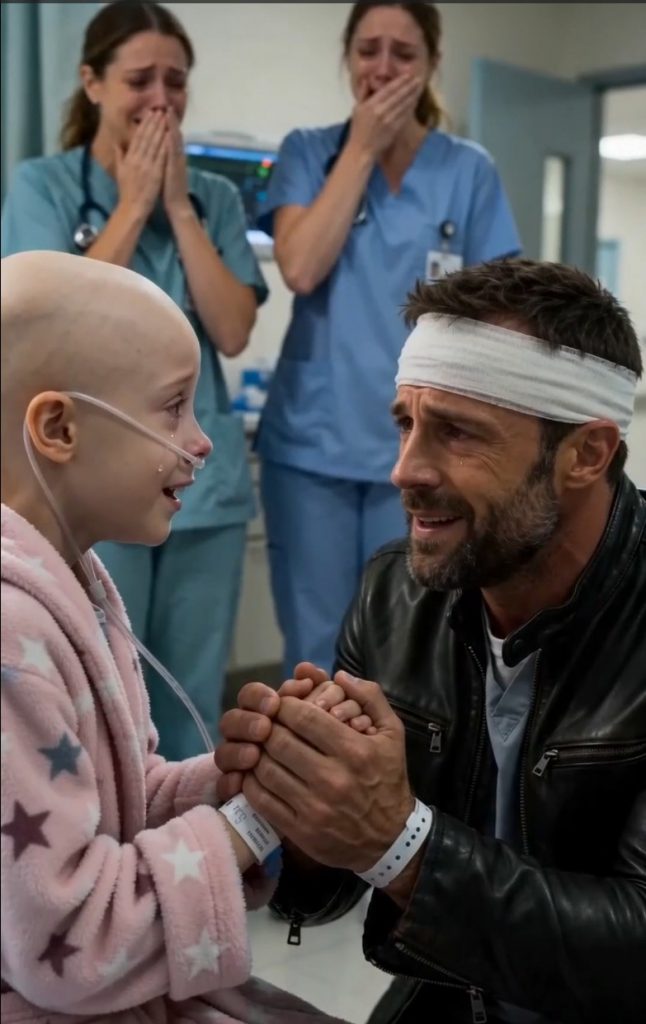
The nurses started crying before the little girl did.
Kin saw it from the doorway of the pediatric ward: one nurse covering her mouth with trembling fingers, another standing near the monitor with red eyes, pretending to check the chart so no one would see her break.
The room smelled like antiseptic, plastic tubing, and rain-damp coats drying near the heater.
At the center of it all sat a seven-year-old girl in a fuzzy pink robe covered in silver stars, her small hands folded in her lap, a clear nasal cannula resting beneath her nose. Her head was smooth and bare beneath the fluorescent lights, but her eyes were enormous, dark, and searching.
She looked too small for the hospital bed.
Too small for the silence around her.
Kin stood there in gray hospital scrubs, a black leather jacket thrown over his shoulders, a white bandage wrapped around his head. His ribs ached every time he breathed. His wrist still wore the hospital ID bracelet they had not managed to cut off before he left his own room.
He should have been lying down.
He should have been listening to doctors.
Instead, he was standing in a children’s ward with one hand braced against the doorframe and the other curled into a fist to hide how badly it shook.
The girl saw him.
Her lips parted.
For a moment, she only stared, as if she did not trust her own eyes.
Then her face crumpled with relief.
“Kin,” she whispered, her voice thin and trembling. “You really came.”
Kin crossed the room before anyone could stop him.
He lowered himself carefully to one knee beside her bed, swallowing the sharp pain that ran through his side. When he reached for her hands, she gave them to him instantly.
Her fingers were cold.
So small inside his.
“I promised you,” he said.
The words came out rougher than he meant them to.
The girl’s eyes filled. “They said you were hurt.”
Kin glanced down at the hospital bracelet on his wrist and gave her the smallest smile. “I’ve had worse.”
One of the nurses let out a quiet sob.
The girl noticed the bandage around his head. “Because of me?”
Kin’s face changed.
“No,” he said firmly. “Because I’m stubborn and not as young as I think I am.”
That made her almost smile.
Almost.
Then her eyes drifted toward the window, where the hospital glass reflected the last gold of the evening. Somewhere outside, faint but unmistakable, a motorcycle engine idled.
Her fingers tightened around his.
The sadness in her face cracked open, and a spark came through.
“Take me riding,” she said.
The room froze.
Kin looked at her.
The nurses looked at Kin.
And beyond the hospital doors, the old silver motorcycle kept waiting like it had heard her first.
Act II
Her name was Rosie Vale, and she had first met Kin on the worst Tuesday of her life.
It was raining that day too.
Not hard enough to flood the streets, just enough to turn the sidewalks black and make the hospital windows look like they were crying. Rosie had been sitting in the lobby with a blanket around her shoulders, angry at the world and refusing to speak to anyone.
Her mother had gone home to shower after two sleepless nights.
Her doctor had said more tests.
The nurses had said brave girl.
Rosie had decided she hated all of those words.
That was when the elevator doors opened and Kin walked in carrying a motorcycle helmet under one arm and a vending machine coffee in the other.
He looked out of place immediately.
Scruffy beard. Black leather jacket. Heavy boots. A face built by bad roads and long nights. The kind of man people either moved away from or stared at too long.
Rosie stared.
Kin noticed.
“What?” he said, glancing at his coffee. “You judging my breakfast?”
Rosie had not meant to answer. But something about his voice was not careful the way adults usually were around sick children. He did not sound like he was afraid she might break if he spoke normally.
“That’s not breakfast,” she said.
Kin looked down at the paper cup. “It says French vanilla.”
“That’s not food.”
He considered this seriously. “You make a strong case.”
That was the first time she laughed in three days.
After that, Kin became part of the hospital in a way no one officially approved but everyone quietly accepted.
His garage was two blocks away, a place called Saint’s Motor Works, where old bikes were brought back from the dead by men with oil under their nails and stories they never told twice. Kin had started delivering donated toys to the pediatric ward during Christmas after one of his customers lost a grandson to a long illness.
One visit became two.
Then birthdays.
Then weekend drop-ins.
Then Rosie.
She asked him about motorcycles constantly.
How fast they went. Why some were loud. Why riders waved to each other. Whether helmets made people look like astronauts. Whether girls could ride them too.
“Girls can ride anything they want,” Kin told her.
Rosie decided then that she would ride a silver motorcycle someday.
Not a red one. Not black. Silver.
“Like moonlight,” she said.
Kin happened to have one.
A 1972 Norton Commando he had rebuilt piece by piece over fourteen months after buying it from a widower who could not bear to sell it to a stranger. The bike was polished silver, low and beautiful, with a voice like thunder wrapped in velvet.
Rosie saw a photo of it on Kin’s phone and went silent.
Then she whispered, “That one.”
Kin smiled. “That one’s special.”
“I’m special.”
He put the phone away, trying not to laugh. “Can’t argue with that.”
So he promised her.
Not a real ride on the road, not then. She was too fragile. The doctors were too careful. Her mother was too afraid.
But one day, when the air was warm and the doctors said yes, Kin would bring the silver bike to the hospital entrance. He would let Rosie sit on it. He would start the engine. They would roll slowly through the private loop near the garden, just once, with the nurses watching and her mother crying and Rosie wearing the smallest helmet he could find.
Rosie made him swear.
Kin swore.
Then the months got harder.
Rosie got thinner. Her robe seemed to grow bigger around her. Some days she still asked about the motorcycle. Other days she barely opened her eyes.
Kin kept coming.
Until the accident.
A delivery van ran a red light three blocks from the hospital. Kin saw it too late. Metal screamed. Glass burst across the pavement. The silver motorcycle slid under a parked car, and Kin hit the street hard enough that the first thing he heard when he woke was someone shouting for an ambulance.
They brought him to the same hospital.
Different wing. Different bed.
When he regained consciousness, the first thing he asked was not about his bike.
It was Rosie.
The nurse looked away before answering.
And Kin understood that promises did not wait for pain to pass.
Act III
The doctors told him no.
Kin listened.
Then he ignored them.
Not because he thought he was invincible. He knew exactly how breakable a body could be. Every breath reminded him. Every step sent pain through his side. The bandage around his head pulled tight when he moved too fast.
But Rosie had asked for one ride.
Not a cure. Not a miracle. Not the impossible thing every adult in the hospital wished they could give her.
One ride.
One moment where the world did not smell like medicine. One moment where she was not a chart, a case, a fragile body in a quiet room. One moment where she could be a little girl under a sunset, giggling on a silver motorcycle, holding tight to someone who had come back.
So Kin called his garage.
“Tell me she survived,” he said.
His mechanic, Luis, went silent.
Then he said, “The bike?”
Kin closed his eyes.
“Yeah.”
“She’s ugly right now,” Luis said. “But she breathes.”
“Can she move?”
“Kin.”
“Can she move?”
Luis swore under his breath. “Slow. Maybe. The forks are straight. Tank’s scratched. Left mirror’s gone. But she’ll move.”
“Bring her to the hospital entrance at sunset.”
Another silence.
Luis knew better than to ask why.
“Rosie?” he said finally.
Kin said nothing.
Luis exhaled. “I’ll make her shine.”
By late afternoon, the whole ward seemed to know something was happening.
Nobody announced it. Nobody wrote it on a board. But nurses who had been working twelve-hour shifts found excuses to pass Rosie’s room. A doctor lingered outside the doorway longer than necessary. Someone brought a soft blanket from the warmer. Someone else found a child-sized helmet with faded pink lightning bolts on the side.
Rosie’s mother, Elena, stood beside the window with both hands pressed to her mouth.
She looked exhausted in the way only parents in hospitals look exhausted, as if sleep had become an old language she no longer spoke. When she saw Kin enter, hurt and pale but standing, her eyes filled immediately.
“You shouldn’t be out of bed,” she said.
Kin gave her a weak smile. “Neither should Rosie.”
Elena laughed once, broken and helpless.
Then Rosie said, “Kin… you really came.”
And the room stopped being about rules.
Kin held her hands and felt how little strength she had left in them. He remembered the first day in the lobby. The French vanilla coffee. The judgment in her tiny voice. The way she talked about motorcycles like they were dragons and stars and freedom all at once.
“I promised you,” he said.
Rosie leaned closer.
Outside, the engine idled.
Her face changed when she heard it.
It was not health that returned to her. Kin did not lie to himself about that. Her body was still tired. Her breath still came thinly through the cannula. The hospital still stood around them with all its machines and truths.
But joy came back.
Joy, bright and stubborn.
“Take me riding,” she said.
A nurse whispered, “Oh, honey.”
Kin looked at Elena.
No one else’s permission mattered as much as hers.
Elena looked from her daughter to the man kneeling beside her, the injured biker who had dragged himself out of a hospital bed to keep one small promise.
Her tears spilled.
“Slow,” she said.
Kin nodded. “Slow as a prayer.”
Rosie smiled then.
And suddenly the whole hospital seemed to make room for her.
Act IV
They moved like a procession.
Not a medical transfer. Not a discharge. Something quieter and more sacred.
Kin walked beside the wheelchair with one hand on the handle, refusing to let anyone else push. Elena walked on Rosie’s other side, carrying the oxygen line carefully while a nurse guided the portable tank. Two staff members followed, crying openly now, no longer pretending this was just another unusual request.
The hallway lights glowed pale above them.
Doctors stepped aside.
Visitors stopped mid-conversation.
Rosie sat wrapped in her pink star-patterned robe, the little helmet resting in her lap. She looked down at it with reverence, touching the lightning bolt sticker as if it were made of gold.
“You really got me a helmet,” she said.
Kin looked down at her. “Rule one.”
“What’s rule two?”
“Hold on.”
“What’s rule three?”
“Smile like you’re breaking the law.”
Rosie giggled.
The sound moved through the hallway like sunlight breaking into a locked room.
Kin had to turn his face away for a second.
The hospital entrance opened ahead of them, spilling white light onto the concrete. Beyond it, the evening waited in warm orange and gold. The air outside smelled faintly of cut grass, exhaust, and the first cool edge of night.
And there she was.
The silver motorcycle.
Scratched now. Scarred in places. One mirror replaced in a hurry. Freshly wiped down until the sunset slid across her tank like liquid fire.
Luis stood beside it with red eyes and grease on his hands.
“She’s ready,” he said.
Kin nodded once.
It was all he could manage.
Rosie stared at the bike as if the world had given her a door no one else could see.
“She’s prettier than the picture,” she whispered.
Kin crouched slowly, hiding the pain as best he could. “You ready, moonlight?”
Rosie nodded.
The nurses helped with the tubing. Elena kissed her daughter’s forehead and held on for one extra second before letting go. Kin lifted Rosie with extreme care, every movement controlled, every breath measured.
When he settled her onto the motorcycle in front of him, she fit against him like a bird in a storm.
Fragile.
Warm.
Alive.
Kin swung one leg over and sat behind her, keeping one arm firm around her waist while the other found the handlebar. His hospital bracelet flashed against the chrome.
Elena stood near the door with both hands clasped beneath her chin.
The staff watched without speaking.
For once, no one mentioned policy.
No one mentioned risk.
The engine turned over with a deep, vintage growl.
Rosie gasped.
Not in fear.
In wonder.
The sound trembled through the bike, through Kin’s chest, through her small hands resting on the tank.
Kin leaned down. “Too loud?”
Rosie shook her head quickly. “It sounds like a lion.”
“A polite lion,” he said.
She giggled again, and this time Elena covered her face because the joy was almost too much to bear.
Kin looked toward the small private drive that curved around the hospital garden. No traffic. No speed. Just one slow loop under the sunset.
He glanced down at Rosie.
Her cheeks were wet. Her smile was enormous.
“Let’s ride already,” Kin said.
And the motorcycle rolled forward.
Act V
They did not go fast.
They barely went faster than walking.
But to Rosie, it was flying.
The hospital slid behind them. The glass doors, the white lights, the worried faces, the machines and charts and whispered conversations all softened into the background. Ahead, the private garden path curved beneath maple trees glowing orange in the sunset.
The motorcycle moved gently over the concrete, engine humming beneath them.
Rosie leaned back against Kin’s chest, both hands tucked safely where he told her to keep them. The pink robe fluttered slightly at the edges. The small helmet made her look even tinier, but her laughter made her seem endless.
Kin felt it through his ribs.
Every giggle hurt.
Every second was worth it.
“Kin!” she called over the engine.
“I’m here.”
“I’m riding!”
“You sure are.”
“I’m really riding!”
He smiled, his eyes burning. “Told you I don’t break promises.”
They passed the garden where patients sometimes sat with blankets over their knees. They passed a bronze statue of two hands holding a dove. They passed a window where someone inside lifted a hand and waved.
Rosie waved back like she was leading a parade.
At the entrance, Elena cried into a nurse’s shoulder. Luis stood with his arms folded, staring at the ground because men like him often needed somewhere to look when their hearts became too visible.
The loop took less than three minutes.
It felt bigger than a lifetime.
When they returned to the entrance, Kin stopped the bike gently and let the engine idle. Rosie did not move at first.
Neither did he.
The sunset painted them both in gold.
For a moment, there was no illness. No accident. No hospital bracelet. No bandage. No clock ticking louder than anyone wanted to admit.
There was only a biker and a little girl on a silver motorcycle.
There was only a promise kept.
Rosie turned her face up toward him. “Again?”
The word struck every adult listening.
Kin looked at Elena.
Elena’s face broke into the saddest smile he had ever seen.
Kin swallowed hard. “Not tonight, moonlight.”
Rosie thought about that.
Then she nodded, serious and brave in the way children should never have to be.
“Tomorrow?” she asked.
Kin’s throat tightened.
He did not lie.
He could not.
So he bent closer and pressed his forehead lightly against the side of her helmet.
“We’ll see what the morning says,” he whispered.
Rosie accepted this because sometimes children understand honesty better than comfort.
The nurses helped lift her down. Kin’s knees nearly gave, but he stayed standing until she was safely back in the wheelchair. She reached for his hand immediately.
“Was I good?” she asked.
Kin laughed softly, wiping at his face with the back of his wrist.
“You were legendary.”
That pleased her.
As they wheeled her back inside, Rosie kept looking over her shoulder at the motorcycle until the doors began to close.
“Kin?”
He stepped forward. “Yeah?”
“Don’t sell her.”
He looked at the scratched silver tank, the patched mirror, the machine that had nearly taken him down and still carried him back to the only promise that mattered.
“I won’t.”
“She’s mine too now.”
Kin nodded. “Half yours.”
Rosie smiled, sleepy and glowing. “Moonlight bike.”
The doors closed behind her.
The engine faded.
Kin stood outside in the dusk, one hand on the motorcycle seat, the other pressed carefully against his aching ribs. The hospital bracelet still circled his wrist. The bandage still pulled tight across his brow. He was hurt, exhausted, and suddenly unable to pretend he was made of stone.
Luis came up beside him.
“You okay?”
Kin looked through the glass doors.
Inside, Rosie was laughing weakly as a nurse tried to fix the crooked helmet hair she did not have.
Kin’s eyes filled.
“No,” he said.
Then, after a long moment, he smiled.
“But she rode.”
The sunset deepened behind the hospital, turning the windows amber. Somewhere inside, machines kept beeping. Nurses kept moving. Doctors kept fighting quiet battles in bright rooms.
And beside the entrance, the silver motorcycle cooled slowly, ticking softly in the evening air.
It had not been a rescue.
Kin knew that.
It had not changed the diagnosis or rewritten the future.
But it had stolen one perfect moment back from everything trying to take her childhood away.
For one slow loop around a hospital garden, Rosie Vale had not been a patient.
She had been a rider.
And Kin, injured and trembling beneath his leather jacket, had kept the kind of promise that grief itself could not erase.