Act I
The hallway was too quiet for the sound of his boots.
Every step echoed across the polished white tile, sharp and steady, bouncing off cream-colored walls covered in finger-painted suns, construction-paper flowers, and crooked spelling tests pinned proudly to bulletin boards.
Sergeant Daniel Harper had imagined this moment for eight months.
He had pictured his daughter’s face the second she saw him. He had pictured Lily dropping her pencil, screaming his name, running into his arms so fast the teddy bear would nearly fall from his hand. He had pictured laughter, tears, maybe a few students clapping because children loved surprises and soldiers in uniform still made teachers smile.
That was the scene he carried with him through the airport, through the cab ride, through the front office of Oakridge Elementary where the receptionist whispered, “Room 104, down the hall to the left.”
Now he stood outside that room with a soft brown teddy bear tucked against his camouflage uniform.
The bear wore a tiny red ribbon around its neck. Daniel had bought it in an airport gift shop at 5:40 that morning because Lily had once told him, over a grainy video call, that every little girl needed “one brave bear for bad dreams.”
He smiled at the memory.
Then he looked through the small rectangular window in the classroom door.
The smile vanished.
At first, his mind refused to understand what his eyes were seeing.
Lily was not at her desk.
She was not coloring. She was not reading. She was not sitting with the other children.
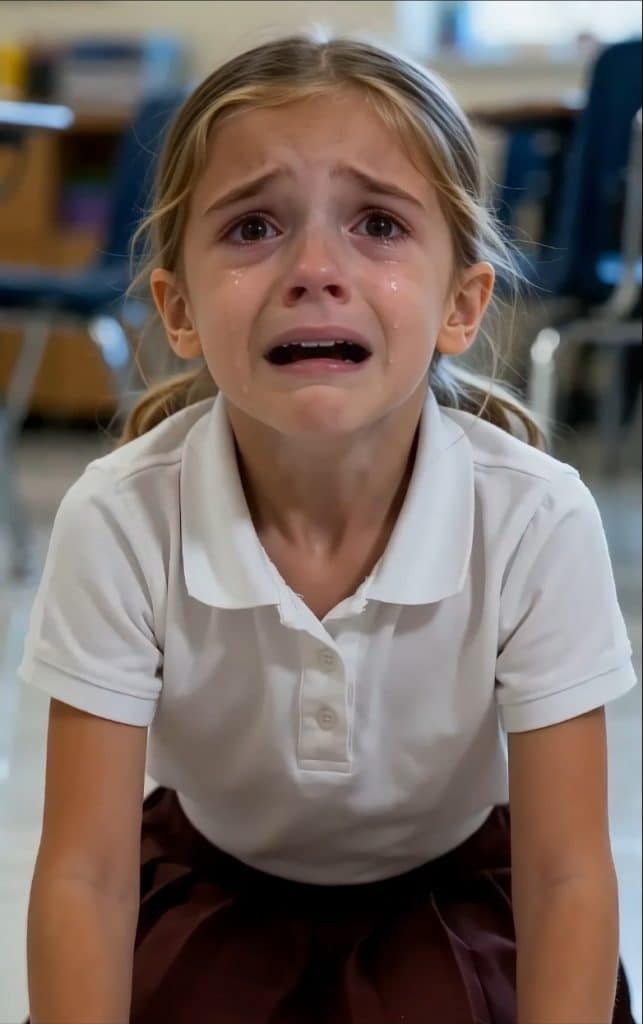
She was on her knees beneath a student desk, still wearing her white polo shirt and maroon pleated skirt, scrubbing the classroom floor with a blue cloth.
Her shoulders shook.
The cloth scraped across the tile in small, desperate circles.
At the teacher’s desk, Mrs. Calder sat comfortably with a white mug in her hand, watching as if this were normal. As if a seven-year-old child on the floor during class was just another rule being enforced.
Daniel’s fingers tightened around the teddy bear.
For one terrible second, all the battlefield noise he had learned to survive disappeared. There was only the muffled scratch of cloth on tile, the fluorescent hum, and the sight of his little girl lowering her head like shame had become too heavy to carry.
Then Lily looked up.
Through the glass, their eyes met.
Her face changed so fast it broke him.
Shock. Relief. Shame. Fear. Hope.
“Daddy!”
The word tore through the door.
Daniel did not remember reaching for the handle.
He only remembered the wooden door slamming open so hard every child in Room 104 froze.
And Mrs. Calder’s mug rattled against her desk.
Act II
Eight months earlier, Lily Harper had drawn a calendar on pink construction paper and taped it beside her bed.
Every night, she crossed off one square.
Sometimes she did it proudly. Sometimes she did it with her lower lip trembling. Sometimes she refused to cross off anything at all because, in her words, “The days are cheating.”
Daniel had tried to make the distance smaller.
He called when the signal allowed it. He read bedtime stories through a cracked phone speaker. He mailed postcards with camels, airplanes, maps, flags, and one badly drawn dinosaur that Lily taped to the refrigerator because she insisted it looked “exactly like Daddy when he wakes up.”
But the distance was never small enough.
Lily had lost her mother when she was four.
A car accident on a rainy November evening. No warning. No goodbye. Just a phone call that split Daniel’s life cleanly in two.
After that, it was just the two of them.
Daniel learned to braid hair badly, then better. He learned which brand of cereal Lily would eat and which one she called “dust flakes.” He learned that grief in a child did not always look like crying. Sometimes it looked like hiding under a table at birthday parties. Sometimes it looked like asking the same question at bedtime.
“Will you come back?”
Every time, Daniel gave the same answer.
“Always.”
Then deployment orders came.
He nearly broke trying to tell her.
Lily had sat on the edge of her bed holding the same teddy bear she had owned since toddlerhood, a worn gray one with one eye scratched loose. She listened carefully while he explained duty in the gentlest words he could find.
“So other people need you too?” she asked.
Daniel swallowed. “For a little while.”
“But I need you.”
He had no answer that did not hurt.
While he was gone, Lily stayed with Daniel’s sister, Rachel, who lived fifteen minutes from the school and loved Lily fiercely. Rachel packed lunches, signed forms, bought school shoes, and sent Daniel updates whenever he could receive them.
At first, the updates were good.
Lily’s reading had improved. Lily made a friend named Emma. Lily finally stopped crying during fire drills.
Then the messages changed.
“She’s been quiet lately.”
“Teacher says she’s distracted.”
“Another note came home.”
“She got in trouble for humming during silent work.”
Daniel called the school once from overseas, standing outside a communications tent under a pale sky, his voice calm but tight as he asked whether Lily was okay.
Mrs. Calder had sounded polished, patient, almost bored.
“Lily struggles with attention and emotional regulation,” she said. “Children from complicated homes sometimes test boundaries.”
Complicated homes.
Daniel remembered that phrase.
It landed like an accusation dressed as concern.
He explained that Lily had lost her mother, that he was deployed, that she might need patience. Mrs. Calder gave a small sigh.
“Of course. But grief cannot become an excuse for defiance.”
Daniel had ended the call with his jaw locked.
Still, he trusted the system more than he should have.
Because that was what parents were told to do. Trust the teacher. Trust the school. Trust that the adult in the room understood the difference between discipline and humiliation.
He did not know that Lily had begun eating lunch alone.
He did not know she had stopped raising her hand.
He did not know that when she accidentally knocked over a cup of water during morning work, Mrs. Calder did not hand her paper towels.
She handed her a cloth.
And told her to clean more than the spill.
Act III
The first thing Daniel did when he entered the classroom was not shout.
That frightened Mrs. Calder more than shouting would have.
He walked in with the rigid control of a man holding back a storm by force of will. His boots struck the tile in slow, deliberate steps. The teddy bear dangled from one hand, ridiculous and heartbreaking against his uniform.
Every child stared.
Lily remained on her knees, the blue cloth trapped in her small fist.
Daniel’s eyes moved once across the room.
Rows of desks. Blue chairs. Wide-eyed students. His daughter on the floor. The teacher behind her desk with a mug in her hand.
Then he crouched in front of Lily.
The anger in his face softened instantly.
“Baby,” he whispered.
Lily dropped the cloth and threw herself into him.
The teddy bear fell against his shoulder as he wrapped one arm around her and held her so tightly she disappeared against his uniform. Her sobs came hard now, the kind a child holds in until safety arrives.
“I’m sorry,” she cried. “I’m sorry, Daddy.”
Daniel closed his eyes.
Those words almost undid him.
“You didn’t do anything wrong,” he said, his voice low enough for only her at first. “Look at me. You hear me? You did not do anything wrong.”
She shook in his arms.
Mrs. Calder stood from her desk.
“Sergeant Harper,” she began, trying to recover authority through tone alone. “This is a classroom. You cannot just burst in here.”
Daniel did not look at her yet.
That made the room even quieter.
He picked up the cloth from the floor and held it between two fingers.
“What was my daughter doing?” he asked.
Mrs. Calder adjusted her glasses. “Lily made a mess.”
His eyes lifted then.
The entire temperature of the room changed.
“So you put her on her knees.”
“She was cleaning what she disrupted.”
Daniel stood slowly, keeping Lily tucked behind him with one protective hand on her shoulder.
“She is seven.”
“She is old enough to understand consequences.”
One of the children in the second row began to cry silently.
Daniel noticed.
So did Mrs. Calder.
Her face tightened.
“Class,” she said sharply, “eyes forward.”
No one moved.
A small boy near the window raised his hand halfway, then lowered it. Daniel saw the fear on his face and understood with a sick certainty that this was not the first time the room had been taught to stay silent.
He turned back to Mrs. Calder.
“What exactly did she disrupt?”
Mrs. Calder hesitated. “She knocked over water.”
Lily’s voice came from behind him, tiny and broken. “It spilled on Emma’s paper.”
Daniel glanced down. “And then?”
Lily wiped her nose with her sleeve. “I said sorry.”
Mrs. Calder’s mouth pressed flat. “She became emotional.”
“She cried?”
“She refused to regulate.”
Daniel repeated the phrase carefully, as if tasting something bitter.
“She refused to regulate.”
The teacher crossed her arms. “I will not have my classroom controlled by tantrums.”
Daniel looked down at Lily’s damp skirt, her red knees, her trembling hands.
Then he looked at the cloth.
The blue fibers were stained gray from more than one small spill.
“How long was she cleaning?”
Mrs. Calder did not answer.
From the back of the room, a girl whispered, “Since reading time.”
Mrs. Calder snapped, “Emma.”
But the truth had already escaped.
Daniel turned toward the girl. “How long ago was reading time?”
Emma swallowed. “After lunch.”
Daniel looked at the clock.
Nearly forty minutes.
The teddy bear in his hand suddenly felt heavier than his gear ever had.
He had crossed oceans to surprise his child.
And found her being taught that pain was something adults could assign.
Act IV
The principal arrived three minutes later because the classroom phone had been left off the hook.
Her name was Dr. Elaine Foster, and she entered briskly, already wearing the strained expression of someone preparing to smooth over an inconvenience.
“What is going on here?”
Daniel turned.
Lily stood beside him now, holding the teddy bear with both arms. Its soft brown face pressed against her cheek. Her breathing was still uneven, but she had stopped apologizing.
That was the only thing keeping Daniel calm.
Mrs. Calder spoke first.
“Dr. Foster, Sergeant Harper forced his way into my room during instruction and disrupted class.”
Daniel gave a short, humorless laugh.
Not loud.
Worse than loud.
Dr. Foster looked from him to Lily, then to the cloth on the floor.
“What happened?”
Mrs. Calder lifted her chin. “Lily spilled water, refused to settle down, and was assigned a restorative cleaning task.”
Daniel’s eyes narrowed.
“Restorative?”
“It is a classroom management strategy.”
“She was on her knees under a desk for forty minutes.”
Dr. Foster’s expression flickered.
Only for a moment.
But Daniel saw it.
Mrs. Calder did too.
“That is an exaggeration,” the teacher said quickly.
A boy near the front whispered, “It’s not.”
The room went still.
Daniel looked at him. “What’s your name?”
The boy’s face flushed. “Noah.”
“Noah,” Dr. Foster warned gently, “this is not—”
“It’s not an exaggeration,” Noah said, his voice shaking but clear. “She was crying. Mrs. Calder told us not to help.”
Mrs. Calder went pale.
Emma raised her hand, crying now. “Lily asked to call her aunt.”
Daniel turned sharply toward the teacher.
“She asked to call home?”
Mrs. Calder’s voice sharpened. “Students often try to escape consequences.”
“She asked to call her family because she was humiliated and scared.”
“She needed discipline.”
“No,” Daniel said, and for the first time his voice filled the whole room. “She needed an adult.”
No one spoke.
Daniel reached into the chest pocket of his uniform and removed a folded paper.
Dr. Foster looked at it uneasily. “What is that?”
“My deployment return authorization and family reunification notice,” he said. “I filed it with the office last week. I requested permission to surprise my daughter in class today.”
Dr. Foster’s face changed.
Daniel continued.
“So someone in this building knew I was coming. Someone knew her father was walking into this school today after eight months overseas.” His voice lowered. “And no one thought to make sure she was okay before I got here.”
Dr. Foster swallowed.
Mrs. Calder’s eyes darted toward the door.
Daniel was not finished.
“My sister has every note you sent home. Every vague complaint. Every phrase about emotional regulation. Every time you framed grief like disobedience.” He pointed to the cloth on the floor. “But this? This is not discipline.”
Dr. Foster said quietly, “Sergeant Harper, perhaps we should discuss this privately.”
“No,” Daniel said.
The word landed hard.
The students stared at him, not frightened now, but listening.
He looked around the room, then back to the principal.
“These children watched it happen. They were taught to sit quietly while a classmate was shamed. So they can hear an adult say clearly that it was wrong.”
Dr. Foster’s lips parted, then closed.
Because he was right.
Daniel crouched beside Lily again.
“Do you want to stay in this room?” he asked.
Lily shook her head immediately.
He looked at Dr. Foster. “Then she’s leaving with me.”
Mrs. Calder stepped forward. “You cannot simply remove a child from class because you dislike a consequence.”
Daniel stood to his full height.
“I am her father. I am her legal guardian. And you will not give another order involving my daughter.”
Mrs. Calder stopped.
The authority she had worn all morning cracked under the weight of a parent who was no longer far away, no longer reduced to phone calls and emails, no longer forced to imagine what his child was enduring behind a closed door.
Dr. Foster finally looked at the teacher.
“Mrs. Calder,” she said carefully, “please step into the hall.”
The teacher’s face went stiff. “Now?”
“Yes.”
Mrs. Calder’s eyes swept over the students, then Daniel, then Lily.
For the first time that day, she looked smaller than the child she had punished.
And Lily saw it.
Act V
Daniel did not leave immediately.
That surprised everyone.
He could have carried Lily out in anger. He could have slammed the door behind him and let the school deal with the silence he left behind. Part of him wanted to.
Instead, he knelt beside her desk.
“Where’s your backpack, baby?”
Lily pointed.
He helped her gather her folder, her crayons, her little pencil case with stars on it. The ordinary objects nearly broke his heart. They looked so small in his hands. So innocent.
A child’s things.
Not evidence. Not weapons. Not proof of defiance.
Just a backpack, a lunchbox, and a drawing of a house with three people standing under a yellow sun.
Daniel paused when he saw it.
One tall figure in green. One small girl in maroon. One woman with brown hair drawn in the clouds above them.
Mommy watching us, Lily had written in careful letters.
He folded the paper gently and placed it in her folder.
By the door, Dr. Foster spoke in a low voice with Mrs. Calder. The teacher’s face had gone tight and defensive, but her confidence was gone. The word “investigation” drifted into the room. Then “administrative leave.”
Lily heard it and looked up at her father.
“Is she mad at me?”
Daniel’s chest tightened.
“No,” he said. “And even if she is, that is not your burden to carry.”
Lily hugged the teddy bear harder. “I spilled water.”
“Water can be cleaned.” He brushed a loose strand of hair from her face. “What happened to your heart matters more.”
Her eyes filled again, but this time the tears came softer.
Not from fear.
From being believed.
Before they left, Noah stood up.
He looked terrified of his own courage.
“I’m sorry I didn’t help,” he said.
Lily looked at him.
Daniel did too.
The boy’s face crumpled. “I wanted to.”
Lily whispered, “It’s okay.”
Daniel rested a hand lightly on his daughter’s shoulder.
“Noah,” he said, “being scared doesn’t make you bad. But next time you see someone being hurt, find another adult. Make noise. Tell the truth. That matters.”
Noah nodded quickly, wiping his eyes.
Emma came forward and hugged Lily. Then another child. Then another.
For a moment, Room 104 became what it should have been all along: a place where children protected each other before they learned how to pretend not to see.
Mrs. Calder watched from the hallway, silent.
Daniel did not look at her again.
He took Lily’s backpack in one hand and her hand in the other. She carried the teddy bear against her chest as they walked out under the Room 104 sign.
The hallway looked different on the way back.
The same bulletin boards. The same polished tile. The same construction-paper flowers.
But Lily’s steps were uneven, and Daniel slowed his pace to match hers.
Halfway down the hall, she stopped.
“Daddy?”
“Yes, sweetheart?”
“Are you home now?”
Daniel swallowed.
He had answered that question a hundred times from thousands of miles away. He had said soon. He had said almost. He had said count the squares.
This time, he knelt right there in the hallway, the knees of his uniform touching the cold tile.
“I’m home,” he said.
Lily studied his face like she needed to make sure the words were real.
Then she climbed into his arms.
Daniel held her in the middle of the elementary school hallway, surrounded by paper suns and crooked drawings, while the teddy bear pressed between them. His eyes burned, but he did not hide the tears this time.
Some battles ended with silence.
Some ended with medals.
This one ended with a little girl finally letting go of the shame that was never hers to carry.
Behind them, Room 104 stayed quiet.
Ahead of them, the front doors glowed with afternoon sunlight.
Daniel stood with Lily in his arms and walked toward it slowly, not as a soldier returning from war, but as a father reclaiming the one promise he had made before every deployment, every goodbye, every long night under a foreign sky.
Always.
He had come back.
And this time, he arrived before anyone could make his daughter feel alone again.