Act I
The shove came so hard that the old man’s shoulder struck the side of the green truck with a dull metallic thud.
For a second, the whole gas station seemed to hold its breath.
Sunlight flashed across the Shell sign above the pumps. Motorcycles rumbled under the awning. Black SUVs sat in a row near the gravel edge of the lot, their tinted windows reflecting the bright blue sky.
And beside a muddy puddle near the vintage truck, Arthur Whitaker clutched his green duffle bag to his chest like it was the only thing keeping him upright.
“Move it, old man!” the bald man barked.
He was tall, thick-necked, dressed in black tactical gear like he had spent the morning hoping someone would give him an excuse. His finger jabbed inches from Arthur’s face. His boots dug into the dirt and gravel as he leaned closer.
Arthur tried to breathe.
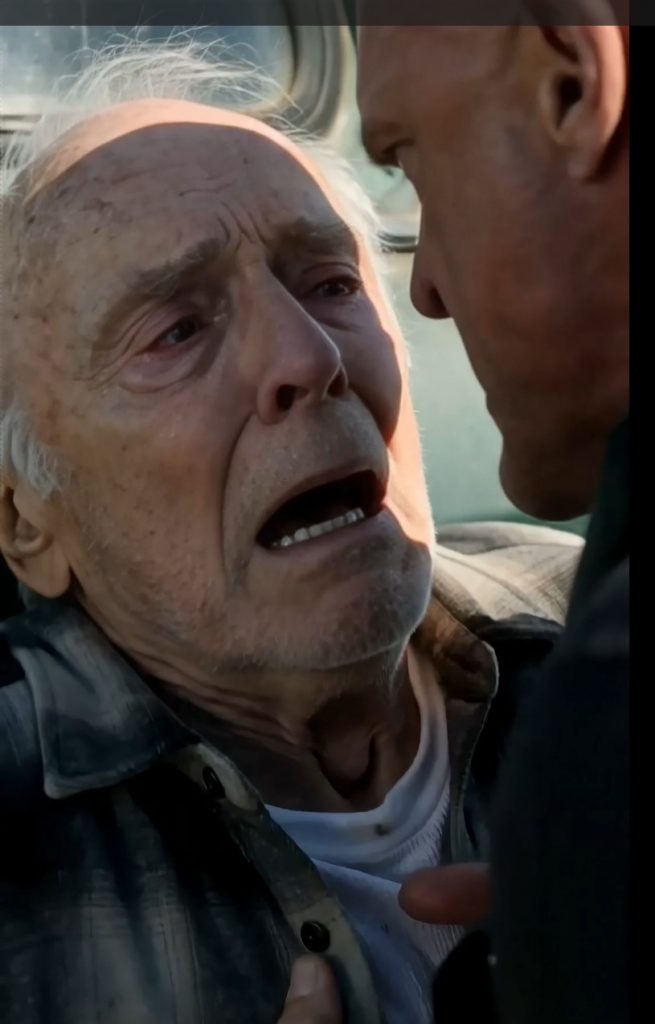
His hand trembled near his chest. His white hair was thin and windblown, his plaid flannel wrinkled from the long drive, his face pale beneath the heat.
“I…” Arthur swallowed. “I need five minutes.”
The man stared at him like mercy was an insult.
“Five minutes?” he repeated, voice rising. “You messing with me?”
Arthur shook his head weakly. “Please. I just need to sit down.”
There was a time when Arthur Whitaker could have stood straighter under a threat like that. There was a time when his hands were steady enough to stitch torn skin under the shaking lights of an emergency room, when his voice could calm a screaming room, when grown men twice his size listened the moment he spoke.
But that time felt far away now.
Now he was seventy-six, dizzy from the road, carrying an old duffle bag filled with things he had spent years avoiding. He had pulled into the gas station because his vision had blurred and his heart had started to hammer in a way he recognized too well.
He had not come looking for trouble.
Trouble had found him anyway.
The aggressor stepped even closer. “I told you to move the truck.”
Arthur glanced behind him at the green off-road vehicle, its paint faded in places, its tires caked with dried mud from a hundred old rides. “I can’t drive right now.”
The man’s expression hardened.
Across the lot, a few bikers turned their heads.
Leather creaked. Engines idled. Boots shifted on gravel.
Arthur saw them only as shapes in the glare.
Then the man in black swung.
Arthur fell sideways into the mud, his duffle bag hitting the ground beside him with a heavy splash.
And that was the moment the wrong people finally started watching.
Act II
The green truck had once been famous in places Arthur never talked about anymore.
Not famous in newspapers. Not famous in polished magazines. Famous at midnight rest stops, storm-soaked highways, hospital parking lots, funeral processions, and roadside memorial rides where men in leather stood silent with tears in their beards.
Back then, everyone called him Doc.
Not because he asked them to.
Because he had earned it.
Arthur Whitaker had been a trauma surgeon before grief bent his back and age slowed his hands. Long before that, he had been a field medic in places where young men learned too early how fragile life was. He came home with quiet eyes, a steady voice, and a belief that men who survived storms owed something to the ones still stuck in them.
So he built something.
It started with five riders and a borrowed garage behind a closed tire shop. A little group called the Iron Saints. They were rough men, most of them veterans, mechanics, truckers, night-shift workers. People crossed the street when they saw them, but Arthur knew better.
He knew how many of them were one bad month away from disappearing.
He opened his clinic after hours for them. He treated infections they were too proud to mention. He stitched cuts. He listened to confessions. He drove widows to court hearings and sat beside recovering addicts through the long shaking hours when nobody else wanted the job.
When a rider died, Arthur showed up.
When a kid needed surgery, Arthur made calls.
When one of the younger members lost control and nearly went to prison, Arthur walked into the courtroom in a suit and told the judge exactly who that man could still become.
People thought bikers respected strength.
Arthur learned they respected loyalty more.
And he gave them thirty years of it.
The giant biker under the Shell awning remembered all of that.
His real name was Caleb Rhodes, but nobody had called him Caleb since he was sixteen. To everyone in the club, he was Bear. Six-foot-seven, broad as a doorway, bald head shining in the sun, black leather vest stretched over a white T-shirt.
Bear had been a wild kid once.
Angry. Fatherless. Always swinging first because he believed the world would hit him anyway.
Arthur had found him behind a county fairground with a broken nose and two cracked ribs after a fight he was too ashamed to explain. Bear had expected a lecture. Instead, Arthur cleaned him up, handed him a sandwich, and said, “You can keep acting like nobody loves you, or you can let somebody prove you wrong.”
Bear never forgot that.
Years later, when Bear’s little sister needed a specialist his family couldn’t afford, Arthur made three calls and one miracle happen by morning.
Years after that, when Bear buried her anyway, Arthur stood next to him in the rain and held the umbrella over Bear’s mother, not himself.
That was the kind of man Arthur had been.
The kind of man people owed more than thanks.
But five years ago, Arthur disappeared from the rides.
First, he missed the summer memorial run. Then the winter toy drive. Then he stopped answering calls. Rumors spread. Some said he had moved south. Some said his health had failed. Some said losing his wife had hollowed him out so badly he simply couldn’t bear the noise of engines anymore.
Bear had searched twice.
Arthur had refused to be found.
Until that morning.
When Bear saw the old green truck pull into the gas station, something in his chest tightened. He recognized it before he recognized the man.
The dent in the rear fender.
The faded sticker on the back window.
The little silver cross wired to the mirror.
Doc’s truck.
Bear had taken one step toward it when the man in black got there first.
And then he heard the old man say, “I need five minutes.”
Bear stopped smiling.
Because he knew that voice.
Older now. Weaker. Strained by pain.
But still Doc.
Then the punch landed.
And the past came roaring across the lot with him.
Act III
Arthur lay half on the gravel, half in the muddy puddle, staring up at a sky too bright to make sense of.
The world sounded far away.
A pump clicked somewhere. An engine coughed. Someone cursed under their breath.
His cheek stung. His shirt was wet. The duffle bag had fallen open beside him, one zipper split wide enough for the corner of black leather to show.
The aggressor stepped over him, still breathing hard.
“You should’ve moved,” he snapped.
Arthur tried to push himself up, but his arm shook beneath him.
That was when Bear began walking.
Not running.
Walking.
Slow enough for every person at the station to understand that what was coming did not need speed.
The other bikers turned with him.
Dozens of them.
Men in leather vests and bandanas, women in riding boots, older riders with gray beards and younger ones who had been laughing five seconds earlier but were silent now. One by one, they stepped away from the motorcycles until they formed a dark, watchful line behind Bear.
The motorcycle engines kept rumbling.
Low. Heavy. Like thunder deciding whether to break.
The man in black noticed the change too late.
He turned, annoyed at first, as if expecting some random stranger to complain. Then he saw Bear.
His face shifted.
Just slightly.
Enough.
Bear stopped inches from him.
The size difference was immediate and humiliating. The aggressor had used his body to frighten an old man, but now he had to tilt his head up to meet Bear’s eyes.
Bear’s voice cracked across the lot.
“Step away.”
Two words.
That was all.
The aggressor’s hands lowered.
“I don’t know what you think you saw,” he said, trying to recover his tone. “Old man was blocking the lane.”
Bear did not blink. “I saw enough.”
“He wouldn’t move.”
“He said he needed five minutes.”
The aggressor let out a humorless laugh. “So what? You his nurse?”
A few bikers moved behind Bear.
Not forward. Not yet.
Just enough to make the air change.
Bear glanced past the man and looked down at Arthur. For a moment, all the fury in his face cracked open into something much deeper.
Recognition.
Pain.
“Doc?” he said.
Arthur’s eyes struggled to focus.
Bear stepped around the aggressor and dropped to one knee beside him, his huge hand hovering near Arthur’s shoulder with surprising gentleness.
“Doc, it’s me,” he said, voice lower now. “It’s Bear.”
Arthur blinked once.
Then something like shame crossed his face.
“Caleb,” he whispered.
No one at the station missed it.
The giant biker, the one every rider seemed to follow without question, had just knelt in the mud beside the old man like he was in the presence of someone sacred.
The aggressor looked from Bear to Arthur, confusion replacing his arrogance.
“You know this guy?”
Bear slowly turned his head.
“This guy,” he said, standing again, “built the club you’re standing in front of.”
The words hit harder than any shout.
The bikers behind him went completely still.
The aggressor looked toward them, and for the first time, he understood that he had not attacked a helpless stranger.
He had attacked a legend.
And Arthur’s duffle bag still had one more secret inside.
Act IV
A woman in a leather vest hurried forward with a bottle of water while another rider called for medical help.
Bear crouched again and helped Arthur sit against the truck’s tire, shielding him from the sun with his own body. His voice stayed calm, but his hands were tight with anger.
“Where are your pills?”
Arthur nodded weakly toward the duffle.
Bear opened it carefully.
Inside were folded clothes, an old medicine pouch, and a black leather vest wrapped in butcher paper like something too important to touch with dirty hands. Bear froze when he saw the patch.
IRON SAINTS.
Founder.
The word sat beneath the emblem, faded but unmistakable.
A murmur moved through the bikers.
Arthur closed his eyes. “I was bringing it back.”
Bear looked at him. “Back?”
Arthur gave a thin, exhausted smile. “Thought it belonged with the club. Not in my closet.”
Bear’s jaw tightened. “You belonged with the club.”
Arthur did not answer.
He looked smaller than Bear remembered. Not weak in spirit, but worn thin by years of carrying grief alone. His wife, Evelyn, had been the heart of every charity ride, the woman who remembered every birthday, every sick child, every widow’s name. When she died, Arthur had not just lost his wife.
He had lost the only person who knew how tired he really was.
“I should’ve called,” Arthur said.
Bear shook his head. “We should’ve kept knocking.”
The aggressor backed away a step.
Nobody blocked him.
That somehow made it worse.
There was nowhere to hide when an entire crowd had already judged you.
“I didn’t know who he was,” the man muttered.
Bear turned slowly.
“That’s your excuse?”
The man swallowed. “I’m saying, I didn’t know.”
Bear walked toward him again, each step crunching into the gravel.
“You didn’t need to know his name to know he was old. You didn’t need to know his history to hear him asking for help. You didn’t need to know what he built before you decided not to be cruel.”
The aggressor’s mouth tightened. “Don’t lecture me.”
Bear leaned closer.
The station fell silent except for the engines.
“You put your hands on a man who could barely stand,” Bear said. “So here’s how this goes. You stay right there until the sheriff arrives. You tell the truth. And if you try to leave, every person here becomes a witness to that too.”
The man looked toward the SUVs.
One of his friends inside had suddenly become fascinated by the dashboard.
No one came to help him.
A younger biker lifted his phone. “Already recorded everything after the hit.”
Another pointed toward the station building. “Camera over the pump caught the rest.”
The aggressor’s face went pale.
Arthur, still seated by the truck, watched the man’s confidence collapse under the weight of something bigger than fear.
Accountability.
Bear returned to Arthur and pulled the old founder vest from the bag. Mud stained the outside paper, but the leather itself was safe.
For a moment, Bear just held it.
Then he looked at Arthur with a question he did not need to speak.
Arthur’s eyes watered.
“I’m not that man anymore,” he said.
Bear knelt in front of him. “You’re exactly that man.”
Arthur shook his head. “I left.”
“You grieved.”
“I disappeared.”
“You survived.”
Arthur’s breathing caught.
The riders behind Bear lowered their heads, not in weakness, but in respect. Some of them had never met Doc. They had only heard stories. The surgeon who paid hospital bills anonymously. The founder who banned cruelty from the club before he banned anything else. The man who said a leather vest meant nothing if the person wearing it couldn’t protect someone weaker.
Now they were seeing him in the dirt, trembling, ashamed to need help.
And somehow that made the stories feel more real.
Bear unfolded the vest.
“Then come home tired,” he said. “Come home angry. Come home broken if you have to. But come home.”
Arthur looked at the patch.
Founder.
For years, he had believed it belonged to a dead version of himself.
But Bear held it out like a door reopening.
And this time, Arthur did not turn away.
Act V
The sheriff arrived twelve minutes later.
By then, the gas station had transformed.
The aggressor stood beside one of the SUVs with his hands visible, no longer shouting, no longer pointing, no longer pretending his size made him powerful. The station attendant had handed over security footage. Three witnesses were giving statements. Two bikers had moved the green truck into the shade.
Arthur sat on a folding chair someone had pulled from an RV, a blanket around his shoulders despite the heat.
The founder vest rested across his lap.
Bear stayed beside him the whole time.
When the deputy asked Arthur if he wanted to press charges, the old man looked at the aggressor.
The man would not meet his eyes.
Arthur thought of all the people he had treated over the years. Men who made mistakes. Men who came back from them. Men who needed someone to tell them the truth before it was too late.
Then he thought of the hand striking him after he asked for five minutes.
His voice was quiet but steady.
“Yes,” Arthur said.
Bear nodded once.
Not with satisfaction.
With respect.
The aggressor’s face tightened as the deputy led him away. He looked smaller now, stripped of the audience he had tried to dominate. His black vest, his boots, his hard stare—all of it seemed like costume without courage beneath it.
As the SUV doors closed and the witnesses stepped back, Arthur stared across the gas station at the motorcycles.
The machines gleamed in the sunlight, lined up like memory itself.
He had avoided that sound for years.
After Evelyn died, every engine reminded him of rides she would never join again. Every fundraiser reminded him of the empty chair beside him. Every familiar face asked him to be Doc when all he felt like was a widower who had outlived the best part of his life.
So he packed the vest away.
He ignored calls.
He told himself the club was better off remembering him strong.
But now, sitting in the shade with mud drying on his trousers and Bear watching him like a son afraid to lose his father twice, Arthur understood the truth.
He had not protected them by disappearing.
He had only denied them the chance to protect him back.
A young rider approached carefully. He could not have been more than twenty-five, with nervous eyes and grease still under his fingernails.
“Sir,” he said, voice rough. “My dad told me about you.”
Arthur looked up.
The young man swallowed. “You helped him get clean. Before I was born. He said if it wasn’t for Doc, I wouldn’t have had a father.”
Arthur’s lips parted, but no words came.
The young rider tapped two fingers to his heart and stepped back.
Then another rider came forward.
Then another.
Not crowding him. Not overwhelming him. Just passing by, one at a time, offering a nod, a hand on the shoulder, a quiet “Welcome back, Doc.”
Arthur tried to hold himself together.
He failed.
His eyes filled, and this time he did not look away.
Bear helped him stand.
Arthur’s legs were unsteady, but the circle around him made falling seem impossible. Bear lifted the founder vest and held it open.
Arthur hesitated.
The whole gas station waited.
Then he slipped one arm through.
Then the other.
The leather settled on his shoulders heavier than he remembered, but not because it was a burden.
Because it carried every mile, every funeral, every rescue, every second chance, every name he thought grief had stolen from him.
Bear stepped back and looked at him.
“There he is,” he said.
Arthur gave a shaky laugh.
It was small. Almost broken.
But it was real.
The riders did not cheer loudly. They did something better.
They started their engines.
One by one, the motorcycles roared to life, not as a threat now, but as a salute. The sound rolled across the Shell station, over the gravel, past the black SUVs, past the puddle where Arthur had fallen, past the old green truck that had carried him back to the one place he still belonged.
Arthur looked at Bear. “I only stopped for five minutes.”
Bear smiled, eyes wet. “Good. We’ve been waiting five years.”
The old man looked down at the vest, then toward the open road beyond the pumps.
For the first time since Evelyn’s funeral, the sound of engines did not feel like grief.
It felt like home calling his name.