Act I
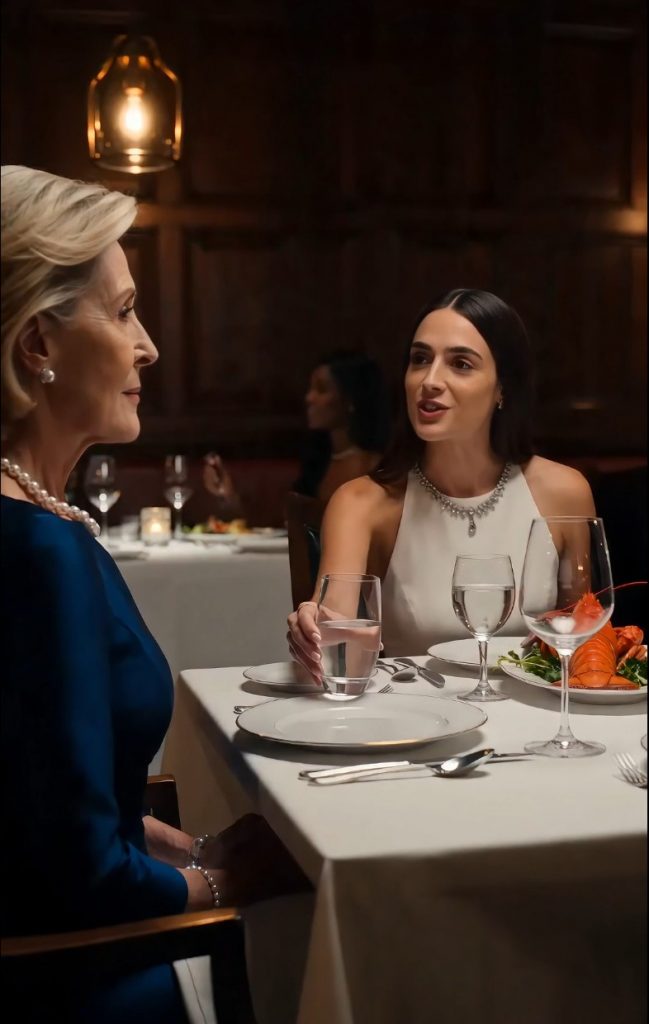
The glass slid across the white tablecloth so slowly that everyone at the table had time to understand the insult before it stopped.
Mrs. Helen looked down at it.
Just water.
No lemon. No ice. No waiter’s hand placing it with care. Just a glass pushed toward her by a young woman in a white dress, the diamonds at her throat flashing beneath the amber pendant lights.
“We don’t serve extra food,” Vanessa said.
Her voice was soft enough not to disturb the whole restaurant, but sharp enough to cut through Helen’s dignity.
Across the table, Helen’s son kept eating lobster.
Alex cracked the shell with the casual cruelty of someone who had never wondered who paid for the table, who polished the silver, who trained the staff, or who spent years building a place where people came to feel important.
He lifted the meat to his mouth and smirked.
“You should know your place, Mom.”
For one second, the restaurant kept moving.
Forks touched china. Wine glasses chimed. A waiter crossed between two tables carrying a silver tray. In the corner, a couple laughed over champagne.
But at Helen’s table, time seemed to narrow into the space between a mother and the son who had decided she was an embarrassment.
Helen did not touch the glass.
She sat upright in her navy dress, pearl necklace resting against her collarbone, her short blonde hair perfectly styled. Not flashy. Not desperate to be noticed.
That had always bothered Vanessa.
Vanessa liked things that announced themselves. Diamonds. White silk. Names on reservation lists. Rooms that turned when she entered them.
Helen had never needed that.
And perhaps that was why Vanessa had mistaken quietness for weakness.
“You can’t just come here and expect to be included in everything,” Vanessa continued, smiling as if she were explaining manners to a child. “This dinner is for people who understand how these places work.”
Alex laughed under his breath.
Helen looked at him then.
Not at Vanessa. Not at the lobster. Not at the glass of water.
At her son.
For twenty-nine years, she had known every version of his face. The infant who cried whenever she left the room. The boy who hid behind her skirt on his first day of school. The teenager who yelled that he hated her, then came back ten minutes later asking if she had made dinner.
And now this.
A man in a tuxedo, mocking her in public to impress a woman who thought love was measured in shame.
Helen took one slow breath.
Then she smiled.
Barely.
“Noted,” she said.
The word landed quietly.
Too quietly.
Alex rolled his eyes and reached for his wine.
Vanessa leaned back, satisfied, believing she had won.
But Helen’s calm had changed something in the air.
Because at the far end of the dining room, the head chef had just stepped out from behind the service doors.
And he was walking straight toward them.
Act II
Chef Marcel did not move through the restaurant like a man checking tables.
He moved like a man answering a summons.
His white coat stood out sharply against the dark polished wood walls. Conversations dipped as he passed. A waiter moved aside without being asked. Two diners looked up from their plates, recognizing him from magazine covers and charity galas, then whispered his name.
Vanessa noticed first.
Her smug smile flickered.
Alex was still chewing when the chef arrived beside Helen’s chair.
Marcel stopped, lowered his head, and bowed.
Not to Alex.
Not to Vanessa.
To Helen.
“Mrs. Helen,” he said, his voice deep with respect. “We need you in the office.”
The room changed.
It was not dramatic in the loud way Vanessa would have preferred. No one gasped. No one shouted.
But attention shifted like a curtain being pulled open.
Nearby diners turned. A waiter froze with a bottle of wine angled over a glass. The hostess at the front looked toward the table and went still.
Alex slowly lowered the lobster piece back onto his plate.
Vanessa’s hand tightened around her napkin.
Helen looked up at the chef as if she had expected him all along.
“I’ll be there in a moment, Marcel,” she said.
Marcel nodded once. “Of course, Mrs. Whitmore.”
The surname hit Alex harder than the bow.
Whitmore.
Not just his mother’s last name.
The name engraved in brass near the entrance.
Whitmore House.
Vanessa had praised that name three times before dinner. She had called it “old money without trying too hard.” She had told Alex that people who mattered would respect their wedding more if the rehearsal dinner happened here.
She had not known that Helen Whitmore was the woman behind it.
Or perhaps she had refused to believe it.
Alex blinked at his mother. “What is he talking about?”
Helen stood slowly.
She smoothed the front of her navy dress with both hands, a small, controlled movement that made Vanessa suddenly aware of every careless thing she had said that night.
The water glass still sat untouched between them.
Helen looked at it, then back at her son.
“You invited me here to humiliate me,” she said softly. “At my own restaurant.”
The silence spread table by table.
Alex’s face drained.
Vanessa let out a small laugh, brittle and panicked. “Your restaurant?”
Helen turned to her.
“Yes.”
One word again.
Vanessa’s diamonds glittered at her throat, but now they looked less like proof of power and more like ornaments on someone who had walked into a room she did not understand.
Alex pushed his chair back. “Mom, wait.”
But Helen did not sit.
She looked past him, toward the long dining room, the amber lights, the servers moving with practiced grace, the white linens, the silver, the china, the scent of butter and sea salt rising from expensive plates.
She had built this place from a failing dining room with cracked floors and a leaking ceiling.
She had signed the first loan with shaking hands.
She had washed glasses herself after midnight.
She had worked double shifts while Alex slept in a portable crib in the office because she could not afford childcare.
And now he sat beneath her roof, eating from her kitchen, telling her to know her place.
The worst part was not the insult.
It was that he truly believed it.
But Alex had not yet understood the real reason the chef had come.
Act III
The office was behind a velvet rope, past the service corridor, through a door that most guests never noticed.
Helen walked there with Marcel at her side while the restaurant watched in stunned silence.
Alex followed.
Vanessa followed him because leaving would have looked worse.
The door closed behind them, muting the dining room into a low hum.
Inside, the office was nothing like the glittering restaurant outside. It was small, warm, and practical. Shelves of invoices. Framed newspaper reviews. A photograph of Helen in her twenties, hair pulled back, sleeves rolled up, standing beside a man with kind eyes and flour on his shirt.
Her late husband, Daniel.
Alex glanced at the photo and looked away.
He had not visited the office in years.
He hated this room.
It smelled, he once said, like work.
Marcel placed a folder on the desk.
“The inspector arrived early,” he said. “And Mr. Graves is waiting on the call. He says he needs final approval tonight.”
Vanessa frowned. “Final approval for what?”
Helen did not answer her.
She opened the folder.
Inside were contracts, photographs, inspection notes, and a printed copy of an email chain. Alex saw the logo at the top and his stomach tightened.
Briar & Vale Hospitality Group.
He knew that name. Of course he knew it.
For six months, he had been trying to impress them. Vanessa’s father had friends there. Investors. Men who wore simple watches that cost more than cars and talked about “legacy properties” as if they were chess pieces.
Alex had told them he could help secure Whitmore House after his mother retired.
He had told them Helen was tired.
Sentimental.
Easy to persuade.
He had told Vanessa the restaurant would be theirs soon enough.
Helen lifted one page.
“Do you want to explain this,” she asked, “or should I?”
Alex stared.
Vanessa’s eyes darted toward him.
“What is that?” she whispered.
Helen turned the paper so they could see.
It was a proposal.
Not signed by Helen.
Signed by Alex.
A proposal offering Briar & Vale an inside path to purchase a controlling stake in Whitmore House after “family succession adjustments.”
Helen’s voice stayed calm. “You told them I was preparing to step down.”
Alex swallowed. “I was trying to help.”
“No,” Helen said. “You were trying to sell what you never built.”
Vanessa stepped forward. “That’s not fair. Alex is your son. He should inherit something.”
Helen looked at her, almost sadly.
“He was going to.”
The sentence seemed to wound Alex more than an accusation would have.
Helen opened the drawer and removed another folder. This one was older. Its corners were soft from years of handling.
She placed it on the desk.
“Your father and I wrote the original succession plan when you were sixteen,” she said. “After he got sick.”
Alex’s jaw tightened.
He hated when she mentioned Daniel. Not because he had not loved his father, but because grief made him feel small, and Alex had spent his adult life running from anything that made him feel small.
Helen continued.
“Daniel wanted you to have a place here, if you earned it. Not because of your last name. Because of your character.”
Vanessa crossed her arms. “Character doesn’t pay legal fees.”
Marcel’s face hardened, but Helen lifted one hand slightly, and he stayed silent.
Helen opened the old folder.
There were letters inside.
One was addressed in Daniel’s handwriting.
To Alex, when you are ready to understand what your mother carried for you.
Alex did not move.
Helen looked at him for a long moment.
“I kept this because I hoped one day you would ask about the years you were too young to remember.”
Alex forced a laugh, but it came out thin. “This is ridiculous.”
“No,” Helen said. “Ridiculous was watching you let your fiancée tell your mother she wasn’t worth feeding.”
Vanessa flinched.
Helen’s gaze moved to her.
“And cruel was you thinking hunger was an acceptable prop for status.”
The room became so quiet that the hum of the refrigerator down the hall could be heard through the wall.
Then Helen pulled out the final document.
It was not old.
It was dated that morning.
Alex saw the notary stamp before he understood the words.
Helen had amended the trust.
And Alex’s name was no longer where he expected it to be.
Act IV
“What did you do?” Alex asked.
His voice was low now. Not mocking. Not amused.
Afraid.
Helen placed the amended trust on the desk between them.
“I protected your father’s restaurant.”
Alex stepped closer. “From me?”
Helen’s eyes did not soften, though something behind them did.
“Yes.”
Vanessa made a sharp sound. “You can’t just cut him out because of one awkward dinner.”
Helen looked at her then, and for the first time all evening, there was steel in her expression.
“One awkward dinner?” she repeated.
She opened the Briar & Vale file again and spread the pages across the desk.
“There are emails here from Alex promising access to private financials. There are messages where you describe our staff as replaceable. There is a draft plan to remove Marcel after the sale because his salary was, in your words, ‘too emotional for the margins.’”
Marcel looked down.
For years, he had treated Alex kindly out of loyalty to Helen. He had remembered Alex’s birthdays. Sent food to his apartment when he was sick. Once, when Alex crashed his car at nineteen, Marcel was the one who drove Helen to the hospital because her hands were shaking too badly to hold the wheel.
Alex had forgotten all of it.
Helen had not.
Vanessa’s face reddened. “Those were private discussions.”
Helen nodded. “So was my grief. You used that too.”
Alex looked at Vanessa.
For the first time, doubt cracked across his face.
Helen saw it and knew.
He had not written all of those words alone.
Vanessa had fed him ambition and called it love. She had studied his resentments, polished them, and handed them back as a future.
She had told him he deserved more.
She had never asked what he had given.
Helen reached for another page.
“This afternoon, Briar & Vale’s attorney sent a courtesy copy to my office by mistake,” she said. “Your name was on it, Alex. Vanessa’s too.”
Vanessa’s lips parted.
That was the moment the mask slipped.
Not fully. Just enough.
Her fear was not guilt.
It was exposure.
Alex noticed.
“Vanessa?” he said.
She turned on him instantly. “Don’t look at me like that. You agreed. You said she was holding you back.”
“I said I wanted a role.”
“You said this place should have been yours already.”
Helen closed her eyes briefly.
There it was.
The truth, ugly and plain.
Alex had not been manipulated into betrayal. He had been invited, and he had walked in willingly.
A knock came at the office door.
Marcel opened it.
The maître d’ stood outside, pale but composed. “Mrs. Whitmore, Mr. Graves is on the line. And the private dining room is ready.”
Helen nodded. “Thank you, Elise.”
Alex looked confused. “Private dining room?”
Helen gathered the documents.
“I was not supposed to be at your table tonight,” she said.
Vanessa frowned. “What does that mean?”
Helen walked past them to the door.
“I had a board dinner scheduled. Investors. Staff partners. Our legal counsel. The people you tried to go around.”
Alex’s mouth opened, but nothing came out.
Helen paused with her hand on the doorknob.
“When you invited me, I thought perhaps you wanted to make peace before your wedding. I thought maybe you wanted your mother there because some part of you remembered who stayed after everyone else left.”
Her voice trembled once.
Only once.
“Then you handed me a glass of water and told me I was extra.”
She opened the door.
The hallway beyond seemed brighter now, the restaurant’s golden light spilling in like a stage.
“Come with me,” Helen said. “Both of you.”
Vanessa shook her head. “Absolutely not.”
Helen looked back at her.
“You wanted an audience.”
Then she stepped into the dining room.
Act V
The private dining room doors opened to a table of twelve.
Lawyers. Senior staff. Two investors. Elise, the maître d’. Marcel stood beside Helen, his expression unreadable.
At the center of the table was an empty chair.
Helen’s chair.
Alex saw the brass plaque on the wall behind it.
Founder and Chairwoman: Helen Whitmore.
Vanessa stopped so abruptly that Alex nearly bumped into her.
The people in the room looked up.
Not with surprise.
With knowledge.
They had been waiting.
Helen walked to the head of the table and placed the folders down.
“I apologize for the delay,” she said. “A family matter became a business matter.”
No one spoke.
Helen turned to Alex.
For a moment, he was not the arrogant man from the dining room. He was a boy again, standing in a school uniform too big for him, asking if his father would come home from the hospital.
Helen remembered kneeling in front of him and lying because she had no other mercy to offer.
Soon, she had said.
Daniel never did.
Everything after that had been survival.
Helen had survived for both of them.
Alex lowered his eyes.
“Mom,” he said, and this time the word sounded different.
Not like ownership.
Like a plea.
Helen held herself still.
“I will not destroy you,” she said. “Your father would not have wanted that.”
Vanessa’s shoulders relaxed slightly.
Too soon.
“But you will not inherit control of Whitmore House. Not now. Not through marriage. Not through pressure. Not through a sale arranged behind my back.”
Alex whispered, “What happens to me?”
“You keep your trust income,” Helen said. “For one year. During that year, you may work here if you choose.”
Vanessa blinked. “Work here?”
Helen looked at her. “Yes.”
Marcel stepped forward and placed a folded black apron on the table.
Alex stared at it.
Helen’s voice remained even. “Dish room first. Then prep. Then service. Then accounts. Every department your father and I worked before anyone called this place luxury.”
A few people at the table exchanged glances.
No one laughed.
That made it worse for Alex.
This was not a joke. It was a verdict.
Vanessa took one step back. “This is humiliating.”
Helen nodded. “It is.”
Then she picked up the untouched glass of water someone had carried from the main table and set it in front of Vanessa.
“Humiliation teaches quickly when comfort fails.”
Vanessa looked at Alex, waiting for him to defend her.
But Alex was looking at the apron.
For the first time that night, he seemed to understand that the thing he wanted had weight. It was not a name on a door or a reservation list. It was mornings before sunrise, burns hidden beneath sleeves, payroll covered before profit, staff protected when numbers did not work.
It was his mother staying late in the office while he slept.
It was his father signing menus from a hospital bed because he still believed the place could live.
It was Marcel learning to make Daniel’s chowder exactly right after he died because Helen could not bear to take it off the menu.
Alex sat down slowly.
Vanessa stared at him. “You’re not seriously considering this.”
He did not answer.
Her face hardened.
“Alex.”
He looked up at her, and something in him finally broke away from the version of himself she had been feeding.
“You told my mother we don’t serve extra food,” he said.
Vanessa’s lips tightened. “Because she embarrassed us.”
“No,” he said quietly. “We embarrassed ourselves.”
The words hung in the room.
Helen’s expression changed, but only slightly.
Pain was still there. So was caution.
Forgiveness had not arrived. Not yet.
But a door, long closed, had opened a crack.
Vanessa looked around at the lawyers, the staff, the investors, the chef, the woman she had mistaken for a powerless mother.
There was no ally in the room.
No one to impress.
No one left to manipulate.
She lifted her chin, turned, and walked out.
Her heels struck the floor hard at first, then faster, then softer as the restaurant swallowed her exit.
In the main dining room, people watched her pass. Some pretended not to. Others did not bother pretending.
At the table she had abandoned, her diamond necklace caught the light one last time before she disappeared through the front doors.
Alex remained in the private room.
Helen looked at him.
“I won’t beg you to become someone better,” she said. “But I will give you the chance your father wanted you to have.”
Alex reached for the apron.
His hands shook.
“I don’t know how to start,” he admitted.
For the first time all night, Helen’s face softened.
“You start,” she said, “by clearing the table where you insulted me.”
So he did.
In his tuxedo, beneath the gaze of diners who had watched him mock his mother, Alex walked back to the table with a bus tray in his hands.
He removed the lobster plate first.
Then the wine glasses.
Then the untouched water.
No one clapped. No one needed to.
The humiliation was complete because it had turned into something stronger than shame.
It had become truth.
Helen stood near the entrance to the private room, watching her son fold the stained napkin and lift the plates he once believed appeared by magic.
Marcel came to her side.
“Are you all right, Mrs. Whitmore?”
Helen looked at Alex.
Then at the restaurant.
The amber lights glowed warmly over the white linens, the polished silver, the room she had built out of grief and grit and love.
“No,” she said softly.
A small smile touched her lips.
“But I think, for the first time in years, he might be.”