Act I
The laughter came first.
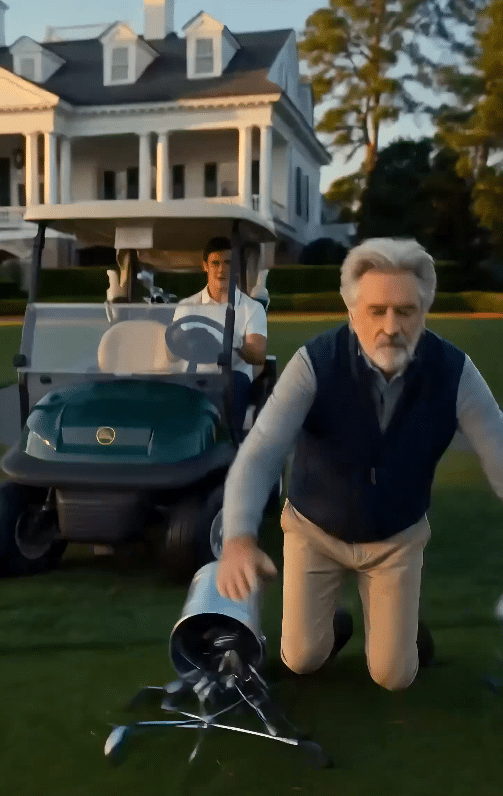
Not loud enough to draw attention from the entire golf course, but loud enough for the older man kneeling in the grass to hear every word.
A metallic bucket had tipped over beside him, scattering tools, divot mix, and maintenance supplies across the green.
Without hesitation, the old man dropped to his knees.
His fingers dug into the damaged turf.
He pressed loose soil back into place. Smoothed the grass. Patched the scar on the course as carefully as a surgeon stitching a wound.
To most people, he looked like a groundskeeper.
Maybe a maintenance worker.
Certainly not someone important.
That assumption proved expensive.
A few feet away, a young golfer lounged comfortably in a golf cart.
His name was Trevor Langley.
Twenty-six years old.
Son of a hedge fund manager.
New member.
New money.
The kind of person who believed expensive memberships automatically created status.
He watched the old man working and smirked.
“Step back,” Trevor called out. “Members don’t pay six figures for this kind of scene.”
The older man didn’t respond.
He kept repairing the turf.
That only encouraged Trevor.
Several nearby golfers glanced over uncomfortably, but nobody said anything.
The old man reached for another handful of soil.
Trevor slowly clapped.
Twice.
Mockingly.
Then he pointed toward the luxury watch on the man’s wrist.
“Nice watch,” he said with a grin. “Trying to look like you belong here?”
A few nervous chuckles escaped from nearby players.
The old man finally looked up.
His expression revealed nothing.
No anger.
No embarrassment.
No need to defend himself.
Just silence.
And somehow that silence felt heavier than any reply.
Because the truth was already on its way.
And within minutes, Trevor would wish he had never opened his mouth.
Act II
Whitmore Hills Country Club wasn’t just another golf course.
It was one of the most exclusive clubs in the country.
Professional athletes played there.
CEOs negotiated deals there.
Politicians quietly held meetings there.
Membership wasn’t merely expensive.
It was nearly impossible.
Families remained on waiting lists for years.
The club represented prestige.
Influence.
Power.
And nobody understood that better than Trevor.
His father had spent years trying to gain admission.
When they were finally accepted, Trevor treated the membership like a royal title.
Within months, he had developed a reputation.
Arrogant.
Entitled.
Dismissive toward staff.
He tipped poorly and complained often.
Most employees simply tolerated him.
After all, wealthy members could create problems.
The old man kneeling in the grass appeared to be exactly the kind of worker Trevor enjoyed looking down upon.
What Trevor didn’t know was that the older gentleman hadn’t arrived at the club that morning to inspect employees.
He wasn’t there for a board meeting.
He wasn’t even scheduled to be there at all.
He had come because of a memory.
A simple memory.
Thirty-seven years earlier, before the clubhouse existed, before the luxury villas surrounded the property, before private helicopters occasionally landed nearby, there had only been open land.
And one stubborn man with a dream.
That man was kneeling in the grass.
His name was Richard Whitmore.
The founder.
The creator of everything around them.
The reason the club existed at all.
But Richard rarely announced who he was.
He preferred observing people when they believed he was nobody.
Over the years, he had learned an important lesson.
Titles revealed very little.
Character revealed everything.
And Trevor had just revealed quite a lot.
The problem was that Trevor still didn’t realize who was standing in front of him.
Or who was rapidly approaching from the clubhouse.
Act III
Richard finished smoothing the final patch of turf.
For a brief moment, he stared at the repaired grass.
Satisfied.
Then he slowly stood.
His knees weren’t as strong as they once were.
Age had made certain tasks harder.
But it hadn’t weakened his presence.
Trevor noticed it immediately.
There was something unusual about the older man’s posture.
Something commanding.
Something impossible to ignore.
Still, Trevor doubled down.
“Need help carrying your tools?” he asked sarcastically.
Richard brushed dirt from his hands.
“No.”
One word.
Calm.
Controlled.
Trevor rolled his eyes.
Then movement near the clubhouse caught everyone’s attention.
A man in a green club blazer was hurrying across the course.
Fast.
Far too fast for someone concerned about appearances.
Several employees followed close behind.
The official’s face looked pale.
Anxious.
Almost frightened.
Golfers paused their games.
Conversations stopped.
Trevor frowned.
The official wasn’t looking at him.
He wasn’t looking at any member.
His eyes were fixed entirely on Richard.
And suddenly Trevor felt a small knot form in his stomach.
Because he had never seen senior club officials move like that before.
Not for anyone.
The official reached Richard and immediately extended both hands.
His voice carried across the green.
“Mr. Whitmore, forgive us for arriving late.”
Trevor blinked.
Whitmore?
The name sounded familiar.
Dangerously familiar.
Then the official spoke the sentence that shattered Trevor’s confidence.
“No one here outranks the founder.”
The world seemed to stop.
Act IV
Silence spread across the course.
Not ordinary silence.
The kind that arrives when an entire crowd realizes something important at exactly the same moment.
Trevor’s face drained of color.
Founder.
The word echoed inside his head.
Founder.
Not a groundskeeper.
Not maintenance staff.
Not a laborer.
The founder.
The man responsible for every fairway.
Every building.
Every membership.
Every dollar flowing through the club.
Richard Whitmore calmly accepted the official’s handshake.
Nothing about his expression changed.
It was as if Trevor’s insults had barely registered.
That somehow made the humiliation worse.
Nearby golfers began whispering.
Some recognized Richard instantly.
Others pieced it together from stories.
Most members had heard legends about him.
Very few had ever met him.
Richard rarely attended social events.
He avoided publicity.
He preferred staying out of photographs.
But every important person at the club knew his name.
Trevor’s hands tightened around the steering wheel.
His earlier confidence evaporated.
The watch.
The boots.
The simple clothes.
None of it had been a disguise.
Richard simply didn’t care about impressing strangers.
He never needed to.
The official cleared his throat nervously.
“Mr. Whitmore, the board has assembled for your visit.”
Richard nodded.
Then his eyes settled on Trevor.
Not angry.
Not emotional.
Just disappointed.
That look hurt far more than shouting ever could.
Trevor quickly climbed out of the golf cart.
“I… I didn’t know.”
Richard studied him for several seconds.
Long enough to make the young man’s stomach twist.
Then he asked a question nobody expected.
“What difference would it make?”
Trevor froze.
Richard took one step closer.
“What difference would it make if I were a worker?”
No answer came.
Because there wasn’t one.
The truth stood exposed for everyone to see.
Trevor hadn’t insulted Richard because he thought he was the founder.
He insulted him because he thought he wasn’t.
And that revealed everything.
But Richard wasn’t finished.
Act V
The board meeting never became the biggest story that day.
Neither did Richard’s surprise visit.
Instead, members spent weeks talking about what happened on the eighteenth green.
Because after the confrontation, Richard made an unexpected decision.
He asked Trevor to walk with him.
Alone.
Across the course.
For nearly an hour.
No one knew exactly what was said.
But several witnesses saw the young man return looking completely different.
Gone was the smug grin.
Gone was the arrogance.
Gone was the certainty that money automatically created worth.
A week later, Trevor voluntarily joined the club’s turf restoration program.
Then he began helping at junior golf events.
Then charitable projects.
Then employee appreciation initiatives.
People noticed.
Some assumed he was protecting his reputation.
Others believed he had genuinely changed.
Only Richard knew the full conversation.
Months later, Trevor finally shared part of it during a club banquet.
Standing before hundreds of members, he told them something he would never forget.
“When I mocked him, I thought I was judging a worker.”
The room listened quietly.
Trevor swallowed hard.
“But Mr. Whitmore told me the same thing he would tell all of you.”
He paused.
Then repeated the words.
“The true measure of a person isn’t how they treat people above them.”
The ballroom became silent.
“It’s how they treat people they think are beneath them.”
Across the room, Richard sat quietly.
No applause.
No celebration.
No demand for recognition.
Just a small nod.
The same calm confidence he had carried that day on the grass.
Because he had never built Whitmore Hills to create a place for wealthy people.
He built it to create something that would outlast him.
A place where character mattered more than status.
And on that bright afternoon, kneeling in the dirt while a young man laughed at him, Richard learned something valuable.
Not about the golf course.
Not about the club.
But about the people who inherited it.
The founder left the green with dirt on his hands.
The young golfer left with something far harder to carry.
The truth about himself.