Act I
The traffic had been stopped for nearly twenty minutes before anyone understood why.
At first, people thought it was another accident on the bridge. Another stalled car. Another miserable morning under a gray sky with engines idling and drivers leaning out of windows, searching for someone to blame.
Then they saw the dog.
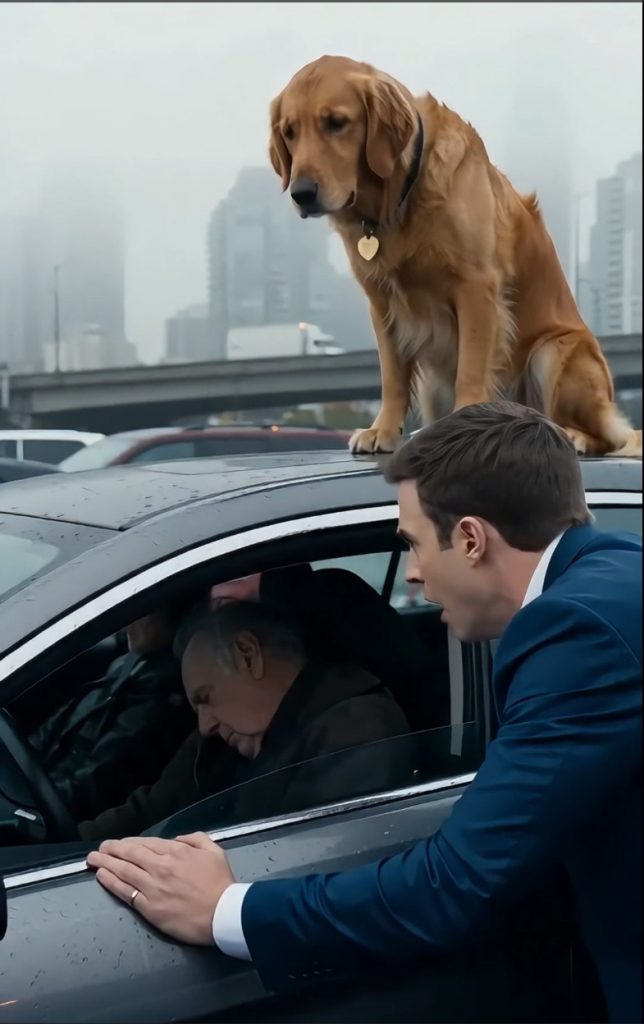
A Golden Retriever sat on top of a dark gray sedan in the middle lane, its golden-brown fur damp from the mist and its black collar glinting beneath the cold light. A small heart-shaped tag swung from its neck every time it shifted its head.
The dog was not pacing.
It was not barking at traffic.
It sat upright on the roof like a statue, staring over the stopped cars with eyes so wet and desperate that people stopped complaining.
A woman in a tan trench coat stepped out first.
“Oh my God,” she whispered. “Is it hurt?”
A bearded man in an olive bomber jacket stood beside his open door, watching the dog with a grief-stricken expression he could not hide.
The dog lowered its head toward the windshield.
Then it whimpered.
The sound moved through the highway more powerfully than a siren.
Drivers stepped out of their cars one by one. A businessman in a navy suit stood near the sedan, one hand pressed uncertainly to his chest, looking from the dog to the vehicle beneath it.
The windshield was fogged.
The driver’s seat was hidden by glare.
No one could see inside clearly.
The dog lifted its head and gave a long, mournful howl toward the misty sky.
Some people thought it was grief.
Some thought the dog had been abandoned.
Some thought the driver had stepped away and left it trapped.
But the businessman noticed something different.
Every time someone moved toward the dog, it did not retreat.
It looked down.
Toward the driver’s side.
Toward the locked sedan.
The businessman took a slow step forward.
The dog whined again, sharper this time, as if begging him to understand.
He approached the window, cupped his hands against the damp glass, and leaned in.
For one second, he did not move.
Then his face turned pale.
He spun toward the crowd, voice breaking through the highway wind.
“Somebody call 911 now!”
And suddenly the dog’s howl was no longer grief.
It was a warning no one had heard in time.
Act II
The dog’s name was Cooper.
That was what the heart-shaped tag said in tiny engraved letters.
COOPER
CALL ELIAS
But Elias Hart could not answer.
He sat slumped behind the wheel of the gray sedan, one hand still near the steering wheel, his head lowered in a way that made the businessman’s stomach twist.
The engine was still running.
The brake lights glowed red.
The doors were locked.
And Cooper, somehow, had climbed out through the half-open rear window, scrambled onto the roof, and refused to come down.
That was why traffic had stopped.
Not because of a crash.
Because one loyal dog had turned an ordinary sedan into a distress signal.
The businessman’s name was Nathan Cole. Thirty-two years old. Corporate attorney. Late for a deposition across town. The kind of man who usually measured emergencies by billable interruptions and traffic delays by how much they cost.
He had been irritated ten minutes earlier.
Now he could barely breathe.
“Sir!” Nathan shouted through the glass. “Can you hear me?”
No response.
The woman in the tan trench coat rushed closer, phone already in her hand.
“I’m calling,” she said, voice shaking. “I’m calling now.”
The bearded man moved to the passenger side and peered in, his face tightening.
“He’s not moving.”
Cooper scratched once at the roof, then leaned down toward the windshield and whined again.
Not randomly.
Not helplessly.
Specifically.
As if saying, He is in there. Help him.
Nathan looked up at the dog.
“I see him,” he said, though he did not know why he was speaking to an animal as if it could understand. “We see him.”
Cooper’s eyes stayed fixed on him.
The highway around them began to shift from curiosity to panic.
Someone shouted for a medic.
Someone else ran between cars, asking if anyone had tools. A delivery driver waved traffic away from the sedan. A mother pulled her children back from the lane and told them not to look, but they looked anyway.
Above them, Cooper remained on the roof.
He did not leave his post.
Nathan tried the driver’s door.
Locked.
He tried the rear door.
Locked.
The woman on the phone repeated the location to the dispatcher, her voice trembling as she described the bridge, the stopped traffic, the unresponsive elderly driver, the dog on the roof.
Nathan pressed his palm to the glass.
“Elias,” he said, reading the name from the tag. “Sir, stay with us.”
The bearded man looked at him sharply.
“You know him?”
Nathan shook his head.
“No.”
But as he looked at Cooper, he felt the lie inside that answer.
He did not know Elias Hart.
Not yet.
But Cooper did.
And Cooper had chosen Nathan from the crowd.
That choice was about to change everything.
Act III
Elias Hart had taken the bridge every Thursday morning for eleven years.
People would learn that later.
He was seventy-six, a retired music teacher, a widower, and the kind of man who still mailed handwritten birthday cards because he said texts did not hold enough love.
Every Thursday, he drove across the city to visit his granddaughter Lily.
He brought the same three things: a bag of oranges because Lily liked peeling them herself, a small envelope with five dollars inside because he said every child needed pocket money, and Cooper, who had become Lily’s unofficial best friend after Elias’s wife died.
That morning, there had been a fourth item in the sedan.
A small wrapped box on the passenger seat.
Inside was a silver music-box ballerina Elias had repaired by hand. It had belonged to Lily’s grandmother.
He had promised to bring it before the school recital.
He never made it across the bridge.
What happened inside the car was pieced together afterward from traffic cameras and witness statements.
The sedan slowed suddenly in the middle lane.
Not violently.
Not enough to crash.
Just enough for the cars behind it to brake, honk, and stop. Elias must have felt something wrong and managed to keep the car from drifting into another lane. His foot stayed pressed enough to hold the brake after the vehicle came to rest.
Then he stopped responding.
Cooper was in the back seat.
At first, he barked.
No one heard over traffic.
Then he clawed at the window.
Still no one understood.
Finally, he forced himself through the narrow opening Elias always left cracked for fresh air. He reached the roof, slipped once on the damp metal, then climbed upright and howled until the highway noticed.
That was why the dog looked mournful.
That was why he refused to come down.
He was not mourning a death.
He was fighting against one.
Nathan did not know all of that yet. He only knew the man inside the car needed help and the minutes felt cruelly fast.
A police cruiser forced its way up the shoulder with lights flashing. Behind it came an ambulance, blocked by the tangled rows of cars but pushing forward inch by inch as drivers squeezed aside.
Cooper stood when he saw the lights.
His paws shifted on the sedan roof.
He barked once, loud and urgent, then looked down toward Elias again.
The officer who arrived first, a woman with rain beading on her cap, took command immediately.
“Everyone back. Give them room.”
Nathan stepped away but stayed close enough to point.
“He’s in the driver’s seat. Doors are locked. He hasn’t responded.”
The officer nodded to the paramedics as they reached the car.
Cooper barked again.
One of the paramedics looked up.
“We need the dog off the roof.”
Nathan glanced at Cooper.
The dog looked terrified now. Not of people. Of being separated from the man beneath him.
“I’ll try,” Nathan said.
The officer gave him a doubtful look.
“You know the dog?”
Nathan swallowed.
“No.”
Then he looked up at Cooper.
“But he knows what he’s doing.”
He lifted both hands slowly.
“Cooper,” he said. “Come here, buddy. They’re going to help him.”
The dog did not move.
Nathan’s voice cracked.
“They’re going to help Elias.”
At the sound of the name, Cooper froze.
Then he lowered himself inch by inch, sliding toward the rear window.
Nathan opened his arms.
Cooper climbed down into them with a shaky weight, damp fur pressing against Nathan’s suit. The dog trembled so hard Nathan could feel it through his bones.
“It’s okay,” Nathan whispered, holding him tightly. “You did it. You got us here.”
Behind him, emergency crews opened the sedan.
And the bridge fell silent.
Act IV
The silence broke when one paramedic called for equipment.
Not in panic.
In urgency.
That difference gave Nathan hope.
Cooper fought against his arms, whining, trying to get back to Elias.
“I know,” Nathan said, struggling to hold him gently. “I know.”
The woman in the tan trench coat stood nearby with tears on her face, still gripping her phone. The bearded man turned away for a second, wiping his eyes with the heel of his hand.
Traffic no longer mattered.
No one honked.
No one cursed.
No one asked how long this would take.
Hundreds of strangers stood on the bridge under the gray sky, watching emergency workers gather around one old man and the dog who loved him enough to stop a city.
Nathan saw the wrapped box on the passenger seat.
The silver paper had a blue ribbon around it.
A small card was tucked beneath the bow.
For Lily. Play it when you miss us.
Nathan looked away quickly, his throat tightening.
Cooper saw the box too.
The dog gave a low, broken sound and leaned hard against Nathan’s chest.
“You’re his family,” Nathan whispered.
The paramedics worked quickly. The officer spoke into her radio. Another patrolman directed traffic and created space around the ambulance. A firefighter arrived and helped move Elias safely from the car.
When they brought him out, Cooper cried out.
It was not a bark.
It was not a howl.
It was something smaller and more painful.
Nathan held him back as Elias was placed onto the stretcher, alive but unresponsive, surrounded by hands trained to save him.
One paramedic glanced at Cooper, then at Nathan.
“He belongs to him?”
Nathan nodded.
“I think so.”
“Then keep him close. But not in the way.”
Cooper seemed to understand the rule before Nathan did. He stopped pulling and stood beside him, trembling, eyes locked on the stretcher.
As they lifted Elias into the ambulance, his hand shifted slightly.
It was small.
So small Nathan almost thought he imagined it.
But Cooper saw.
The dog barked once.
A clear, bright bark that made several people gasp.
The paramedic turned back.
“Sir? Elias, can you hear me?”
There was no clear answer.
But the hand moved again.
Cooper’s tail gave one uncertain wag.
The bearded man covered his mouth.
The woman in the tan coat began crying openly.
Nathan did not move.
For the first time in years, he forgot the meeting he was late for, the client waiting downtown, the careful schedule he lived inside like a locked room.
He stood in the middle of the bridge with a stranger’s dog leaning against his leg and understood that some lives were saved only because someone refused to ignore a sound that did not fit.
A whimper.
A howl.
A dog on a roof.
The ambulance doors closed.
Cooper stared after them, shaking.
The paramedic leaned out once.
“Is someone coming with the dog?”
No one answered.
Nathan looked at the hundreds of stopped cars.
Then at Cooper.
Then at the gray sedan with oranges in the back seat and a music box on the passenger side.
“I am,” he said.
He did not know why.
But Cooper pressed his head against Nathan’s hand as if that had been the right answer all along.
Act V
Elias Hart woke up two days later.
The first thing he asked was not where he was.
It was, “Where’s Cooper?”
His granddaughter Lily was sitting beside the hospital bed when he said it. She was nine years old, with a recital ribbon still tied around her wrist because she had refused to take it off until her grandfather saw it.
Her mother started crying.
Nathan was standing by the doorway, holding Cooper’s leash.
The dog heard Elias’s voice and surged forward with such desperate joy that the nurse had to laugh through her own tears.
“Easy,” she warned. “Gentle.”
Cooper was gentle.
He placed his front paws carefully beside the bed and pushed his face against Elias’s hand.
The old man’s fingers curled weakly into the golden fur.
“There you are,” Elias whispered.
Cooper closed his eyes.
Lily climbed onto the chair and leaned against her grandfather’s side.
“You scared us,” she said.
Elias looked at Nathan then.
His eyes were tired, but aware.
“You helped him?”
Nathan shook his head.
“He helped you. I just listened.”
That became the sentence reporters used later.
I just listened.
Nathan hated how polished it sounded in print, because the truth had been messier. He had been confused, irritated, late, and unsure. He had almost walked away like everyone else. He had almost accepted the scene as strange instead of urgent.
But Cooper had made that impossible.
The story spread fast.
A Golden Retriever Stops Traffic to Save Owner.
Dog Climbs Car Roof During Medical Emergency.
Hero Dog Alerts Bridge Drivers.
The headlines were dramatic, but none of them captured the real moment.
The real moment was a dog looking down at a windshield while hundreds of humans looked at the dog.
The real moment was the difference between being seen and being understood.
Elias recovered slowly.
He missed Lily’s recital, but the hospital staff arranged a second one in his room. Lily stood at the foot of his bed in a blue dress and played a simple piano piece on a small keyboard her mother brought from home.
When she finished, Elias cried.
Cooper rested his chin on the blanket.
Nathan stood near the wall, feeling like an intruder and somehow not one.
Afterward, Lily opened the repaired music box.
The tiny ballerina turned under a soft, delicate melody.
“My grandma’s?” she whispered.
Elias nodded.
“She wanted you to have it.”
Lily hugged him carefully.
Then she hugged Cooper harder.
“You saved Grandpa,” she told the dog.
Cooper licked her cheek.
Weeks later, when Elias was released, the city held a small ceremony near the bridge. Nothing too grand. Elias hated attention, and Cooper seemed mostly interested in a pigeon near the railing.
The woman in the tan trench coat came. So did the bearded man. So did several drivers who had been trapped in traffic that morning and later realized they had witnessed something extraordinary.
Nathan came too.
He wore a suit again, but this time he was not checking his watch.
Elias stood with a cane in one hand and Cooper’s leash in the other.
“You know,” Elias told the crowd, “I used to think I rescued Cooper.”
People smiled.
Elias looked down at the dog.
“But I suppose love keeps its own accounts.”
Nathan looked away, blinking against the damp wind.
After the ceremony, Elias handed him something.
The heart-shaped ID tag.
Nathan frowned.
“I can’t take this.”
“It’s his old one,” Elias said. “I got him a new collar. Lily insisted.”
Nathan turned the tag over.
COOPER
CALL ELIAS
On the back, something had been newly engraved.
THANK YOU FOR LISTENING.
Nathan closed his hand around it.
The bridge traffic moved behind them, endless and impatient, as if nothing had ever happened there.
But Nathan knew better now.
Every stopped car held a story.
Every stranger could be someone’s whole world.
And sometimes the most important warning did not come in words.
Sometimes it came from a trembling dog on top of a gray sedan, howling into a city too busy to notice the man dying quietly beneath him.
People called Cooper a hero.
Elias called him family.
Nathan called him the reason he changed his life.
Because after that day, Nathan stopped measuring time only by meetings missed and hours billed. He volunteered with emergency response training groups. He helped fund pet oxygen kits for local ambulances. He answered calls from Elias even when he was busy, especially when he was busy.
And every Thursday, when he could, he drove across the city to visit Lily and Elias.
Cooper always met him at the door.
Not with a mournful howl.
Not with panic.
With a wagging tail, a golden head pressed into his hand, and eyes that still seemed to say what they had said on the bridge.
Look closer.
Listen harder.
Someone needs you.
On the anniversary of the traffic jam, Nathan returned to the bridge alone just after sunrise. The sky was gray again. The road was damp. Cars rushed past, each driver sealed inside a private world.
He stood by the railing and held Cooper’s old tag in his palm.
For a moment, he heard it all again.
The idling engines.
The wind.
The confused crowd.
The long sorrowful howl.
Then he smiled, closed his fist around the tag, and whispered the only words that felt big enough.
“You saved him.”
And somewhere across the city, in a warm kitchen where Elias made tea and Lily practiced piano, Cooper lifted his head as if he had heard.