Act I
Alena pointed across the ballroom with a trembling finger.
“I want her.”
The room went still.
Above them, crystal chandeliers poured warm gold light over marble floors, champagne glasses, silk gowns, black tuxedos, and a sweeping staircase crowded with guests who had come to witness a celebration of wealth.
But no one was looking at the chandeliers anymore.
They were looking at the little girl in the blue dress.
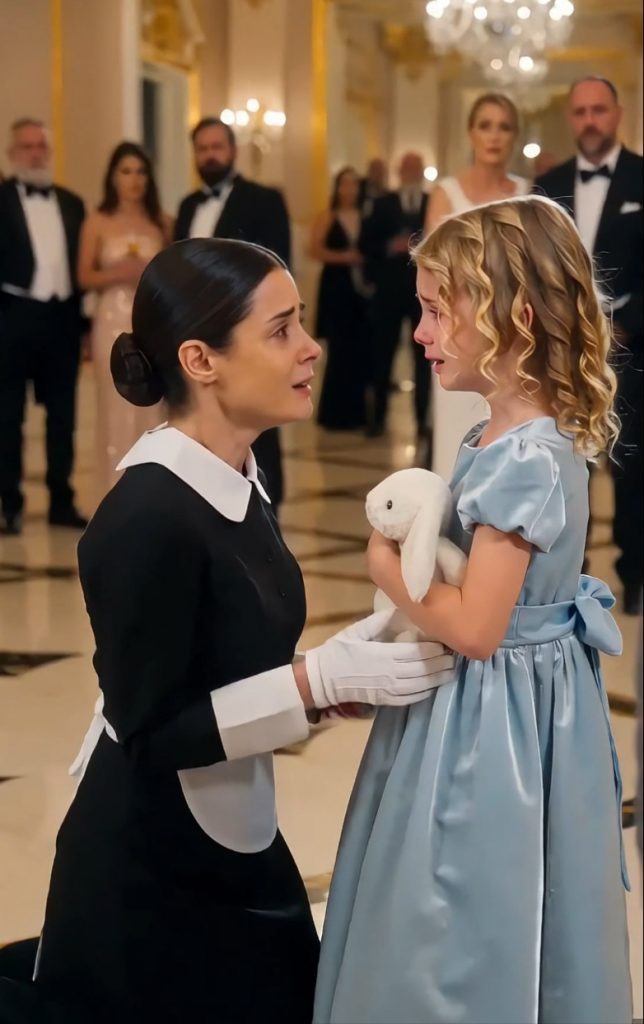
Alena Ashbourne stood near the center of the ballroom, her blonde curls pinned too neatly, her small hands wrapped around a white stuffed rabbit. Her cheeks were flushed from crying, and her lower lip shook as if she had been trying to be brave all night and could not do it one second longer.
At the edge of the room, the maid froze.
Clara Bell stood in her black uniform with the white Peter Pan collar, one hand rising slowly to her chest. Her dark hair was pinned into a perfect bun, but her eyes betrayed her. They filled instantly.
“Me?” she whispered. “Alena, don’t…”
The guests shifted uncomfortably.
Some of them knew Clara as the woman who folded napkins, carried trays, and disappeared through service doors. They had passed her all evening without really seeing her.
Now the child at the center of the Ashbourne fortune was pointing at her as if she were the only person in the room who mattered.
At the base of the staircase, Richard Ashbourne stood motionless.
He was Alena’s father, a man used to command. Boardrooms softened when he entered. Lawyers lowered their voices. Investors waited for his approval.
But at that moment, he looked like a man who had forgotten how to stand.
“Alena,” he said quietly, “sweetheart…”
She did not look at him.
Her eyes stayed on Clara.
The maid took one hesitant step forward, then stopped, as if an invisible line on the marble floor warned her not to cross. She knew the rules of that house. Comfort the child in private. Be invisible in public. Never embarrass the family. Never let affection look like belonging.
But Alena was already breaking every rule.
Clutching her rabbit, she took a shaky breath.
“She was the only one who came to my side when I cried…”
Clara’s face crumpled.
Richard’s eyes widened.
The guests on the staircase fell silent.
Alena’s voice dropped into a whisper that somehow reached every corner of the ballroom.
“…because I missed my mother.”
And that was when Richard Ashbourne realized the most expensive room in his house had become a courtroom, and his daughter had just named the only witness who had truly been there.
Act II
The gala had been Richard’s idea.
That was what made it hurt.
Six months after his wife’s death, his advisors told him the family needed to reappear in public. The Ashbourne Foundation had delayed three charity events, two hospital grants, and one major scholarship announcement. The board was growing nervous. The newspapers were beginning to write about Richard’s “private collapse.”
So he planned a memorial gala in Eleanor’s honor.
White roses. Candlelight. Piano music. A speech about legacy.
Everyone said it was tasteful.
Everyone said it was what Eleanor would have wanted.
No one asked Alena.
Not really.
They dressed her in pale blue because Eleanor had loved that color. They brushed her curls until she cried. They gave her the white rabbit Eleanor had left on her pillow during her final week at home and told her to hold it nicely for photographs.
Alena did everything she was told.
She stood beside her father as guests bent down and said, “You’re so brave.”
She accepted kisses from women whose perfume made her dizzy.
She listened to men tell Richard that time would heal things, as if grief were a contract dispute that could be settled with enough patience.
But by the second hour, Alena’s small hand had gone cold in his.
Richard noticed.
He asked if she needed water.
She shook her head.
He asked if she wanted cake.
She shook her head again.
Then someone mentioned Eleanor.
Not gently.
Not with love.
A guest near the staircase said, “At least the child is young. She’ll adjust.”
Alena heard it.
Richard did not.
He was speaking to a senator, his hand on his daughter’s shoulder, his mind already three conversations ahead.
But Clara heard.
From across the ballroom, carrying a tray of untouched champagne, Clara saw Alena’s face change. The little girl’s chin trembled once. Her fingers tightened around the rabbit. Then she lowered her head and tried to disappear while standing in plain sight.
Clara set the tray down.
She did not ask permission.
She moved through the crowd like a shadow and knelt beside Alena behind one of the white floral arrangements.
“Miss Alena,” she whispered, “breathe with me.”
Alena did not answer.
Her eyes were fixed on the rabbit.
Clara reached into her apron pocket and pulled out a folded handkerchief, one she had carried since Eleanor’s funeral.
“Your mother used to cry quietly too,” Clara said.
Alena looked up.
“She did?”
Clara nodded.
“And then she would pretend she had something in her eye.”
That almost made Alena smile.
Almost.
“Did she miss people?” Alena whispered.
“Yes.”
“Does she miss me?”
Clara’s throat tightened.
“I believe love like hers does not go away just because someone leaves the room.”
Alena leaned into Clara then, so suddenly Clara nearly lost her balance. The child buried her face against the maid’s shoulder and shook with silent sobs.
Clara held her.
Not as staff.
Not as help.
As the only adult in the room willing to stop pretending the child was fine.
From across the ballroom, Richard saw only the end of it.
He saw Clara step back.
He saw Alena wipe her face.
He saw the event continue.
And because it was easier, he told himself nothing was wrong.
But grief does not vanish because adults look away.
It waits.
And when it finally speaks, it chooses the one room where everyone can hear.
Act III
Clara had loved Eleanor before she ever worked for the Ashbournes.
That was the secret no one in the ballroom knew.
They had met at seventeen in a community theater dressing room, long before Eleanor married into money and long before Clara learned how to fold hospital corners with military precision. Eleanor was the lead in the play. Clara was the girl backstage pinning hems, fixing loose straps, and pretending she did not know every line.
Eleanor noticed anyway.
“You say the words better than I do,” she told her one night.
Clara laughed. “I say them to the costumes.”
“That still counts.”
They became friends in the strange, fierce way young women do when the world has not yet taught them to measure each other by class. Eleanor came from old money. Clara came from a rented apartment above a laundromat. Eleanor owned pearl earrings by eighteen. Clara owned one good black dress.
None of it mattered then.
Years later, it mattered to everyone else.
When Eleanor married Richard Ashbourne, Clara stood at the back of the church in the same good black dress and cried quietly. Not from envy. From love. From worry. From knowing Eleanor was stepping into a world that polished people until their softer parts became inconvenient.
Eleanor never let Clara disappear.
When Alena was born, Eleanor called Clara first after family.
“She has my stubborn chin,” Eleanor whispered from the hospital bed, exhausted and glowing.
“And your terrible timing,” Clara said. “She arrived during a thunderstorm.”
“Then she’ll be dramatic.”
“She’ll be loved.”
Eleanor went quiet.
Then she said, “Promise?”
Clara thought she meant the usual promise. A friend’s promise. A godmother’s promise, though Richard’s family never officially allowed that title.
“I promise.”
Years later, when Eleanor became ill, the promise changed.
By then, Clara was working in the Ashbourne household—not because Eleanor needed a maid, but because she needed someone near Alena who loved her without ambition.
Richard was traveling constantly. Doctors came and went. Relatives visited, whispered, and left. The house filled with flowers that smelled like endings.
One evening, Eleanor called Clara into the bedroom.
She was thinner then, but her eyes were still clear.
“Richard will drown in work when I’m gone,” Eleanor said. “He will think money can build a bridge back to Alena. It can’t.”
Clara sat beside her.
“Don’t talk like that.”
“Promise me again.”
Clara held her hand.
“I’ll stay.”
“No matter what they call you.”
Clara’s eyes burned.
“No matter what.”
Eleanor reached toward the bedside table and picked up the white stuffed rabbit.
It had a blue ribbon around its neck then, fresh and bright.
“I recorded something for Alena,” Eleanor whispered. “Inside the rabbit. There’s a little device sewn under the lining. When she’s old enough, she can hear my voice. But not yet. Not until she asks for me and no one can answer.”
Clara stared at the rabbit.
“Richard knows?”
Eleanor closed her eyes.
“Richard knows facts. He does not always know what matters.”
After Eleanor died, Clara waited.
She waited through the funeral.
Through the visitors.
Through Richard’s silence.
Through Alena’s night terrors and unanswered questions and mornings when the child sat outside her mother’s locked dressing room holding the rabbit in her lap.
Clara wanted to tell Richard.
But every time she tried, he was on a call, in a meeting, leaving for the airport, or standing in a room full of people who needed him to be composed.
So Clara kept the promise alone.
Until the gala.
Until Alena pointed at her in front of everyone.
Until grief forced the truth into the light.
Act IV
Richard crossed the ballroom slowly.
For the first time all evening, no one approached him.
Not the senator. Not the donors. Not his mother, who stood near the staircase with one hand pressed to her pearls, horrified that a servant had become the center of the night.
Clara remained kneeling in front of Alena, holding the child’s hand with both of hers.
“I’m sorry,” Clara whispered. “I’m so sorry.”
Alena shook her head.
“Don’t go.”
The words were small, but Richard heard them.
Something inside him gave way.
How many nights had Alena said that to Clara?
How many mornings had his daughter looked for comfort from someone he had trained himself not to see?
His mother stepped forward.
“Richard, this is not appropriate.”
He turned to her.
The room seemed to hold its breath.
“What part?” he asked.
Her expression tightened.
“The child is emotional. The maid should have known better than to encourage this display.”
Clara lowered her eyes.
Alena’s hand tightened around hers.
Richard saw it.
That tiny movement.
His daughter defending the woman who had defended her.
And shame struck him harder than any accusation could have.
“No,” he said.
His mother blinked.
“No?”
Richard’s voice was quiet, but it carried.
“The display was mine. This entire evening. I dressed my daughter in grief and asked her to stand under chandeliers while strangers praised her bravery. Clara did not create this moment. She was the only one honest enough to kneel when my daughter was breaking.”
No one moved.
Alena looked at him now.
Not trusting yet.
Listening.
Richard crouched in front of her, his gray suit creasing at the knees against the marble.
“Alena,” he said, his voice rough, “I did not know you felt so alone.”
Her eyes filled again.
“You were always busy.”
The sentence was not angry.
That made it worse.
Richard nodded once, as if accepting a verdict.
“I was.”
“You don’t talk about Mommy.”
His face twisted.
“I thought I was protecting you.”
“I thought you forgot her.”
The sound that came from Clara was almost a sob.
Richard covered his mouth for one second, then lowered his hand.
“I never forgot,” he said. “I just did not know how to miss her with you.”
Alena looked down at the rabbit.
Clara’s breath caught.
Richard noticed.
“What is it?”
Clara hesitated.
Then she reached toward the rabbit with trembling fingers.
“Mrs. Ashbourne left something,” she said. “For Alena. I was told to wait until she asked for her mother in a way no one could answer.”
Richard stared at her.
Clara turned the rabbit carefully and opened a hidden seam beneath its bow.
The guests watched in stunned silence as she removed a small, flat recording device wrapped in soft cloth.
Richard went pale.
Clara looked at Alena.
“Your mother wanted you to have this when you needed her voice.”
Alena stopped breathing for a moment.
“My mommy?”
Clara nodded, tears slipping down her cheeks.
Richard could barely speak.
“Play it.”
Clara looked at him, uncertain.
He swallowed.
“Please.”
Act V
Eleanor’s voice filled the ballroom.
Soft.
Weak.
Alive.
“My darling Alena…”
The child made a sound like her heart had recognized the voice before her mind did.
Richard closed his eyes.
Around them, guests lowered their heads. Even the ones who had been uncomfortable moments before seemed ashamed to be standing inside something so intimate.
The recording continued.
“If you are hearing this, it means there is a day I cannot hold you, and that is the cruelest thing I can imagine. So I need you to know something. Love does not end when a person leaves. It changes rooms.”
Alena pressed the rabbit to her mouth and cried.
Clara wrapped an arm around her, then stopped herself, remembering the crowd.
Richard saw the hesitation.
“Hold her,” he said.
Clara did.
Alena collapsed into her.
Eleanor’s voice trembled through the tiny speaker.
“Your father loves you. He may get lost inside his sadness. He may try to be strong in all the wrong ways. Be patient with him if you can. But do not ever think his silence means you are unloved.”
Richard bent his head.
The words cut him open.
“And Clara,” Eleanor’s voice continued, softer now, “if you are there, thank you. I know you will keep your promise. You always did.”
Clara covered her face with one hand.
The recording ended with a faint breath, then a whisper.
“Goodnight, my little star.”
The ballroom stayed silent long after the device clicked off.
Alena looked up at Clara first.
Then at her father.
“She called me that,” Alena whispered. “Little star.”
Richard nodded, tears finally falling.
“Yes.”
“You never did.”
“I was afraid it would hurt too much.”
“It already hurt.”
He had no defense.
Only truth.
“I know.”
Slowly, he opened his arms.
Alena hesitated.
Then she stepped into them.
Richard held his daughter on the marble floor in front of everyone and wept into her curls. Not elegantly. Not privately. Not like a man preserving dignity.
Like a father who had finally understood that grief shared too late becomes loneliness for the child left waiting.
Clara began to stand, but Alena reached back and grabbed her hand.
“No,” the girl said.
Richard looked at Clara.
The old boundary hovered there between them—employer and servant, family and staff, wealth and need.
Then Richard broke it.
“Stay,” he said.
Clara’s lips parted.
“Sir…”
“Richard,” he corrected gently. “Please.”
That night, the gala ended without the speech.
The donors still gave money, but no one remembered the pledge cards. What they remembered was the child’s confession, the maid on her knees, and the voice of Eleanor Ashbourne turning a ballroom into a place of reckoning.
The next morning, Clara found a formal envelope outside her room.
Her hands shook when she opened it.
Inside was not a dismissal.
It was a new contract.
Not for maid service.
For household director and legal guardian designate in matters concerning Alena’s care, education, and emotional welfare.
At the bottom was a handwritten note from Richard.
Eleanor trusted you. Alena trusts you. I should have trusted you sooner.
Clara sat on the edge of her narrow bed and cried until Alena came running in with the rabbit.
“Are you sad?”
Clara pulled her close.
“No, sweetheart. Not sad.”
“Then why are you crying?”
Clara smiled through tears.
“Because sometimes being loved feels too big to hold quietly.”
Life did not heal all at once.
Richard still worked too much until Alena learned to walk into his office and close his laptop without asking. Clara still woke early out of habit before remembering she no longer had to enter rooms like a ghost. Alena still missed her mother with sudden force—in the scent of lavender soap, in piano music, in pale blue dresses.
But now, when she missed Eleanor, no one told her to be brave.
Richard sat with her.
Clara stayed close.
Sometimes they played the recording. Sometimes they did not need to.
A year later, Richard held another event in the ballroom.
Smaller.
No reporters.
No grand performance of grief.
At the top of the staircase, a portrait of Eleanor watched over the room, not as a decoration, but as a presence.
Alena wore a simple blue dress and carried her rabbit openly. Clara stood beside her, not in a maid’s uniform, but in a black evening gown with white cuffs at the sleeves because she said it felt like honoring both who she had been and who she had become.
Richard gave only one toast.
“To the people who come to our side when we cry,” he said.
His eyes found Clara.
Then Alena.
“And to the courage it takes to admit we needed them.”
Alena lifted her glass of sparkling cider.
“To Mommy,” she said.
Everyone echoed it.
“To Eleanor.”
Later, when the music began, Richard asked Alena to dance. She nodded, then pulled Clara with her too.
So the three of them turned slowly beneath the chandeliers, awkward and laughing softly, while Eleanor’s portrait seemed almost warm in the golden light.
For the first time, the ballroom did not feel like a place where grief had been displayed.
It felt like a place where love had been allowed to stay.
And Alena, holding her rabbit close, finally understood what her mother had meant.
Love did not end.
Sometimes, it simply changed rooms.