Act I
The boy stood alone at the cemetery gates while the rain fell around him.
Beyond the black iron bars, a funeral was already underway.
Black umbrellas formed a dark circle around the casket. Mourners stood shoulder to shoulder beside rows of wet tombstones, their expensive coats and polished shoes dulled by the gray weather. A priest’s voice carried softly through the wind, low and solemn, almost swallowed by the rain.
The boy did not move at first.
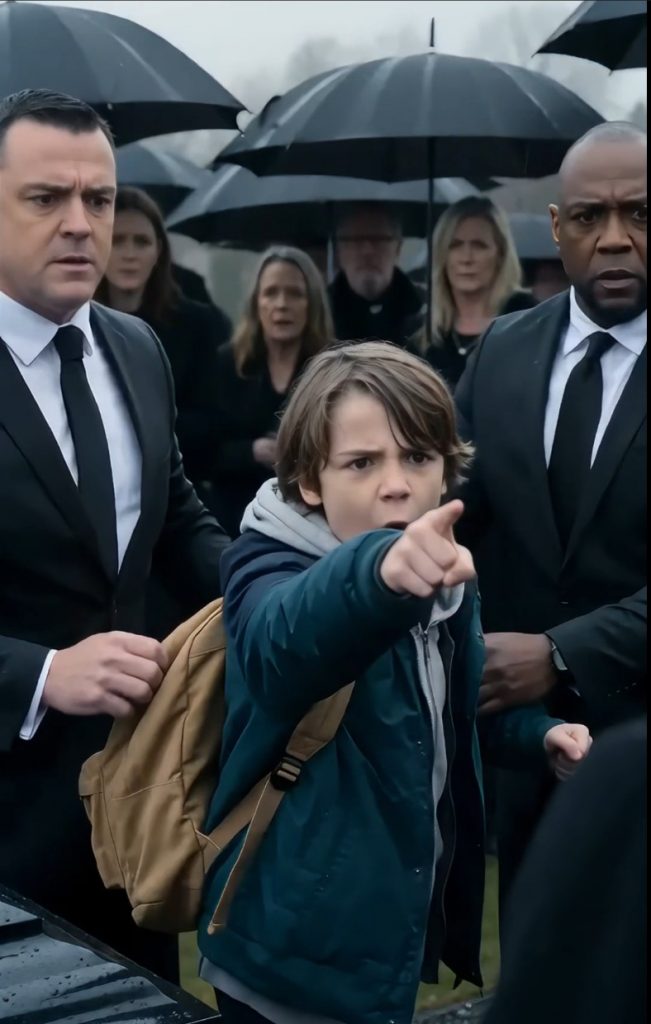
He was small for his age, maybe eleven, with shaggy brown hair plastered against his forehead. A dark teal jacket hung loose over his gray hoodie, and a tan canvas backpack pulled heavily at his shoulders.
He looked nothing like the people at the grave.
They looked rich.
He looked like he had taken three buses and walked the last mile in the rain.
Then he saw her.
The woman in the wide-brimmed black hat.
She stood close to the casket beneath an umbrella, pearls glowing at her throat, a gold brooch pinned neatly to her coat. Her face was composed, elegant, unreadable.
The boy’s hands curled into fists.
He stepped through the cemetery gates.
At first, no one noticed him. The mourners kept their heads bowed. The priest continued speaking. Rain tapped against umbrellas, flowers, polished wood.
Then the boy broke into a run.
Two men in black suits moved before he reached the grave.
“Stop,” one of them said.
The boy tried to push past them.
“I need to talk to someone!”
His voice cut through the funeral like a thrown stone.
Heads turned.
Murmurs spread.
The bodyguards grabbed his shoulders and arms, steering him away from the casket.
“Let go!” the boy shouted, digging his shoes into the wet gravel. “You don’t understand!”
The woman in the black hat looked at him.
Only for a second.
Then she looked away.
But the boy saw it.
Fear.
Not confusion.
Not grief.
Fear.
The priest stepped forward, raising one hand.
“Please,” he said. “Listen to him.”
The bodyguards hesitated.
The boy’s breathing was ragged. Rain ran down his face, but his eyes stayed locked on the woman across the grave.
He raised his trembling hand and pointed directly at her.
“She knew who I was!”
The cemetery fell silent.
Every umbrella seemed to stop moving.
The woman’s fingers tightened around her umbrella handle. Her polished mask cracked. Her eyes widened, her lips parted, and for the first time, the entire funeral saw terror on her face.
“What did you say?” she whispered.
The boy did not lower his hand.
“You heard me.”
And in the rain, beside the casket, the secret she had buried years ago began clawing its way back to the surface.
Act II
His name was Noah Bell.
At least, that was the name he had grown up with.
For most of his life, Noah believed his father was just a blank space no one wanted to fill in. His mother, Anna, never said much about him. When Noah asked, she would touch the small silver locket around her neck and say, “He loved us. That is all you need to know for now.”
For now.
Those two words haunted Noah after she died.
Anna Bell had been a quiet woman with tired hands and sad eyes. She worked in a laundry behind an old hotel, folding sheets that belonged to people who would never know her name. She never complained, not even when the rent rose, not even when her cough got worse, not even when she came home so exhausted she fell asleep at the kitchen table.
But she kept one box under her bed.
A cedar box.
Noah was forbidden to open it.
After her funeral, when the apartment had become too quiet and the landlord had already started asking about unpaid bills, Noah opened the box with shaking hands.
Inside were old photographs, yellowed letters, a hospital bracelet, and a folded newspaper clipping about the Harrington family.
The Harringtons owned half the city.
Hotels. Hospitals. A foundation. A historic mansion on the hill.
The man in the photograph looked younger than he did in the newspaper, but Noah recognized him immediately. The same dark eyes. The same serious mouth. The same face staring from the front page under the headline:
EDWARD HARRINGTON, PHILANTHROPIST AND HEIR, DEAD AT 43.
Noah sat on the floor for a long time, unable to breathe properly.
Then he found the letter.
It was addressed to Anna.
My mother says you are lying, but I know you are not. I saw him. I held him. I know my son.
The letter was signed:
Edward.
Noah read it again.
And again.
By dawn, he understood just enough to feel betrayed by everyone.
His mother had not lied.
She had hidden the truth because someone powerful had forced her to.
That someone was in the photographs too.
The woman in the black hat.
Victoria Harrington.
Edward’s mother.
Noah found her face in old clippings: society galas, charity boards, museum openings. Always poised. Always perfect. Always standing beside Edward like she owned the air around him.
Then he found the last envelope.
Inside was a photograph of baby Noah in Anna’s arms.
On the back, in Anna’s handwriting, were six words:
She knew. She sent us away.
Noah did not sleep after that.
He carried the box to Father Michael, the priest who had buried his mother three months earlier. Father Michael read the letters in silence, his face growing more grave with every page.
“Noah,” he said gently, “where did you get these?”
“My mom kept them.”
“Does anyone else know?”
Noah shook his head.
The priest looked at the newspaper clipping again.
Edward Harrington’s funeral was scheduled for the following morning.
Victoria Harrington would be there.
The entire family would be there.
And Noah, who had spent his life being told to wait for the truth, decided he was done waiting.
So he packed the letters into his tan backpack.
He took the locket.
He took the hospital bracelet.
Then he went to the cemetery where the father he had never been allowed to meet was being lowered into the ground.
But he did not come only to mourn.
He came to be seen.
Act III
Victoria Harrington recovered faster than everyone else.
That was what frightened Noah most.
For one moment, her face had betrayed her. Horror. Recognition. Panic. Then the old mask slid back into place.
“This child is confused,” she said, her voice cold under the rain. “Remove him.”
The bodyguards moved again.
Father Michael stepped between them and Noah.
“No,” the priest said.
Victoria’s eyes narrowed. “Father, this is a funeral.”
“Yes,” he replied. “Which makes truth more urgent, not less.”
A murmur rippled through the mourners.
Noah pulled the backpack off his shoulders and unzipped it with wet, shaking fingers.
Victoria’s gaze dropped to the bag.
Her jaw tightened.
“You should not have come here,” she said.
Noah looked up.
“My mother said you’d say that.”
The words struck harder than he expected.
Several mourners turned toward Victoria.
A tall man near the casket, Edward’s younger brother Charles, frowned. “Mother?”
Victoria did not look at him.
Noah pulled out the first photograph.
Anna Bell, young and smiling nervously, standing beside Edward Harrington on the back steps of a summer house. Edward’s arm was around her shoulders. They looked happy in the unguarded way people look before someone teaches them to be afraid.
Noah held it up.
“This was my mom.”
Charles stepped closer.
“I remember her,” he said quietly. “Anna worked at the lake house.”
Victoria snapped, “That was years ago.”
Noah pulled out the letter.
Rain dotted the paper, so Father Michael quickly held his umbrella over it.
Noah’s voice trembled as he read.
“My mother says you are lying, but I know you are not. I saw him. I held him. I know my son.”
The mourners went still.
Charles’s face drained of color.
“Edward wrote that?”
Noah handed it to him.
Charles read the signature. His hand tightened around the page.
Victoria’s voice turned sharp.
“Anyone can forge a letter.”
Noah’s cheeks burned.
“My mom didn’t forge anything.”
“Your mother,” Victoria said, each word polished and poisonous, “was paid generously to leave this family alone.”
The cemetery froze.
Even Victoria seemed to realize she had said too much.
Noah stared at her.
“So you admit you knew.”
Her lips pressed together.
Charles turned slowly toward his mother.
“Paid?”
Victoria lifted her chin.
“She was trying to trap your brother.”
Noah’s voice cracked. “She loved him.”
“She wanted money.”
“She wanted him to know me!”
The boy’s shout echoed over the graves.
The black casket sat between them, silent and final.
Charles looked at the letter again. Then at Noah. Then at Victoria.
“You told us Anna left without explanation,” he said.
“She did.”
“You told Edward the child wasn’t his.”
Victoria’s nostrils flared.
“I protected this family.”
Noah reached into the backpack one final time.
His hand closed around the silver locket.
“My mom protected me from you.”
He opened it.
Inside was a tiny photograph of Edward holding a newborn baby.
On the other side was a lock of baby hair and a folded slip of paper so worn it nearly fell apart.
Father Michael unfolded it carefully.
It was a certificate from a private clinic.
Noah Bell Harrington.
Father: Edward James Harrington.
Mother: Anna Bell.
Charles covered his mouth.
The priest looked at Victoria with deep sorrow.
“You knew.”
Victoria’s umbrella trembled in her hand.
The rain grew heavier.
And behind them, the lawyer who had been standing silently near the grave finally stepped forward.
“I believe,” he said, “this changes the will.”
Act IV
The lawyer’s name was Mr. Alden Cross.
He had served the Harrington family for thirty years, and his expression was the kind of calm that made guilty people nervous.
Victoria turned on him.
“This is not the place.”
Alden looked at Edward’s casket.
“On the contrary, Mrs. Harrington. Edward specifically instructed that the reading begin before burial if any heir came forward.”
Victoria went pale.
Noah blinked.
“What?”
Charles stared at the lawyer. “Edward knew?”
Alden removed a sealed envelope from inside his coat.
“He suspected. He never stopped searching for Anna Bell or the child. He believed his mother had interfered, but he lacked proof.”
Victoria’s face hardened.
“You are violating privilege.”
“I am carrying out the instructions of a dead client,” Alden said. “There is a difference.”
The mourners shifted, no longer simply shocked but hungry for the truth.
Alden broke the seal.
The sound was small.
Victoria flinched anyway.
He unfolded the letter and began reading.
If my son is found, or if Anna Bell’s child ever appears with proof of birth, he is to be recognized before the family and protected from any attempt to erase him again.
Noah’s throat tightened.
His legs felt weak.
Alden continued.
My mother told me the child was not mine. I believed her for too long because I was young, ashamed, and afraid of losing my place in a family that valued obedience more than love. By the time I searched for Anna, she was gone. If this letter is being read, then my cowardice has outlived me. Do not let my son pay for it.
Charles lowered his head.
Victoria stood rigid, rain slipping from the brim of her hat.
Alden’s voice carried through the cemetery.
I leave a protected trust for Anna Bell’s child, should he be found. I leave him my personal journals, the lake house, and my shares in the Harrington Foundation. Most importantly, I leave him my name, if he wants it, and my apology, though I know it is too late.
Noah’s face crumpled.
He had come prepared to fight.
He had not prepared himself to be wanted.
The priest placed a steady hand on his shoulder.
Alden looked at him.
“Are you Noah?”
The boy nodded, crying silently now.
“Then your father spent the last years of his life looking for you.”
Victoria snapped, “Enough.”
Everyone turned.
Her face was no longer elegant. It was naked with rage.
“You think a few letters make him family? You think this boy can walk in from nowhere and take what generations built?”
Noah stepped back, startled by the force of her hatred.
Charles moved between them.
“He is Edward’s son.”
“He is Anna Bell’s mistake.”
The slap did not come from Noah.
It came from Charles.
Not hard enough to hurt her badly, but sharp enough to stop the words.
Victoria gasped, one hand flying to her cheek.
The cemetery went silent again.
Charles’s voice shook.
“No. The mistake was ours.”
For the first time, Victoria looked small beneath her black umbrella.
Alden turned to the bodyguards.
“You will not touch the boy again.”
Neither man moved.
They knew authority had shifted.
Noah wiped his face with his sleeve.
He looked at the casket.
The father inside it would never hug him. Never explain why he had failed to find them sooner. Never hear Noah say he had his eyes. Never meet Anna again and ask forgiveness.
But under the rain, among strangers and secrets, Edward had finally done the one thing he could still do.
He had left the truth behind.
And truth, once spoken aloud, began rearranging the entire family.
Act V
Noah did not become a Harrington that day.
Not in the way people imagined.
No choir sang. No one welcomed him with open arms. The dead did not rise to correct the living. The rain did not stop.
He remained a grieving boy in wet sneakers, holding a backpack full of proof, standing beside the grave of a father he had known only through paper.
But the world changed anyway.
The burial was delayed.
Victoria was escorted away from the graveside, not by force, but by the weight of everyone finally seeing her. She walked stiffly between the tombstones, pearls bright against her throat, hat low over her face.
No one followed her.
That was her punishment before any court or board could act.
Charles stayed.
So did Father Michael.
So did Alden Cross.
When the crowd began to thin, Noah stood beside Edward’s casket alone. His fingers closed around the silver locket.
“I don’t know what I’m supposed to say,” he whispered.
Father Michael stood a few steps behind him, giving him space.
The answer came from Charles.
“You don’t have to say anything.”
Noah looked at him warily.
Charles looked older now than he had at the beginning of the funeral.
“I failed him too,” Charles said. “I believed what I was told because it was easier.”
Noah said nothing.
Charles’s eyes moved to the locket.
“May I see?”
Noah hesitated, then handed it over.
Charles opened it.
The photograph inside made him inhale sharply.
Edward with baby Noah.
His hand covered his mouth.
“He held you,” Charles whispered.
Noah’s eyes filled again.
“My mom said he loved us.”
Charles nodded, unable to look away from the tiny photograph.
“I believe her.”
That mattered more than Noah wanted it to.
Over the following weeks, the Harrington name became a public wound.
The story spread through newspapers and court filings. Victoria’s lawyers tried to challenge the documents, then retreated when the clinic records, Edward’s journals, and payment records to Anna were uncovered. There were bank transfers labeled relocation assistance. Letters returned unopened. Private investigators dismissed after Victoria intervened.
Each document built the same truth.
Anna had not vanished.
She had been pushed out.
Edward had not forgotten.
He had been lied to, then spent too long trying to undo the damage.
Noah moved into Father Michael’s rectory temporarily while the court appointed guardianship proceedings began. He refused at first to stay with any Harrington. The name felt too large, too cold, too dangerous.
Charles visited every Thursday.
He never came empty-handed.
Not with lavish gifts. Noah hated those.
Instead, he brought pieces of Edward.
A baseball glove. A sketchbook. A stack of old records. A photograph of Edward at twelve, missing a front tooth, looking so much like Noah that the boy stared at it for ten silent minutes.
One afternoon, Charles brought the journals.
Noah did not open them until night.
The first entries were full of business, travel, family pressure.
Then Anna’s name appeared.
Anna laughed at me today because I tried to make tea and forgot the water.
A few pages later:
Mother knows. Everything is different now.
Then:
Anna is gone. Mother says the child was never mine. I do not believe her. I hate myself for not going after them sooner.
Noah closed the journal and cried into his pillow until Father Michael knocked softly and sat on the floor beside the bed.
No speeches.
Just presence.
Eventually, Noah visited the lake house.
It sat at the edge of gray water, shuttered for years, smelling of cedar and dust. In the back bedroom, Alden found a small wooden cradle covered by a sheet.
Edward had kept it.
Noah ran his hand along the rail.
For the first time, anger and love became impossible to separate.
“He was going to bring me here,” Noah said.
Charles stood in the doorway.
“I think he hoped to.”
Hope was not enough.
Noah knew that.
But it was something.
Months later, on a bright morning that felt nothing like the funeral, Noah returned to the cemetery.
No umbrellas this time.
No crowd.
No bodyguards.
Only Father Michael, Charles, and a small bouquet of white flowers Noah had chosen himself.
He stood between two graves now.
Edward Harrington.
And beside it, newly placed after Charles arranged the transfer with Noah’s permission:
Anna Bell.
Beloved mother.
Braver than the truth that tried to bury her.
Noah set the flowers between them.
Then he opened the locket and placed it against the stone for a moment.
“I’m still mad,” he said.
Charles looked down.
“At him?”
“At everyone.”
“That’s fair.”
Noah swallowed.
“But I’m glad I came.”
Father Michael smiled softly.
“So am I.”
Noah looked toward the line of tombstones, remembering the rain, the umbrellas, Victoria’s face when he pointed at her. He had arrived as an interruption, a problem to be removed, a poor boy with a backpack standing among people who thought grief belonged only to those with invitations.
But he had left as proof.
Proof that love could be hidden but not erased.
Proof that money could delay truth but not kill it.
Proof that a child denied a name could still stand in front of an entire family and demand to be seen.
Noah did not know yet whether he would use the Harrington name.
Maybe someday.
Maybe never.
But he knew this:
His mother had not lied.
His father had not forgotten.
And the woman in the black hat had not won.
At the funeral, Victoria Harrington had expected to bury her son.
Instead, she buried her secret.
And the boy she tried to erase walked out of the cemetery carrying the one thing she could never buy back.
The truth.