Act I
The wind swallowed his voice the first time.
“Buddy!”
Arthur Hale climbed higher anyway.
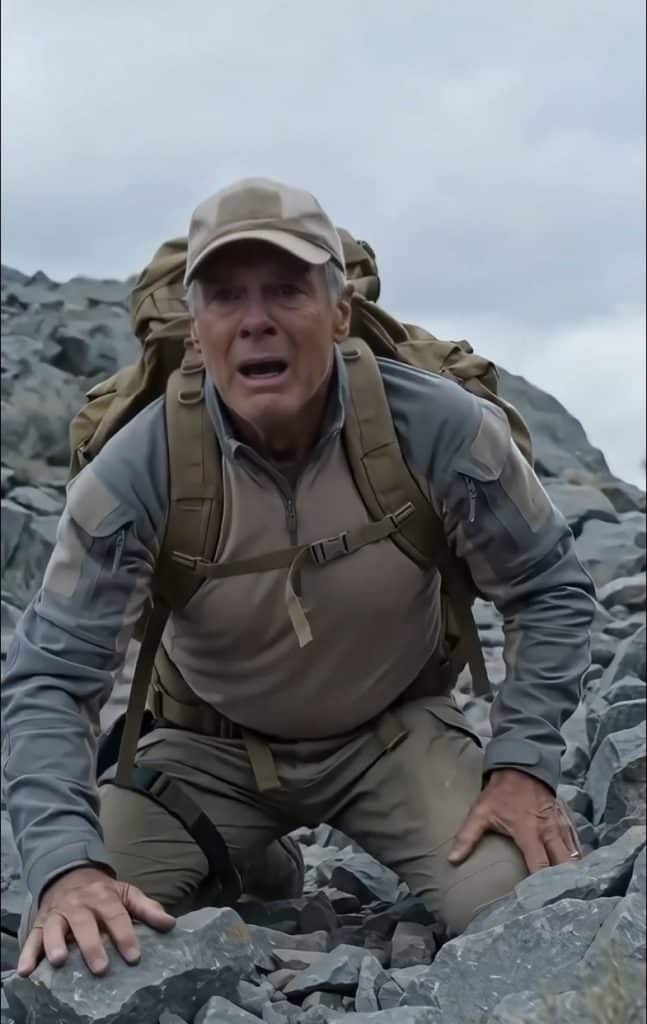
His boots scraped against loose gray stones. Gravel rolled under his feet and skittered down the slope behind him. His right ankle throbbed with every step, the torn side of his hiking boot flexing open against the bandage beneath it.
Still, he climbed.
The canyon around him looked dead in the overcast light. Jagged rocks. Dry shrubs. Steep slopes with no mercy in them. The kind of place where a man could disappear ten yards from the trail and never be seen again.
Arthur stopped halfway up the incline and braced both hands against the rocks.
His breath came hard.
His backpack dragged at his shoulders.
His leg shook.
“Buddy!” he shouted again.
This time, the name echoed back.
Empty.
Thin.
Cruel.
Three days earlier, the search team had told him to stop.
They said the storm had washed out the lower trail. They said the cliffs were unstable. They said Buddy had likely slipped into one of the ravines or wandered too far into the backcountry.
They used gentle voices.
Arthur hated gentle voices.
Gentle voices were what people used when they had already given up for you.
So he came back alone.
He climbed through pain. Through wind. Through the ache in his chest that had started the moment the leash went slack and Buddy vanished into the storm.
By the time Arthur reached a flatter patch of rock, his body failed him.
He dropped to one knee.
The impact shot pain up his leg, and he gasped, one hand pressing into the dirt to keep himself from falling completely.
For a moment, he could only breathe.
Then the wind changed.
Arthur lifted his head.
Several yards away, between two pale boulders, stood a large gray dog.
Still.
Silent.
Almost the same color as the rocks around him.
Arthur froze.
His heart seemed to forget its rhythm.
The dog’s ears were slightly raised. His light eyes were fixed on the old man. His body was dusty, lean, and calm, as if he had been waiting there for years instead of days.
Arthur’s mouth opened.
No sound came at first.
Then a whisper broke out of him.
“Buddy… is that you?”
The dog took one slow step forward.
Arthur’s eyes filled.
The mountain blurred.
And the old man reached out with both trembling hands.
Act II
Buddy had been Arthur’s last promise to his wife.
That was what no one understood.
To the neighbors, Buddy was just a dog. A sleek gray rescue with strange pale eyes and a quiet way of moving through rooms. To Arthur’s daughter, he was companionship, something to keep her father from rattling around the house alone after cancer took her mother.
But to Arthur, Buddy was the final voice of a life that had once been full.
His wife, Margaret, had found Buddy at a roadside shelter six years earlier.
Arthur had said no.
He was seventy-one then and practical in the way older men become when life has already taken enough from them. A dog meant vet bills. Walks in bad weather. Fur on the furniture. One more creature to worry about.
Margaret ignored him completely.
“He looked at me like he knew something,” she said.
“He probably knows how to get adopted.”
“Exactly.”
Buddy came home that afternoon.
He was not affectionate at first. He did not leap, bark, or lick hands. He watched. He followed Margaret from room to room like a shadow with paws. When her treatments grew harder and her body weakened, Buddy learned her routine better than any nurse.
He knew when she needed help standing.
He knew when she was in pain before Arthur did.
He slept beside her bed every night until the end.
On Margaret’s last clear morning, she placed her hand on Buddy’s head and looked at Arthur.
“Don’t shut the world out when I’m gone,” she whispered.
Arthur tried to laugh.
Failed.
She smiled.
“Buddy won’t let you.”
She was right.
After the funeral, Arthur stopped answering calls. Stopped going to church. Stopped meeting his old hiking group for coffee. He let the garden die and left Margaret’s blue sweater on the chair by the window because moving it felt like betraying her.
Buddy waited.
Then insisted.
Every morning, he placed his chin on the mattress until Arthur got up. Every afternoon, he carried a leash to the recliner and stared until Arthur cursed, stood, and followed him outside.
The walks became longer.
Then the trails returned.
The mountains had been Margaret’s favorite place. She and Arthur had hiked the canyon routes for forty years, back when their knees were reliable and their future still seemed wide.
Buddy brought Arthur back there.
At first, it hurt.
Then it healed in small, stubborn ways.
One step. One sunrise. One trail marker. One gray dog waiting patiently whenever Arthur needed to stop and catch his breath.
On the first anniversary of Margaret’s death, Arthur scattered a handful of wildflower seeds near the overlook where she used to sit and eat oranges from her pack.
Buddy stood beside him the whole time.
Arthur had put one hand on the dog’s neck and said, “All right. I’m still here.”
Then came the storm.
A sudden black wall of rain rolled over the canyon during what was supposed to be a short hike. The trail turned slick. The wind howled between the rocks. Arthur slipped near a narrow cut in the slope and landed hard, tearing his boot and twisting his ankle.
Buddy circled back, frantic.
Arthur tried to stand.
A burst of thunder cracked above them.
Buddy bolted toward the ridge.
“Buddy!” Arthur shouted.
The dog vanished into rain and rock.
By dusk, volunteers had found Arthur limping near the lower trail.
They did not find Buddy.
Arthur went home with a bandaged ankle, a torn boot, and a silence in the house so total it felt like death had come back for the last thing Margaret left behind.
Act III
Everyone told Arthur he had done enough.
His daughter, Claire, begged him not to return to the canyon.
“You can barely walk,” she said, standing in his kitchen with tears in her eyes. “Dad, please. Buddy wouldn’t want you to hurt yourself.”
Arthur looked at the empty dog bed near the fireplace.
“You don’t know what he’d want.”
Claire’s face crumpled.
“I know Mom wouldn’t want to lose you too.”
That stopped him.
For one night.
But grief has its own logic, and guilt is louder than love when the house is quiet.
Arthur kept seeing the moment Buddy disappeared. Kept hearing the thunder. Kept wondering if the dog had run ahead for help, if he had fallen, if he had waited somewhere while Arthur was taken away.
The search team went out twice.
They found muddy tracks near the wash.
Then nothing.
On the third day, a ranger told Arthur there was no safe reason to continue.
Arthur heard something else.
We are done.
So before dawn on the fourth day, he packed water, a flashlight, Margaret’s old compass, and a small tin of Buddy’s favorite biscuits. He did not tell Claire. He did not call the ranger station. He taped his ankle tighter, forced his torn boot onto his foot, and drove back to the canyon.
At the trailhead, he sat in the truck for several minutes.
Not praying exactly.
Arthur had never been good at asking heaven for favors.
But he held Margaret’s compass in both hands and whispered, “I can’t leave him out there.”
The climb was worse than he expected.
The storm had changed the trail. Sections were washed out. Rocks had slid across familiar paths. Twice, Arthur had to crawl on hands and knees because his ankle would not hold his weight on the slope.
He shouted Buddy’s name until his voice cracked.
Nothing answered.
By midday, the sky was low and gray. The wind cut through his shirt. He had drunk half his water and knew, with the cold clarity old men hate, that he had gone farther than he should.
Then he found the first sign.
A paw print in dried mud under a rock shelf.
Large.
Fresh enough.
Arthur dropped beside it with a sound halfway between a laugh and a sob.
“Buddy.”
The track led upward.
Not toward the lower wash where the searchers had looked.
Toward the ridge trail Margaret used to love.
Arthur followed.
Every step became a bargain.
One more rock.
One more bend.
One more call.
When his ankle finally gave out, he collapsed onto one knee and nearly blacked out from the pain. His hands shook against the stone. The wind roared. For one terrible moment, he wondered if Claire had been right.
Maybe he had not come to save Buddy.
Maybe he had come to die near the last thing he loved.
Then the gray shape appeared between the rocks.
And the mountain gave him back his dog.
Act IV
Buddy walked toward him slowly.
Not because he was unsure.
Because Arthur was crying so hard he could barely stay upright.
The dog crossed the gravel with careful steps, his paws crunching softly against the stones. His coat was dusty. His sides moved with tired breaths. A faint scratch marked one shoulder, but he was standing.
Alive.
Arthur reached for him.
Buddy lowered his head and pressed his body into the old man’s chest.
That was when Arthur broke.
He wrapped both arms around the dog’s neck and held on with a force that made his injured ankle, the cold wind, and the brutal climb disappear for one suspended moment.
Buddy nuzzled into him.
Then lifted his head and licked the tears from Arthur’s cheek.
Arthur sobbed openly, rocking slightly on his knees.
“I thought I lost you,” he whispered. “I thought I left you.”
Buddy panted softly.
Arthur buried his face in the gray fur.
“I’m sorry. I’m so sorry, boy.”
The dog did not understand apologies the way people do.
Or maybe he understood them better.
He simply stayed pressed against Arthur as if to say the only thing that mattered was that they had found each other again.
For several minutes, neither moved.
Then Buddy pulled back.
Arthur tightened his grip. “No. No, don’t you run again.”
Buddy stepped away only a little.
Then looked over his shoulder.
Arthur knew that look.
He had seen it on trails for years.
Follow me.
His stomach clenched.
“What is it?”
Buddy turned and walked toward a cluster of rocks beyond the ridge.
Arthur tried to stand. Pain tore through his ankle, and he nearly fell. Buddy stopped immediately and came back, whining low in his throat.
“All right,” Arthur gasped. “Slow. I’m slow now.”
Buddy waited.
Step by agonizing step, Arthur followed him around the rocks.
There, tucked beneath an overhang, was the reason Buddy had not come home.
A small red daypack.
Not Arthur’s.
Not Margaret’s.
A child’s pack, faded from weather, half-buried under windblown grit.
Arthur stared at it.
Then he saw the cracked water bottle beside it.
And the torn corner of a trail map weighted under a stone.
Buddy nosed the ground near the overhang and whined again.
Arthur lowered himself carefully.
The daypack had a name written in black marker on the strap.
Milo.
Arthur’s breath caught.
Three months earlier, the town had searched for a twelve-year-old boy who vanished during a family camping trip near the upper canyon. The official search had lasted almost two weeks. Everyone knew the story. Everyone knew the parents still came out some weekends, walking trails with printed flyers that the weather slowly destroyed.
Arthur looked at Buddy.
“You found this?”
Buddy stood over the pack, quiet and solemn.
Arthur reached inside with shaking hands and found a small plastic whistle, a snack wrapper, and a folded photograph sealed in a sandwich bag.
A family photo.
A smiling boy between his parents.
Arthur closed his eyes.
The reunion that had filled him moments earlier now widened into something heavier.
Buddy had not simply been lost.
He had been staying near a place no one had found.
Guarding it.
Waiting again.
Arthur pulled out his emergency radio with trembling fingers. The signal crackled, weak but present from the ridge.
“This is Arthur Hale,” he said, forcing his voice steady. “I’m above the north wash, near Margaret’s overlook. I found evidence connected to the missing boy. I need a ranger. And I need medical help.”
Static answered.
Then a voice.
“Mr. Hale, repeat your location.”
Arthur looked at Buddy, who had come to sit beside him, shoulder touching his arm.
He gave the location again.
This time, help answered.
Act V
They came before sunset.
Rangers first, then search personnel, then Claire, who arrived pale with fear and furious relief.
She found her father wrapped in a thermal blanket beside Buddy, his torn boot removed, his ankle elevated on a pack.
She dropped to her knees in front of him.
“I’m so mad at you,” she sobbed.
Arthur nodded.
“I know.”
“I’m serious.”
“I know.”
Then she threw her arms around him carefully, and he held her with one hand while the other stayed on Buddy’s back.
Claire pulled away and looked at the dog.
Buddy’s head rested on Arthur’s knee, his light eyes half-closed.
“You found him,” she whispered.
Arthur nodded, his throat tight.
“He found me too.”
The discovery of Milo’s pack reopened a search no one in town had truly stopped grieving. The rangers did not make promises they could not keep, but the evidence gave the family something they had been denied for months.
A place.
A direction.
A truth beginning to surface.
Buddy was examined by a vet that night. Dehydrated. Thin. Scratched. Exhausted. But alive.
Arthur was taken to the hospital with a badly sprained ankle, bruises, and the kind of stubbornness no doctor could treat.
Claire sat beside his bed with Buddy asleep on the floor.
“You could have died,” she said.
Arthur looked at the dog.
“I know.”
“Dad.”
He turned to her.
“I couldn’t lose him too.”
Claire’s anger softened into grief.
“I know,” she whispered.
For the first time in years, they talked about Margaret without stepping around the pain. They talked about how the house still felt arranged around her absence. How Arthur had mistaken loneliness for loyalty. How Claire had been afraid to push him because she knew Buddy was the only reason he kept leaving the house.
Arthur cried again.
Not the wild sobbing from the canyon.
A quieter grief.
The kind that had waited patiently until there was room for it.
Buddy woke, stood stiffly, and rested his head on the hospital bed.
Arthur scratched behind his ear.
“You did good, boy.”
Buddy sighed.
Two weeks later, Milo’s parents came to Arthur’s house.
They brought flowers, though no one knew what kind of flowers fit a visit like that. The mother held the photograph from the daypack in both hands. The father could not stop looking at Buddy.
“We don’t know what they’ll find,” Milo’s mother said. “But you gave us something. You gave us a place to look.”
Arthur shook his head.
“Buddy did.”
The woman knelt in front of the dog.
Buddy sat very still.
She touched his head with trembling fingers.
“Thank you,” she whispered.
Buddy leaned forward and pressed his forehead against her shoulder.
Everyone in the room cried then.
Not because the story had become easy.
Because it had become human again.
The following spring, Arthur returned to the canyon with Claire, the rangers’ approval, a proper brace on his ankle, and Buddy walking close at his side.
They did not climb as high as before.
Arthur knew better now.
They stopped at Margaret’s overlook, where wildflowers had begun to grow from the seeds he had scattered the year after her death. Small yellow blooms pushed through the rocky soil, fragile and stubborn under the wide gray sky.
Arthur sat on a flat stone.
Buddy settled beside him.
Claire stood quietly behind them for a while, then placed one hand on her father’s shoulder.
“You okay?”
Arthur looked across the canyon.
For a long time, he did not answer.
Then he said, “I think I’m still here.”
Claire smiled through tears.
“Yeah. You are.”
Buddy lifted his head, ears flicking toward the wind.
Arthur laughed softly.
“What do you hear now?”
The dog turned and looked at him with those pale, patient eyes.
No urgency this time.
No warning.
Just presence.
Arthur reached into his pocket and pulled out one of the biscuits he had carried on the day he found him. Buddy accepted it gently, then rested his chin on Arthur’s knee.
The mountain no longer felt like the place where loss had waited to finish its work.
It felt like a place where love had refused to disappear.
Arthur had climbed into that canyon believing he was chasing a ghost.
Instead, he found Buddy standing between the rocks, alive, calm, and waiting with one more truth to give.
A dog had stayed loyal through storm, hunger, darkness, and silence.
An old man had followed pain because love would not let him turn back.
And somewhere in the barren landscape, where the world looked cold and empty, both of them learned the same impossible thing:
Not every lost thing is gone.
Some are waiting for you to be brave enough to call their name one more time.