Act I
The guard’s hand hit the glass before the old man could reach the emergency doors.
“No money, no treatment.”
The words were cold enough to stop the hallway around them.
Elias Martel stood beneath the bright red EMERGENCY sign, soaked in sweat despite the sterile hospital air, his arms locked around the little girl clinging to his neck. His olive-green field jacket was worn thin at the elbows. His gray hair stuck to his forehead. His face looked like it had been carved down by years of weather, work, and worry.
In his arms, five-year-old Lily trembled against him.
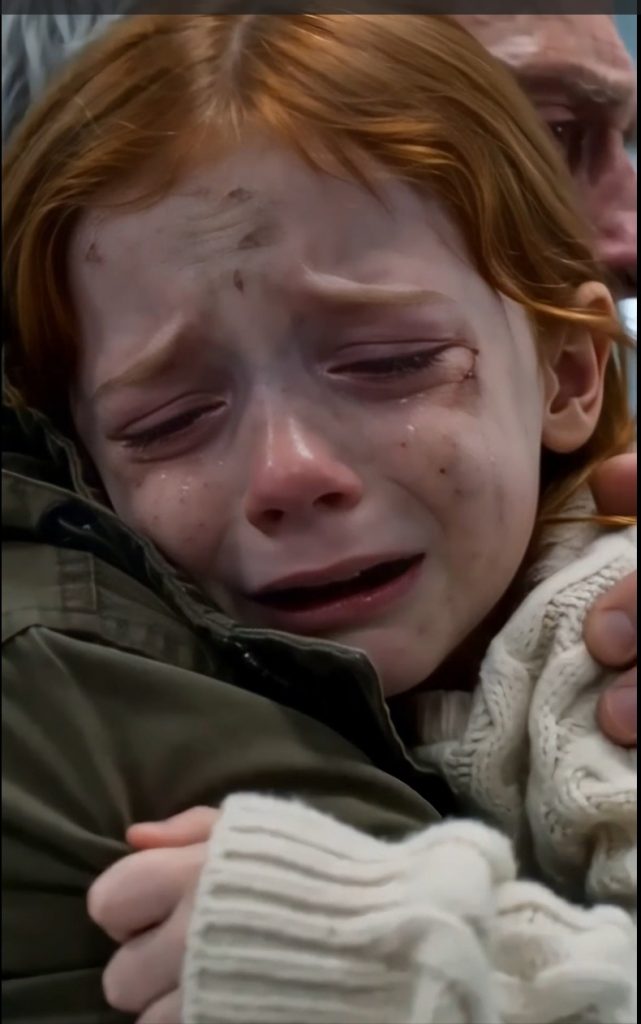
Her cream-colored sweater was wrinkled from the ride. Her reddish-blonde hair stuck to her tear-streaked cheeks. She had been crying for so long that her voice had almost vanished.
“Grandpa,” she whispered. “Don’t leave me.”
Elias pressed his cheek against her hair.
“I won’t, sweetheart,” he said, but his voice broke before he could finish.
He looked at the guard’s hand on the glass.
Then at the doors.
Then at the bright, clean world beyond them where doctors moved quickly, monitors beeped, and people in scrubs walked past as if help was something that belonged to those who knew which forms to fill out.
“Please,” Elias said. “She needs a doctor.”
The guard did not move.
“Billing desk first.”
“She can’t wait.”
“Then call another facility.”
Elias stared at him.
Another facility was thirty miles away. The pickup truck was still running crooked outside, one headlight broken from the ditch he had nearly slid into on the way there. Lily had been fading in and out on the drive, her small fingers opening and closing against his jacket like she was trying to hold on to the world.
He had no credit card.
No insurance card.
No one to call.
Only the child.
The guard’s mouth tightened. “Sir, step aside.”
Elias took one step back because Lily flinched at the man’s voice.
That was what broke him.
Not the humiliation. Not the refusal. Not even the fear that he had arrived too late.
It was the way his granddaughter, barely old enough to tie her shoes, tried to make herself smaller in his arms because adults were arguing over whether she deserved help.
He turned away from the emergency entrance and walked into the main hospital corridor.
Every step felt wrong.
Nurses passed. A cart rolled by. Someone glanced at Lily, then looked away. The polished floor reflected Elias’s boots, the child’s dangling shoes, the fluorescent lights above them.
He had no idea where to go.
Then a voice cut through the corridor.
“Bring her inside.”
Elias stopped.
A doctor stood several feet away in a white coat, dark red tie, stethoscope around his neck. His face was stern, his posture controlled, but his eyes were fixed on Lily with immediate, unmistakable concern.
The doctor pointed toward the treatment area.
“Now.”
For the first time since the emergency doors, Elias felt air enter his lungs.
Then he saw the ID badge clipped to the man’s coat.
Dr. Michael Martel.
Elias’s body went still.
He looked from the badge to the doctor’s face.
The years fell away so violently he nearly dropped to his knees.
“Michael,” he whispered. “My son.”
And the doctor froze like the old man had struck him.
Act II
Elias had lost Michael on a rainy Tuesday in 1989.
That was how he remembered it.
Not as a legal event. Not as a custody matter. Not as a decision made in a courthouse by people who never once sat at his kitchen table.
He remembered rain.
He remembered Michael’s red lunchbox on the counter.
He remembered his wife, Anna, already gone six months by then, her photograph still on the mantel because Elias could not bring himself to move it.
Michael had been seven.
A serious little boy with dark hair, quiet eyes, and a habit of lining up his toy cars by color. He had wanted to be a doctor even then, though he called it “a hospital fixer.” Whenever Elias cut his hand at the garage, Michael would run for the medicine cabinet and wrap the wound in so much gauze that Elias looked like he had survived a battle.
After Anna died, everything became harder.
Bills. School calls. Grief. Work that never paid enough. Elias was a mechanic with cracked hands and one good suit, raising a son alone in a town that respected hard work only when hard work came with money.
Anna’s parents never liked him.
They thought she had married beneath herself. They thought poverty was a character flaw. After her funeral, they began visiting more often, speaking softly to Michael and sharply to Elias when the boy left the room.
“He needs stability,” Anna’s mother said.
Elias answered, “He has me.”
“That is not the same thing.”
Then came the accident at the garage.
A hydraulic lift failed. Elias was trapped under a truck frame and spent twelve days in the hospital. While he was sedated, Anna’s parents took Michael “temporarily.”
When Elias woke up, his son was gone.
By the time he could walk again, papers had been filed. Claims had been made. Elias was called unstable, unfit, financially incapable. A grieving, injured mechanic against a family with attorneys and influence.
He fought.
He lost.
Michael was moved out of state within months.
Letters came back unopened.
Phone numbers changed.
A birthday card Elias mailed when Michael turned eight was returned with a stamp that said address unknown. Elias kept it anyway. Then the card for age nine. Then ten. Then eleven.
He never stopped writing.
Years later, when his older daughter Claire had Lily, Elias thought some part of his life had been forgiven. Claire had her mother’s laugh and her father’s stubbornness. She had stayed close when the rest of the family scattered. She was the one who told him, “Dad, if Michael is out there, he’ll find the truth one day.”
But Claire died before that could happen.
A winter crash on an icy road.
Sudden. senseless. absolute.
Lily was three.
Her father had never stayed, and so Elias became a parent again at an age when other men were learning to enjoy quiet porches and early dinners.
He did not mind.
Lily brought sound back into the house.
She colored at the kitchen table. She slept with three stuffed animals and kicked all the blankets off by midnight. She called Elias “Grandpa Bear” because his beard scratched her cheek when he kissed her goodnight.
Then Lily got sick.
At first, it looked like nothing. A fever. A stomach ache. Crying. Then worse pain. Then weakness. The local clinic was closed. The neighbor who usually drove them was away. Elias put Lily in the truck and drove toward the nearest hospital with one hand on the wheel and the other reaching back every few seconds to touch her knee.
“Stay with me,” he kept saying.
She answered until she couldn’t.
Now, standing in the hospital corridor, Elias saw the name that had lived inside him for three decades.
Michael Martel.
Not on an old envelope.
Not on a returned birthday card.
On the badge of the doctor who had just ordered help for Lily.
The son he had lost was standing in front of him.
And he did not recognize his father.
Act III
Dr. Michael Martel did not like surprises in a hospital corridor.
Surprises meant missed symptoms, wrong charts, falling oxygen levels, family members collapsing after bad news. He preferred facts. Vitals. Orders. Hands moving with purpose.
But the old man’s whisper stopped him colder than any alarm.
Michael… my son.
For a second, he could not move.
The old man’s eyes were red and bright, full of something too intimate to be confusion. Not admiration. Not gratitude.
Recognition.
Michael had heard stories about his father all his life.
Not from his father.
From the people who raised him.
They told him Elias Martel was a reckless man. A drunk. A failure. A mechanic who could not care for a grieving child and eventually stopped trying. They said he had signed papers. They said he had chosen his own life over his son’s.
Michael believed them because children believe the adults who stay.
But there were things the story never explained.
The birthday card he found once hidden in his grandmother’s desk.
The one with a cartoon doctor on the front.
To my brave hospital fixer, it said inside. I love you every day. Dad.
His grandmother had taken it from him and told him it was old trash.
He remembered that card now.
He remembered the handwriting.
His gaze dropped to the old man’s hands.
Grease-stained under the nails even now. Scar along the thumb. A mechanic’s hands.
Then Lily whimpered.
The sound snapped him back into motion.
Whatever this was, whatever truth had just opened in front of him, a child was in danger.
“Nurse!” Michael shouted. “Pediatric emergency bay. Now.”
The corridor came alive.
A nurse rushed forward. Another appeared with a gurney. Michael stepped toward Elias.
“I need to take her.”
Elias tightened his hold instinctively.
Michael softened his voice.
“She needs treatment. Let me help her.”
The old man stared at him, torn between paternal shock and grandfather terror.
Then Lily lifted her head weakly.
“Grandpa…”
Elias kissed her forehead and placed her gently onto the gurney.
“I’m right here,” he said. “I’m not leaving.”
Michael moved with practiced urgency.
He checked her pulse, her skin, her breathing. He asked questions fast, but not harshly.
“When did symptoms start?”
“Yesterday evening.”
“Fever?”
“Yes.”
“Vomiting?”
“A little. Then pain. She kept saying her side hurt.”
“Any allergies?”
“No. No, I don’t think so.”
The guard from the emergency entrance appeared at the corridor edge, looking uneasy now that a senior doctor had taken control.
Michael turned on him.
“Who blocked them?”
The guard stiffened. “Sir, policy requires—”
“Emergency care is not held at the door for payment.”
The guard opened his mouth.
Michael’s voice dropped.
“Move.”
The guard moved.
Elias stood near the wall, shaking violently now that Lily was out of his arms. He watched through the open treatment bay doors as nurses surrounded her. The hospital swallowed her in white sheets, gloved hands, monitors, clipped medical language.
Michael worked at the center of it, calm and precise.
But every few seconds, his eyes flicked back toward Elias.
The old man saw it.
So did the nurse beside him.
“Sir,” she said gently, “are you family?”
Elias looked at Michael through the glass.
“Yes,” he whispered. “But he doesn’t know that yet.”
The nurse did not understand.
Michael did.
He heard it.
And for the first time in thirty-one years, the name Elias Martel did not sound like a warning.
It sounded like a door opening.
Act IV
Lily was stabilized within the hour.
Not healed. Not safe enough for Elias to breathe normally. But stable.
The doctors believed they had caught the emergency just in time. She needed tests, fluids, monitoring, and possibly surgery depending on the scans. Michael explained all of it in a small consultation room while Elias sat across from him with both hands wrapped around a paper cup of coffee he had not touched.
The room was too bright.
Too quiet.
Too full of unsaid things.
Michael finished the medical explanation first.
He had to.
It was the only way he could remain upright.
“She is very ill,” he said carefully, “but she is in the right place now.”
Elias closed his eyes.
“Thank you.”
Michael looked at him.
“Why did you call me your son?”
Elias opened his eyes again.
There it was.
The question that had waited thirty years.
“Because you are.”
Michael’s jaw tightened. “My father abandoned me.”
Elias flinched as if struck.
“No.”
“That’s what I was told.”
“They lied.”
The words came out broken, not angry.
Michael leaned back slowly. “Who lied?”
Elias looked at the doctor’s face. His son’s face. Older, sharper, shaped by education and distance, but still Anna’s eyes. Still the crease between his brows when he was trying not to feel too much.
“Your grandparents,” Elias said. “Anna’s parents.”
Michael’s face changed at his mother’s name.
“You knew my mother?”
Elias’s eyes filled.
“I loved your mother from the day she spilled coffee on my work boots and blamed the table.”
Michael looked away.
It was too specific.
Too human.
Too unlike the vague, ugly stories he had been fed.
Elias reached into his jacket with trembling fingers. From an inside pocket, he pulled a cracked leather wallet. Inside was a folded photograph, softened at the creases from years of being opened.
He slid it across the table.
Michael did not touch it at first.
Then he looked down.
A younger Elias stood in front of an old pickup truck, one arm around a woman with dark hair. Between them was a little boy holding a red lunchbox and squinting into the sun.
Michael’s hand moved before he gave it permission.
He picked up the photo.
On the back, in faded ink, were three words.
My whole world.
Michael stopped breathing.
Elias’s voice trembled.
“I wrote to you every birthday. I went to every courthouse. I called every number I could find. They told me you didn’t want contact. Then they moved you. Changed schools. Changed addresses. I never signed you away, Michael.”
Michael pressed one hand over his mouth.
The room blurred.
He had built a life on the belief that he had been unwanted. That belief had hardened him, disciplined him, driven him. It had helped make him a doctor, but it had also made tenderness feel dangerous.
Now an old man in a worn field jacket was sitting across from him with proof that the wound had been built by other hands.
Michael’s voice came out rough.
“Why didn’t you find me later?”
“I tried,” Elias said. “By the time I found a listing for you, you were already Dr. Michael Martel. I came to the hospital once.”
Michael looked up.
“You came here?”
“Three years ago. I stood in the lobby.” Elias gave a small, ashamed laugh. “I saw you walk by in your white coat. You looked important. Busy. Whole.”
Michael’s eyes burned.
“And you left?”
“I thought maybe they were right by then.”
“About what?”
“That you were better without me.”
Silence filled the room.
Then a nurse appeared at the door.
“Dr. Martel. Lily’s asking for her grandfather.”
Both men stood at once.
For a moment, neither moved.
Then Michael stepped aside.
“She needs you,” he said.
Elias looked at him.
“So did you.”
Michael looked down.
That truth landed too late to be gentle.
Act V
Lily woke in a pediatric room with a plastic bracelet on her wrist and a monitor glowing beside her bed.
Elias sat on one side, holding her hand.
Michael stood on the other.
The girl looked small beneath the hospital blanket. Too small for the machines, the wires, the fear that had brought her there. But her eyes opened, and when she saw Elias, she managed the faintest smile.
“Grandpa Bear.”
Elias bent over her hand.
“I’m here.”
Her eyes shifted to Michael.
“Is he the doctor?”
Elias looked across the bed.
“Yes, sweetheart.”
Michael forced a smile. “I’m Dr. Michael.”
Lily studied him with the blunt seriousness of a child who had survived a frightening day.
“You helped me.”
“I did.”
“Grandpa said angels wear white coats sometimes.”
Michael looked at Elias.
The old man’s face flushed, embarrassed.
“I was scared,” Elias muttered. “People say things.”
Lily’s fingers tightened weakly around his.
“Is he an angel?”
Michael’s voice softened.
“No. Just someone who should have been there sooner.”
Lily did not understand the full weight of that.
Elias did.
The surgery came later that night.
Michael did not operate; hospital rules and emotional reality made that impossible. But he stayed nearby. He reviewed every chart, spoke to every specialist, and walked Elias through each update in words he could understand without making him feel small.
The guard from the entrance never came near them again.
By morning, Lily was out of immediate danger.
When the surgeon finally said she was expected to recover, Elias sat down in the hallway and wept into both hands.
Michael stood beside him for a moment.
Then he sat too.
Not as a doctor.
As a son who had just learned he had spent most of his life grieving the wrong story.
“I hated you,” Michael said quietly.
Elias nodded, tears still falling.
“I know.”
“I needed someone to blame.”
“I know.”
“I thought you left me.”
Elias turned toward him.
“I woke up in a hospital and you were gone.”
Michael’s face crumpled.
For the first time that day, the doctor broke.
Not loudly. Not theatrically. Just a sharp breath, a hand over his eyes, shoulders folding under the weight of a boyhood stolen by pride, money, and lies.
Elias reached for him slowly, giving him time to pull away.
Michael did not.
The old man’s hand came to rest on his son’s shoulder.
It was not enough to fix thirty years.
Nothing was.
But it was the first touch that had not been stolen from them.
Over the next week, Lily improved.
Color returned to her cheeks. She demanded apple juice. She complained about hospital socks. She asked Michael whether all doctors had to wear ties or if he was “just fancy.”
Michael told her he was professionally fancy.
She accepted that.
Elias stayed in a chair beside her bed until nurses threatened him with a second patient bracelet. Michael brought him meals from the cafeteria and pretended not to notice when Elias saved the bread roll in his coat pocket for later out of old habit.
On the fourth day, Michael came into the room holding a box.
Inside were letters.
Dozens of them.
Recovered from a storage unit belonging to his late grandparents, after Michael made one phone call that turned into six. Birthday cards. Christmas notes. School photos Elias had somehow copied and kept. Receipts from registered mail. Court petitions. Returned envelopes.
Proof of love.
Messy. incomplete. too late.
But real.
Elias touched the top envelope like it might disappear.
Michael sat beside him.
“They kept them,” he said. “They never gave them to me.”
Elias closed his eyes.
“I’m sorry.”
Michael shook his head.
“No. Not this time.”
Lily watched from the bed, holding a stuffed rabbit a nurse had given her.
“Are you crying because you’re sad?” she asked.
Michael looked at Elias.
Then at the letters.
Then at the child who had brought them back together by needing help at exactly the right terrible moment.
“A little,” he said. “But also because I found something.”
“What?”
Michael smiled through tears.
“My dad.”
Lily considered that.
Then she looked at Elias.
“Grandpa, does that mean he’s my uncle?”
Elias laughed, a wet, broken sound full of disbelief and joy.
“Yes,” he said. “I suppose it does.”
Lily nodded seriously.
“Then Uncle Doctor Michael has to come to my birthday.”
Michael looked at Elias.
The old man looked back, hope and fear both visible on his face.
“I’d like that,” Michael said.
Months later, when Lily ran across Elias’s backyard in a yellow coat, fully recovered and laughing so hard she hiccuped, Michael stood beside the porch with a paper plate in his hand, watching like a man still learning how to belong.
Elias came up beside him.
For a while, neither spoke.
The afternoon sun warmed the old fence. Lily chased bubbles across the grass. A cake waited on the picnic table, lopsided because Elias had insisted on frosting it himself.
Michael looked at the old man’s hands.
The same hands from the photo.
The same hands that had held letters, tools, and grief for three decades.
“I don’t know how to be your son,” Michael said.
Elias nodded.
“I don’t know how to be your father at this age.”
Michael gave a small, sad smile.
“So what do we do?”
Elias looked at Lily.
Then at the house.
Then at the son he had lost and found in the same hospital corridor where he almost lost his granddaughter.
“We start with dinner,” he said.
Michael laughed softly.
“That’s your plan?”
“It’s a good plan. People make things too complicated.”
Michael looked toward the yard as Lily shouted for both of them to watch her jump off the porch step.
“Dinner,” he said.
“And next week,” Elias added, “you come early. I’ll show you the letters.”
Michael nodded.
This time, the word did not hurt.
“Okay, Dad.”
Elias turned away fast, pretending to cough.
Michael let him.
Some wounds do not close in a single embrace. Some families are not restored by one revelation, one photograph, or one hospital miracle. They return slowly, through meals, birthdays, awkward phone calls, medical updates, and the courage to ask questions whose answers might break your heart.
But on the day Elias carried Lily to those emergency doors, he thought he was begging strangers to save the last person he had left.
Instead, a doctor in a white coat stepped forward, looked past his poverty, ignored the guard, and said the only words that mattered.
Bring her inside.
He saved the child first.
Then the old man read the badge.
And in the brightest, coldest hallway of the hospital, a family that had been broken for thirty years began, impossibly, to breathe again.