Act I
The classroom door opened, and every whisper died at once.
Officer Daniel Reyes stepped into Room 204 with his badge catching the fluorescent light and his boots heavy against the tile. He had expected noise. It was a high school, after all. Bells, chairs scraping, students pretending not to talk, teachers fighting to be heard.
But this room was too quiet.
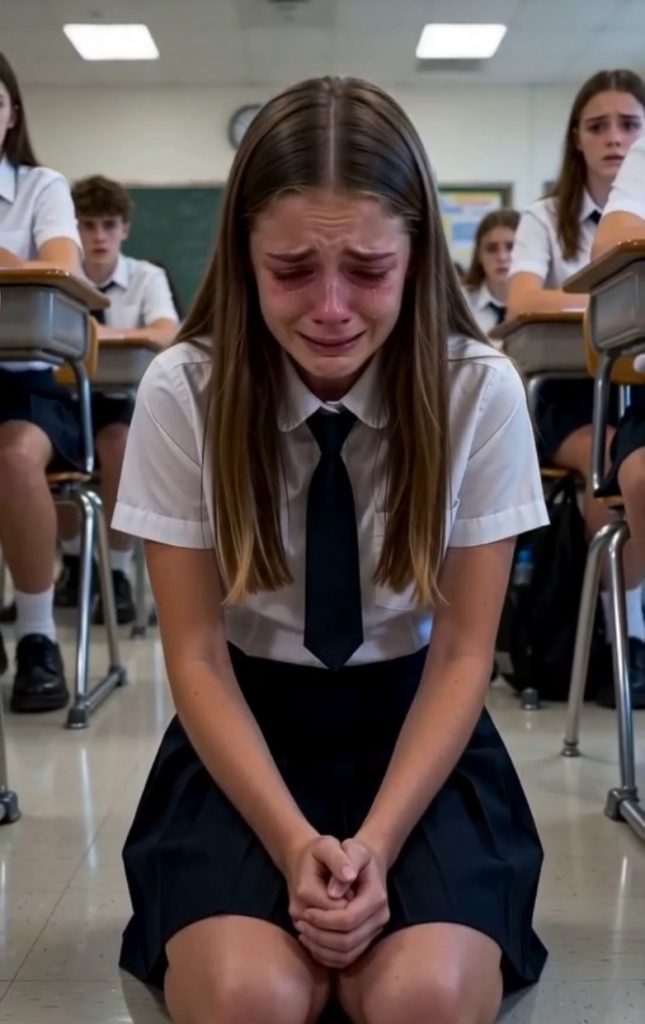
Rows of students sat at wooden desks, all in white shirts and black ties, their eyes fixed on the floor near the front of the room.
That was where the girl was kneeling.
She looked about fifteen, with long brown hair hanging forward over her tear-streaked face. Her hands were clasped in front of her uniform skirt. Her knees pressed against the hard tile as if she had been there long enough for pain to become part of the punishment.
Officer Reyes stopped walking.
The teacher turned sharply from the chalkboard.
“Excuse me,” she said, chin lifted. “We are in the middle of a lesson.”
Reyes did not answer right away.
His eyes moved from the girl to the students, then back to the teacher.
“What lesson is this?”
The teacher’s face tightened.
“I beg your pardon?”
Reyes took another step into the room.
Behind him, the classroom door swung slowly shut. The click sounded louder than it should have.
The girl tried to quiet her sobbing, but the effort only made her shoulders tremble harder.
The teacher crossed her arms.
“She is being disciplined.”
“For what?”
“For disrespect.”
Reyes looked down at the girl.
“What’s your name?”
The girl opened her mouth, but no sound came out.
The teacher answered for her.
“Lena Morales. And she will remain on that floor until she understands her place.”
A low shock moved through the students.
Not because they had not heard the sentence before.
Because now someone else had.
Reyes turned his head slowly toward the teacher.
“Her place?”
The teacher’s confidence flickered, but only for a second.
“Yes. Her place as a student. This generation thinks crying is a defense against consequences.”
Lena bowed her head lower.
A tear dropped onto the tile.
Reyes took one breath. Slow. Controlled.
Then he walked past the first row of desks and stopped directly in front of the teacher.
“Get her off the floor.”
The teacher’s eyes widened.
“You do not give orders in my classroom.”
Reyes did not raise his voice.
“No,” he said. “But I do enforce the law in this building.”
The students froze.
The teacher’s arms tightened across her chest.
And for the first time, Lena lifted her head.
Act II
Lena Morales had been invisible before that morning.
Not because nobody saw her.
Because everyone saw the wrong things.
They saw the quiet girl with secondhand shoes polished until they nearly passed for new. They saw the scholarship student who always packed lunch in the same faded blue container. They saw the girl who took notes with perfect handwriting and never raised her voice, even when other students whispered about where she lived.
They did not see the girl who woke at five every morning to help her mother clean offices before school.
They did not see her studying at the kitchen table while her younger brother slept on the couch beside a broken heater.
They did not see her father’s photograph tucked inside her backpack, the one where he stood in a firefighter uniform, smiling with one hand on her shoulder when she was seven.
Her father had died three years earlier.
After that, Lena learned the shape of adult pity.
At first, people brought casseroles. Then gift cards. Then advice. Finally, silence.
Her mother, Rosa, took more shifts. Lena became older without permission.
School was supposed to be the place where she could still be a child.
Then Mrs. Vivian Hartley became her homeroom teacher.
Mrs. Hartley believed discipline fixed everything. Bad grades. Poverty. Grief. Tardiness. Tears. Hunger. She liked straight rows, quiet mouths, polished shoes, and students who treated fear as respect.
To parents, she was strict.
To administrators, she was reliable.
To students, she was untouchable.
Lena had tried to stay away from her attention. She turned in assignments early. She kept her uniform clean. She apologized when bumped into.
But one thing made her visible.
A folder.
Two weeks earlier, Lena had stayed late to help arrange books in the classroom. While placing old worksheets into a cabinet, she found a brown envelope wedged behind a stack of exam papers.
Inside were receipts.
Cash withdrawal slips.
Lists of student names.
At first, Lena did not understand.
Then she saw her own name under a heading:
Emergency Aid Recipients.
She knew that fund.
Everyone did.
The school had collected donations for students who could not afford uniforms, lunches, exam fees, and field trips. Teachers spoke about it at assemblies. Parents sent money in envelopes. The principal praised Mrs. Hartley for managing it.
But the receipts did not match the announcements.
Money had been withdrawn.
Students had never received it.
Lena found her brother’s name too. He had been denied a winter coat request the month before because the fund was “empty.”
That night, Lena took photos of the papers.
She did not know what else to do.
The next morning, she tried to ask Mrs. Hartley privately.
That was her mistake.
Mrs. Hartley’s face changed the moment she saw the envelope in Lena’s hand.
Not fear.
Fury.
“You went through my cabinet?”
“I was cleaning,” Lena said. “I just found—”
“You stole confidential documents.”
“No, ma’am. I didn’t steal anything.”
Mrs. Hartley stepped close enough that Lena could smell her perfume.
“Girls like you are always looking for someone to blame.”
The sentence lodged in Lena’s chest.
Girls like you.
By lunch, Mrs. Hartley had accused Lena of stealing from the classroom donation box.
By sixth period, Lena was ordered to kneel in front of the class as “a lesson in humility.”
Her classmates watched in horror.
Some looked down.
Some whispered.
One student, Maya Chen, hid her phone under her desk and recorded.
She sent the video to her older brother, who worked as a dispatcher at the police station.
That was why Officer Reyes came.
Not for a school presentation.
Not by accident.
He came because one brave student pressed send.
And he arrived before Mrs. Hartley could finish breaking Lena.
Act III
Officer Reyes crouched beside Lena.
The teacher made a sharp sound of protest.
“She is being punished.”
Reyes did not look up.
“Lena,” he said gently, “can you stand?”
Lena’s lips trembled.
“My knees hurt.”
That sentence changed the room more than a scream would have.
A few students shifted in their seats. Someone whispered, “She’s been there almost an hour.”
Mrs. Hartley snapped, “Quiet.”
Reyes turned his head.
“No. They can speak.”
The teacher stared at him as if he had overturned the laws of nature.
Reyes offered Lena his hand.
She hesitated.
Then she took it.
When she tried to stand, her legs shook. Reyes helped her carefully, one hand steady at her elbow. A girl in the front row pushed her chair forward without being asked.
“Sit here,” she whispered.
Lena sat.
Her face crumpled with relief and shame all at once.
Mrs. Hartley’s voice hardened.
“This is absurd. Officer, you are undermining classroom authority.”
Reyes stood.
“Authority is not humiliation.”
“She stole from this room.”
A murmur broke out.
Lena shook her head quickly. “I didn’t.”
Mrs. Hartley pointed at her.
“She was found with school documents and cash records.”
Reyes looked at her.
“Interesting. Because I came here for those records.”
The teacher’s face went still.
The room felt suddenly airless.
Reyes reached into the folder under his arm and removed printed screenshots.
Maya’s video had been enough to bring him to the school.
But Lena’s photos had been sent too.
Not to the police at first.
To her mother.
Rosa Morales had taken one look at the receipts, left her cleaning shift, and walked to the station with tears in her eyes and fury in her voice.
Officer Reyes had reviewed them before coming to Room 204.
Now he placed the first page on the teacher’s desk.
“Donation fund withdrawals,” he said. “Signed by you.”
Mrs. Hartley’s mouth tightened.
“That is administrative business.”
“Student aid money transferred into a personal account.”
“That is not what it shows.”
Reyes placed down another page.
“Store receipts. A designer handbag. A weekend hotel stay. Restaurant charges.”
The students stared.
Mrs. Hartley’s face lost color.
Reyes continued, voice controlled but cutting.
“Meanwhile, Lena Morales’s brother was denied a coat request. Another student was denied exam-fee help. Three students were told lunch assistance had run out.”
A boy in the back whispered, “That was me.”
Lena looked at him.
He looked down, embarrassed.
Mrs. Hartley stepped forward.
“These are private financial misunderstandings. She had no right to photograph anything.”
Reyes looked at the teacher’s crossed arms, then at Lena’s swollen eyes.
“You forced a child to kneel because she found evidence.”
Mrs. Hartley’s lips parted.
No answer came.
Then the classroom door opened again.
This time, the principal entered with Rosa Morales beside him.
Rosa’s work uniform was still damp at the sleeves. Her hair had come loose from its bun. Her eyes went straight to Lena.
“Mija.”
Lena broke.
She ran to her mother, and Rosa caught her so tightly that the room looked away.
Officer Reyes turned back to Mrs. Hartley.
“Now,” he said, “we can talk about who needs to understand their place.”
Act IV
Mrs. Hartley did not collapse immediately.
People like her rarely do.
They deny first.
Then minimize.
Then blame whoever caught them.
“This is a misunderstanding,” she said to the principal. “I have managed that fund for years.”
The principal, Mr. Adler, looked as if he had aged ten years in ten minutes.
“Yes,” he said quietly. “That appears to be the problem.”
Mrs. Hartley’s eyes flashed.
“You’re going to believe a student over me?”
Rosa lifted her head from Lena’s hair.
“You made my daughter kneel.”
Mrs. Hartley looked at her with cold annoyance.
“Your daughter violated school privacy.”
“My daughter came home crying because children were cold and hungry while you bought yourself handbags.”
A few students gasped.
Mrs. Hartley’s face reddened.
“You don’t know what it takes to run a classroom.”
Rosa stepped forward.
“No,” she said. “But I know what it takes to clean one after everyone leaves. I know which children hide food in their bags. I know which ones wear thin jackets in winter. I know because people like you stop seeing them once the bell rings.”
The room went silent.
Reyes watched Mrs. Hartley carefully.
The teacher looked around and realized she had lost something she thought permanent.
Control.
The students were no longer looking down.
Maya Chen raised her hand slowly.
Everyone turned.
Mr. Adler’s voice was soft. “Yes, Maya?”
Maya swallowed.
“She made Lena kneel before. Last month. In the hallway.”
Another student raised his hand.
“She calls us charity cases.”
Then another.
“She said my mom was lazy because we couldn’t pay for the field trip.”
Another voice, barely above a whisper.
“She keeps a list of who gets free lunch and reads it out when people forget homework.”
Each statement landed like a stone.
Mrs. Hartley backed toward her desk.
“That’s enough,” she said.
But it was not enough.
Not anymore.
Officer Reyes turned to the class.
“Anyone who wants to make a statement will be allowed to do so privately. No one has to speak in front of the room.”
That was the first time the students heard an adult give them permission without demanding performance.
Lena stayed pressed to her mother’s side.
Her face was still red, but something had changed in her eyes.
She was still hurt.
But no longer alone.
Mr. Adler looked at Mrs. Hartley.
“You are relieved of classroom duties pending investigation.”
Her mouth opened.
“Immediately,” he added.
Officer Reyes stepped aside.
A second officer appeared at the doorway.
Mrs. Hartley looked from one adult to another, searching for the old protection that came with title, age, and authority.
It was gone.
As she was escorted from the classroom, the students did not clap.
This was not a victory parade.
It was heavier than that.
It was the sound of a room learning how long it had been afraid.
At the doorway, Mrs. Hartley turned once toward Lena.
For a second, it looked as if she might apologize.
Instead, she said, “You’ve ruined my life.”
Lena’s mother held her tighter.
Officer Reyes answered before Lena could absorb the blame.
“No,” he said. “She told the truth about it.”
The door closed behind the teacher.
And only then did Lena begin to breathe normally again.
Act V
The story did not end with Mrs. Hartley leaving the room.
That would have been too easy.
Schools, like families, sometimes prefer quiet repairs. A substitute teacher. A letter home. A promise that “procedures are being reviewed.” A hope that children will forget faster than adults feel ashamed.
But Lena did not forget.
Neither did her classmates.
The investigation confirmed what the documents had suggested. The student aid fund had been misused for years. Not all at once. Not in ways dramatic enough to set off alarms. Small withdrawals. Fake receipts. Delayed approvals. Missing cash donations.
Enough to steal warmth from children one winter at a time.
Mrs. Hartley resigned before she could be fired.
Charges followed.
So did a district audit.
But the real change began in Room 204.
Mr. Adler visited the class the next morning. He did not stand behind the teacher’s desk. He stood in front of it.
“I failed to see what was happening here,” he said. “I am sorry.”
The students were quiet.
They did not know what to do with an adult apology that sounded real.
He continued.
“No student will ever be disciplined by public humiliation in this school again. Not in this classroom. Not in the hallway. Not anywhere.”
Then he looked at Lena.
“And Miss Morales, what happened to you should never have happened.”
Lena’s hands tightened around the edge of her desk.
She nodded once.
It was not forgiveness.
It was acknowledgment.
That was enough for the moment.
The aid fund was rebuilt under a new system, managed by three staff members, two parents, and one student representative. Names were kept private. Requests were handled with dignity. The first purchases were winter coats, exam fees, and lunch balances.
Lena’s brother got a coat.
Dark green.
Too big in the sleeves.
He wore it anyway and refused to take it off indoors for three days.
Maya Chen received a commendation for reporting abuse, though she tried to refuse it because she said she had only done what anyone should do. Officer Reyes attended the small assembly where she received it.
Afterward, he found Lena standing near the trophy case.
“How are the knees?” he asked.
She smiled faintly.
“Better.”
“And the heart?”
Her smile faded.
She looked through the glass at old trophies with names engraved in gold.
“I don’t know.”
Reyes nodded.
“That takes longer.”
Lena glanced at him.
“Were you mad when you saw me?”
“Yes.”
“At me?”
His face softened.
“No. Never at you.”
She looked down.
“I felt stupid. Kneeling there. Everyone watching.”
“You were not the one who should have felt ashamed.”
“I know.”
But her voice said she did not fully know yet.
Reyes crouched slightly so he was closer to her eye level.
“Courage does not always look like standing up,” he said. “Sometimes it looks like surviving until someone opens the door.”
Lena’s eyes filled.
For the first time, she did not try to hide it.
Months later, Room 204 looked different.
Not physically. The same desks. Same chalkboard. Same posters. Same bright institutional lights.
But the air had changed.
Students spoke more. Teachers knocked before entering emotional territory. A counselor visited once a week. A small sign near the front of the room read:
Discipline teaches. Humiliation only wounds.
Lena kept sitting in the third row.
At first, classmates treated her carefully, as if she were made of glass. Eventually, they learned she preferred normal kindness. Sharing notes. Saving her a seat. Rolling their eyes with her at bad cafeteria food.
Normal became its own healing.
At the end of the school year, Lena was asked to speak at an assembly about integrity.
She almost said no.
Then her brother, still wearing the green coat even though spring had arrived, said, “You should. You’re scary now.”
She laughed for the first time all day.
When Lena stepped onto the stage, she saw Officer Reyes near the back wall, arms folded, badge glinting softly under the lights. Her mother sat in the front row, crying before Lena even reached the microphone.
Lena looked out at the students.
Her voice shook at first.
“When people talk about courage,” she said, “they make it sound loud. Like you have to shout or fight or not be afraid.”
She took a breath.
“I was afraid. I cried. I couldn’t even stand up by myself.”
The auditorium went still.
“But I took pictures of something wrong. Maya sent a video. My mom believed me. Officer Reyes walked through the door. So maybe courage is not one person being fearless. Maybe it’s a chain. One person does one right thing, then another person does the next.”
In the front row, Maya wiped her eyes angrily, as if annoyed by her own tears.
Lena smiled a little.
“That day, I thought the whole class saw me at my lowest. But now I think they saw the truth. Not just about me. About what happens when authority forgets kindness.”
She looked at her classmates.
“No one’s place is on the floor.”
The applause came slowly.
Then all at once.
Lena did not cry until she stepped offstage and her mother wrapped her in both arms.
Officer Reyes waited until the crowd thinned.
Then he handed Lena a small card.
It had the police department seal on it and one sentence written beneath her name.
For courage in telling the truth.
Lena ran her thumb over the words.
“Can I keep this?”
Reyes smiled.
“You’d better.”
Years later, Lena would still remember the tile against her knees.
She would remember the laughter that almost started but did not. The students too scared to speak. The teacher’s cold voice telling her to understand her place.
But she would remember something else more clearly.
The door opening.
The footsteps.
The moment an adult entered the room, saw a child being humiliated, and refused to call it discipline.
That was the moment Lena learned that her place had never been on the floor.
Her place was wherever she could stand in the truth.
And this time, when she stood, she did not stand alone.