Act I
The dog did not go for the man’s throat.
It did not go for his legs, his face, or the towel draped over his shoulder.
It went for the keys.
In the cold rain at Millbrook Park, the scruffy brown dog charged across the wet asphalt and launched itself at the heavy metal ring hanging from the worker’s belt. The keys clattered wildly as the man stumbled back, his boots sliding over slick leaves.
“Get off!” he shouted.
His right hand clamped down over the key ring.
That was when the dog’s teeth caught his hand.
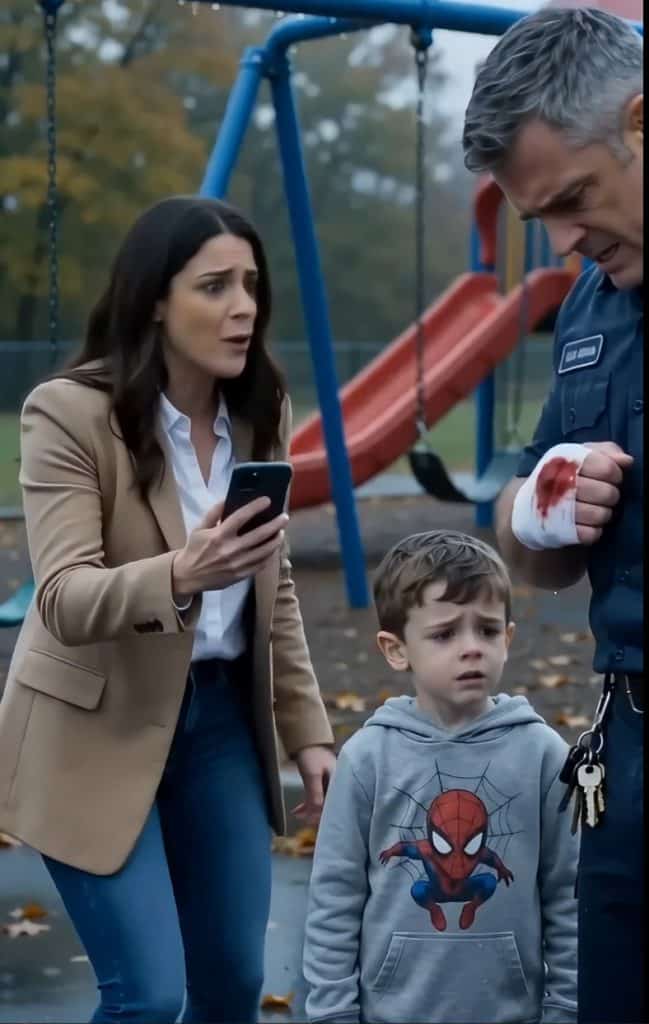
The man cried out and yanked away, knocking into the blue frame of the swing set. Rain ran down his gray hair and dark blue work shirt, where a name tag read:
BLAIR ADRIAN.
The dog dropped back to the ground, barking sharply.
Not wild.
Not confused.
Warning.
A young mother gasped and pulled her little boy behind her. She had only looked away for one second to check her phone. One second, her son Ben was standing near the slide. The next, a wet, matted dog was barking at a bleeding park worker while rain hammered the playground around them.
“That mutt bit me!” Blair shouted.
He ripped the white towel from his shoulder and wrapped it around his hand. A dark red stain spread through the cloth as he held it up like evidence.
The mother’s face went pale.
“Animal control,” she said, fumbling with her phone. “Right now. Get rid of that dog!”
The dog barked again, but its eyes never left Blair’s waist.
The keys jingled.
Ben heard them.
He was five years old, small in a gray hoodie with a Spider-Man graphic, his cheeks damp from rain and fear. While his mother stared at the bloodied towel, Ben stared at the key ring.
It was huge. Too many keys for one park. Brass keys, silver keys, black plastic fobs, a tiny red tag, and one long old-fashioned key that swung lower than the others.
Blair noticed the child looking.
He shifted his hip away.
Ben’s mouth trembled.
“No,” he whispered. “Keys… bad.”
His mother looked down. “Ben?”
The worker’s eyes flashed.
“That dog is dangerous,” Blair snapped. “It should be put down before it hurts a child.”
Ben raised one shaking hand and pointed straight at the key ring.
“Keys!” he cried. “Bad!”
The police officer who had just arrived at the edge of the playground slowed beneath the rain.
Officer Daniel Reeves followed the child’s finger to Blair’s belt.
Then to the dog.
Then back to the keys.
His voice dropped.
“Why do you say that?”
Ben’s lips parted.
And Blair Adrian stopped breathing.
Act II
Millbrook Park had been almost empty all afternoon.
That was why Claire Mason brought Ben there.
He had been restless all morning, bouncing from couch cushions to kitchen chairs, asking if rain meant worms came out, if worms had families, if Spider-Man ever got tired of saving people.
Claire was exhausted. Not angry. Just worn thin in the way parents get when money is tight, sleep is short, and the world keeps asking them to be cheerful anyway.
So when the rain softened from a downpour to a steady drizzle, she put Ben in his hoodie and took him to the park.
“Fifteen minutes,” she said.
Ben held up five fingers. “Fifty?”
“Fifteen.”
“Fifteen is almost fifty.”
“It absolutely is not.”
He laughed and ran toward the red slide.
The park looked sad in the rain. Fallen leaves stuck to the asphalt. Water pooled under the swings. The benches were empty except for one forgotten paper cup turning soft near the trash can.
And near the maintenance building, Blair Adrian was locking a gray door.
Claire recognized him. Everyone in the neighborhood did.
He was the park maintenance supervisor, always around with a key ring, a leaf blower, or a clipboard. He waved at parents. Fixed broken swing chains. Told kids not to climb the fence.
He had been interviewed on local news two weeks earlier after a little girl named Lily Mercer disappeared from the park.
Eight years old.
Yellow raincoat.
Pink backpack.
Last seen near the bathrooms during a school picnic.
The search had consumed the town. Flyers went up in every shop window. Volunteers combed the creek, the woods, the drainage tunnels, the vacant houses near the old rail line. Her parents stood on TV with hollow eyes and begged for her return.
Blair had been there too, standing behind the mayor, saying he had checked every locked building in the park.
Every shed.
Every restroom.
Every utility room.
Nothing.
The police kept looking, but the public hope was beginning to change shape. It always did after enough days. Hope became whispers. Whispers became theories. Theories became silence.
Claire tried not to think about Lily while Ben played.
But every parent in Millbrook thought about her.
They counted their children every thirty seconds now. They checked under slides. They looked too long at strangers. They held small hands tighter in parking lots.
That was why Claire noticed the dog.
It emerged from the mist beyond the basketball court, wet and filthy, fur clumped along its sides, blue collar bright against its neck. It moved with purpose, nose low, heading straight toward Blair.
Ben saw it too.
“Doggy,” he whispered.
Blair turned.
For one second, his face showed something Claire could not name.
Not surprise.
Fear.
Then the dog lunged at his keys.
Now, standing in the rain with Officer Reeves watching him, Blair looked less like a wounded victim and more like a man afraid of what a five-year-old might remember.
Ben kept pointing.
“Keys bad,” he said again, smaller this time.
Claire knelt beside him, rain soaking through her jeans.
“What do you mean, baby?”
Ben’s eyes filled.
“Door,” he whispered.
Officer Reeves crouched too.
“What door?”
Ben looked toward the maintenance building.
Then at the dog.
The dog had stopped barking.
It stood in the rain, body trembling, eyes fixed on the same gray door Blair had locked minutes earlier.
Act III
Blair laughed too loudly.
It was the kind of laugh people use when fear has nowhere else to hide.
“A door?” he said. “He’s a kid. Kids say weird stuff.”
Officer Reeves stood slowly.
“Mr. Adrian, step away from the keys.”
Blair’s jaw tightened. “I’m the one bleeding.”
“I see that.”
“That animal attacked me.”
“It attacked your key ring.”
Claire looked at the dog again.
The animal was soaked, shivering, and covered in mud, but not advancing. It stood between Ben and the maintenance building as if waiting for the adults to finally become useful.
Officer Reeves radioed for backup.
Blair’s expression hardened.
“For a dog bite?”
“For a locked park facility connected to a child’s statement,” Reeves said. “And because you just tried to move your keys behind your back.”
Blair’s hand froze.
The rain seemed louder after that.
Ben tugged on his mother’s sleeve.
“Mommy,” he whispered, “girl cried.”
Claire went cold.
Officer Reeves turned his head. “What did you say?”
Ben’s face crumpled.
“Yesterday. When we left. I heard girl cried.”
Claire stared at him.
They had come to the park the day before, just before sunset. Ben had stopped near the maintenance building, looking back. Claire remembered pulling him along because her phone was buzzing and dinner was late and she had thought he was just distracted.
“What girl?” Claire asked, her voice barely working.
Ben pointed at the gray door again.
“Behind there.”
Blair stepped forward. “That is a lie.”
The dog barked once.
Officer Reeves moved between Blair and the child.
“Don’t.”
Blair lifted his towel-wrapped hand, eyes sharp with panic now. “You cannot open that building without a city order. There’s equipment inside. Chemicals. Liability. This is insane.”
The word liability sounded strange in the rain.
Too polished.
Too prepared.
Another cruiser pulled into the park entrance. Then another. A female officer stepped out, one hand near her radio, scanning the playground.
Officer Reeves held out his palm.
“Keys.”
Blair did not move.
“Now.”
For three seconds, the whole park seemed to hold its breath.
Then Blair ran.
Not far.
The dog moved first.
It shot across the wet asphalt and cut him off near the swings, barking so fiercely that Blair slipped on the leaves and fell hard to one knee. Before he could scramble up, two officers reached him and forced his hands away from his belt.
The keys clattered to the ground.
The dog stopped barking.
It walked straight to the key ring, lowered its nose, and nudged one long old-fashioned key with the red tag.
Ben whispered, “That one.”
Claire pressed a hand over her mouth.
Officer Reeves picked up the key.
The dog turned toward the gray door.
And began to whine.
Act IV
The maintenance door opened on the third try.
The first key stuck.
The second did nothing.
The third, the long key with the red tag, slid in cleanly and turned with a heavy metallic click that everyone in the rain seemed to hear.
Officer Reeves pulled the door open.
Cold air rolled out.
Not the ordinary damp smell of a storage room.
Something older.
Dust. Metal. Wet concrete.
A narrow stairwell led down beneath the park.
Claire had lived in Millbrook for seven years and never known there was anything under the playground.
The dog pushed forward, but Reeves held out an arm.
“Wait.”
The dog whined, almost screaming now, paws scraping at the threshold.
More officers arrived. Flashlights came out. One called for medics. Another called for a full search team.
Blair, held near the cruiser, shouted through the rain.
“You don’t understand! I didn’t hurt anyone!”
No one answered him.
Officer Reeves descended first.
The dog pulled free from the officer trying to hold it and raced down after him.
Claire held Ben against her chest.
She wanted to cover his ears, his eyes, his whole memory of this day.
But Ben stared at the door.
Minutes passed.
Too many.
The rain fell harder.
Then a voice rose from below.
“We need medics down here!”
Claire’s knees nearly gave.
A second later, Officer Reeves emerged carrying a child wrapped in his uniform jacket.
A small girl.
Pale. Shaking. Alive.
Her yellow raincoat was torn at the sleeve, but unmistakable.
Lily Mercer.
The park seemed to split open around her name.
One officer ran for the ambulance. Another spoke urgently into a radio. The female officer took Lily from Reeves and carried her toward the warm cruiser, speaking softly the whole way.
The dog followed.
It stayed so close to Lily that Reeves finally understood.
“This is her dog,” he said.
Claire looked at the animal.
The blue collar.
The mud.
The desperation.
Lily’s missing flyer had mentioned a family dog.
Rusty.
He had disappeared the same day she did.
Everyone assumed he ran away in the chaos.
He hadn’t.
He had been searching.
For two weeks, Rusty had tracked the one sound, one smell, one key ring that connected him to the child everyone else had failed to find.
Lily’s parents arrived twenty minutes later.
Her mother came barefoot from the car, screaming her daughter’s name before the door even closed. Her father stumbled behind her like his body had forgotten how to run.
They reached the cruiser.
Lily lifted her head.
“Mom?”
Her mother collapsed against the open door.
No officer in that park looked away fast enough to hide their tears.
Rusty climbed halfway into the cruiser and pressed his wet face into Lily’s lap.
Lily’s weak hand found his fur.
“Rusty found me,” she whispered.
Her father covered his mouth.
The dog closed his eyes.
The rain kept falling, but the park had changed.
It was no longer the place where Lily disappeared.
It was the place where a dog refused to let the wrong man keep the right key.
Act V
Blair Adrian confessed before sunrise.
Not because he became honest.
Because the evidence left him nowhere to stand.
The underground space beneath the maintenance building was an old storm shelter connected to utility corridors built decades earlier and forgotten by most of the city. Blair had access because he oversaw park repairs. He had found the room during a renovation and kept it off every inventory sheet.
He claimed Lily followed him by accident.
He claimed he panicked.
He claimed he meant to “figure out what to do.”
No one believed the soft version.
The security footage showed him leading her toward the maintenance building after she asked for help finding Rusty. It showed him locking the door. It showed him returning alone.
Then it showed Rusty.
For days, the dog appeared on cameras around the park, circling, scratching, barking at locked doors, digging near vents, chasing Blair’s maintenance cart.
Blair had tried to trap him twice.
Failed twice.
On the rainy day Claire brought Ben back to the playground, Rusty finally saw the key ring again.
This time, he had witnesses.
This time, one small child had heard enough to say what adults almost missed.
Keys bad.
Lily recovered slowly.
That was the word everyone used.
Recovered.
It sounded too simple for what her family lived through. There were doctors, counselors, quiet nights, nightmares, and mornings when Lily would not let Rusty out of her sight. Her parents learned not to rush healing just because they had gotten the miracle they begged for.
Rusty became famous for a while.
News crews filmed him wearing his blue collar, looking deeply unimpressed as reporters called him a hero. The mayor tried to give him a medal in front of city hall. Rusty tolerated the applause only because Lily stood beside him with one hand on his back.
Officer Reeves kept the red-tagged key in an evidence bag until the trial.
He said later that he dreamed about the sound it made in the lock.
That heavy click.
The sound of a lie opening.
Blair was convicted on multiple charges and sentenced to prison. The city launched an investigation into maintenance access across every public facility. Locks were changed. Old rooms were mapped. Forgotten doors were opened in every park in the county.
Claire testified too.
So did Ben, though not in open court.
A child specialist asked him gentle questions in a room with crayons and a stuffed turtle. Ben told the truth the way children do when adults finally stop making it too complicated.
“The dog wanted the keys,” he said. “The keys were bad because the girl was behind the door.”
That sentence helped seal the case.
Months later, Claire brought Ben back to Millbrook Park.
She almost turned around three times.
The red slide had been cleaned. The swing set repainted. The gray maintenance door was gone, replaced with a sealed wall and a plaque near the path.
FOR LILY.
FOR RUSTY.
FOR EVERY CHILD WHO DESERVES TO BE HEARD.
Ben stood in front of it, holding Claire’s hand.
“Is the bad key gone?” he asked.
“Yes,” Claire said.
“Is the girl home?”
“Yes.”
“Is the dog home?”
Claire smiled softly.
“Yes.”
Ben thought about that, then nodded like the world had passed inspection.
Across the playground, a car door opened.
Lily Mercer stepped out with her parents.
Rusty jumped down after her.
The dog saw Ben first.
His tail wagged.
Ben’s eyes widened. “Mommy, it’s the key dog.”
Claire laughed through a sudden ache in her throat.
Rusty trotted over and sat at Ben’s feet as if reporting for duty. Ben reached out carefully and touched the dog’s damp nose.
“You did good,” he whispered.
Lily heard him.
She smiled for the first time Claire had ever seen in person.
“He always does,” Lily said.
The two children stood there quietly, connected by a rainy day neither of them fully had words for. One had been trapped behind a door. One had pointed at the key. And between them sat the scruffy brown dog who had understood the truth before anyone else.
Rain began to fall again, softer this time.
Parents started gathering their bags, calling children toward cars, complaining about wet socks and muddy shoes. Ordinary life returned in small, precious noises.
A swing creaked.
A child laughed.
Rusty leaned against Lily’s leg.
Claire watched Ben climb the first step of the red slide, then turn back to check that she was watching.
She was.
She would be for a long time.
Because the lesson of that day did not leave her.
Danger does not always look like a stranger in the shadows. Sometimes it wears a name tag. Sometimes it carries official keys. Sometimes it speaks loudly enough that frightened people believe the wrong story first.
And truth does not always arrive in perfect sentences.
Sometimes it barks in the rain.
Sometimes it bites the hand covering the clue.
Sometimes it comes from a child pointing with a trembling finger, trying to say the only words he has.
Keys.
Bad.
And if someone listens in time, a locked door opens.