Act I
The wind at the cliff edge sounded like it wanted a confession.
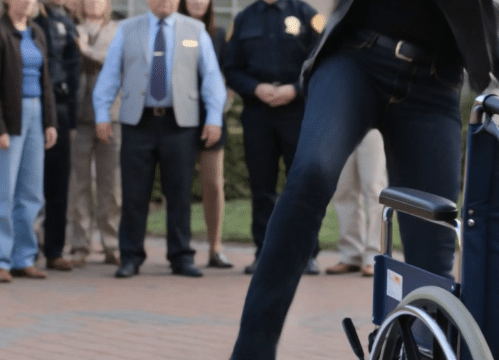
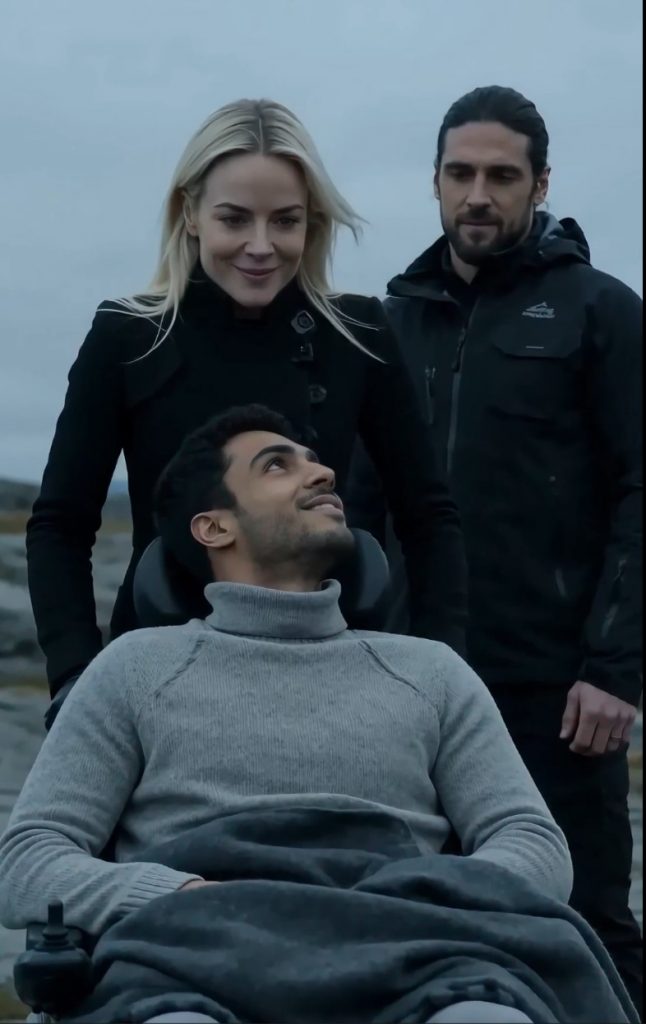
It tore across the gray stone, snapped at Helena Voss’s long black coat, and pushed strands of blonde hair across her mouth as she stood behind her husband’s wheelchair.
Far below, the fjord lay dark and still between the mountains.
Elias Voss looked out over it with quiet wonder.
Even after everything that had happened to him, he still loved this place. The cold. The height. The silence. The way the cliffs made every human problem seem small.
Helena’s hands tightened around the wheelchair handles.
Behind her, Marcus stood with his black outdoor jacket zipped to his throat, watching.
Elias turned his face slightly toward his wife and smiled.
A soft smile.
Trusting.
“Beautiful, isn’t it?” he said.
Helena did not answer.
For three years, she had worn the mask of a devoted wife. She had sat beside hospital beds, signed sympathy cards, and accepted praise from strangers who called her brave for staying after the accident.
But bravery had never been the reason she stayed.
Money was.
The Voss estate. The shipping shares. The house above the harbor. The life she believed should have been hers long before Elias ever put a ring on her finger.
Then Elias survived the crash.
Survived, but changed.
A wheelchair. Chronic pain. A slower life. A husband who needed help getting through doorways while Helena dreamed of hotel suites, warm beaches, and Marcus’s hand at the small of her back.
She had waited.
Then she had planned.
Now the plan stood on the edge of a Norwegian cliff with no witnesses close enough to hear the truth.
Elias’s blanket shifted over his lap as the wind pulled at it.
“Helena?” he asked.
Something in his voice almost stopped her.
Almost.
Then Marcus gave a small nod.
Helena leaned forward and pushed.
The wheelchair shot toward the cliff edge.
Elias’s hand jerked to the wheel. His head snapped back, eyes wide with a kind of disbelief that cut deeper than terror.
Not because he did not know danger.
Because he finally knew her.
The chair vanished beyond the edge.
The wind swallowed his name before anyone spoke it.
Helena staggered back, breathing hard, staring down into the endless drop.
For one wild second, she looked like a woman who had escaped prison.
Then she smiled.
“Finally,” she whispered, turning toward Marcus. “Now we can be together.”
Marcus stepped close.
His hand settled gently on her shoulder.
He chuckled once, low and soft.
Helena leaned into him.
And then his smile disappeared.
“No,” he said. “Now we can finish this properly.”
Before she understood, his hands moved.
Helena gasped as the world tilted behind her.
And in that final second before everything changed, she realized Marcus had never been her accomplice.
He had been waiting for her to confess.
Act II
Elias Voss had not been born rich.
That was the first thing Helena had chosen to forget.
Before the harbor house, before the board seats, before newspapers called him “the youngest heir of Voss Maritime,” Elias had been a boy sleeping in the back office of his father’s repair yard while his mother balanced invoices beside a rusted heater.
The Voss family fortune had been built slowly.
Not with diamonds.
With steel, salt, and weather.
Elias grew up knowing the names of every mechanic, dockhand, and captain who worked for his father. By twenty-two, he could read storm charts better than most men twice his age. By thirty, he had turned the failing company into one of the most respected rescue-vessel manufacturers in Scandinavia.
Then he met Helena.
She was dazzling in the way dangerous things often are.
Beautiful. Intelligent. Restless. She knew how to make a room look at her without seeming to ask. She listened to Elias talk about ship design, laughed at his quiet jokes, and touched his wrist as if she had chosen him from all possible men.
His friends warned him she liked the life more than the man.
Elias ignored them.
Love can make intelligence look like suspicion.
For a while, he was happy.
Then came the crash.
A mountain road. Black ice. A guardrail already weakened by an old impact no one had repaired. Elias woke in a hospital with metal in his spine, pain in his legs, and Helena crying beside him like the world had wronged her personally.
The doctors said he might never walk again.
Helena held his hand when they told him.
The photographs from that day later became her favorite proof of devotion.
But the change in her came quietly.
She began staying out later. She took phone calls in other rooms. She complained about nurses, ramps, medication schedules, and the way people looked at them in restaurants.
She told friends she felt trapped.
She told Elias she was tired.
Then Marcus arrived.
Marcus Vale had introduced himself as an investment consultant. A man with polished manners, dark hair, and the calm confidence of someone who never seemed surprised by anything. Helena said he was helping restructure one of the family trusts.
Elias disliked him immediately.
Not because Marcus was rude.
Because he was too careful.
After that, Elias did what people rarely expect disabled men to do.
He watched.
He noticed Helena deleting messages. He noticed Marcus’s car parked two streets away. He noticed new insurance documents arriving in thick envelopes. He noticed Helena asking questions about inheritance with the fake innocence of someone rehearsing for grief.
So Elias hired a private investigator.
The investigator found the affair in three days.
The money trail took longer.
Helena had been draining accounts slowly, using shell invoices and forged approvals. Marcus had helped her open a private account in Switzerland. Together, they had contacted a lawyer in Spain about property transfers.
But greed has a rhythm.
Once Elias heard it, he could predict the next beat.
The cliff trip had been Helena’s idea.
“Fresh air,” she said. “One beautiful day away from doctors and business.”
Elias said yes.
Then he made a call.
Not to the police first.
To his older sister, Ingrid.
Ingrid Voss had once served with Norway’s mountain rescue unit. She knew the cliffs. She knew the wind. She knew how easily an accident could become a story no one questioned.
She also knew Elias.
When he told her what he suspected, she did not tell him he was being dramatic.
She said, “Then we make sure the mountain hears everything.”
And that was why, beneath Elias’s gray blanket on the day Helena pushed him, there was more than a paralyzed man’s legs.
There was a climbing harness.
A hidden tether.
A transmitter recording every word.
And a rescue team positioned on the narrow rock shelf below.
Helena thought she had pushed him into death.
In truth, she had pushed herself into evidence.
Act III
Elias did not fall far.
That was what the official report would later say.
It would not describe the fear of the moment. It would not capture the sound of metal scraping stone or the violence of being betrayed by hands he had once held at the altar.
Reports are poor containers for heartbreak.
The safety line caught before the wheelchair dropped out of reach. Rescue officers hidden below moved quickly, securing Elias against the cliff face and cutting the chair free from the worst pull of gravity.
He was shaken.
Bruised.
Alive.
Above him, Helena was already performing relief into the wind.
“Finally,” she whispered. “Now we can be together.”
Elias heard it through the transmitter.
His eyes closed.
Not from surprise.
From the last tiny death of hope.
A part of him had still wanted to be wrong.
Then Marcus spoke.
His voice came through the earpiece held by Ingrid, who crouched beside Elias on the lower ledge.
“No,” Marcus said. “Now we can finish this properly.”
Ingrid’s jaw tightened.
Above, Helena screamed.
Elias tried to move, but Ingrid held him still.
“Don’t,” she said. “They have her.”
On the cliff top, Marcus had shoved Helena backward with enough force to make her believe she had been betrayed the same way she had betrayed her husband.
But Helena did not disappear into the fjord.
She fell onto a lower safety shelf concealed from her angle by the uneven rock. Mountain rescue officers surged from behind a stone ridge and caught her before panic could turn into something irreversible.
Marcus stepped away as the officers moved in.
His face was cold.
Not cruel.
Controlled.
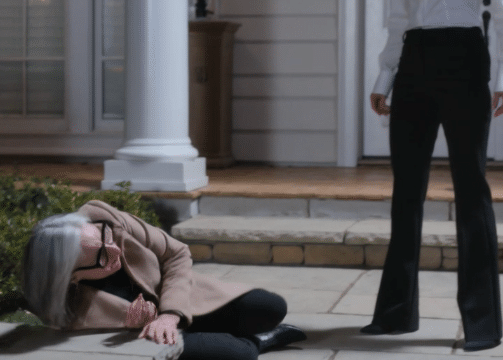
Helena lay stunned on the stone, hair across her face, gasping at the sky.
Then she saw the uniforms.
The ropes.
The cameras.
The truth.
“What is this?” she shrieked.
Marcus unzipped his jacket and removed the small microphone clipped beneath the collar.
“An investigation,” he said.
Helena stared at him.
“You said you loved me.”
Marcus looked down at her with no expression.
“I said what I needed to say so you would keep talking.”
Only then did Helena understand the depth of her mistake.
Marcus Vale was not an investment consultant.
He was not her escape.
He was not the man who would help her turn murder into freedom.
He was an investigator hired after the first suspicious transfers. When the evidence became bigger than fraud, he worked with Elias, Ingrid, and law enforcement to catch the plan before Helena could make it look like an accident.
Helena’s face changed.
Not grief.
Not remorse.
Calculation.
“Elias is dead,” she said suddenly. “You can’t prove anything.”
From below, a voice rose through the wind.
Weak.
Rough.
Alive.
“You should have looked down before celebrating.”
Helena froze.
Ingrid appeared first at the top of the path, walking beside the rescue team.
Then Elias came into view, secured in a rescue chair, pale but conscious, his dark hair whipped by the wind. His eyes were fixed on his wife.
Helena made a sound that was almost a sob.
Not because he was alive.
Because she was finished.
Act IV
The arrest happened on the cliff edge where Helena had planned to become a widow.
There was no dramatic chase.
No final clever speech.
Just the click of hand restraints, the wind, and Helena repeating that everyone had misunderstood while every recording proved they had understood perfectly.
Elias watched from a few feet away.
He had imagined anger.
He had imagined shouting.
He had imagined asking her why, even though the answer had been standing beside him for months in designer coats and unsigned transfers.
But when the moment arrived, he felt only exhaustion.
Helena looked at him as the officers led her past.
“Elias,” she said, suddenly soft. “Please.”
That was the cruelest voice of all.
The one she used when she wanted to be saved.
He looked at the woman he had loved, the woman who had learned his pain schedule, his medication drawer, his fears, and had used all of it to make him easier to remove.
“No,” he said.
One word.
Small.
Final.
Her face hardened instantly.
The mask dropped.
“You think they’ll stay when they see what you are?” she snapped. “You think anyone wants this life with you?”
Ingrid stepped forward, but Elias raised a hand.
He wanted Helena to say it.
All of it.
In front of witnesses.
In front of cameras.
In front of the mountain.
Elias met her eyes. “I thought you were tired of my wheelchair.”
Helena’s laugh was sharp and broken. “I was tired of being buried with you.”
The officers pulled her back.
Marcus looked away.
Even he seemed disgusted by the honesty he had forced from her.
Elias did not answer.
Because there are some sentences that reveal the speaker so completely that replying only makes them smaller.
By the time they reached the parking area, police vehicles waited beside the trailhead. Tourists stood at a distance, confused and whispering. A rescue helicopter moved somewhere beyond the ridge, its sound rising and fading through the clouds.
Helena was placed in a vehicle.
Marcus gave a statement.
Ingrid wrapped a thermal blanket around Elias’s shoulders, though he insisted he was not cold.
“You are shaking,” she said.
“I’m angry.”
“You can be both.”
He almost smiled.
Almost.
Later, in the hospital, officers played back the recording.
The push. The whisper. The confession. Helena’s words after she believed Elias was gone. Marcus’s staged betrayal. Helena’s panic. Her final cruelty.
Elias sat in bed with bruised hands and a face that looked older than it had that morning.
His lawyer, a careful woman named Sofie Lund, closed the file and said the charges would be severe.
Attempted murder.
Conspiracy.
Financial fraud.
Evidence tampering.
The list continued.
Elias stopped listening halfway through.
“Was she ever going to leave me alive?” he asked.
No one answered.
That was answer enough.
Then Sofie placed another document on the table.
“There’s something else,” she said.
Elias frowned.
His father’s trust had included a clause no one had needed until now. If a spouse or family member attempted to benefit financially through harm, every personal claim was voided immediately. Helena would receive nothing. Not the house. Not the shares. Not the insurance.
Everything she had tried to steal would be protected.
But there was one detail Elias did not expect.
His father had named Ingrid as emergency trustee.
Not because he distrusted Elias.
Because he distrusted charm.
Elias read the clause twice, then laughed once under his breath.
His father had been dead for four years.
And still, somehow, he had reached into the cold room and closed the door Helena had tried to escape through.
Act V
The trial began six months later.
By then, Helena had changed her hair, changed lawyers, and changed her story three times.
First, she said Elias had asked to be near the cliff edge and the wheelchair slipped.
Then she said Marcus manipulated her.
Then she said the entire thing had been a cruel setup designed to ruin her because Elias was bitter she wanted a divorce.
But recordings do not care about beauty.
Bank records do not care about tears.
And mountain rescue cameras do not care how softly someone speaks in court.
The jury saw the cliff.
They heard the wind.
They heard Helena whisper, “Finally.”
Elias did not watch her face when the audio played.
He watched the jurors.
One woman pressed her lips together. One man looked down at his hands. Another stared at Helena with the kind of quiet horror that made her lawyer shift uncomfortably.
Marcus testified for three hours.
He admitted the deception. He explained the investigation. He described how Helena had escalated from fraud to “an accident that would solve everything.”
When Helena’s lawyer accused him of leading her on, Marcus did not flinch.
“I gave her opportunities to choose differently,” he said. “She used every one to plan more carefully.”
Ingrid testified last.
She did not cry. She did not dramatize. She simply described the safety rig, the rescue team, the risk, and the brother who had agreed to stand at the edge of his own marriage so the truth could be caught before it became a funeral.
When Elias took the stand, the courtroom changed.
People expected bitterness.
Instead, he spoke calmly.
He told them about the crash, the recovery, the marriage, and the slow humiliation of realizing his wife did not see him as a man anymore, only as an obstacle with paperwork attached.
Helena looked away first.
That mattered.
After the verdict, Elias returned to the harbor house.
Not immediately.
First, he spent several weeks with Ingrid in a smaller home near the water, where there were no marble stairs, no rooms decorated by Helena, no closets full of coats she had worn like costumes.
He learned how to sleep again.
That took longer than he expected.
Betrayal has a way of returning at night, wearing the face it used to wear when it said good morning.
But life returned in pieces.
Coffee on the balcony.
Physical therapy at dawn.
Board meetings where no one used his wheelchair as proof that he had become fragile.
A new ramp built down to the docks.
A dog Ingrid insisted he adopt, a stubborn gray rescue named Otto who disliked everyone except Elias and the elderly mailman.
The cliff became famous for the wrong reasons.
Reporters called it “the Voss betrayal.” Documentaries came. Strangers sent messages. Some kind. Some invasive. Most useless.
Elias ignored them.
Then, one year after the trial, he went back.
Not to the exact edge.
Not for drama.
For himself.
Ingrid came with him. So did Otto, who hated the wind and made that clear with offended little huffs. The sky was overcast again. The fjord lay dark below, the mountains quiet and severe around them.
Elias sat in his wheelchair several yards from the drop.
Safe distance.
Firm ground.
No one behind him.
For a long time, he said nothing.
Ingrid stood beside him, hands in her pockets.
“Do you regret the sting?” she asked.
Elias watched a bird move through the gray air.
“I regret needing it.”
That was the truth.
He did not regret surviving. He did not regret exposing Helena. He did not regret the trust his father had built like a hidden wall around him.
But he regretted the version of himself that had smiled back at her on the cliff because some final foolish part of his heart still hoped she would stop.
Otto placed his chin on Elias’s knee.
Elias looked down and scratched behind his ear.
“She thought the chair made me helpless,” he said.
Ingrid’s voice was soft. “She was wrong.”
Elias nodded.
The wind moved across the cliff, cold and clean.
Below, the fjord held its silence.
For the first time since that day, Elias did not hear Helena’s whisper in it.
Finally.
Now we can be together.
He heard something else.
His own voice in the courtroom.
His own voice at the cliff edge.
His own voice saying no.
People often imagined survival as a loud thing. A victory. A triumph. A moment with music swelling behind it.
But for Elias, survival was quieter.
It was sitting beneath the same sky where someone tried to erase him and realizing he was no longer afraid of the view.
Helena had pushed him toward the edge believing his life was over.
Instead, she had pushed the truth into the open.
And truth, once it reached the cliffside wind, did not fall.
It carried.