Act I
The violin hit the grass before the applause ever had a chance to begin.
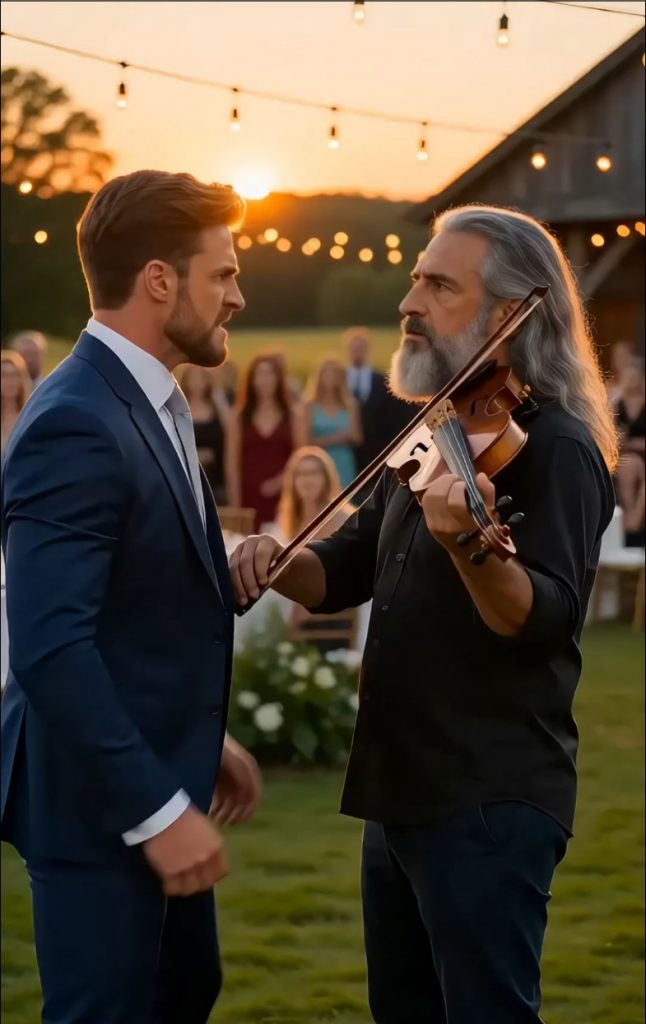
One moment, the old musician was standing beneath the string lights, bow lifted, gray hair glowing in the sunset. The next, Grant Whitmore’s hands slammed into his chest, and the man went backward onto the lawn.
A dull thud rolled through the reception.
The bow clattered beside him.
The guests gasped, then fell silent.
Grant stood over him in a navy tuxedo, his jaw tight, his polished shoes planted in the manicured grass as if the whole estate existed only to obey him.
“Pick your junk up and get off my property!” he shouted.
The violinist did not scramble.
He did not plead.
He sat slowly upright, one hand closing around the neck of the violin. His black shirt was dusted with grass. His face was calm in a way that made the air feel colder.
The party had been beautiful until then.
White linen tables. Floral centerpieces. Champagne glasses catching the golden light. A rustic barn behind them, polished and restored for the kind of celebrations that looked effortless only because someone else had paid for every detail.
Grant had paid for this one.
At least, that was what everyone believed.
He was the host, the groom-to-be, the man of the hour. He had spent the evening making sure no one forgot it. Every toast mentioned his success. Every guest admired his estate. Every server moved faster when he looked their way.
And then the violinist had started playing.
Not the song on the program.
Not the cheerful arrangement Grant had approved.
Something slower.
Older.
A melody so gentle and sad that a few elderly guests looked up as if hearing a ghost call their names.
Grant’s face changed immediately.
He crossed the lawn before the second phrase ended.
Then came the shove.
Now the old violinist looked up at him from the grass, eyes steady beneath his gray brows.
“You have no idea,” he said, voice low and controlled, “what mistake you just made.”
Grant’s anger flickered.
Only for a second.
But the guests saw it.
And from the far edge of the lawn, near the barn doors, Grant’s fiancée turned pale as if she had recognized the song too.
Act II
The estate was called Briarfield.
For nearly a century, it had belonged to the Ashford family, though Grant liked to tell people he had “saved” it.
He said the old place had been rotting when he found it. He said he had restored the barn, revived the orchard, refinanced the land, and turned a fading family property into an event destination worthy of investors.
What he did not say was that Briarfield had never belonged to him.
Not fully.
It belonged to his fiancée, Clara Ashford.
Clara was the last living granddaughter of Margaret Ashford, the woman who had run the estate before age and illness took her voice. Grant had met Clara at a fundraising dinner two years after Margaret’s first stroke, when Clara was exhausted, overwhelmed, and still mourning the parents she had lost young.
Grant arrived like an answer.
He was charming, efficient, good with numbers, and excellent at making difficult decisions sound like love.
“You shouldn’t have to carry all this alone,” he told her.
Within six months, he was handling the contractors.
Within nine, he was negotiating with lenders.
Within a year, he had convinced Clara to sign limited authority over the estate’s finances.
“You’re not losing control,” he promised. “You’re letting me protect you.”
Clara wanted to believe him.
Everyone did.
Grant had a talent for making domination look like competence.
But Briarfield had one rule Grant could never understand: the estate was not valuable because of its land. It was valuable because of what people had left inside it.
Old letters in cedar boxes. War medals in drawers. Sheet music in the piano bench. Photographs of weddings, wakes, harvests, birthdays, and children running through grass that had not yet been turned into a luxury venue.
At the center of that history was a song.
“Briarfield Lullaby.”
Margaret’s late husband had written it for their first child. For decades, it was played at family weddings, not as entertainment, but as a blessing. No one announced it. No one explained it. When the first notes began, every Ashford knew to stand still and remember.
Grant hated it.
He called it gloomy.
He said it ruined the mood.
But Clara had asked the violinist privately to play it anyway, just once, during sunset, before the speeches began. She had found his name in an old address book hidden in Margaret’s desk.
Elias Voss.
Violinist.
Friend of the family.
Please call if Briarfield needs music.
Clara did not know he was more than that.
Grant did.
That was why he reacted before anyone else understood.
Because he had seen Elias’s name somewhere else.
On a document he had stolen from Margaret’s locked cabinet.
And now the old man he thought he had buried in paperwork was sitting in front of him, holding a violin, looking at him like judgment had finally accepted an invitation.
Act III
Grant forced a laugh.
It sounded wrong.
“What mistake?” he snapped. “You think because you play sad music, people owe you respect?”
Elias looked at the violin in his hand.
The instrument was old, its varnish worn at the edges from decades of use. There was a scratch near the bridge and a small silver plate beneath the chin rest, dulled by time.
He brushed a blade of grass from the wood.
“No,” he said. “I think because I was invited, you should have asked who invited me.”
Grant’s eyes moved to Clara.
She stood near the nearest table, her hands clasped in front of her pale dress. Her mouth parted, but no words came.
Grant turned on her.
“You brought him?”
Clara swallowed. “I asked him to play Grandmother’s song.”
“I told you that song was not to be played.”
The sentence landed badly.
Not like a preference.
Like an order.
Guests shifted. Someone set down a champagne glass too loudly. Clara’s expression changed in a small but important way.
For the first time, she looked embarrassed not by the scene, but by him.
Elias slowly rose to his feet.
He was not tall, but he had presence. The kind that did not push into a room because it had already survived enough rooms to stop asking permission.
Grant stepped closer. “You are done here.”
“No,” Elias said. “I’m afraid you are.”
A murmur moved through the guests.
Grant smiled, but the edges of it were thin now.
“Excuse me?”
Elias reached into the inner pocket of his black jacket and withdrew a folded envelope sealed with old cream wax.
Clara’s breath caught.
The seal was unmistakable.
An ash branch pressed into wax.
The Ashford family mark.
Elias held it out to her, not Grant.
“Your grandmother asked me to give you this when a man tried to sell Briarfield without your full consent.”
Grant went still.
Clara stared at the envelope.
“What?”
Grant lunged for it.
Elias moved faster than anyone expected, pulling it back just enough.
The guests gasped again.
Grant’s face darkened.
“You’re lying.”
Elias’s gaze did not move.
“Am I?”
From the barn doorway, an elderly woman in a wheelchair appeared, pushed by a private nurse.
Margaret Ashford.
The lawn seemed to stop breathing.
Grant’s lips parted.
Clara’s eyes filled instantly.
“Grandmother?”
Margaret had not appeared publicly in nearly a year. Grant had told everyone her condition was too fragile. He had told Clara visits upset her. He had controlled the schedule, the nurses, the calls, the access.
But now Margaret sat under the barn lights in a pale blue shawl, one hand resting on the arm of her chair, the other curled around a small recorder.
Her voice, weak but clear, came through the device when the nurse pressed play.
“If Elias is standing on my lawn,” the recording said, “then Grant has shown you who he is.”
Grant took a step back.
And Clara, trembling, broke the seal.
Act IV
The letter was short.
Margaret had never wasted words.
My darling Clara,
If you are reading this, then I was right to be afraid.
Briarfield is not to be sold, leveraged, or transferred without your direct consent and the approval of the family trust. Grant has no authority beyond the temporary management access you signed under pressure. I revoked that access six weeks ago.
Elias Voss is not merely an old friend. He is a trustee of Briarfield and the legal witness to your grandfather’s final amendment.
Trust him.
Do not marry a man who mistakes stewardship for ownership.
Clara read the last line twice.
Grant’s face had gone bloodless.
“That’s not valid,” he said.
Elias looked at him. “It is.”
“You can’t just appear at my event with some sentimental nonsense and—”
“Your event?” Clara asked.
Her voice was quiet.
But it cut deeper than shouting.
Grant turned to her. “Clara, don’t be dramatic.”
Something in the guests shifted. A few heads turned. A few eyes narrowed. Everyone heard the familiar cruelty under the polished tone.
Clara held the letter in both hands.
“You told me she couldn’t speak.”
Grant’s jaw tightened.
“She can barely speak.”
“You told me she didn’t recognize me.”
“She has episodes.”
Margaret lifted her hand.
The nurse pressed another button.
This time, the recording was Grant’s voice.
“Once Clara signs after the wedding, the trust won’t matter. Margaret won’t be around forever, and Clara doesn’t have the spine to fight me.”
A woman at the nearest table covered her mouth.
Grant’s eyes snapped toward the recorder.
“You recorded me?”
Margaret’s smile was faint but devastating.
The nurse spoke for her. “Mrs. Ashford records all legal visits now. Doctor’s recommendation.”
Elias stepped forward.
“You tried to isolate her. You tried to sell land that was not yours. And tonight, when you heard the family song, you shoved the one person Margaret trusted to protect Clara.”
Grant looked around the lawn.
No one moved toward him.
Not his friends.
Not his investors.
Not even the men who had laughed at his sharper jokes all night.
Public power is a fragile thing. It depends on people agreeing not to look too closely.
Now everyone was looking.
Clara slowly removed the engagement ring from her finger.
Grant saw it and his expression cracked.
“Clara.”
She looked at him with tears in her eyes, but her voice did not shake.
“You don’t love me. You love access.”
“That is insane.”
“No,” she said. “What’s insane is that I almost let you convince me this place was a burden.”
She placed the ring on the nearest table.
It sounded tiny against the china.
But everyone heard it.
Grant’s breathing grew harsh.
“You’ll regret humiliating me.”
Elias’s eyes hardened.
“You shoved an old man in front of witnesses, threatened a trustee, and attempted to defraud a protected estate. I would choose my next sentence carefully.”
For once, Grant did.
He said nothing.
The hired security guards, who had been standing uncertainly near the bar, finally approached.
This time, they did not look to Grant for instruction.
They looked to Clara.
She nodded once.
“Escort him off my property.”
The words struck him harder than any shove.
Act V
Grant left Briarfield in the back of a black SUV, still in his navy tuxedo, still trying to make phone calls no one answered.
By morning, the engagement was over.
By the end of the week, his management access was frozen, his attempted contracts were under review, and three investors who had planned to help him convert part of the estate into luxury lots denied knowing anything about his pressure campaign.
People always scatter when the scheme loses its shine.
Clara did not read the gossip.
She had enough truth to carry.
For two days, she stayed in Margaret’s room, sitting beside the bed, holding her grandmother’s hand while the older woman drifted in and out of sleep. Sometimes Margaret squeezed her fingers. Sometimes she only watched her with eyes that said everything her body could no longer manage.
Elias visited on the third day.
Not with legal folders.
With the violin.
He stood in the doorway until Clara looked up.
“I owe you an apology,” she said.
“For what?”
“For letting him touch you. For not stopping him.”
Elias stepped inside.
“You were waking up.”
Clara’s face crumpled.
“I should have known.”
“People like him don’t begin with cruelty,” Elias said. “They begin by making themselves useful.”
Margaret’s eyes opened.
A faint sound left her throat.
Elias moved closer and bent his head.
Margaret lifted one trembling finger toward the violin.
He understood.
That evening, they brought her wheelchair to the lawn.
Not for a party.
Not for donors.
For family.
Clara, the nurse, two longtime groundskeepers, the cook who had worked at Briarfield since Clara was a child, and Elias standing under the string lights that still hung from the ruined reception.
The tables were gone.
The flowers had been moved inside.
Only the lawn remained, soft under the amber dusk.
Elias lifted the violin.
This time, no one stopped him.
“Briarfield Lullaby” began again.
The melody floated over the grass, slow and aching, the kind of music that did not ask grief to leave but made room for it to sit beside love.
Clara cried quietly.
Margaret closed her eyes.
When the final note faded, the old woman’s hand relaxed in her lap.
She was still breathing.
Still there.
But Clara understood the gift.
The song had been returned before the silence came.
Margaret passed three weeks later.
Peacefully.
Without Grant near the door.
At the memorial, Clara asked Elias to play the lullaby once more. This time, half the county came. People told stories Clara had never heard: how Margaret paid school fees for a groundskeeper’s daughter, how she let a widowed neighbor live rent-free in a cottage for six years, how she had once sold jewelry to keep the estate workers paid during a bad season.
Briarfield was not a brand.
It was a promise.
Clara began learning how to keep it.
She canceled Grant’s development plans. She opened part of the barn for community music programs. She restored the old tenant cottages instead of demolishing them. She turned the formal lawn into a summer concert space where local musicians were paid properly and treated like honored guests, not background decoration.
On the first anniversary of the broken engagement, Elias returned to the same spot where he had fallen.
The grass had grown thick there.
Clara noticed him looking down.
“Does it still hurt?” she asked.
“My hip? Sometimes.”
“I meant the insult.”
Elias smiled faintly.
“I have survived worse men than Grant Whitmore.”
She believed him.
Later that evening, as guests gathered for the first public concert at Briarfield, Clara stood near the barn and watched Elias tune his violin. Children sat on blankets. Elderly couples settled into chairs. Workers who once served champagne to Grant’s friends now sat at tables as guests themselves.
No one was invisible.
No one was background.
Before the music began, Clara walked onto the small wooden platform and faced the crowd.
“My grandmother believed a place belongs not to the person who controls it, but to the people who are safe there,” she said. “Tonight, Briarfield belongs to everyone who remembers that.”
Applause moved across the lawn.
Elias lifted his bow.
For a moment, Clara saw the scene from a year before: Grant’s hands, the shove, the violin in the grass, the stunned faces, the warning that changed everything.
You have no idea what mistake you just made.
Grant had thought the mistake was insulting a musician with hidden authority.
He was wrong.
His mistake was believing power lived in ownership papers, bank accounts, raised voices, and the ability to make people afraid.
Real power had been in the old woman who planned beyond her silence.
In the musician who stood up slowly with grass on his shirt and truth in his pocket.
In Clara, when she finally took back the words my property and made them mean responsibility instead of control.
The first notes rose into the warm evening air.
This time, no one interrupted.
The violin sang across the lawn, through the lights, over the tables, past the barn, and into the open fields beyond Briarfield.
And Clara understood at last why her grandmother had protected the song.
It was not simply music.
It was memory refusing to be shoved aside.