Act I
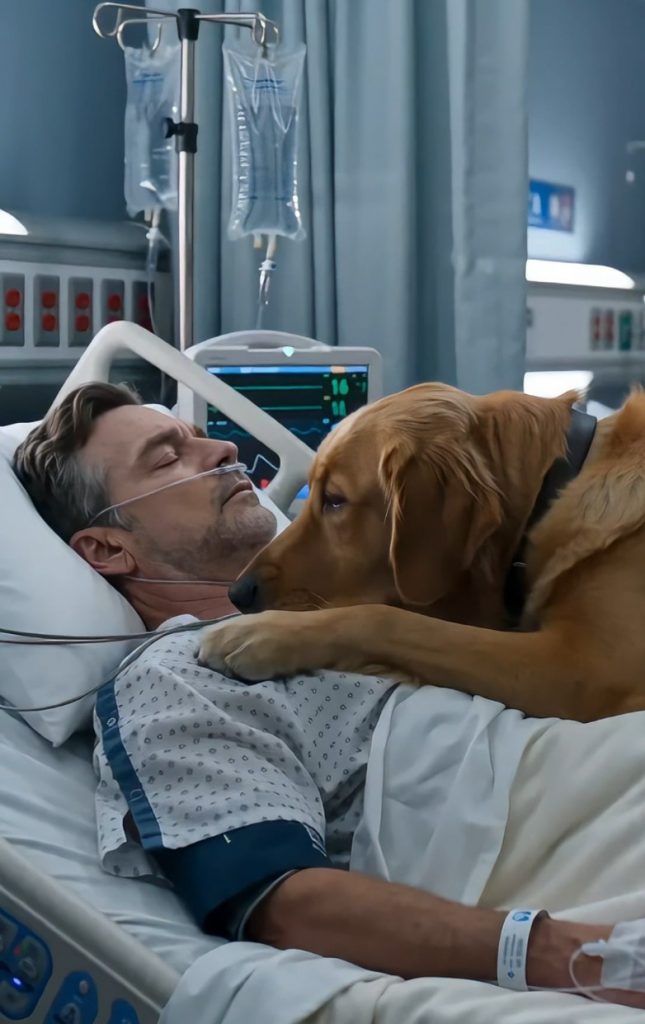
The dog climbed onto the hospital bed like he already knew this was his last chance.
No one stopped him.
Not the nurse standing by the IV pole. Not the woman with her hand pressed over her mouth. Not the man in the dark jacket who had been crying so quietly his shoulders barely moved.
The Golden Retriever placed both front paws on the white sheets and lowered his head onto the patient’s chest.
The man in the bed did not respond.
Thomas Whitaker lay motionless beneath a patterned hospital gown, a nasal cannula tucked beneath his nose, wires running from his chest to the monitor beside him. A green line moved steadily across the screen, followed by the same thin electronic ping that had been filling the room for three days.
Alive.
Technically.
Barely.
The dog’s name was Murphy, and for eight years, he had slept at the foot of Thomas’s bed, followed him through the house, ridden in the passenger seat of his truck, and waited every evening by the front window until Thomas came home.
Now Murphy pressed his muzzle under Thomas’s chin and breathed him in.
Once.
Twice.
Then the dog’s eyes filled.
A clear tear gathered at the corner of his left eye and rolled slowly through the golden fur.
Claire Whitaker broke.
She turned away, but the sob escaped anyway.
Her brother-in-law, Daniel, stood at the other side of the bed, one hand gripping the rail so tightly his knuckles turned white. He had not cried at the accident scene. He had not cried in the waiting room. He had not cried when the doctor said the words “low chance of meaningful recovery.”
But when Murphy cried, Daniel lowered his head.
“No,” he whispered. “Don’t do this to me, Tom.”
The monitor beeped.
Steady.
Cold.
Unmoved.
Claire leaned over her husband, trembling. “Tom, please. If you can hear us, please.”
Murphy lifted his eyes toward the monitor.
Then toward Thomas’s face.
Then he did something no one in the room expected.
He pressed his paw gently against Thomas’s chest.
Not hard.
Not rough.
Just once.
Like a knock on a door.
The monitor beeped louder.
Claire froze.
Daniel’s head snapped up.
The green line jumped.
And beneath the white sheet, Thomas Whitaker’s finger moved.
Act II
Three days earlier, Thomas had been driving home in the rain with Murphy in the back seat.
That was what everyone knew.
What no one understood was why he had taken the old mountain road instead of the highway.
Thomas was not reckless. He was a careful man, almost annoyingly careful. He checked tire pressure before road trips. Replaced smoke detector batteries every January. Labeled boxes in the garage even when everyone laughed at him for it.
So when the sheriff called Claire and said Thomas’s truck had gone through the guardrail on Hawthorne Pass, she asked the same question over and over.
“Why was he up there?”
Nobody had an answer.
Murphy had been found nearly half a mile from the crash site, soaked, muddy, and barking at the road until a passing driver stopped. The dog led rescuers through the trees to the wreckage below.
Thomas was unconscious, trapped, and barely breathing.
The paramedics said Murphy saved his life.
The doctors said saving his life might not mean bringing him back.
For seventy-two hours, Claire lived in the space between those two sentences.
She sat beside the bed and watched the monitor. Daniel made phone calls. Nurses came and went. Doctors spoke in careful tones. Everyone used soft voices, which Claire began to hate because soft voices made bad news sound polite.
Thomas remained still.
Then came the conversation in the hallway.
The neurologist, kind but exhausted, told Claire that Thomas’s brain activity was weak. There were reflexes, but no true response. They could continue supportive care, but the family needed to discuss what Thomas would have wanted.
Claire knew what Thomas would have wanted.
He had written it down.
No machines if there’s no hope.
But hope was a cruel thing in a hospital room. It did not leave all at once. It hid in eyelids, fingers, breaths, numbers on screens. It made you bargain with beeps.
Daniel insisted they wait.
Claire accused him of refusing reality.
Daniel accused her of giving up.
They said things siblings-in-law should never say beside a man who could not defend either of them.
Then Murphy arrived.
The hospital did not usually allow pets in the ICU, but one nurse had seen the local news clip of Murphy leading rescuers to the wreck. She spoke to the charge nurse. The charge nurse spoke to the doctor. A special exception was made.
“Ten minutes,” they said.
Just enough time to say goodbye.
Claire almost refused.
She did not think she could survive watching Murphy search Thomas’s face and find nothing there.
But Daniel said, “He earned the right.”
So Murphy came in with wet eyes, a brushed coat, and a collar Thomas had bought him at a roadside farm stand years ago.
Blue leather.
Silver tag.
MURPHY — IF LOST, CALL TOM.
Claire saw the tag and almost fell apart before the dog reached the bed.
But Murphy did not act lost.
He acted certain.
And that certainty became the first crack in the room’s despair.
Act III
The monitor changed again.
Not dramatically at first.
Just enough for the nurse to step forward.
“Hold on,” she said.
Claire looked at Thomas’s hand.
“Did you see that?”
Daniel’s voice was barely audible. “I saw it.”
Murphy lifted his head, ears rising slightly, eyes fixed on Thomas.
The monitor beeped stronger.
The nurse pressed a button on the wall. “I need Dr. Patel in here now.”
Claire clutched the bed rail.
“Is he waking up?”
“I don’t know yet.”
The answer was honest, which made it terrifying.
Thomas’s eyelids fluttered.
Not open.
Not fully.
But enough.
Claire made a sound that was half sob, half prayer.
“Tom?”
Murphy whined softly and pressed closer.
The nurse tried to move him back, but Dr. Patel entered and stopped her with a raised hand.
“Leave the dog for now.”
He came to Thomas’s side, checked his pupils, called his name, gave instructions to the nurse, and watched the monitor with controlled intensity.
“Mr. Whitaker,” he said firmly. “Thomas, if you can hear me, squeeze your wife’s hand.”
Claire slid her fingers into Thomas’s.
Nothing.
Her face crumpled.
Then Murphy nudged Thomas’s wrist.
The fingers closed.
Weakly.
But unmistakably.
Claire gasped so sharply Daniel reached for her elbow.
Dr. Patel’s expression changed.
Not into celebration.
Doctors learn not to celebrate too early.
But into focus.
“Again,” he said. “Thomas, squeeze again.”
This time, the movement came faster.
Claire began to cry openly.
Daniel covered his face.
Murphy laid his head down beside Thomas’s arm and let out one long trembling breath.
Dr. Patel looked at the nurse.
“Call neuro. Get imaging ready. And document response to verbal command.”
Claire did not understand every word.
She understood enough.
Thomas was not gone.
Not yet.
Maybe never had been.
As the room filled with motion, Daniel stepped back toward the wall. His face had gone pale, but not from fear.
From memory.
Claire saw it.
“Daniel?”
He did not answer.
He was staring at Murphy.
Then at Thomas.
Then at the blue leather collar.
“What is it?” Claire asked.
Daniel swallowed.
“Tom wasn’t supposed to have Murphy in the truck.”
Claire blinked through tears. “What?”
Daniel’s voice shook.
“He told me he was going to take him somewhere safe.”
The hospital sounds seemed to fall away.
Claire stared at him.
“Safe from what?”
Daniel looked toward Thomas, then lowered his eyes.
“From me.”
Act IV
The truth came out in pieces.
Not all that night. Not while doctors moved around Thomas’s bed and the monitor kept beeping like a fragile promise.
It came later, in the waiting room, under fluorescent lights that made everyone look guilty.
Daniel sat across from Claire with his hands clasped, his eyes fixed on the floor.
“I borrowed money from Tom,” he said.
Claire was too exhausted to react at first.
“How much?”
Daniel closed his eyes.
“Enough.”
That word told her everything.
Daniel had always been the charming one. The younger brother with big plans, bad timing, and a talent for making disasters sound temporary. Thomas had rescued him for years. Loans. Jobs. A place to stay after the divorce. Repairs on cars Daniel could not afford.
Claire had argued with Thomas about it more than once.
“He’s using you,” she had said.
Thomas always answered the same way.
“He’s my brother.”
But two weeks before the accident, Thomas discovered Daniel had used his name to secure another loan.
A dangerous one.
Not from a bank.
From men who did not send polite reminders.
“They threatened him?” Claire whispered.
Daniel nodded, tears sliding down his face.
“They came to the house when you were at work. Tom didn’t tell you because he didn’t want you scared. He said he was taking Murphy to your sister’s farm until he figured it out.”
Claire’s hands went cold.
“Why Murphy?”
Daniel’s mouth twisted in pain.
“Because they said they’d start with what he loved.”
Claire stood so quickly her chair scraped backward.
“You knew?”
Daniel looked up, wrecked.
“I didn’t know they’d follow him. I swear. I called Tom that night to warn him. I told him not to take Hawthorne Pass.”
Claire’s voice was barely more than a breath.
“But he did.”
Daniel nodded.
“He said the highway was too exposed. He thought the mountain road would lose them.”
The room tilted.
The accident had not been an accident.
Not completely.
Thomas had been running from a threat created by the brother now sobbing into his hands.
Claire wanted to hate Daniel.
Part of her did.
But hatred had nowhere to land cleanly. Daniel had not pushed the truck off the road. He had not meant for this to happen. He had simply built a fire and acted surprised when it burned someone else.
“Why didn’t you tell the police?” she asked.
Daniel’s face collapsed.
“I was afraid.”
Claire looked through the glass wall toward the ICU doors.
Murphy was still inside with Thomas, calm now, watching him breathe.
“Tom almost died because you were afraid.”
Daniel had no answer.
By morning, he gave one.
He walked into the sheriff’s office and told them everything.
Names. Numbers. Messages. Threats. The loan. The men who had followed Thomas’s truck in the rain.
The investigation would take months.
But the first arrest came within forty-eight hours.
The second came three days later.
Daniel was charged too, though not for the crash itself. Fraud. false statements. financial crimes tied to the debt that had started it all.
Claire did not protect him.
Thomas, when he was finally awake enough to understand, did not either.
But when Daniel came to the hospital in handcuffs before his arraignment and stood at the doorway sobbing, Thomas lifted one weak hand.
Daniel broke down.
“I’m sorry,” he said.
Thomas’s voice was rough, barely there.
“I know.”
Daniel waited for forgiveness.
Thomas did not give it.
Not yet.
Instead, Thomas looked at Murphy, then back at his brother.
“Tell the truth.”
Daniel nodded.
And for once in his life, he did.
Act V
Recovery was not a miracle.
Not the kind people make movies about.
Thomas did not sit up the next morning laughing. He did not walk out of the ICU while nurses applauded. He did not become instantly whole because a dog cried on his chest and a monitor changed its rhythm.
He fought for every inch.
First came waking.
Then confusion.
Then pain.
Then the frustration of a body that remembered strength but could not reach it.
His right hand trembled for weeks. His speech came back slowly. Sometimes he lost words in the middle of sentences and closed his eyes until they returned. Claire learned the language of recovery: therapy schedules, swallow tests, medication changes, insurance calls, small victories no one outside a hospital would understand.
Murphy became part of the treatment plan by refusing to be anything else.
He lay beside the bed during exercises. He rested his head on Thomas’s knee when frustration turned sharp. He barked once when Thomas tried to stand without help, which brought two nurses running and earned him the title of “unlicensed supervisor.”
Thomas called him Sergeant Murphy after that.
The name stuck.
Three months after the accident, Thomas came home.
The house had changed.
Claire had installed grab bars in the bathroom, moved furniture, taped down rugs, and placed a hospital bed in the den, though Thomas hated it on sight.
Murphy loved it.
He jumped onto it the moment Thomas arrived, circled twice, and settled as if inspecting the work.
Thomas looked at Claire.
“He thinks it’s his.”
Claire smiled through tears.
“It probably is.”
Daniel went to prison that fall.
Before sentencing, he stood in court and gave a statement that did not ask for pity. He admitted the fraud. He admitted the debt. He admitted that fear had made him selfish, and selfishness had nearly cost his brother his life.
Thomas attended in a wheelchair.
Claire sat beside him.
Murphy was not allowed in the courtroom, but he waited outside with a volunteer from the victim services office, wearing his blue collar and watching every door.
When Daniel turned to Thomas, his voice broke.
“You saved me my whole life,” he said. “And I repaid you by making you run.”
Thomas did not speak for a long time.
Then he said, “You didn’t make me run.”
Daniel looked confused.
Thomas’s eyes moved toward the courtroom doors, toward the place where Murphy waited beyond them.
“You made me choose what I had to protect.”
That sentence stayed with everyone.
After Daniel was led away, Claire pushed Thomas’s wheelchair into the hallway. Murphy stood the moment he saw him, tail sweeping the floor.
Thomas reached down with his good hand.
The dog pressed his head into Thomas’s palm.
No tear this time.
Only warmth.
A year later, the hospital invited Murphy back.
Not as an exception.
As a guest of honor.
They were starting a therapy dog program in the ICU, inspired partly by what the nurses still called “the Whitaker moment.” Dr. Patel insisted the phrase was medically imprecise. The nurses ignored him.
Thomas walked into the hospital lobby with a cane in one hand and Murphy’s leash in the other.
Slowly.
Carefully.
Alive.
Claire walked beside him, one hand hovering near his back even though he kept telling her he was fine.
“You are not fine,” she said.
“I am extremely fine.”
“You almost fell getting out of the car.”
“Gracefully.”
Murphy sneezed.
Claire laughed.
Thomas looked down. “Traitor.”
In the ICU, the nurse who had allowed Murphy’s visit cried when she saw them. She tried to hide it and failed.
Thomas hugged her with one arm.
“Thank you for breaking the rules,” he said.
She shook her head.
“I think Murphy did that.”
They brought him to the room where it had happened.
Not the same patient now. Not the same family. But the same blue-gray walls. The same monitor glow. The same kind of silence, heavy with waiting.
Thomas stood in the doorway for a moment.
Claire watched his face.
“You okay?”
He nodded.
Then stopped.
“No,” he said honestly. “But I’m here.”
Murphy stepped forward and leaned gently against his leg.
That was enough.
The therapy program began with one dog.
Then three.
Then seven.
Families who had been sitting in sterile rooms with nothing to hold but fear suddenly had fur beneath their fingers, warmth beside the bed, a breathing reminder that love could enter even places built around machines.
Not every patient woke.
Thomas knew that.
Claire knew that.
Murphy seemed to know it too.
But sometimes, a hand moved.
Sometimes, breathing changed.
Sometimes, grief softened enough for people to say what they needed to say.
And sometimes, a Golden Retriever climbed onto a hospital bed, put his head on a man’s chest, and refused to believe the story was finished.
Years later, when Thomas told people about the accident, he never began with the crash.
He began with the beep.
The ordinary, relentless beep of a monitor in a cold hospital room.
Then the louder one.
The one that made Claire lift her head.
The one that made Daniel confess.
The one that made doctors rush in and nurses cry and Murphy open his wet eyes like he had been waiting for the world to catch up.
Thomas did not call it a miracle.
He said miracles were too easy to misunderstand.
“It was loyalty,” he would say, resting one hand on Murphy’s graying head. “And loyalty is harder. It stays after the miracle part is over.”
Murphy grew old slowly, then all at once.
His muzzle whitened. His steps shortened. He slept more deeply and barked less often. But every night, he still made his way to Thomas’s side of the bed and rested where he could hear him breathe.
One evening, years after the ICU, Thomas woke to find Claire standing in the doorway, watching them both.
“What?” he asked.
She smiled softly.
“Nothing.”
Murphy sighed in his sleep.
Thomas placed a hand on the dog’s side and felt the steady rise and fall.
Alive.
Technically.
Fully.
Beautifully.
Outside, rain tapped lightly against the windows.
Inside, no machines beeped.
No doctors whispered.
No one stood waiting to say goodbye.
There was only a man, his wife, and the dog who had once cried over his chest until the heart monitor answered.