Act I
The basement was silent until the dog stopped walking.
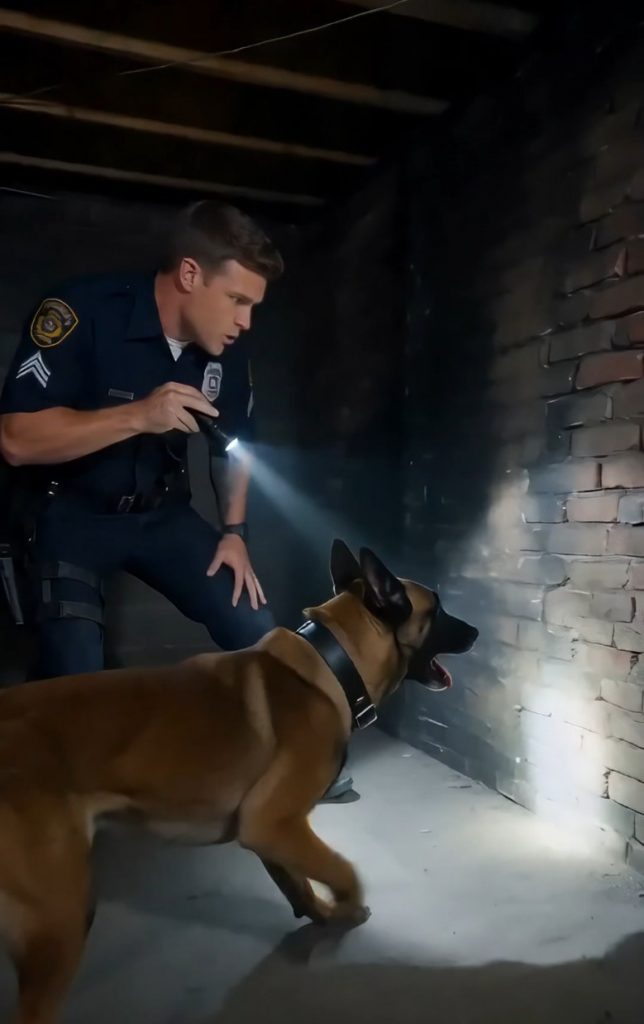
Officer Daniel Reeves felt it through the leash before he understood it with his eyes. Nax, his Belgian Malinois, had gone rigid beside him, paws planted on the dusty concrete, black ears pitched forward toward the old brick structure in the center of the room.
Daniel lifted his flashlight.
The narrow beam cut through the darkness, sliding over exposed beams, cracked concrete, and a soot-darkened wall that looked like it had been swallowing secrets for years.
“Nax,” Daniel whispered.
The dog did not blink.
His nose hovered inches from the lower bricks. His breathing changed, quick and sharp, the way it did when scent became certainty.
Daniel had followed Nax into drug houses, storm drains, abandoned warehouses, and half-collapsed trailers. He knew the difference between curiosity and an alert.
This was not curiosity.
This was urgency.
“Show me, Nax.”
The dog lunged.
His claws scraped the brick, metal collar shifting as his whole body drove toward the wall. Dust shook loose from the mortar lines. Somewhere behind the bricks came a faint sound.
Not the house settling.
Not a rat.
A scrape.
Daniel’s hand tightened around the flashlight.
He angled the beam lower, staring at the uneven brickwork. The basement smelled of damp concrete, old ash, and something recently disturbed. The mortar looked older in some places, newer in others, as if someone had patched a weak spot and hoped darkness would hide the difference.
Nax barked once.
Then he stepped back, lowered his head, and slammed his shoulder into the wall.
The impact cracked through the basement.
Dust burst into the flashlight beam.
“Nax!” Daniel snapped, but the command died halfway out.
Because from behind the bricks came another sound.
A small, terrified whimper.
Daniel’s blood went cold.
He crouched beside the dog, flashlight steady now, every nerve in his body alive.
“Police!” he called toward the wall. “Can you hear me?”
Nothing.
Then Nax hit the wall again.
The brick shifted.
A thin black gap opened in the red and gray.
Daniel leaned closer.
Inside that gap, something moved.
A pale hand flashed in the darkness, then vanished.
For one frozen second, Daniel forgot the dust, the cold, the house, even the woman upstairs who had sworn no one else was home.
There was a child behind the wall.
And someone had sealed him in.
Then the scream came from the staircase.
Act II
The call had started as a welfare check.
Not dramatic. Not urgent enough for sirens. Just a neighbor on Crescent Lane saying she had not seen little Eli Porter in three days.
Eli was seven.
He lived with his aunt, Marla Voss, after his mother died the previous winter. According to Marla, the boy was “difficult,” “withdrawn,” and “always running off when he wanted attention.”
Daniel had heard that kind of language before.
Adults used it when they wanted a child’s fear to sound like misbehavior.
When he arrived, Marla answered the door before he knocked twice. She was dressed in dark clothing, her long hair loose around her shoulders, her face pale beneath the porch light.
“Officer,” she said. “I already told the school he’s with relatives.”
“Which relatives?”
“My cousin. Out of town.”
“Name?”
Her eyes flicked down to Nax.
“Is the dog necessary?”
Daniel did not answer right away.
Behind her, the house was almost completely dark. No television. No child’s voice. No movement except the slow swing of a kitchen light at the far end of the hallway.
“I need to speak with Eli,” he said.
“He isn’t here.”
“Then I need to verify where he is.”
Marla’s mouth tightened. “You people never cared when my sister was alive. Now suddenly everyone’s worried?”
Daniel kept his voice calm. “A teacher called. A neighbor called. His doctor’s office called after he missed an appointment.”
Marla laughed once, sharp and empty.
“Eli misses things all the time.”
Nax shifted beside Daniel.
The dog’s nose lifted.
He was scenting through the open doorway.
Marla saw it and stepped into the gap, blocking him.
Daniel looked past her shoulder.
A child’s backpack sat under the hallway bench. Small sneakers lined the mat. A blue lunchbox rested beside the stairs, still zipped.
Children who left town usually took their shoes.
And their lunch.
“Ms. Voss,” Daniel said, “I’m coming in.”
She argued. Then she cried. Then she threatened to call a lawyer.
But when backup was requested and the word “warrant” entered the conversation, something in her face went flat.
She stepped aside.
The house looked normal at first.
Too normal.
Eli’s room had been cleaned with almost violent care. The bed was made. The drawers were shut. The shelves had been wiped down. Even the stuffed fox on the pillow sat upright, facing the door like a prop.
But Nax ignored the bedroom.
He ignored the bathroom.
He ignored the kitchen.
At the basement door, he stopped.
A low whine pressed out of his throat.
Daniel turned his flashlight toward Marla.
Her face had changed again.
Not sad now.
Afraid.
“There’s nothing down there,” she said quickly. “Just old junk. The stairs are unsafe.”
Nax scratched once at the door.
Hard.
Daniel opened it.
Cold air rose from below.
The dog surged down the stairs so fast Daniel had to tighten the leash and follow at an angle. His boots struck the wood, then concrete. The flashlight beam swung over exposed joists, shadowed corners, and a brick structure that might once have been a fireplace.
Nax went straight to it.
Straight to the sealed section.
Straight to Eli.
Daniel did not know that yet.
But Marla did.
And when the first brick cracked, her secret began to breathe.
Act III
Nax hit the wall a third time.
This time, the sound was different.
Not just impact.
Breakthrough.
A cluster of old mortar snapped loose. One brick tipped inward, then dropped, clattering into the hidden space behind the wall. Dust rolled outward in a thick gray cloud, coating Nax’s muzzle and Daniel’s sleeve.
The dog pushed forward, panting hard, eyes fixed on the opening.
Daniel grabbed his radio.
“Unit Twelve. I need fire rescue and additional officers at 38 Crescent Lane. Possible child trapped behind a basement wall.”
The words sounded unreal even as he said them.
Possible child.
Trapped.
Behind a wall.
He lowered himself to one knee and shone the light into the gap.
At first, the beam caught only brick dust and darkness.
Then a face appeared.
Small.
Dirty.
Terrified.
The boy huddled behind the broken bricks with his knees drawn up, one arm shielding his eyes from the sudden light. His gray shirt was smeared with soot and dust. His lips trembled, but no words came out.
“Eli,” Daniel said softly.
The boy flinched.
Daniel forced his voice lower, gentler.
“My name is Officer Reeves. I’m here with Nax. We’re going to get you out.”
Eli’s eyes moved from the flashlight to the dog.
Nax had gone still.
All that violent force, all that frantic determination, had vanished into a careful, watchful quiet. He stood at the edge of the broken wall as if guarding the opening from the entire world.
Eli’s breath hitched.
“Dog,” he whispered.
Daniel swallowed hard.
“Yeah. He found you.”
Above them, a floorboard creaked.
Daniel turned his head.
The basement stairs were dark.
Too dark.
“Nax,” he said quietly.
The dog’s ears snapped toward the stairwell.
Then Marla screamed.
She burst into view at the top of the stairs with an iron axe gripped in both hands, hair flying around her face, eyes locked not on Daniel, but on the broken wall.
“No!”
She charged downward.
The axe lifted over her shoulder.
Daniel twisted away from the opening, one hand still holding the flashlight, the other reaching for his sidearm but not drawing yet. There was a child behind him. A dog beside him. A narrow staircase in front of him.
And a desperate woman coming down with nothing left to lose.
Nax moved first.
He sprang between Daniel and the stairs, barking with a force that shook the basement.
Marla faltered.
Only one step.
But one step was enough.
Her foot slipped on the dusty edge of the stair. The axe handle struck the railing with a sharp crack, throwing her balance sideways. Daniel surged up, caught her wrist, and drove her back against the wall before she could raise it again.
“Drop it!” he shouted.
The axe fell.
It hit the stairs and slid down two steps before stopping.
Marla fought for half a second, wild and breathless, then seemed to empty all at once. Daniel secured her hands behind her back as another officer thundered down the stairs.
From the cavity, Eli began to cry.
Not loudly.
Not like a tantrum.
Like a child who had been holding fear inside his chest because fear was all he had left.
Daniel looked over his shoulder.
Nax had returned to the broken wall.
The dog stood there, body angled between Eli and everyone else.
And in that moment, Daniel understood this was not just a rescue.
It was the end of a lie someone had built brick by brick.
Act IV
Fire rescue arrived seven minutes later.
To Eli, it must have felt like another lifetime.
The basement filled with noise: boots, radios, tools, clipped instructions, and the steady voice of a firefighter telling him not to move toward the broken edge. Dust floated in the flashlight beams like ash.
Daniel stayed beside the opening.
Nax stayed beside Daniel.
Marla sat on the basement floor near the stairs, cuffed and shaking, watched by two officers. She was no longer screaming. That made her more frightening somehow. Her face had gone blank, as though she had retreated into some private place where what she had done could not reach her.
“Why?” Daniel asked her once.
She stared at the broken wall.
“He wasn’t supposed to find it,” she whispered.
Daniel crouched in front of her. “Find what?”
Her mouth closed.
But Eli heard.
From inside the wall, his voice came small and rough.
“Mom’s tin.”
Daniel turned back.
“What tin, Eli?”
The boy coughed softly, then pointed with one dusty finger toward the old fireplace base.
“There,” he whispered. “Behind the loose brick. Mom said not to tell Aunt Marla.”
A firefighter paused.
Daniel followed the direction of the boy’s hand and found a brick different from the others. Older. Smoke-stained. Not part of the new patch.
He worked it loose carefully.
Behind it sat a small metal cookie tin wrapped in plastic.
Marla made a sound behind him.
Not fear.
Defeat.
Daniel handed the tin to the evidence officer without opening it, but Marla’s reaction had already told him enough. Whatever was inside mattered. Maybe money. Maybe documents. Maybe the thing Eli’s mother had hidden before she died.
The thing Marla had been willing to bury a child to protect.
The firefighters widened the opening slowly, removing one brick at a time, checking the structure before each movement. Eli watched every hand, every tool, every falling piece of mortar with huge eyes.
“You’re doing great,” Daniel told him.
“I didn’t run away,” Eli whispered.
“I know.”
“She said everybody would think I did.”
Daniel’s throat tightened.
“No one thinks that now.”
Eli looked at Nax again. “He heard me?”
“He smelled you first,” Daniel said. “Then he heard you.”
“I tried yelling.”
“I know.”
“My voice stopped.”
Daniel leaned closer to the opening.
“But you didn’t stop being there,” he said. “And Nax didn’t stop looking.”
Eli’s eyes filled again.
When the last brick came free, the firefighters reached inside and eased him out with careful hands. He was so small under all that dust. Smaller than Daniel expected. Smaller than any child should look after being found behind a wall.
The paramedic wrapped a blanket around him.
Eli clung to the edge of it, trembling.
Then he reached one hand toward Nax.
Daniel gave the dog a quiet command.
Nax stepped forward and lowered his dusty head.
Eli touched his ear.
The basement seemed to exhale.
No one cheered. No one clapped. Some moments were too heavy for noise.
But every adult in that room understood what had just happened.
A boy had been erased.
A dog had refused to let him disappear.
And the tin from behind the fireplace was about to explain why.
Act V
Inside the tin was a photograph, a key, and a letter from Eli’s mother.
Her name was Rachel Porter.
She had known she was dying, but she had also known something else: her sister Marla was stealing from the estate, pressuring her to change guardianship papers, and trying to sell the house before it legally passed into Eli’s trust.
The letter was written in a shaky hand, but the message was clear.
If anything happens to me, Eli is not to remain with Marla. The house belongs to my son. The bank records are in the storage unit. The key is inside this tin. Please believe my child if he says he is afraid.
Please believe my child.
Those four words followed Daniel for days.
Marla had counted on the world doing the opposite.
She had built her story carefully. Eli was difficult. Eli was dramatic. Eli made things up. Eli ran away when he did not get attention.
By the time she sealed him behind the old brick structure, she had already prepared the explanation.
The missing boy was not missing.
He was misbehaving.
That was the cruelty of it.
Not just the wall.
The story around the wall.
But stories built on lies collapse quickly once the right brick comes loose.
The storage unit revealed bank documents, forged signatures, and recordings Rachel had made before her death. The school counselor came forward with notes from Eli’s quiet warnings. A neighbor remembered seeing Marla carrying bags of mortar into the house two nights before the welfare check.
The truth assembled itself slowly, then all at once.
Eli survived.
That was the miracle Daniel held onto.
At the hospital, after the dust had been washed from his hair and the blanket had been replaced with clean sheets, Eli asked for the dog before he asked for food.
So Daniel brought Nax.
The hospital made an exception after hearing what happened.
When Nax entered the room, Eli sat up as much as the nurse allowed. His face was pale, his eyes tired, but something changed when he saw the Malinois at the door.
The fear loosened.
Just a little.
“There he is,” Daniel said.
Nax walked to the bed with unusual care, as if he understood the room required gentleness. Eli reached down, and the dog rested his head beside the boy’s hand.
“You broke the wall,” Eli whispered.
Nax blinked up at him.
Daniel smiled faintly. “He’s been bragging about it all morning.”
Eli’s mouth lifted at the corner.
It was barely a smile.
But it was real.
Across the room stood Hannah Porter, Rachel’s cousin and the guardian named in the recovered documents. She had driven through the night after police contacted her. When she saw Eli, she did not rush him. She did not overwhelm him with promises.
She simply placed his stuffed fox on the bed.
Eli stared at it for a long moment.
Then he pulled it against his chest and began to cry.
Hannah sat beside him and waited.
That was all.
She waited.
For a child who had been trapped in darkness, patience was its own kind of rescue.
Weeks later, the house on Crescent Lane was sealed with police tape. The basement wall was gone. The brick structure had been dismantled, photographed, and carried away as evidence.
Marla’s lies did not survive the investigation.
Neither did the version of Eli she had tried to create.
He was not difficult.
He was not dramatic.
He was not a runaway.
He was a little boy who had told the truth in the only ways he knew how, while adults were still deciding whether to listen.
Nax had listened first.
At the department ceremony, Daniel stood beside his K9 partner as the chief placed a small medal on the dog’s collar. Cameras flashed. Officers clapped. Nax sat tall and proud, his tan coat clean now, his black mask bright under the lights.
Eli stood nearby with Hannah’s hand on his shoulder.
He still startled at loud sounds. He still disliked closed doors. Some nights, he woke crying from dreams he could not explain.
Healing did not arrive like a rescue team.
It came slowly.
In safe rooms. In patient voices. In doors left open. In the soft weight of a stuffed fox under his arm.
When the ceremony ended, Eli walked to Nax and placed both small hands on the dog’s face.
“Thank you,” he whispered.
Nax leaned forward and pressed his nose gently to Eli’s chest.
Daniel looked away for a moment.
Not because he was embarrassed.
Because some victories were too tender to stare at directly.
Later, Eli would keep a photo from that day on the desk in his new room. In it, Daniel stood straight in uniform, Nax sat alert at his side, and Eli stood close enough to touch the dog’s collar.
Behind them, everyone was smiling.
But Eli liked the photo for another reason.
It proved something.
The wall had been real.
The darkness had been real.
The fear had been real.
But so was the sound of paws on concrete.
So was the flashlight cutting through dust.
So was the dog who would not stop ramming the bricks until the hidden boy was seen.
And every time Eli looked at that picture, he remembered the truth that saved him.
Some people build walls to bury secrets.
But love, loyalty, and a good dog can tear them down.