Act I
The little girl was crying so hard she could barely walk.
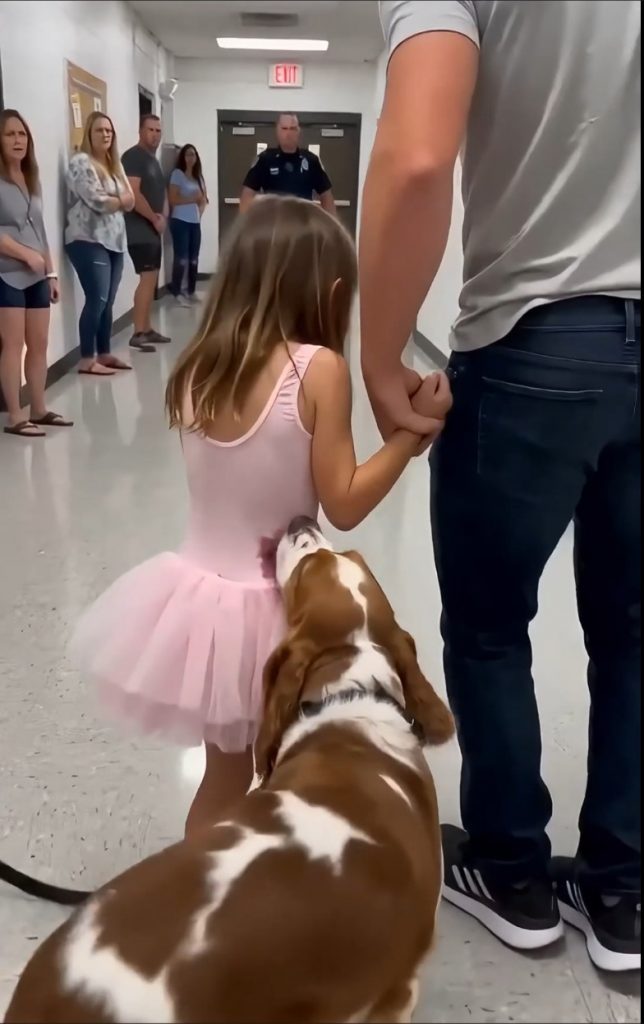
Her white sandals slipped against the gray tile as the man dragged her down the hallway by the arm. She wore a pink ballet leotard with a matching tutu, the kind of outfit meant for twirling under stage lights, not stumbling beneath fluorescent bulbs while strangers stared from the wall.
The man leaned close to her ear.
“Keep walking,” he hissed. “Don’t try to—”
He stopped because the dog had gotten too close.
A brown-and-white Spaniel trotted beside them on a retractable leash, nose low, ears swinging, eyes fixed on the back of the girl’s dress. It was not distracted by the crowd. Not confused by the echoing hallway. Not interested in the man’s shoes, the bystanders, or the glowing EXIT sign at the end of the corridor.
Only the girl.
Only the back of her tutu.
The child sobbed into her hand, shoulders shaking.
A police officer in a dark blue uniform watched from farther down the hall. He had been speaking with event staff near the double doors when the crying started. At first, he thought it was a parent rushing a tired child out of a dance recital.
Then he saw the man’s grip.
Too tight.
Too angry.
Too certain no one would challenge him.
The Spaniel stopped suddenly and pushed its nose toward the girl’s lower back. It sniffed hard, then nudged the pink fabric once, twice, insistently.
The man jerked the child forward.
“Move.”
The dog followed.
That was when Officer Nathan Brooks stepped into the hallway.
He saw the stain.
Dark purple-pink across the back of the girl’s pale ballet outfit, spreading just above the waistband of the tutu. Not a normal spill. Not something a child would be dragged away for in silence.
The dog sat beside her and stared at the officer.
The man tried to keep walking.
Nathan’s voice cracked through the hallway like a slammed door.
“Let go of her arm.”
Every bystander froze.
The man released her so quickly the girl stumbled.
She looked down at the floor, trembling, tears still running down her cheeks.
“I didn’t mean to,” she whispered.
Nathan’s expression changed.
Because the words were not a confession.
They were something a frightened child says when she has been trained to apologize for being hurt.
Act II
Her name was Sophie Vale.
She was six years old, though everyone said she looked younger when she was scared.
That afternoon should have been the happiest day of her little life. The community center was hosting its annual spring recital, and Sophie had practiced her butterfly dance for nine weeks in the corner of her bedroom, spinning carefully so she would not bump the dresser.
Her mother, Elise, had sewn tiny pearl beads along the edge of the pink tutu.
Sophie believed they were magic.
Her stepfather, Grant, called them ridiculous.
Grant Vale was the kind of man who smiled in photographs and lowered his voice at home. In public, he wore plain shirts, helped carry folding chairs, and told other parents Sophie was “sensitive.” At home, sensitive became a weapon.
Too loud.
Too slow.
Too messy.
Too much like her father.
Sophie’s real father, Adam, had died when she was three. She remembered almost nothing about him except his laugh, his big hands, and the way he used to call her “little star.” Elise kept his photo beside Sophie’s bed until Grant moved into the house.
Then the frame disappeared.
Elise asked once.
Grant said it was unhealthy for the child to cling to ghosts.
After that, Elise stopped asking in front of Sophie.
What no one knew was that Elise had been trying to leave.
Quietly.
Carefully.
She had spoken with a family attorney. She had kept copies of documents at her sister’s house. She had begun recording Grant’s threats on an old phone hidden behind the linen closet.
Grant found out two days before the recital.
That morning, Elise was missing from the audience.
Grant told everyone she had a migraine.
Sophie knew better.
Mommy never missed dancing.
She searched every row from behind the curtain, her small hands twisting the edge of her tutu. She saw mothers holding flowers, fathers with phones raised, grandmothers waving from folding chairs.
No Elise.
Only Grant standing at the back with his arms crossed.
When Sophie’s music began, she forgot the first move.
The audience waited.
Someone coughed.
Grant’s face tightened.
Then Sophie saw the Spaniel.
The dog sat near Officer Brooks, part of a children’s safety demonstration scheduled after the recital. Its ears were long and silky, its eyes gentle. It looked at Sophie with such calm attention that she remembered the dance.
She lifted her arms.
She spun.
For one minute, she was a butterfly.
Then, backstage afterward, everything went wrong.
Act III
Nathan did not touch Sophie at first.
He lowered himself slightly, keeping his hands visible, his voice calm.
“What’s your name, sweetheart?”
The girl looked at the man before answering.
That told Nathan too much.
The man snapped, “She’s my daughter. She’s having a tantrum.”
Nathan did not look away from Sophie.
“Is that true?”
Her lips moved, but no sound came out.
The Spaniel pressed closer to her side.
His name was Scout.
He was not a patrol dog in the traditional sense. He belonged to the department’s youth outreach unit, trained to help calm children during interviews and alert to certain distress cues during school and community events. Nathan had worked with him for three years.
Scout was gentle with children.
But he did not alert for nothing.
Nathan turned his eyes to Grant.
“I asked you to step back.”
Grant’s jaw flexed.
“We’re leaving.”
“No,” Nathan said. “You’re staying right here.”
Bystanders shifted against the wall. No one spoke.
That was the part that made Nathan angry in a deep, familiar way. A hallway full of adults had heard a child sobbing. They had seen her being pulled. They had watched the dog try to show them something was wrong.
And still, everyone waited for permission to care.
Sophie hugged herself, crying harder now.
“I didn’t mean to,” she repeated.
Nathan softened his voice.
“What didn’t you mean to do?”
Grant answered for her.
“She spilled punch on herself. Then she started screaming. She does this. She lies for attention.”
Scout’s head snapped toward him.
A low sound came from the dog’s throat.
Not a growl.
A warning.
Nathan saw Grant’s hand curl into a fist, then relax.
“Sir,” Nathan said, “put both hands where I can see them.”
Grant laughed once.
“You’re serious?”
“Very.”
A woman stepped forward from the bystanders. She wore a navy cardigan and had a staff badge clipped to her shirt.
“I saw them backstage,” she said quietly.
Grant turned on her.
“Stay out of this.”
Nathan moved half a step between them.
The woman swallowed but continued.
“She was crying before the spill. He was angry. I heard him tell her she ruined everything.”
Sophie covered her face.
Nathan crouched lower.
“Sophie,” he said, using the name printed on the small recital tag pinned to her costume. “Did someone tell you not to talk?”
Her shoulders shook.
Grant’s voice cut in.
“She’s confused.”
Nathan looked at him.
“No. She’s terrified.”
The hallway went silent.
Scout leaned his head against Sophie’s leg.
And finally, the little girl whispered, “He said Mommy won’t come back if I tell.”
Act IV
That sentence changed the entire building.
Nathan stood slowly.
“Where is her mother?”
Grant’s face went flat.
“At home.”
“Then we’ll call her.”
“She’s sleeping.”
“We’ll wake her.”
Grant looked toward the EXIT sign.
For one second, he was not a concerned parent. Not even a convincing liar.
He was a man measuring distance.
Nathan saw it.
So did Scout.
The dog stood.
“Don’t,” Nathan said.
Grant stopped.
Radio static cracked at Nathan’s shoulder as he called for another unit and emergency medical support. He kept his voice steady, but his pulse had changed.
A frightened child.
A missing mother.
A man trying to leave quickly.
A stain he did not want anyone to examine.
The pieces were forming a picture Nathan hated.
The staff woman, whose name was Carla, knelt near Sophie with permission and offered her a clean jacket. Sophie hesitated, then let Carla drape it around her front, keeping her small body covered without hiding the visible stain from the officer’s view.
Grant scoffed.
“This is insane.”
Nathan ignored him.
“Sophie, did you get hurt today?”
She shook her head quickly.
Too quickly.
Then she glanced at Grant.
Nathan lowered his voice.
“You’re not in trouble.”
Her face crumpled.
“I fell.”
Grant snapped, “Exactly. She fell.”
Nathan’s eyes stayed on Sophie.
“Where?”
“Backstage.”
“Did someone help you?”
She shook her head again.
Scout nudged her hand.
Sophie looked down at him, and some tiny part of her seemed to trust the dog more than every adult in the hallway.
“He grabbed me,” she whispered. “After I asked where Mommy was.”
Grant lunged verbally.
“You little—”
Nathan stepped into him so fast Grant backed up.
“Enough.”
The second officer arrived through the double doors. Then a school administrator. Then paramedics.
Grant’s confidence began to collapse in stages.
First into outrage.
Then into accusation.
Then into silence.
At the house, officers found Elise locked in an upstairs bedroom, frightened but alive. Grant had taken her phone, hidden her keys, and told Sophie that if she danced badly or spoke to anyone, her mother would be gone forever.
Elise had heard none of the recital.
None of the hallway.
None of her daughter crying.
When officers brought Sophie to the ambulance bay behind the community center, Elise arrived wrapped in a borrowed coat, hair loose, face pale with panic.
Sophie saw her and screamed, “Mommy!”
This time, no one held her back.
Elise dropped to her knees on the pavement and caught her daughter with both arms. Sophie clung to her so tightly the paramedic had to wait before checking either of them.
“I’m sorry,” Sophie sobbed.
Elise held her face.
“No. No, baby. You did nothing wrong.”
Sophie kept crying.
Elise looked over her daughter’s head at Nathan.
Then at Scout.
The Spaniel sat calmly beside the ambulance, ears damp from the mist outside, eyes fixed on the little girl he had refused to ignore.
Elise whispered, “Thank you.”
Nathan looked at the dog.
“He heard her before we did.”
Act V
Grant was arrested before sunset.
The charges were not simple, because harm inside families rarely fits neatly into one box. Unlawful restraint. child endangerment. intimidation. assault. interfering with communication. The legal language sounded clean and narrow compared with the fear he had built inside that house.
But it was a beginning.
Elise gave her statement the next morning.
Then Sophie gave hers two weeks later, in a child advocacy room with soft chairs, crayons, and Scout lying on the rug beside her feet.
She did not have to face Grant.
Nathan made sure of that.
Every time Sophie struggled to speak, Scout lifted his head. She would rest her toes against his side, breathe, and try again.
At one point, the interviewer asked what made her feel safe enough to talk in the hallway.
Sophie looked at Scout.
“The dog knew I was sad,” she said.
Then she added, “And the police man told him it was okay to help me.”
Nathan heard that later and had to step outside.
It was not the worst case he had ever worked.
Not by paperwork.
Not by courtroom standards.
But it stayed with him because of the hallway.
Because of all the adults watching.
Because he knew how easily Grant could have reached the exit if Scout had not stopped walking.
Elise filed for divorce and emergency protection. She moved with Sophie into her sister’s house two towns over, where the bedroom had yellow curtains and a lock Elise controlled herself.
At first, Sophie would not wear pink.
Not the tutu. Not socks. Not hair clips. Nothing.
Elise packed the ballet outfit into a box, unsure whether to save it or throw it away. One night, Sophie found her holding it and said, “Can we make it different?”
So they did.
Elise washed what could be washed and cut away what could not. Together, they turned the tutu into fabric butterflies. Pink wings, pearl beads, uneven little bodies made of ribbon.
They hung them above Sophie’s bed.
The first night, Sophie stared up at them for a long time.
“They don’t look scared anymore,” she said.
Elise lay beside her.
“No. They look free.”
Months passed.
Grant’s case moved forward. Elise testified. Carla testified. Nathan testified. The hallway video confirmed the forced grip, the crying, the dog’s alert, and the moment Sophie said she did not mean to.
The prosecutor used that line carefully.
Not as shame.
As proof.
A child apologizing for distress she did not cause.
Grant’s defense tried to call it a misunderstanding, a stressed parent, a chaotic recital. The jury watched the footage of Scout repeatedly alerting while Grant pulled Sophie toward the exit.
They watched Nathan step in.
They heard Sophie’s small voice.
They did not misunderstand.
After the sentencing, Elise and Sophie went to the community center again.
Not for ballet at first.
Just to walk the hallway.
Nathan met them there with Scout.
The building looked ordinary in daylight. White walls. Gray tile. EXIT sign glowing above the doors. No crowd, no whispering, no forced footsteps echoing toward the exit.
Sophie held her mother’s hand.
Scout walked slowly beside her, matching her pace as if he remembered.
When they reached the spot where Nathan had told Grant to let go, Sophie stopped.
For a moment, no one spoke.
Then she crouched and put both arms around Scout’s neck.
“You’re my good dog,” she whispered.
Scout wagged his tail gently.
Nathan smiled.
“He knows.”
Sophie looked up at him.
“Can I dance again?”
Elise went still.
Nathan did not answer for her.
Elise knelt.
“Only if you want to.”
Sophie thought about it seriously.
“Not butterflies.”
“What then?”
She looked at Scout.
“Dogs.”
For the first time in months, Elise laughed.
A year later, Sophie danced on the same community center stage in a costume she chose herself: blue, not pink, with a little silver star pinned near her shoulder. Elise sat in the front row, crying openly. Carla sat beside her. Nathan stood near the back wall with Scout, officially there for community safety, unofficially there because Sophie had asked.
When the music began, Sophie looked toward the hallway doors.
Only once.
Then she looked at Scout.
The dog sat tall, ears forward, watching her like the most important performance in the world.
Sophie lifted her arms.
She danced.
Not perfectly.
Not like nothing had happened.
Like something had happened, and it had not taken the music from her.
The audience applauded when she finished.
Sophie bowed.
Then she ran offstage straight to her mother, laughing so hard she could barely breathe.
Nathan looked down at Scout and rested a hand on his head.
“Good boy,” he said.
Scout’s tail thumped once against the floor.
The hallway outside remained quiet.
No crying.
No forced footsteps.
No child apologizing for fear.
Just the fading sound of applause, the soft jingle of a dog’s collar, and a little girl learning that being rescued was not the end of her story.
It was the place where her voice began again.