Act I
The courtroom had been silent for almost eight minutes.
That was what everyone remembered later.
Not the judge’s questions. Not the polished wood walls or the microphones on the counsel table. Not even the defendant in his dark suit, sitting with his hands folded as if the entire hearing were an inconvenience he planned to survive.
They remembered the silence before the boy ran.
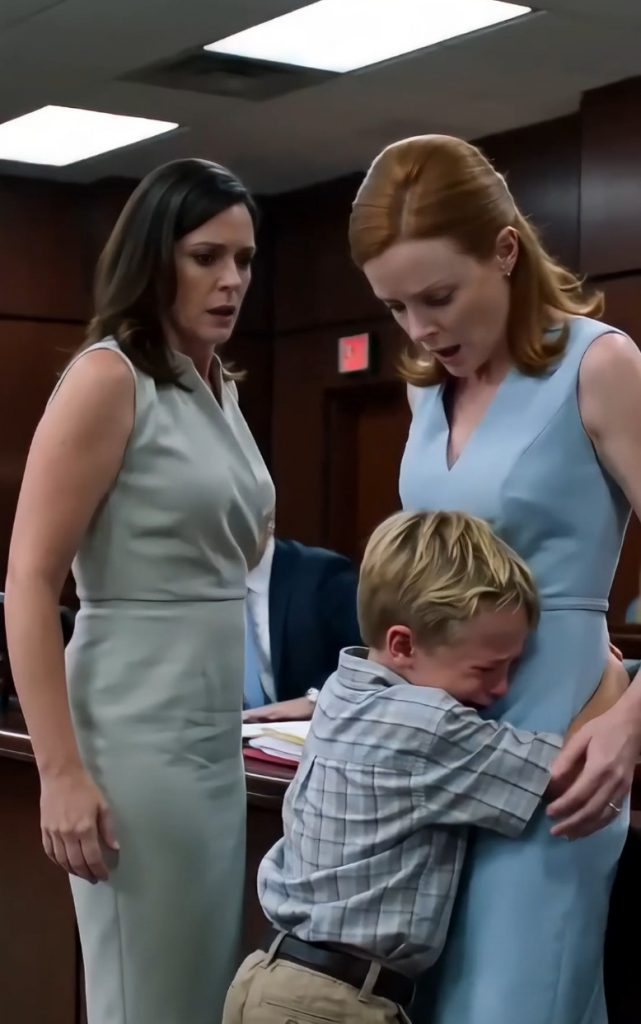
Theo Whitman came from the back of the courtroom with the wild, uneven speed of a child who had been holding something inside too long. His blond hair was messy. His plaid shirt was tucked into tan pants, but one side had come loose. His face was red from crying before he ever reached the front.
“Mom!”
The word tore through the room.
Every adult turned.
At the counsel table, Lydia Whitman stood frozen in a pale blue dress, one hand gripping the edge of the table, her face going white.
Her son slammed into her waist and clung to her like he was afraid she would vanish if he let go.
Lydia did not push him away.
She looked down, stunned, then slowly wrapped one arm around his shaking shoulders.
Theo buried his face against her dress and sobbed so hard his small body trembled.
Across the table, Andrew Whitman shot to his feet.
His chair scraped the floor with a harsh sound that made the gallery flinch.
For three weeks, Andrew had sat through the hearing as the grieving widower, the respectable father, the man who wanted only justice for his dead second wife and stability for his traumatized son.
Now his face had changed.
Not grief.
Panic.
Theo lifted his tear-streaked face from Lydia’s dress.
“I know who it was,” he said, his voice trembling.
The courtroom went still.
Andrew leaned forward, eyes sharp. “Theo!”
The shout cracked like a whip.
Theo flinched.
Lydia tightened her arm around him.
Judge Elaine Mercer leaned forward from the bench. “Mr. Whitman, sit down.”
But Theo was already crying harder, gasping between words, trying to force out the sentence he had been too terrified to say.
“No,” he sobbed. “It was… it was my…”
His eyes moved toward the defense table.
Toward Andrew.
Then toward the woman sitting behind him in pearls, his grandmother, Helen Whitman, who had not blinked once since the boy entered.
Theo’s voice broke.
“It was my grandma.”
Act II
Six months earlier, Lydia had been told she would never see Theo alone again.
The words came from a judge, but Lydia heard Andrew’s voice behind them.
Temporary restriction pending investigation.
That was what the order said.
A clean phrase.
A merciless phrase.
It meant Lydia could not pick her son up from school. She could not tuck him into bed. She could not answer when he called her name in the hallway outside the supervised visitation room and reached for her through a social worker’s arms.
Andrew had cried in court that day.
Lydia had not.
That hurt her case.
People trusted tears when they came from men in good suits. They distrusted silence from women who had run out of ways to prove they were bleeding.
Lydia was not Theo’s birth mother.
That had been used against her from the beginning.
She had married Andrew when Theo was three, two years after his first wife, Maren, died in a boating accident. Andrew spoke of Maren with careful sadness. Helen, his mother, spoke of her like a saint whose place no woman could ever fill.
Theo had been shy then. A pale, watchful little boy who carried a stuffed fox everywhere and refused to sleep unless the closet light stayed on.
Lydia did not try to replace his mother.
She made pancakes shaped like moons because Theo liked space. She learned the names of his dinosaurs. She sat outside his bedroom during nightmares and told him stories through the door until he opened it.
One morning, half-asleep, he called her Mom.
Lydia cried in the pantry where no one could see.
Andrew loved the idea of that at first.
He loved posting photographs of their “healed family.” He loved guests praising Lydia for her patience. He loved the way Theo’s softness made him look like a devoted father who had overcome tragedy.
But Andrew’s love always had an audience.
At home, everything changed.
Andrew controlled money, schedules, phone calls, friendships. When Lydia asked questions about Maren’s accident, he called it morbid. When Theo had nightmares about “the dock lights,” Andrew told him dreams were not memories.
Helen was worse.
She ruled the Whitman house with perfume, pearls, and quiet cruelty. She called Lydia “the new wife” even after four years. She corrected Theo when he called Lydia Mom.
“You only have one mother,” Helen would say.
Theo would look down and whisper, “I know.”
The night everything collapsed, Lydia had gone to the police.
Not because of Andrew.
Because of Theo.
He had woken screaming, saying he saw someone push Maren. Not in a dream, he insisted. He remembered rain, a red scarf, Helen’s voice, and his father telling him to be quiet.
Lydia did not know what was true, but she knew fear.
She wrote down every word.
Andrew found the notebook.
By morning, he accused Lydia of manipulating Theo, inventing memories, and trying to steal control of Maren’s estate money, which had been placed in trust for Theo.
Two weeks later, Lydia was arrested for allegedly falsifying evidence and threatening Andrew during a domestic dispute he staged beautifully.
The larger hearing was supposed to decide whether she had coerced Theo into lying.
Andrew brought experts.
Helen brought tears.
Lydia brought the notebook.
But Theo had been kept away from her for months.
Until that morning, when a court-appointed child advocate brought him to observe only part of the proceeding.
No one expected him to run.
No one expected him to speak.
And Andrew Whitman had clearly believed fear would keep his son silent one day longer.
He was wrong.
Act III
The judge cleared the courtroom.
Not completely.
The jury was not present because this was an evidentiary hearing, but the gallery still held reporters, relatives, and strangers who had followed the case because wealthy families and dead wives make people curious in ways they rarely admit.
Judge Mercer ordered a recess, then called counsel into chambers.
Theo refused to release Lydia’s dress.
The child advocate tried to coax him gently.
He shook his head until he nearly choked on his sobs.
“No. I want Mom.”
Lydia looked at the judge.
“Please,” she whispered. “I won’t ask him anything. Just let me sit with him.”
For the first time that morning, Judge Mercer’s face softened.
“Five minutes,” she said. “In this room. With the advocate present.”
Andrew objected instantly.
“That woman has already poisoned him.”
Theo screamed.
Not words.
Just fear.
Everyone stopped.
Because fear has a sound adults cannot argue with once it escapes a child.
The advocate knelt beside him and spoke softly until he could breathe again. Lydia sat on the floor, uncaring of the courtroom, her pale blue dress pooling around her knees while Theo curled against her side.
He whispered into her shoulder.
“I didn’t want them to take you too.”
Lydia closed her eyes.
“Who, baby?”
Theo looked toward the counsel table.
Andrew stood there, fists clenched. Helen sat behind him, her pearl necklace still perfectly centered, her eyes cold.
Theo’s voice dropped.
“Grandma said if I told, you’d go in the lake like first Mommy.”
The advocate went still.
So did the judge.
Lydia felt the entire room tilt.
Maren.
For years, Maren had been framed as an accident, then a tragedy, then a sacred subject no one was allowed to touch. But Theo had been there the night she died. A toddler, yes. Small. Confused. Easy to dismiss.
Not empty.
Children remember in fragments.
A scarf.
A light.
A hand.
A sentence repeated in fear.
Theo had not known what the fragments meant until Lydia gave him safety enough to speak.
The court reconvened an hour later under a different kind of silence.
Judge Mercer ordered Theo’s statement to be taken by a forensic child specialist, not in open court. Andrew argued again. His attorney tried to regain control. Helen dabbed at dry eyes with a handkerchief.
But something had shifted.
Everyone had seen Andrew shout.
Everyone had seen Theo flinch.
Everyone had seen the boy choose Lydia, the woman accused of manipulating him, over the father who claimed to protect him.
Then came the evidence Lydia had almost forgotten.
Her notebook.
On the last page, beneath Theo’s description of the dock lights, she had written one strange detail.
Grandma smelled like roses and smoke.
Maren had been wearing a red scarf the night she died.
Helen wore rose perfume every day.
And the original accident report mentioned a cigarette ember found on the wet dock, though neither Andrew nor Maren smoked.
Helen did.
The prosecutor, who had been quietly reviewing the old Maren Whitman file for weeks, stood.
“Your Honor,” she said, “the state requests immediate preservation of all records related to Maren Whitman’s death.”
Helen’s face finally moved.
Not much.
But enough.
Lydia saw it.
So did Andrew.
And in that tiny break between mother and son, Lydia understood the truth was bigger than one lie.
Act IV
The old case reopened in less than forty-eight hours.
Not officially at first.
Official things require signatures, warrants, procedures, polite language around ugly facts. But behind the scenes, people began pulling files that had sat untouched for years.
Maren Whitman had died on a private dock during a family weekend at the lake house.
Andrew said she slipped.
Helen said she had gone inside early and heard nothing.
The housekeeper said she saw Helen burning something in the kitchen fireplace the next morning, but no one asked her twice. The dock camera had been “out of service.” The neighbor across the water had reported hearing a woman argue, but the storm made voices impossible to identify.
Impossible then.
Not now.
Because Lydia’s notebook contained the phrase Theo had repeated during nightmares.
Don’t wake your father.
That had never made sense.
If Andrew had been there, why would Helen say not to wake him?
Because Andrew had not killed Maren.
Helen had.
And Andrew, discovering it later, had helped bury the truth to preserve the family name, the estate, and his own access to Maren’s trust.
Theo’s forensic interview gave investigators the missing shape.
He remembered his first mother crying near the dock. He remembered his grandmother angry about “leaving with the money.” He remembered a red scarf falling. He remembered his father arriving afterward and saying, “You didn’t see anything.”
No child should have carried that.
No child should have been forced to protect adults from what they had done.
When investigators searched Helen’s old lake house storage room, they found a box labeled Christmas linens.
Inside was Maren’s missing red scarf.
The one Andrew said must have been lost in the water.
It had been folded carefully.
Preserved not out of guilt, but possession.
Helen Whitman kept trophies of control.
That was how Lydia’s attorney described it later.
There were letters too. Maren’s letters to a divorce lawyer. A draft custody petition. Financial records proving she intended to remove Andrew from control of the trust if anything happened to her.
Helen had not been protecting her son from a scandal.
She had been protecting an inheritance.
And Andrew, years later, had done the same thing to Lydia when Theo’s memories threatened to surface.
The hearing that began as Lydia’s defense became Andrew’s collapse.
His staged claims against Lydia fell apart under phone records, edited security clips, and messages between him and Helen.
Get the boy back under control.
She is making him remember.
If Lydia talks, we lose everything.
The judge read those messages in silence.
Andrew stared at the table.
Helen stared straight ahead as if dignity could still be arranged around her like furniture.
But Theo was not in the courtroom for that part.
Lydia made sure of it.
He was in a child-friendly room down the hall, coloring planets with the advocate, because truth mattered, but not enough to make him carry more than he already had.
By the end of the week, Lydia’s charges were dismissed.
Andrew was taken into custody on obstruction and related charges.
Helen was arrested two days later for Maren’s death.
When reporters shouted questions outside the courthouse, Lydia said nothing.
She simply held Theo’s hand.
This time, no one pulled him away.
Act V
Theo did not become okay just because the truth came out.
Adults like to imagine confession as a magic door. Open it, and the child steps into sunlight. But children who survive fear do not work that way. They step forward, then back. They ask the same questions at breakfast, in the car, before sleep.
“Is Grandma coming?”
“No.”
“Is Dad mad?”
“Maybe.”
“Can he take me?”
“No.”
“Did I do bad?”
That was the one that always broke Lydia.
She would sit on the edge of his bed, stroke the hair from his forehead, and say, “No, sweetheart. You told the truth. The bad thing was what they made you carry.”
For a while, Theo slept with every light on.
Lydia let him.
He stopped wearing plaid shirts because he said they made him think of court. Lydia packed them away without asking him to be brave.
They moved out of the Whitman house within a month. Lydia wanted nothing from it except Theo’s clothes, his stuffed fox, and the box of drawings Andrew had once dismissed as “emotional nonsense.”
They rented a small house with a yellow kitchen, a fenced yard, and no lake nearby.
Theo chose the room facing the street.
“I want to see people,” he said.
Lydia understood.
The legal process continued for more than a year.
Andrew’s lawyers tried to blame Helen for everything. Helen’s lawyers tried to paint Andrew as the manipulator. In the end, neither loyalty nor betrayal saved them. Paper trails are patient. So are buried statements. So are children’s memories when finally treated with care instead of pressure.
Maren’s name was cleared of the old whispers.
Lydia’s name was cleared of the new ones.
Theo began therapy with a woman who kept a basket of toy animals in her office. At first, he only played with the fox. Then, after several sessions, he added a blue bird.
When Lydia asked what the bird did, Theo said, “It tells people where the fox is hiding.”
Lydia cried in the car afterward.
Not because it was sad.
Because he was learning the language of rescue.
On the first anniversary of the courtroom hearing, Lydia took Theo to the courthouse steps.
He had asked to go.
She was not sure it was a good idea, but his therapist said children sometimes need to see that frightening places do not remain in charge forever.
They stood outside in the afternoon light.
No cameras.
No shouting.
No dark-suited father at the table.
Just stone steps, heavy doors, and pigeons pecking near a planter.
Theo held Lydia’s hand.
“That’s where I yelled,” he said.
“Yes.”
“I was scared.”
“I know.”
He looked up at her. “Were you scared?”
Lydia knelt so they were eye level.
“Very.”
“But you stayed.”
Her throat tightened.
“Yes.”
Theo nodded like that answered something important.
Then he reached into his pocket and pulled out a folded piece of paper. It was a drawing of three figures. A small boy. A woman in a blue dress. Another woman with brown hair and a red scarf, standing behind them like light.
Maren.
Theo’s first mother.
Lydia’s eyes filled.
“I want to keep both moms,” Theo said.
Lydia pulled him close.
“You get to.”
That was the truth Andrew and Helen had tried hardest to destroy.
Love was not a throne with room for only one woman.
Maren was his mother.
Lydia was his mother too.
One had given him life. One had stayed when the truth made staying dangerous. Neither erased the other.
Months later, when Helen was sentenced and Andrew accepted a plea rather than face every charge in open court, Lydia took Theo to Maren’s grave.
They brought white flowers and a small toy bird.
Theo placed the bird beside the stone.
“It’s okay,” he whispered. “I told.”
Lydia stood behind him, one hand over her mouth.
The wind moved through the cemetery grass.
For years, a powerful family had built a house of silence around a child’s memory. They thought time would make him forget. They thought fear would make him obey. They thought the woman who loved him without blood would be easy to remove.
But in a courtroom full of adults, where everyone spoke in legal phrases and careful objections, the truth did not arrive through evidence first.
It came running down the aisle in a plaid shirt.
It screamed “Mom.”
It clung to the woman they tried to take away.
And through tears, trembling so hard he could barely breathe, one little boy finally said the words that brought the whole Whitman family lie to its knees.