Act I
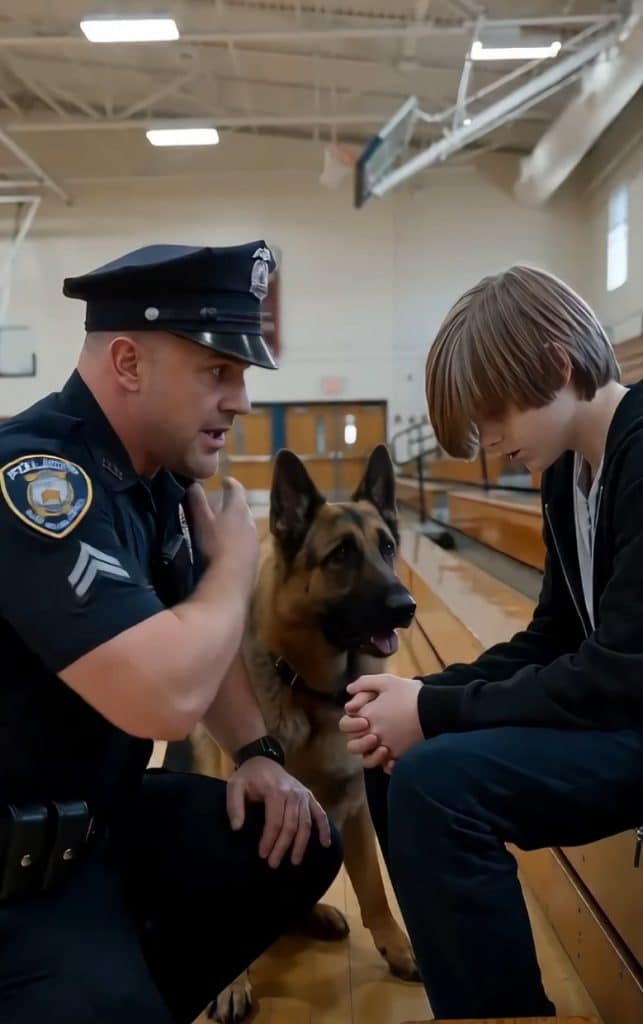
The boy sat alone on the lowest row of the wooden bleachers, trying to disappear inside his black hoodie.
The gym was too bright for secrets.
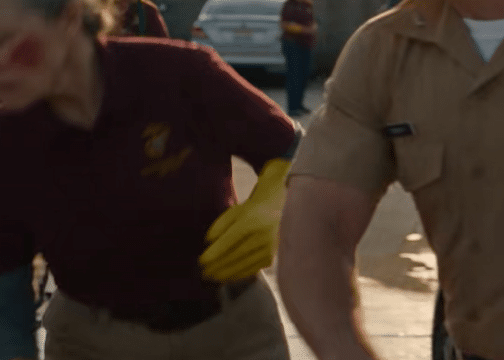
Overhead lights reflected off the polished hardwood court. Basketball hoops hung in the empty air. A yellow mop bucket stood near the far wall, abandoned beside a staff member who had stopped cleaning and started watching.
Officer Ryan Cole crossed the court with his German Shepherd at his side.
Atlas’s claws clicked against the wood.
The boy did not look up.
He was maybe fifteen, pale and thin, with straight light-brown hair falling over his eyes. His hands were clasped tightly in his lap, knuckles pressed together, shoulders hunched as if he could fold himself small enough to escape notice.
Ryan had been called to the school gym for a routine check after an anonymous report about a student hiding something on campus.
He expected contraband.
Maybe a pocketknife.
Maybe pills.
Maybe nothing.
Then Atlas stopped.
The dog’s ears snapped forward.
His nose lifted toward the boy’s hoodie.
Ryan tightened the leash. “Atlas?”
The German Shepherd stepped closer, sniffed once near the boy’s torso, and erupted into urgent barking.
The sound exploded through the empty gym.
The boy flinched but still did not run.
Ryan’s professional calm cracked. Atlas was not giving a narcotics alert. Not an aggression alert either.
This was different.
Sharp.
Immediate.
Distressed.
Ryan moved closer.
“Son,” he said carefully, “look at me.”
The boy’s head tilted just enough for Ryan to see his face. His lips were pale. His eyes were glassy beneath his hair.
Then Ryan looked down.
The boy’s hoodie was partly unzipped.
On the lower front of his gray T-shirt was a small dark red mark.
Ryan’s breath caught.
“Oh my God.”
The boy tried to pull the hoodie closed, but his fingers trembled too badly.
Atlas stopped barking and sat between them, still alert, still staring at the boy like he was guarding him now instead of searching him.
Ryan dropped to one knee.
His voice changed completely.
No command.
No suspicion.
Only urgency.
“Dispatch,” he said into his shoulder radio. “Ambulance needed. We have an injured child.”
The boy finally looked at him.
Not with relief.
With terror.
“Please,” he whispered. “Don’t tell Coach.”
And in that instant, Ryan understood the anonymous call had not been made to expose the boy.
It had been made to silence him.
Act II
The boy’s name was Evan Miller.
Before that afternoon, most teachers at Westbridge High would have described him with the same harmless words.
Quiet.
Polite.
Keeps to himself.
Good grades when he turns things in.
They did not say lonely, because loneliness sounded like something adults were supposed to fix. They did not say afraid, because fear required asking what a child was afraid of.
So they called him quiet.
Evan had transferred to Westbridge at the start of sophomore year after his mother died and his uncle became his guardian. The arrangement was legal, but not warm. His uncle worked nights, slept days, and treated Evan like a box left in the wrong room.
School should have been better.
At first, Evan tried.
He joined the audiovisual club. He stayed after class to ask questions. He volunteered to help livestream basketball games because cameras made more sense to him than people. A camera did what it was told. It did not laugh when your voice shook.
That was how he met Coach Mark Delaney.
At Westbridge, Delaney was more than a coach.
He was a local legend.
Former college player. State championship winner. Smiling face on fundraiser posters. The kind of man parents trusted because he said “teamwork” and “discipline” in the same confident voice.
He also had a private language for boys who disappointed him.
Weak.
Soft.
Waste of space.
Evan heard it through the gym office door more than once while editing game footage. He saw players leave practice with red eyes and forced grins. He saw one senior, Caleb Ross, sit alone in the locker room with his head in his hands while the rest of the team celebrated a win.
Then Evan saw something worse.
It happened after a Friday game.
The livestream camera had kept recording after the final buzzer because Evan forgot to stop the feed. He noticed it only later, while packing cables near the bleachers. On the monitor, in the corner of the frame, Coach Delaney was arguing with Caleb near the equipment hallway.
No sound.
Just movement.
A shove.
A stumble.
A fall out of frame.
Then Delaney looking around before dragging Caleb back toward the locker room.
The next Monday, the school announced Caleb had withdrawn for “personal reasons.”
No one discussed it.
No one asked Evan what he had seen.
But the file stayed on his laptop.
For three weeks, Evan carried it like a burning coal.
He almost deleted it.
Then he saw Caleb’s mother at the grocery store, holding her phone in both hands, staring at a message she could not seem to answer.
That night, Evan copied the video onto a flash drive.
The next morning, he found a note taped inside his locker.
Keep your mouth shut.
Act III
Ryan kept his hand steady as he crouched beside Evan.
The boy was still sitting upright, but barely. His breathing was too shallow. Sweat had gathered along his hairline despite the cool gym air. Atlas pressed closer, not touching him, but close enough to make a barrier between Evan and the rest of the room.
“Evan,” Ryan said softly, reading the student ID clipped to the boy’s backpack. “Help is coming. Stay with me.”
Evan’s eyes darted toward the gym doors.
“Is he here?”
“Who?”
The boy swallowed.
“Coach Delaney.”
Ryan went still.
Behind him, the distant custodian shifted near the mop bucket.
Ryan looked over his shoulder. “Sir, stay where you are.”
The man froze.
“I didn’t do anything,” the custodian said quickly. “I just found him sitting there.”
Ryan heard something in his voice.
Not guilt.
Fear.
“What happened?” Ryan asked.
The custodian glanced at the door, then at Evan.
“I don’t know.”
Atlas turned his head and stared at him.
The man’s face crumpled.
“I didn’t see it happen,” he whispered. “I just heard voices earlier. From the equipment hallway.”
Evan closed his eyes.
Ryan lowered his voice.
“Evan, did someone hurt you?”
The boy’s fingers tightened around the edge of his hoodie.
For a moment, Ryan thought he would not answer.
Then Evan whispered, “They said nobody would believe me.”
“Who said that?”
Evan’s mouth trembled.
“The team captains. Coach said I was confused. He said if I showed anyone the video, they’d say I edited it.”
Ryan’s pulse changed.
“What video?”
Evan slowly unclasped his hands.
In his palm was a small black flash drive.
He had been gripping it so hard it had left marks on his skin.
Ryan took it carefully.
“What’s on this?”
Evan looked toward the locked equipment hallway.
“What really happened to Caleb.”
The gym doors opened.
A man’s voice echoed across the court.
“Officer, I can explain.”
Coach Mark Delaney walked in wearing a Westbridge basketball polo and a smile that never reached his eyes.
Atlas stood.
The German Shepherd moved in front of Evan and let out one low warning bark.
The coach stopped walking.
For the first time since entering, his confidence flickered.
Act IV
Coach Delaney lifted both hands.
“Easy,” he said, giving Atlas a smile meant for humans, not dogs. “No need for drama.”
Ryan rose slowly but stayed between Delaney and the boy.
“Stay back.”
Delaney looked offended.
“That student has been unstable all semester. I was actually the one trying to help him.”
Evan flinched at the word unstable.
Ryan noticed.
So did Atlas.
The dog’s body stayed rigid, ears forward, eyes locked on the coach.
Delaney continued, voice smooth now.
“He’s been spreading stories about our program. I called the office because I was worried he might have brought something dangerous to school.”
Ryan held up the flash drive.
“Like this?”
The coach’s face went blank for half a second.
Then the mask returned.
“I have no idea what that is.”
Evan gave a small, broken laugh.
It was not amusement.
It was the sound of a child realizing a lie was still being told right in front of him.
The school principal arrived next, breathless, followed by an assistant principal and two security staff. The principal’s eyes moved quickly from Evan to Ryan to Delaney.
“What happened?” she demanded.
Ryan did not answer her first.
He spoke into his radio again.
“Send an additional unit. Preserve school camera footage. Possible assault involving a minor and potential evidence tampering.”
The principal paled.
Delaney stepped forward.
“Now hold on—”
Atlas barked once.
Delaney stepped back.
That bark did what adult warnings had failed to do.
It made the room honest.
The custodian finally spoke from across the court.
“I saw the players corner him,” he said.
Every head turned.
His voice shook, but he kept going.
“Near the equipment hallway. Coach came out after. Told me to mind my job if I wanted to keep it.”
The principal looked at Delaney.
“Mark?”
Delaney’s jaw tightened.
“You’re going to take the word of a janitor and a troubled kid?”
Ryan’s eyes hardened.
“There it is.”
The gym went quiet.
Delaney seemed to realize too late what he had revealed. Not innocence. Hierarchy. The belief that some people counted less before they even spoke.
Paramedics entered minutes later.
Evan tried to stand when he saw the stretcher, panic rising again.
“I can walk,” he insisted. “I’m fine.”
Ryan crouched back down.
“You don’t have to prove that.”
The boy stared at him.
For the first time, his eyes filled.
“I didn’t want to get anyone in trouble.”
Ryan’s voice softened.
“You didn’t. They did that themselves.”
Evan looked at Atlas.
The dog had settled beside him again, calm now, watching every adult as if keeping score.
“He knew,” Evan whispered.
Ryan glanced at the dog.
“Yeah,” he said. “He knew somebody needed help.”
Act V
The video on Evan’s flash drive changed everything.
Not all at once.
That would have been too simple.
First came denial.
Coach Delaney said the footage was misleading. The school said it would cooperate fully while quietly asking Evan’s uncle not to speak to reporters. Parents of athletes called the situation “complicated.” Some students claimed Evan was jealous of the team. Others said they always knew something was wrong, though knowing quietly had not saved anyone.
Then Caleb Ross’s mother came forward.
Then two former players.
Then a trainer.
Then an assistant coach who had resigned the year before and kept emails Delaney sent at midnight, full of threats disguised as standards.
The truth widened.
Caleb had not simply withdrawn.
He had been pressured to stay silent after the incident Evan recorded. His family had been told pursuing it would ruin Caleb’s college chances. Delaney had built an empire inside that gym by convincing teenagers that fear was discipline and pain was loyalty.
The principal resigned.
Delaney was arrested after investigators confirmed witness intimidation and abuse of authority. The school district tried to call it an isolated failure. The families refused to let them.
Evan spent three days in the hospital.
His injury healed.
The harder part did not.
He hated the attention. Hated the whispers. Hated that some people called him brave with the same voices they had once used to call him weird. He hated that adults suddenly wanted to praise him for surviving what they should have noticed.
Officer Ryan Cole visited once with permission.
Atlas came too.
Evan was sitting in the hospital bed, hoodie zipped all the way up, staring at a lunch tray he had not touched.
When Atlas entered, the boy’s face changed.
Not into happiness.
Something quieter.
Safety.
Atlas walked to the bed, placed his chin gently on the mattress, and looked up.
Evan touched his head.
“He scared me at first,” Evan admitted.
Ryan smiled faintly.
“He scares a lot of people.”
“He wasn’t mad at me?”
“No.”
Evan’s fingers moved through the dog’s fur.
“He was telling you.”
“Yes.”
The boy swallowed.
“I thought he was telling on me.”
Ryan pulled a chair closer.
“That’s what people do to kids sometimes. Make help feel like punishment.”
Evan looked down.
For a while, no one spoke.
Then Ryan said, “Caleb’s mom saw the video. She asked me to tell you thank you.”
Evan’s mouth tightened.
“Is Caleb okay?”
“He’s getting there.”
That answer was honest.
Evan nodded.
“I hope he hates me less.”
Ryan frowned.
“Why would he hate you?”
“For waiting.”
Ryan did not rush the answer.
He had learned, from years on calls and one German Shepherd with better instincts than most people, that wounded kids listen for blame even inside comfort.
Finally, he said, “You were scared. That’s not the same as guilty.”
Evan closed his eyes.
Atlas stayed still beneath his hand.
Months later, Westbridge High reopened the gym after a district investigation. The banners still hung from the rafters, but Delaney’s championship photo was gone. In its place, near the entrance, the school installed a plain sign.
Safety is not silence.
Some people called it too dramatic.
Evan thought it was not dramatic enough.
He returned to school slowly, half days at first. A new counselor checked in without forcing him to perform gratitude. The audiovisual club gave him space behind the camera again. Caleb came back for one meeting, thinner than before but standing straighter.
They did not hug.
They were teenage boys, after all.
Caleb only sat beside him in the editing room and said, “You kept the file.”
Evan nodded.
Caleb stared at the monitor.
“Thanks.”
That was enough.
At the end of the semester, the police department held a community safety demonstration in the same gym. Ryan almost declined when he saw the location. Then he called Evan and asked what he thought.
Evan said, “Bring Atlas.”
So they did.
Students filled the bleachers. Teachers stood along the walls. The court shone under the same bright lights, but the space felt different now. Less like a place hiding echoes. More like a place being watched properly.
Ryan introduced Atlas as a working dog trained to detect danger, follow scent, and alert when someone needed help.
Then, unexpectedly, Evan stood from the lower bleacher row.
The gym quieted.
He walked down to the court with his hands shoved in his hoodie pocket. He looked nervous. Pale. But he kept going.
Atlas saw him and immediately wagged his tail.
A few students smiled.
Evan stopped beside the dog and looked out at the bleachers.
He had not planned a speech.
That made it better.
“When he barked at me,” Evan said, “I thought my life was over.”
His voice shook, but he continued.
“It wasn’t. It was the first time someone noticed I wasn’t okay.”
No one moved.
Evan looked down at Atlas.
“So, yeah. Listen when someone barks.”
A small laugh moved through the gym.
Then applause.
Not thunderous at first.
Careful.
Then stronger.
Evan stepped back quickly, embarrassed, and Atlas leaned against his leg as if accepting the applause on both their behalf.
Ryan watched from a few feet away.
He remembered the boy hunched on the bleachers, hands clasped, hiding a flash drive and a wound no adult had wanted to see.
Now Evan stood in the same gym, still quiet, still healing, but no longer invisible.
The polished floor reflected the lights overhead.
The bleachers creaked with students shifting in their seats.
Somewhere near the far wall, a yellow mop bucket stood beside a custodian who clapped harder than anyone.
Atlas sat in the center of the court, ears up, calm and proud.
And this time, when the gym echoed, it was not with barking, footsteps, or fear.
It was with the sound of people finally listening.