Act I
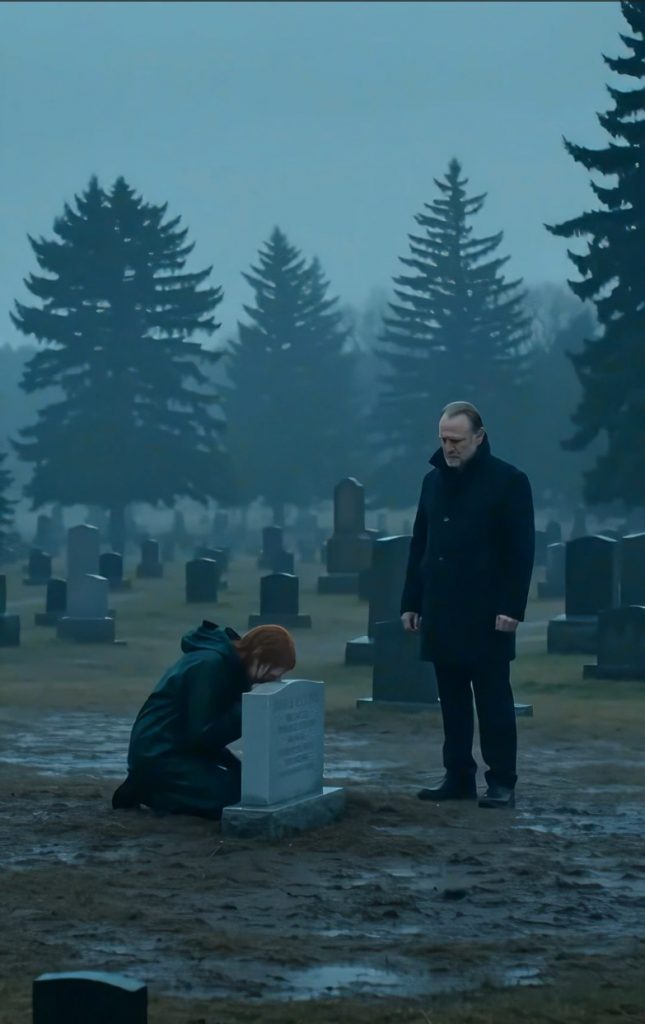
The rain had washed the cemetery clean of everyone except grief.
It fell over the rows of pale headstones, over the dark evergreen trees, over the narrow gravel path where water gathered in shallow silver streams. The sky was a heavy sheet of gray, low enough to make the world feel buried before anyone reached the ground.
Mara Whitlock knelt beside the grave as if she had been placed there and forgotten.
Her dark green rain jacket was soaked through. Wet auburn hair clung to her cheeks and neck. Her hands rested on the pale stone marker, fingers curled against the engraved letters she had traced too many times to count.
Daniel Whitlock.
Beloved Son. Beloved Brother.
The words should have comforted her.
They didn’t.
Nothing did.
“Happy birthday,” Mara whispered, though her voice cracked before the second word.
Daniel would have been thirty-one.
He would have laughed at her for bringing flowers in weather like this. He would have told her she was dramatic. Then he would have stood beside her under the rain anyway, because Daniel never let her face anything alone.
Until the day he vanished from her life inside a sealed coffin and a story nobody let her question.
Behind her, gravel shifted.
Mara stiffened.
She turned slightly and saw a man standing a few feet away on the path. Older. Tall. Rigid beneath a heavy black wool coat. Rain ran through his slicked-back gray-blond hair and down the stubble on his jaw, but he did not seem to notice.
He looked at her.
Not with pity.
With suspicion.
“Who are you?” he asked.
His voice was low, rough, and rain-muffled.
Mara’s fingers tightened on the headstone.
She did not know why the question frightened her. Maybe it was the way he stood so still. Maybe it was the grief hidden behind his hard eyes. Maybe it was the fact that he looked at Daniel’s grave like it belonged to him too.
“He’s my brother,” she said, her voice trembling. “And you?”
The man’s face changed.
Only slightly.
But enough.
The sternness did not leave. It cracked.
A deep breath moved through him, heavy and pained, as if whatever he had come to say had become worse the moment he saw her face.
“I don’t even know how to say this,” he said.
Mara slowly rose to her feet.
The rain struck harder between them.
The man looked at the grave, then back at her.
“Daniel Whitlock was not your brother.”
Mara’s breath stopped.
“And he is not buried in that grave.”
Act II
Mara had been eight years old when Daniel first taught her how to lie.
Not bad lies.
Survival lies.
If the foster mother asks who broke the blue vase, say it was the cat.
If the older boys ask why you’re crying, say you have allergies.
If the social worker asks whether we’re happy here, smile until we get out of the room.
Daniel was eleven then, skinny and sharp-eyed, with bruised knuckles from fighting battles he never let Mara see. He was not her brother by blood, not technically. They had been placed in the same foster home after separate tragedies and decided, with the absolute authority of abandoned children, that family was something you chose before anyone else chose against you.
He chose her.
Again and again.
When they were separated at twelve and fifteen, Daniel ran away twice to find her. When Mara aged out with nothing but two duffel bags, Daniel was waiting outside the group home in a beat-up Honda with a box of donuts and a grin too bright for the damage they had survived.
“You’re free now,” he told her.
Mara had looked at the car, the sky, the empty road ahead.
“Free to do what?”
Daniel shrugged.
“Start lying better.”
They built a life from scraps.
A basement apartment. Two jobs each. Cheap furniture. Sunday pancakes. A little tradition of birthday flowers at cemeteries for the parents neither of them could remember properly.
Daniel became a paramedic. Mara became a school counselor. It made sense. Children who grow up afraid often become adults who listen for fear in other people’s voices.
Then Daniel changed.
It began quietly.
Phone calls taken outside.
A locked drawer in his desk.
A strange envelope addressed to him under a name Mara had never seen: Daniel Ashford.
When she asked, he smiled too quickly.
“Old paperwork.”
That was what he always said when he was scared.
Old paperwork.
Two months later, his car was found near the river after a storm. The police said he had lost control on a wet road. The funeral director advised a closed coffin because of the water damage. The case moved quickly, too quickly, with official sympathy and no real answers.
Mara had stood at this very grave with both hands on the coffin, unable to believe the world could take Daniel and still keep moving.
After the funeral, people told her to find closure.
She hated that word.
Closure sounded like a door.
Grief was not a door.
It was a room you woke up inside every morning.
For three years, she visited Daniel’s grave on his birthday, on her birthday, on the day they met, on days when the city felt too loud, on days when she forgot his voice and panicked until she found an old voicemail.
Then the stranger appeared in the rain and told her the one thing grief had never prepared her for.
The grave was empty.
Act III
The man’s name was Elias Ashford.
Mara knew the surname before he explained it.
Ashford was old money in the county. Ashford Hall sat on the hill beyond the river, a stone house with black iron gates and windows that glowed at night like watchful eyes. Mara had passed it on buses as a child and imagined people inside never had to ask permission to stay anywhere.
Elias Ashford was Daniel’s father.
That was what he told her under the rain, standing beside a grave that suddenly felt less like a memorial and more like a prop in someone else’s lie.
Mara laughed once.
A small, broken sound.
“No,” she said.
Elias did not flinch.
“I know what you were told.”
“You don’t know anything about me.”
“I know Daniel spent fourteen years looking for a girl named Mara.”
Her voice died.
Rainwater ran down her face, but it was no longer possible to tell what was rain and what was not.
Elias reached into his coat and pulled out a folded photograph sealed in plastic. He handed it to her carefully, as if it might explode.
Mara looked down.
Daniel was in the photo.
Younger. Maybe nineteen. Standing in front of the river bridge with his arm around her shoulders. Mara remembered the day instantly. They had eaten convenience-store cupcakes because he had gotten his first real paycheck.
On the back, in Daniel’s handwriting, were the words:
My sister. Not by blood. By truth.
Mara pressed the photo to her chest.
Elias looked away.
“My son was taken from his mother when he was four,” he said. “I was told he died with her in a house fire.”
Mara stared at him.
“He grew up in foster care.”
“Yes.”
“You never looked?”
The question came out cruel.
She meant it to.
Elias accepted it.
“I did,” he said. “For years. Then I was shown records. Ashes. Death certificates. A funeral invoice. I believed what I was handed because I was grieving and because the people handing it to me were family.”
Mara’s stomach tightened.
“Whose family?”
Elias’s mouth hardened.
“My brother.”
The rain seemed to grow colder.
Elias stepped closer to the grave marker and touched the top of the stone with two fingers.
“My brother needed Daniel gone. Daniel was the legal heir to my father’s trust. When Daniel resurfaced three years ago under the Whitlock name, he contacted me through an attorney.”
Mara shook her head.
“He never told me.”
“He was trying to protect you.”
“I didn’t need protection. I needed the truth.”
Elias’s eyes flickered with pain.
“I think he knew that too late.”
Mara looked at the grave.
“Then whose body is here?”
“No one’s.”
The cemetery blurred around her.
“What?”
“This plot was purchased to make the death believable. The coffin was weighted and sealed. The paperwork was rushed through by a funeral director connected to my brother.”
Mara stepped backward, nearly slipping in the mud.
“You’re lying.”
“I wish I were.”
“Why would anyone do this?”
Elias’s voice dropped.
“Because Daniel found proof that my brother had stolen more than an inheritance.”
Mara remembered the locked drawer.
The strange envelope.
Old paperwork.
Her knees nearly buckled.
Elias reached out, then stopped himself before touching her.
“What proof?” she asked.
He looked toward the path, where mist swallowed the rows of graves.
“Daniel left something for you.”
Act IV
The key was hidden where Daniel knew Mara would eventually look.
Not in the grave.
Not under the stone.
In the rusted metal vase bolted beside it, beneath a false bottom sealed with wax.
Mara had placed flowers there for three years.
Her hands shook as Elias pried the base open with a pocketknife.
Inside was a small waterproof capsule.
Mara recognized Daniel’s handwriting on the label.
For M. When you stop believing them.
She made a sound that barely counted as breathing.
Elias stepped back.
“It is yours.”
Mara opened the capsule.
Inside was a flash drive, a bank key, and a letter folded so tightly the paper had begun to crease white at the edges.
She read it under the rain.
Mara,
If you are reading this, I failed to come back before they made you bury me.
I’m sorry.
I know you’re angry. You should be. I kept you out of it because I thought distance meant safety. That was arrogant. You always hated when I made choices for both of us.
Her vision blurred.
She kept reading.
My real name is Daniel Ashford. I didn’t know until six months ago. I found records showing I was stolen from my father after my mother died. The man behind it is Victor Ashford, my uncle. He used forged records to take control of trusts, properties, guardianships, and accounts meant for people who were too young, too old, or too vulnerable to fight back.
I found more than my own file.
That was why he came after me.
Mara covered her mouth.
Elias stood rigid beside her, but his eyes were wet now.
The last paragraph was almost unbearable.
If they tell you I’m dead, do not believe the first story. If they show you a grave, do not trust the stone. If Elias Ashford finds you, listen to him. I was afraid he’d be like the rest of them. He wasn’t. He loved a son he thought was dead.
And Mara, listen to me.
You were my family before I ever knew my name.
No blood will ever outrank that.
Mara folded over the letter and sobbed.
Not quietly.
Not prettily.
The kind of sob that tears through a person because it carries years of believing the wrong wound.
Elias stood in the rain with his hands at his sides, helpless before grief he had not earned the right to hold.
Finally, Mara looked up.
“Is he alive?”
Elias closed his eyes.
That was answer enough.
Her face crumpled.
“We don’t know,” he said quickly.
Hope appeared only to hurt her.
“What does that mean?”
“It means the river story was false. It means the funeral was staged. It means Daniel disappeared after meeting a federal investigator. His blood was never found in the car. His phone went dead twenty miles north. There is no confirmed death.”
Mara stared at him.
“You let me think he was dead for three years?”
“I did not know you existed until two weeks ago.”
“How?”
“The bank key. Daniel’s attorney died last month. His files were released to a court auditor. Your name was in them.”
Mara looked down at the flash drive.
“What’s on this?”
Elias’s jaw tightened.
“Enough to destroy my brother.”
A voice came from behind them.
“Then I suggest you hand it over.”
Mara turned.
A man in a dark coat stood at the edge of the path beneath a black umbrella.
He looked like Elias.
Younger.
Sharper.
Smiling.
Victor Ashford had come to the cemetery.
Act V
Victor did not raise his voice.
Men like him rarely needed to.
He walked toward them slowly, umbrella tilted against the rain, shoes sinking slightly into the wet gravel. His eyes moved from Elias to Mara, then to the capsule in her hand.
“So,” he said. “Daniel did leave a backup.”
Mara closed her fist around the flash drive.
Elias stepped in front of her.
“Leave.”
Victor smiled.
“You always were sentimental.”
“And you always mistook patience for weakness.”
The smile thinned.
Victor looked at Mara.
“You have no idea what he dragged you into.”
Mara’s voice shook, but she held his stare.
“I know you stole him.”
Victor sighed as if disappointed by her simplicity.
“I preserved the family.”
“You erased a child.”
“I corrected an inheritance problem.”
The sentence was so cold that Mara felt the last of her fear turn into something harder.
Elias reached into his coat.
Victor’s eyes sharpened.
But Elias did not pull out a weapon.
He pulled out a phone.
The call was active.
A woman’s voice came through the speaker.
“Mr. Ashford, we heard enough. Agents are entering the cemetery now.”
Victor’s face changed.
For the first time, the rain touched him like everyone else.
Figures appeared between the headstones. Dark jackets. Federal badges. Officers moving quickly along the path.
Victor looked at Elias with open hatred.
“You set me up.”
Elias’s face was pale but steady.
“No. Daniel did. I just finally stopped being too late.”
Victor tried to run.
He made it six steps before two agents stopped him near a row of rain-dark stones.
Mara watched them take him down without triumph.
There was no joy in it.
Only the strange, hollow sound of a lie collapsing after years of holding up too much pain.
The investigation that followed reached further than anyone expected.
Victor Ashford had built an empire out of forged guardianships, stolen inheritances, falsified death records, and families too broken or too poor to fight the paperwork. Daniel had uncovered the first layer because of his own stolen identity, then kept digging because Daniel had never known how to stop once he found someone being hurt.
The flash drive held names.
Dates.
Transfers.
Judges.
Doctors.
Funeral directors.
Social workers.
Every signature became a door.
Every door opened onto another family.
But not Daniel.
Not at first.
For three months, Mara lived in the cruel space between mourning and hope. She moved through interviews, affidavits, courtrooms, and late-night calls from investigators. Elias remained near, never pushing, never claiming a place in her grief he had not earned.
They were bound by Daniel.
That was all.
Then winter came.
A call arrived on a Tuesday morning.
A man had been found in a coastal town under an assumed name after checking himself into a clinic. He had no identification, partial memory loss from trauma, and scars from injuries no one had properly treated. He had been working odd jobs near the docks and drawing the same thing over and over in a notebook.
A girl with auburn hair kneeling beside a grave.
Mara flew there with Elias.
At the clinic, she saw him through a window before anyone said his name.
Thinner.
Older.
Standing by a radiator with a blanket around his shoulders.
But Daniel.
Alive.
Mara did not move.
Her body refused to believe what her eyes were seeing.
Then Daniel turned.
For a second, confusion crossed his face.
Then recognition broke through it like light through storm clouds.
“Mara?”
She ran.
He caught her badly, weakly, almost falling from the force of her grief, but she held him hard enough for both of them.
“You let me bury you,” she sobbed.
His arms tightened.
“I’m sorry.”
“I hate you.”
“I know.”
“I missed you.”
“I know.”
Elias stood in the doorway, unable to step closer.
Daniel looked over Mara’s shoulder.
Father and son saw each other after a lifetime stolen and three years buried beneath a false stone.
No one spoke at first.
Then Daniel, still holding Mara, whispered, “Dad?”
Elias covered his mouth with one trembling hand.
That was all it took.
The stern man from the cemetery disappeared.
In his place stood a father whose grief had finally been interrupted.
The reunion did not fix everything.
Daniel’s memory came back in fragments. Some days he remembered Victor’s men chasing him. Some days he remembered the river. Some days he remembered only darkness and Mara’s name. He had survived by instinct, by kindness from strangers, and by the stubborn part of him that refused to die while someone still needed the truth.
Mara stayed.
So did Elias.
Not perfectly. Not easily. They were not a family in the simple way people imagine at the end of sad stories. They were a rescued thing, fragile and uneven, learning where to place all the years that had been stolen.
The false grave was removed in spring.
Mara insisted on being there.
Daniel stood beside her, one hand in hers, the other gripping Elias’s arm for balance. Rain clouds gathered again over the cemetery, but this time the ground was dry.
Workers lifted the empty stone away.
Beloved Son. Beloved Brother.
Mara watched the words disappear.
Daniel squeezed her hand.
“You were my sister,” he said.
She looked at him sharply.
“Were?”
He smiled faintly.
“Are.”
Elias looked at them both.
“And my son.”
Daniel’s expression softened.
“Yes.”
Mara looked at the empty patch of earth where the lie had stood for three years.
Then she took the flowers she had brought and placed them on the grass anyway.
Daniel frowned.
“You don’t have to leave those.”
“I know.”
“Then why?”
She wiped at her eyes.
“For the girl who cried here because nobody told her the truth.”
Daniel went quiet.
Elias bowed his head.
The wind moved through the cemetery, soft and cold, but no longer cruel.
Mara turned away from the empty grave with Daniel on one side and Elias on the other. The path stretched ahead between rows of pale stones, each carrying a story, some true, some incomplete, some waiting for someone stubborn enough to read deeper than the engraving.
For three years, Mara had come to that cemetery to speak to the dead.
Now she left it holding the hand of the man she had mourned.
And behind her, the rain began again—not as a burial, but as a washing clean.