Act I
The grass moved before anyone heard the sound.
It was only a small shiver at first, a ripple through the tall, dried stalks near the backyard fence. The kind of movement a child notices before an adult does, because children still believe the world is full of hidden things waiting to be discovered.
Noah Carter took one step toward it.
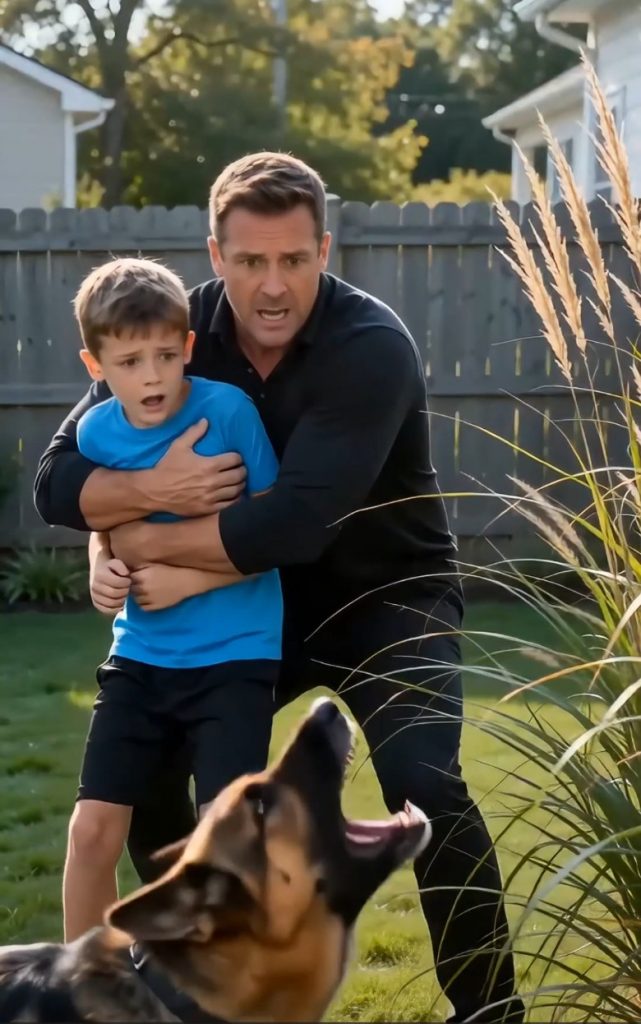
He was seven years old, barefoot on the green lawn, wearing a bright blue T-shirt and black shorts. His head tilted with curiosity as the brittle grass rustled again.
“Dad?” he called.
Then the German Shepherd began to bark.
Ranger shot across the lawn like a bullet, black collar flashing against his thick tan-and-black coat. His bark was not playful. Not warning. It was deep, violent, and desperate enough to make Daniel Carter drop the garden hose in his hand.
“Noah!”
The boy turned.
His father was already running.
Daniel reached him just as Noah stepped closer to the grass. He wrapped one arm across his son’s chest and yanked him backward so hard the boy’s feet left the ground.
“Get away from him right now!” Daniel shouted.
Noah gasped, frozen in his father’s grip.
The dried grass thrashed.
Something inside it moved low, fast, and heavy.
Ranger planted himself between the boy and the fence, barking so fiercely his whole body shook. His paws dug into the lawn. His ears pinned forward. His teeth flashed at the hidden shape moving beneath the stalks.
Daniel kept retreating, both arms locked around Noah now, using his own body as a shield.
“What is it?” Noah whispered.
Daniel did not answer.
He could not see enough.
Only the grass whipping from side to side. Only Ranger lunging closer. Only a dark shape rising and disappearing again in the dry brush.
Then Ranger went in.
The dog vanished into the heart of the grass with a snarl.
“No!” Daniel shouted.
He pushed Noah behind him and lunged forward, reaching for Ranger’s collar. The boy stumbled back, horror-struck, as the grass exploded with movement.
There was a sharp cry from the dog.
A low, furious sound from whatever was hidden.
Daniel grabbed Ranger’s collar and pulled with everything he had.
The grass split open.
And for one second, Daniel saw two things at once.
A thick, coiled rattlesnake striking at the dog.
And around its body, caught in the dried stalks, a bright red plastic tag from a wildlife transport crate.
Daniel’s blood went cold.
That snake had not wandered into his backyard.
Someone had put it there.
Act II
The backyard had been Daniel’s promise.
After the accident, after the funeral, after all the casseroles and sympathy cards and neighbors whispering on the sidewalk, Daniel had stood in the empty kitchen and made his son a vow.
“We’re going to make this place safe again.”
Noah had been five then, too young to understand drunk drivers, hospital hallways, or why his mother’s perfume still lingered on scarves she would never wear again. He only knew that Claire Carter had left one morning to buy pancake mix and never came home.
After that, Noah stopped sleeping through the night.
Daniel stopped sleeping at all.
The backyard became their first attempt at peace. Daniel fixed the fence. Planted grass. Bought a small plastic slide Noah was already too big for but loved anyway. He hung solar lights along the porch because Noah said the dark corners looked “too quiet.”
Then came Ranger.
A retired police dog with stiff hips, intelligent eyes, and a suspicion of everyone except Noah. The first night Ranger came home, he slept outside the boy’s bedroom door. By the end of the week, Noah stopped asking Daniel to check the closet.
For two years, the house breathed again.
Not easily.
Not without grief.
But enough.
Then the strange things began.
The side gate left open, though Daniel knew he had latched it.
A muddy footprint near the fence after a dry week.
Ranger growling at the far corner of the yard long after midnight.
Daniel blamed raccoons. Teenagers. His own nerves.
His sister told him he was becoming paranoid.
His father-in-law told him grief made men see threats where there were none.
But Ranger knew.
Every time Noah played outside, the dog watched the ornamental grass near the fence. Not the street. Not the gate. That grass.
Daniel almost cut it down twice.
Both times, Noah begged him not to. His mother had planted it the spring before she died. She called it “the lion grass” because it turned gold in the sun and roared when the wind moved through it.
So Daniel left it.
That morning, he had finally decided to trim it.
He had gone inside for gloves.
Less than one minute.
That was all.
When he came back, Noah was walking toward the rustling stalks, and Ranger was already running.
Now Daniel knelt on the lawn with one hand locked around Ranger’s collar and the other pressed against Noah’s chest to keep him back. The snake was still partly tangled in the grass, rattling hard, its body tense with panic and fury.
But Daniel’s eyes were fixed on the red plastic tag.
He knew what it meant.
His neighbor, Brent Lawson, owned a private exotic animal removal company.
And three weeks earlier, Brent had offered to buy Daniel’s house.
Act III
The animal control officer arrived with a steel hook, a secure container, and a face that changed the moment he saw the tag.
“That’s not from the wild,” he said.
Daniel stood barefoot on the lawn, still holding Noah behind him.
Ranger lay near the porch, panting hard but alive, his eyes never leaving the grass. The vet was on the way. Daniel had wrapped the dog carefully, hands shaking so badly he could barely fasten the towel around him.
Noah kept crying without sound.
That hurt Daniel more than screaming would have.
The officer lifted the snake carefully from the grass and secured it inside the container. He did it professionally, quickly, without drama.
Then he picked the red tag from the stalks.
His mouth tightened.
“Lawson Wildlife Transport.”
Daniel felt the name land exactly where fear had already pointed.
Across the fence, a curtain shifted in Brent Lawson’s kitchen window.
Daniel saw it.
So did the officer.
Brent had lived next door for eight years. Friendly enough at barbecues. Loud enough when drinking. Always interested in other people’s business.
After Claire died, he started visiting too often.
He offered to help Daniel sell the house.
Said the place had “bad memories.”
Said a single father could use a fresh start.
Said buyers were circling the neighborhood because developers wanted three connected lots.
Daniel always refused.
“This is Noah’s home,” he said.
Brent’s smile would tighten.
“Sentiment gets expensive.”
Now Daniel understood.
The open gate.
The footprints.
Ranger’s midnight growling.
This had not started with the snake.
The snake was only the first thing too dangerous to ignore.
A police cruiser pulled into the driveway.
Then another.
Brent came out of his house before anyone knocked, wearing jeans, boots, and a performance of confusion.
“What’s going on?” he called over the fence.
Daniel turned.
For a moment, he wanted to cross the yard and put every ounce of fear he had felt into his fists.
Then Noah grabbed his sleeve.
“Daddy,” the boy whispered.
Daniel stopped.
That one word saved him from becoming something Brent could use.
The officer held up the red tag.
“Mr. Lawson, do you recognize this?”
Brent’s face flickered.
Only once.
But Daniel saw it.
“That could be old,” Brent said. “We lose tags all the time.”
“In a child’s backyard?” the officer asked.
Brent looked at Daniel.
“You seriously think I put a snake in your grass?”
Daniel’s voice came out low.
“I think my dog knew you were coming into my yard.”
Brent laughed.
But nobody joined him.
Behind Daniel, Ranger lifted his head and let out one low growl.
Brent stopped laughing.
And in that silence, one of the officers looked toward the corner of the fence and said, “What’s that?”
There, half-hidden beneath the gray fence plank, was a small black camera.
Pointing directly at Noah’s play area.
Act IV
The camera changed everything.
Until then, Brent could explain.
He could say the snake escaped. He could say the tag was old. He could call Daniel unstable, grieving, overprotective, dramatic.
But cameras do not install themselves under fences.
The officers found two more.
One near the side gate.
One facing the back porch.
Daniel stood in the lawn with Noah pressed against his side and felt the world tilt from danger into violation.
Someone had been watching his child.
Not once.
Not by accident.
Watching.
The police searched Brent’s property that afternoon.
They found transport crates in his garage. One was missing a red tag. Another had fresh soil inside. They found spare keys to the old side gate hidden in a workbench drawer. They found printed development offers for Daniel’s property, all unsigned, all marked with notes in Brent’s handwriting.
Pressure him after incident.
Unsafe for child.
Force sale.
Daniel read those words later in the police report and had to set the paper down before his hands tore it.
Force sale.
That was what Noah’s fear had been worth to Brent.
A business tactic.
Ranger survived.
The vet said the outcome could have been very different if Daniel had waited even a few minutes. The dog was weak and sore but stable. Noah sat beside him at the clinic with one small hand resting on Ranger’s paw.
“You saved me,” he whispered.
Ranger blinked slowly.
Daniel turned away because the tears came without warning.
At the police station, Brent denied everything.
Then his own phone betrayed him.
Messages to a developer.
Photos of Daniel’s backyard.
A search history about venomous snake handling.
A deleted video from the hidden camera showing Brent entering the yard at 4:18 a.m., carrying a dark container toward the ornamental grass.
The detective showed Daniel only enough to confirm.
Not more.
Daniel was grateful.
There are images a parent does not need burned into memory to understand evil.
Brent was arrested before sunset.
Neighbors gathered on their porches as officers walked him to the cruiser. He shouted that Daniel was ruining his life. That it was a misunderstanding. That nobody was supposed to get hurt.
Daniel stood in his driveway holding Noah’s hand.
He did not shout back.
That surprised him.
He had imagined rage would need noise.
But the truth was quiet.
Brent had placed danger near a child for money.
There was no argument loud enough to make that smaller.
As the cruiser pulled away, Noah leaned into Daniel.
“Can we cut down the lion grass?” he asked.
Daniel looked toward the backyard.
The golden stalks moved softly in the wind, beautiful and terrible now.
“Yes,” he said. “We can.”
Then Noah added, “But not all of it.”
Daniel looked down.
“Why?”
The boy swallowed.
“Mom planted it.”
Daniel closed his eyes.
And suddenly the hardest part was clear.
They did not only have to remove danger.
They had to save what love had left behind.
Act V
They cut the grass the next morning.
Not all of it.
Daniel trimmed the tall patch down carefully while Noah sat on the porch with Ranger beside him, both wrapped in blankets though the day was warm. The vet had insisted Ranger rest. Ranger had agreed with the expression of someone planning to ignore medical advice as soon as possible.
Daniel wore gloves and moved slowly.
Every cut felt like pulling fear out by the roots.
But at the center of the patch, he left one clean, golden circle of grass standing beneath the fence. Small enough to see through. Tall enough to move in the wind.
Noah named it Mom’s corner.
They placed a little stone there a week later.
Nothing dramatic.
Just a smooth gray rock from the garden center with Claire’s favorite word carved into it.
Home.
The trial took months.
Brent’s lawyers tried to argue no one could prove intent. Then the messages surfaced. The videos. The notes. The transport records. The development contract he hoped to sign once Daniel sold.
The courtroom was quiet when the prosecutor explained how close Noah had come to being harmed.
Daniel held his son’s hand through that part.
Noah did not testify in open court. Daniel refused, and the judge agreed there was enough evidence without making a child relive the moment strangers had already tried to turn into headlines.
But Daniel testified.
He spoke about the grass, the dog, the shout, the second when his son’s body hit his chest and he realized fear could move faster than thought.
He spoke about Ranger.
His voice broke only once.
“When people call him a dog,” Daniel said, “they’re not wrong. But that day, he was also the reason my son is alive.”
Brent was convicted on multiple charges tied to reckless endangerment, trespassing, stalking, and unlawful animal handling. The developer denied knowing about the plan, but the investigation stained the project badly enough that the land deal collapsed.
Daniel never sold the house.
People told him maybe he should.
Too much happened there, they said.
But Daniel had learned that safety was not always found by leaving. Sometimes safety meant reclaiming the place someone tried to take from you.
So he stayed.
He installed better locks, better lights, and a new fence. He met every neighbor properly, not with suspicion, but with open eyes. He taught Noah to listen to Ranger, to ask for help, to never walk toward rustling grass alone.
And slowly, the backyard became theirs again.
At first, Noah would only play on the porch.
Then the first step onto the lawn.
Then five.
Then one afternoon, months later, he ran across the grass chasing a soccer ball while Ranger limped behind him with the noble determination of a dog who refused retirement.
Daniel watched from the gray outdoor chair in the foreground, coffee cooling in his hand.
For the first time in a long time, his chest did not tighten at every sound.
The wind moved through Mom’s corner.
The golden grass whispered.
Noah stopped near it, picked up the soccer ball, and looked back at his father.
“Dad?”
“Yeah?”
“Do you think Mom saw Ranger save me?”
Daniel looked at the dog.
Ranger sat proudly in the sun, ears up, eyes on the boy he had protected.
“I don’t know,” Daniel said honestly.
Noah nodded, considering.
Then Daniel added, “But I think she’d say he was a very good boy.”
Ranger barked once.
Noah laughed.
The sound hit Daniel harder than any courtroom sentence.
That laugh was the thing Brent had tried to steal.
Not just a house. Not just land. Not just a sale.
This.
A child laughing safely in his own backyard.
A father breathing again.
A dog resting in sunlight with a black collar around his neck and a hero’s exhaustion in his bones.
That evening, Daniel sat beside Mom’s corner after Noah went to bed. Ranger lay at his feet, head on his paws, still watching the yard even in sleep.
Daniel touched the carved stone.
“I kept my promise,” he whispered.
The grass moved softly in the night breeze.
For two years, Daniel had believed protecting Noah meant never letting fear touch him.
Now he understood better.
Fear would come.
Danger would come.
Cruel people would come wearing ordinary faces and neighborly smiles.
Protection was not pretending the world was safe.
Protection was listening when the dog barked, moving when instinct screamed, and holding your child so tightly that even terror understood it would have to go through you first.
Daniel stood, called Ranger inside, and closed the back door.
This time, he locked it.
Not out of panic.
Out of love.
And behind the glass, the small circle of golden grass kept moving in the dark, no longer hiding a threat, but holding a memory.