Act I
The first thing Elena Vargas destroyed was the white dress.
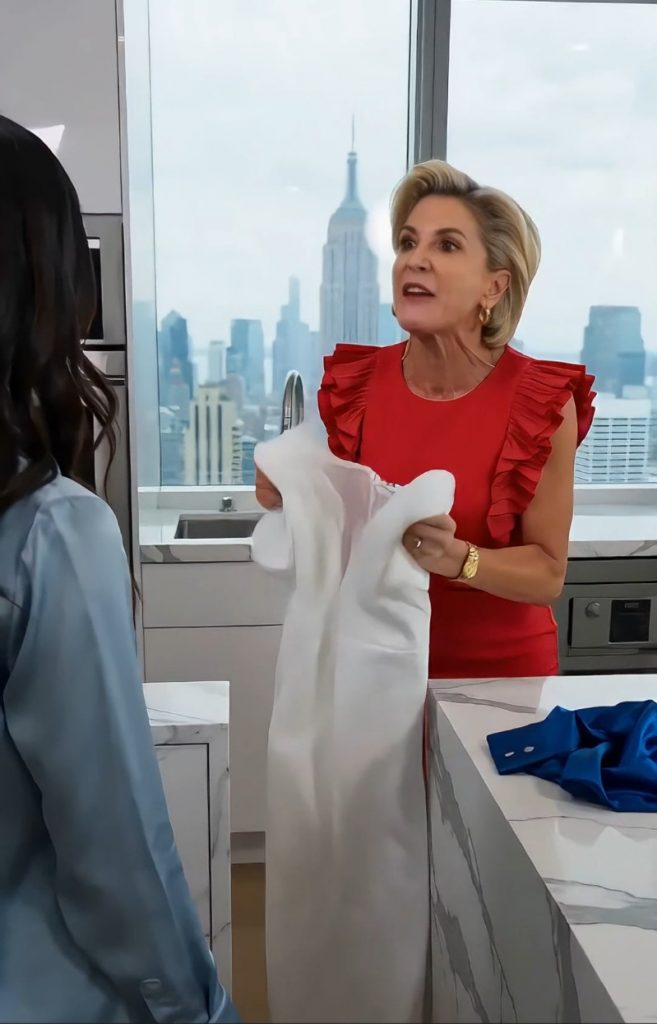
She stood in the center of the luxury kitchen, framed by white marble, stainless steel, and a skyline glittering behind the windows. The apartment sat high above the city, the kind of place where people spoke softly because everything around them looked too expensive to survive a raised voice.
But Elena Vargas was screaming.
“My son paid for everything!” she shrieked, clutching the dress in both hands. “You’re nobody, Mariana!”
Across from her, Mariana Solis stood perfectly still.
Her long dark hair fell over the shoulders of her light blue satin shirt. Her face was pale, but not frightened. Her jaw was set. Her eyes stayed fixed on Elena as if she had been waiting for this exact moment and had promised herself not to blink.
Near the refrigerator, Alejandro Vargas looked ruined.
His shirt was wrinkled. His black tie hung loose. Tears streaked his face as he leaned against the stainless steel door with the posture of a man who had already surrendered before the fight began.
“Mom,” he whispered. “That’s enough.”
Elena ignored him.
She tore the white dress straight down the middle.
The sound ripped through the kitchen like a verdict.
One half fell to the marble floor. Then the other. Lace and silk collapsed at Elena’s feet, ruined beneath her heels.
“Everything you have comes from Alejandro!” she shouted.
Mariana said nothing.
That made Elena angrier.
She turned, snatched the blue satin shirt from the island, and held it up with a laugh sharp enough to cut glass.
“Look at this nonsense,” she sneered. “Who are you dressing up for?”
Alejandro closed his eyes.
Mariana’s gaze flicked down once.
Not to the shirt.
To her phone.
A red-cased phone rested in her hand, raised at chest height, pointed directly at Elena.
Recording.
Elena saw it and smiled wider.
She wanted an audience.
She wanted proof that Mariana had stood there silently while the Vargas family put her in her place.
“Showing off my son’s money?” Elena said, her voice dripping with contempt. “You? Don’t make me laugh.”
Then she tore the blue shirt too.
The pieces landed beside the white dress. Elena stepped onto them, grinding the fabric beneath her heel, kicking the torn cloth toward the island like trash.
“If my son had any sense,” she said, breathing hard, “he would have put everything in his name before you ruined him!”
The phone screen captured it all.
The torn clothes.
The insults.
Alejandro in the background, head bowed.
Elena’s furious face.
The recording timer at the top of the screen.
10:10.
Mariana finally lowered the phone slightly.
Then she spoke for the first time.
“Thank you.”
Elena blinked.
Mariana’s voice remained calm.
“That was the one sentence my lawyer needed.”
Act II
Mariana had not grown up around marble.
She grew up in a one-bedroom apartment above a laundromat, where the walls shook when the machines ran too late and her mother kept envelopes of cash taped behind the pantry because banks had never felt like places built for women like them.
Her father left before she was old enough to hate him properly.
Her mother, Lucia, cleaned offices at night and sewed during the day, hemming gowns for women who complained about fabric while stepping over the hands that made them beautiful.
Mariana learned early that money had a smell.
On some people, it smelled like safety.
On others, it smelled like permission to be cruel.
She promised herself she would never beg anyone for either.
By twenty-eight, Mariana had built a boutique logistics software company from a laptop balanced on a kitchen table. By thirty-one, she had sold part of it and kept enough equity to become quietly rich.
Not flashy rich.
Not diamond-necklace, champagne-camera rich.
The kind of rich that lived inside legal documents, investment accounts, and property deeds no one knew to look for.
Then she met Alejandro.
He was handsome in a tired way, charming without trying, and gentle enough that Mariana let herself believe gentleness was his character instead of his escape route. He told her he hated his family’s obsession with status. He told her he wanted something real.
At first, she believed him.
Elena Vargas did not.
From the beginning, Elena looked at Mariana like a stain on polished stone.
She asked where Mariana’s family was from with the tone of a customs officer. She complimented Mariana’s clothes only when she could add, “Did Alejandro buy that for you?” She referred to Mariana’s company as “that little app thing” even after newspapers profiled it.
Alejandro always apologized afterward.
Privately.
That became the pattern.
In public, Elena cut.
In private, Alejandro soothed.
“I’m sorry,” he would say. “She’s just protective.”
“She thinks I’m using you.”
“She doesn’t know you.”
“Then tell her.”
He would touch Mariana’s hand, eyes soft and ashamed.
“I will.”
But he never did.
The apartment became the final lie.
Elena believed the penthouse belonged to Alejandro because Alejandro let her believe it. When she praised the marble counters, he smiled weakly. When she said, “My son has done so well,” he looked at Mariana and said nothing.
The truth was simple.
Mariana bought it.
Every cabinet, every appliance, every inch of that skyline view belonged to her.
The money came from her work, her risk, her sleepless years, her mother’s sacrifices, and a contract Alejandro had not signed because he had not earned the right to sign it.
Still, Mariana stayed.
Love can make intelligent people patient past the point of wisdom.
Then, one week before the wedding, Mariana found the draft.
A marital property restructuring agreement.
Prepared by Elena’s attorney.
It claimed Alejandro had purchased the penthouse and that Mariana would waive any ownership rights “for the harmony of the Vargas family.”
The document did not frighten her.
Alejandro’s signature line did.
Because beside it, in faint blue ink, was his initials.
Not signed.
Not final.
But considered.
Mariana confronted him that night.
Alejandro cried.
He said his mother pressured him. He said he was confused. He said he never would have gone through with it.
Mariana wanted to believe him.
Instead, she called her lawyer.
And on the morning Elena came to the penthouse to “discuss the wedding clothes,” Mariana turned on her phone before opening the door.
Act III
Elena stared at Mariana.
For the first time, uncertainty entered her face.
“What lawyer?”
Mariana looked at the torn blue satin shirt on the floor. It had been custom-made by her mother, who had stitched a tiny gold thread inside the cuff for luck.
Her throat tightened.
She refused to let Elena see it.
“The lawyer handling the property fraud,” Mariana said.
Alejandro lifted his head.
“Mariana…”
She turned to him.
“No. Not now.”
His face crumpled, but he went silent.
Elena laughed, though it came out too high.
“Property fraud? You dramatic little girl. This is my son’s home.”
Mariana held up the phone again.
“No, Elena. It’s mine.”
The kitchen went still.
Even the city beyond the windows seemed to pause behind the glass.
Elena’s eyes narrowed.
“That’s absurd.”
Mariana walked to the left island and opened a folder that had been lying there beneath a stack of fabric samples. She pulled out the deed, the purchase agreement, the transfer receipts, and the trust documents protecting the penthouse from marital claims.
She placed them on the marble one by one.
Elena did not look at them at first.
She looked at Alejandro.
That was the real reveal.
Not the documents.
The way her eyes demanded he rescue the lie.
But Alejandro did not move.
Mariana’s voice sharpened.
“He knew.”
Elena’s head snapped back.
“What?”
“He knew I bought this apartment. He knew your attorney’s document was false. He knew you had no right to claim any of it.”
Alejandro covered his face.
“Mariana, I was going to tell her.”
“When?” Mariana asked. “After she bullied me into signing? After she convinced herself I was stealing from you? After the wedding?”
Elena stepped forward.
“You manipulated him.”
Mariana almost smiled.
It was not a happy expression.
“No. You trained him.”
The words hit harder than shouting.
Alejandro looked up, wounded because he recognized the truth.
Mariana turned the phone toward Elena’s face.
“You walked into my home, destroyed my property, threatened my legal rights, and admitted your goal was to put everything under Alejandro’s name.”
Elena’s mouth tightened.
“I admitted nothing.”
Mariana tapped the screen.
The recording played back.
If my son had any sense, he would have put everything in his name before you ruined him.
Elena’s own voice filled the kitchen.
Cold.
Clear.
Undeniable.
A second voice came from the phone then, one Elena had not expected.
“Mariana?”
Elena froze.
Mariana lifted the phone.
“Yes, Mr. Reyes?”
Her lawyer had been on the call the entire time.
“I heard enough,” he said. “Do not let Mrs. Vargas leave with any documents. Security is already on the way.”
Elena’s face went white.
Alejandro pushed himself off the refrigerator.
“Security?”
Mariana looked at him, and the last softness in her eyes disappeared.
“Yes,” she said. “For both of you.”
Act IV
Alejandro took one step toward her.
“Mariana, please.”
She raised a hand.
He stopped.
There was a time when that voice would have broken her. The pleading. The wet eyes. The beautiful helplessness that made her feel cruel for asking him to be brave.
Not anymore.
“You stood there,” she said.
His face twisted.
“I was trying to calm her down.”
“No. You were waiting for me to survive it quietly.”
The sentence struck him so visibly that even Elena turned to look.
Mariana continued, her voice shaking now but still controlled.
“She called me nobody. She said everything I had came from you. She ripped my mother’s work apart. She stomped on my clothes in my kitchen. And you leaned against the refrigerator and whispered.”
Alejandro’s eyes filled again.
“I’m sorry.”
Mariana shook her head.
“Sorry is what you say when you spill wine. Not when you let your mother build a whole lie around my life because correcting her would make you uncomfortable.”
Elena snapped back into anger because fear had no place to hide.
“You ungrateful—”
The elevator chimed.
Two building security officers entered with a woman in a charcoal suit behind them. Mariana’s attorney, Sofia Reyes, walked into the kitchen like she had been born unimpressed by wealthy tantrums.
Her eyes moved over the torn fabric on the floor, Elena’s flushed face, Alejandro’s defeated posture, and Mariana’s phone.
“Mrs. Vargas,” Sofia said. “You are being asked to leave the premises immediately.”
Elena lifted her chin.
“I am his mother.”
“This is not his property.”
“I was invited.”
“Your invitation has been revoked.”
Alejandro stepped forward.
“Sofia, wait. Can we just talk?”
The attorney looked at him.
“Mr. Vargas, my client has already spoken. You ignored her for months.”
He looked at Mariana.
The shame in his face was real.
That was the tragedy.
He was not evil in the clean way people prefer villains to be. He was weak. Weak enough to let cruelty speak for him. Weak enough to accept comfort from the person it injured. Weak enough to confuse tears with accountability.
Mariana almost hated that more.
Elena grabbed her purse from the island.
“You’ll regret this,” she hissed. “No respectable family will take you seriously after this.”
Mariana looked at the skyline beyond the windows.
For years, she had imagined respect as something granted by rooms like this, families like this, names like Vargas.
Now she saw how cheap that respect had always been.
“My mother cleaned hotel suites for women like you,” Mariana said quietly. “Then she came home and sewed until her fingers cramped so I could build a company you pretend your son paid for.”
Elena’s face hardened.
Mariana pointed to the torn blue fabric.
“That shirt on the floor is worth more than anything you wore today, because no one had to lie to make it beautiful.”
For once, Elena had no answer.
Security escorted her out.
At the elevator, she turned to Alejandro.
“Are you coming?”
The question carried a lifetime inside it.
Command.
Guilt.
Ownership.
Alejandro looked at Mariana.
Then at his mother.
For one second, Mariana saw the man he could have been.
Then he lowered his eyes and followed Elena into the elevator.
The doors closed.
And whatever remained of Mariana’s engagement closed with them.
Act V
The wedding was canceled before sunset.
Not postponed.
Not “under review.”
Canceled.
Mariana sent one message to the guest list.
Due to circumstances that revealed a lack of respect, honesty, and safety, the wedding will not proceed.
She did not explain further.
She did not have to.
Elena tried.
By morning, the Vargas family had already begun spreading its version. Mariana was unstable. Mariana was greedy. Mariana had humiliated a mother in her own son’s home. Mariana had secretly recorded a private family disagreement.
Then the video reached the right people.
Not the internet.
Not at first.
The wedding planner.
The families.
The board members who had invested in Alejandro’s startup because Mariana had quietly vouched for him.
The tailor who recognized Lucia Solis’s stitching on the torn shirt.
The landlord of Elena’s social reputation.
People saw what Elena did.
More importantly, they heard what she believed.
My son paid for everything.
You’re nobody.
If my son had any sense, he would have put everything in his name.
The lie unraveled quickly after that.
Alejandro’s startup lost its bridge funding within a week. Not because Mariana asked investors to withdraw, but because they discovered how much of his early traction had come from her introductions, her strategy, and her credibility.
He called her eleven times.
She answered once.
“I love you,” he said.
Mariana sat in the kitchen, now cleaned, the torn clothes folded beside her.
“I know,” she replied.
“Then how can you just end it?”
She closed her eyes.
“Because love that requires me to be silent while I’m disrespected is not love I can live inside.”
He cried again.
This time, she let the silence hold him.
“I should have defended you,” he whispered.
“Yes.”
“I was afraid of her.”
“I know.”
“I’m trying to change.”
“I hope you do.”
He waited.
She did not offer rescue.
Finally, he asked, “Is there any chance?”
Mariana looked at the blue fabric her mother had stitched.
“No, Alejandro. There was a chance in the kitchen. You watched it leave.”
After the call, Mariana took the torn white dress and the ruined blue shirt to her mother.
Lucia Solis lived in the same neighborhood where Mariana grew up, though Mariana had offered many times to buy her a better place. Lucia always said the apartment had good light and stubborn walls. That was enough.
When she saw the torn fabric, her face changed.
Not with shock.
With a quiet sadness that cut deeper.
“She did this?”
Mariana nodded.
Lucia touched the ripped seam of the blue shirt.
“I can mend it.”
“I know.”
“But you don’t want me to.”
Mariana’s eyes filled.
“No.”
Lucia folded the fabric carefully.
“Good.”
That surprised a laugh out of Mariana.
Her mother looked at her.
“Some things should stay torn long enough to remind us what hands are not welcome near our life.”
Mariana cried then.
Not delicately.
Not beautifully.
She cried like the woman in the kitchen had not allowed herself to cry. Lucia held her, small and strong, one hand in her daughter’s hair, whispering in Spanish that no marble house, no rich family, no weak man could make her less than what generations had survived to build.
Months passed.
The penthouse changed.
The kitchen stayed white and beautiful, but Mariana filled it with warmer things. Copper pans from her mother. Clay bowls from a trip she took alone. A framed photograph of Lucia at twenty-three, smiling outside the laundromat with a needle tucked behind her ear.
On the right marble island, Mariana placed the mended blue shirt.
Not wearable anymore.
Lucia had stitched the torn halves back together with visible gold thread, turning the damage into a jagged line of light.
Mariana framed it in glass.
Below it, she added a small plaque.
No one owns what you built.
The phrase became a private reminder at first.
Then a public one.
At a women’s business conference six months later, Mariana spoke about contracts, ownership, and the quiet dangers of letting love blur legal clarity. She did not name Elena. She did not need to. She spoke instead about mothers who worked unseen, daughters who learned to build, and the importance of never mistaking a partner’s comfort for proof of his courage.
After the speech, a young woman approached her with tears in her eyes.
“My fiancé wants me to put my company shares into his family trust,” she said. “He says it proves I trust him.”
Mariana held her gaze.
“No,” she said gently. “Keeping what you built proves you trust yourself.”
The woman nodded, crying harder.
That was when Mariana understood the kitchen had not only been an ending.
It had become evidence.
A year later, she sold the penthouse.
Not because Elena had poisoned it.
Because Mariana no longer wanted a home built high above everyone else, sealed behind glass, staged like a life she had outgrown.
She bought a sunlit townhouse with a courtyard where Lucia planted herbs in terracotta pots and complained that rich soil was better than rich neighbors.
On the day Mariana moved in, Sofia Reyes brought champagne.
Lucia brought tamales.
Mariana wore a simple white shirt and gold hoops, no diamonds, no performance, no need to look like anyone’s idea of success but her own.
As evening fell, she stood in the courtyard with her mother.
“You miss him?” Lucia asked.
Mariana thought carefully.
“I miss who I hoped he was.”
Lucia nodded.
“That one is always hardest to bury.”
Mariana leaned her head on her mother’s shoulder.
In the old life, silence had been mistaken for grace.
In the new one, truth sat at the table.
The recording stayed saved in a secure drive, but Mariana rarely watched it. She did not need to. She remembered every second clearly.
Elena tearing fabric.
Alejandro looking down.
Her own hand holding steady.
At the time, she thought she was recording proof of Elena’s cruelty.
Later, she realized she had recorded something more important.
The exact moment she stopped asking a weak man to become brave enough to save her, and became brave enough to choose herself.