Act I
The first thing Mia Calder felt was movement.
Not turbulence. Not the normal vibration of the plane as it pushed through the afternoon sky. This was smaller. Closer. A slow, lazy brushing against the edge of her armrest.
At first, she thought it was the man beside her.
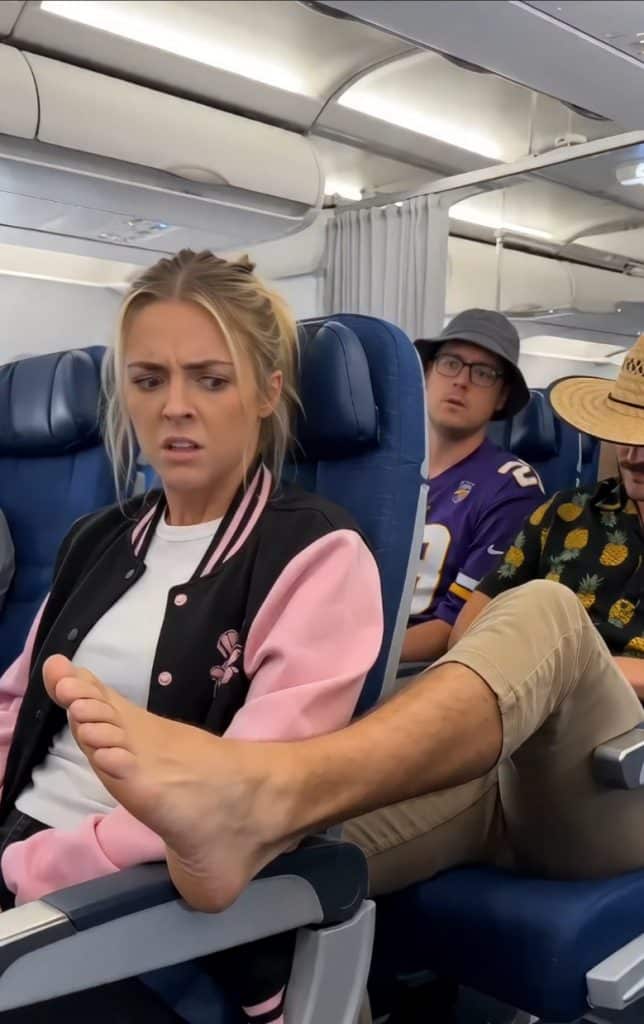
The middle passenger, squeezed between her window seat and the aisle, had spent most of the flight pretending not to exist. He wore glasses, a gray bucket hat, and a purple jersey, and he had folded his arms so tightly against his chest that he looked like a passenger trying to become luggage.
Mia glanced down, ready to give him the polite half-smile people use when cramped strangers accidentally bump elbows.
Then she saw the foot.
Bare.
Resting on her armrest like it owned the seat.
The toes flexed once, slowly, with the confidence of something deeply unwelcome. A big toe wiggled less than an inch from her sleeve.
For one full second, Mia’s brain refused to understand what her eyes were seeing.
Then disgust hit her so hard her shoulders lifted.
She turned.
Behind her, stretched across the economy row like a man lounging on a beach chair instead of sitting in a commercial aircraft, was a mustached passenger in a black shirt covered with yellow pineapples. Khaki pants. Straw hat tilted low over his face. One leg thrust forward between the seats.
His bare foot sat on Mia’s armrest as if the cabin had been designed around his comfort.
Mia stared at him.
The airplane hummed around them. Air vents whispered. Plastic trays rattled faintly. Somewhere farther up the aisle, a baby fussed and then went quiet.
The man did not move.
Mia’s voice cut through the cabin.
“Remove your foot.”
The middle passenger went rigid.
Two rows ahead, someone turned around.
The man behind Mia lifted the brim of his straw hat with two fingers, revealing a face that looked less embarrassed than entertained. His mustache curved over a mouth that had the faintest trace of a smirk.
He met her eyes.
“No.”
The word was flat.
Not defensive. Not confused.
Just no.
Mia blinked, once.
There were rude people in the world. She knew that. She had worked retail in college, sat through board meetings where men interrupted her while repeating her ideas, and survived three years in New York without believing humanity was beyond repair.
But this was different.
This was not accidental.
This was a test.
The cabin seemed to tighten around her. Everyone close enough to hear had suddenly become fascinated by their phones, their tray tables, the safety card in the seat pocket. Nobody wanted to be involved. Nobody wanted to be the person who made the flight awkward.
Mia looked at the foot again.
Then she reached down and shoved it off her armrest.
It hit the floor with a dull thud.
The middle passenger let out a small, trapped breath.
Mia turned forward, heart beating faster, telling herself that was the end of it. A boundary had been set. A grown man had been reminded that other people existed. Nothing more needed to happen.
Then, slowly, deliberately, the foot rose again.
It slid between the seats.
It returned to her armrest.
The toes flexed.
Mia turned back around.
The man in the pineapple shirt leaned comfortably into his seat, straw hat back in place, mouth relaxed in victory.
Mia stared at him in disbelief so sharp it almost became silence.
And somewhere above the clouds, trapped inside row 24, the entire plane was about to learn that one man’s bare foot was not the real scandal.
It was only the first clue.
Act II
Mia Calder hated flying, but not because she was afraid of planes.
She hated what airports did to people.
Something about security lines, boarding groups, delayed connections, and overhead bin space turned perfectly normal adults into desperate little monarchs defending imaginary kingdoms. A man with a neck pillow suddenly believed he deserved priority boarding because he had a “tight schedule.” A woman with three rolling bags insisted one counted as a purse. Someone always took off their shoes.
Always.
Mia had seen enough of it to know the signs.
Still, this flight from Miami to Denver was supposed to be simple. Four hours. Window seat. Noise-canceling earbuds. One presentation deck to review before Monday morning.
She was twenty-nine, blonde, sharp-eyed, and tired in the way only a person who had spent years proving herself in rooms full of louder people could be tired. Her pink and black varsity jacket made her look younger than she was, which had become both a curse and a weapon. People underestimated her quickly. That saved time.
She was flying to Denver because her company had just acquired a struggling hospitality chain called SunVista Retreats, a flashy vacation brand that looked cheerful from the outside and rotten from the inside.
Mia had been assigned to the internal review.
On paper, it was a basic compliance audit.
In reality, it was a mess.
Missing reimbursements. Faked vendor invoices. Staff complaints buried under cheerful HR language. Executives who took “wellness retreats” on company money while housekeepers fought for overtime pay. The deeper Mia dug, the uglier it became.
And one name appeared again and again.
Grant Huxley.
Founder. Former CEO. Still majority shareholder through a family trust. A man famous for appearing barefoot in magazine interviews and calling himself “allergic to corporate stiffness.”
His brand image was carefully built: tropical shirts, straw hats, laughing photos on beaches, quotes about freedom and authenticity.
Mia had never met him.
She had only seen the polished version from press photos, the edited smile, the sunlit decks, the carefully staged humility of a millionaire pretending he did not care about money.
Her job in Denver was to present findings to the new board.
A sealed folder sat in her tote under the seat in front of her, next to her laptop and a granola bar she had forgotten to eat. Inside were copies of the documents that could force Grant Huxley out of the company completely.
Mia had spent six months building the file.
She had missed birthdays, canceled dates, and spent nights reading expense reports until numbers blurred together. Her boss had warned her to keep it quiet. Huxley still had friends on the board. Powerful ones.
“You need to be careful,” he had told her.
Mia had laughed at the time.
Careful was not the same as quiet.
Now, with a stranger’s bare foot on her armrest, she felt the familiar old rage bloom behind her ribs.
Not loud yet.
Controlled.
The middle passenger finally leaned slightly toward her without turning his head.
“I’m sorry,” he whispered.
Mia looked at him. “For what?”
He swallowed. “Just… being here.”
Despite everything, she almost smiled.
“What’s your name?” she asked.
“Evan.”
“Evan, are you comfortable with that man’s foot touching my armrest?”
Evan looked like he would rather answer a question under oath.
“No.”
“Good.”
Mia turned back to the man behind her.
“Sir,” she said, every word clipped clean, “move your foot now.”
He lifted his hat again.
This time he looked bored.
“You people are so uptight.”
Mia’s eyebrows rose.
“You people?”
“People who think every inch of the world belongs to a rulebook.” He tapped his bare heel against the side of her seat. “Relax. We’re all going to the same place.”
A few passengers shifted. Someone coughed. A woman across the aisle slowly lowered her book.
Mia felt heat climbing her neck.
“You are touching my space.”
“It’s an armrest,” he said. “Not a deed.”
“No,” Mia said. “It’s part of the seat I paid for.”
He leaned forward slightly, enough for her to smell the stale sweetness of airport cocktails on his breath.
“Then complain.”
The words were quiet.
Almost intimate.
And that was when Mia understood he was not merely rude.
He was daring her.
People like him lived by a simple calculation: most people would rather endure disrespect than make a scene. Most people feared being called dramatic more than they hated being mistreated.
Mia had been one of those people once.
Before the boardrooms. Before the buried complaints. Before she learned that silence was the cheapest service women were expected to provide.
She reached up and pressed the call button.
The small orange light appeared above her seat.
The man smiled.
“Good luck,” he said.
The flight attendant arrived less than a minute later, a woman in her forties with tired eyes and the practiced calm of someone who had handled spilled coffee, panic attacks, and honeymoon arguments at thirty thousand feet.
“Is everything alright here?” she asked.
Mia gestured to the foot.
The flight attendant’s face changed by half an inch.
Professional training kept the smile in place.
Human disgust nearly defeated it.
“Sir,” she said, “you need to put your foot down.”
The man sighed as if everyone had interrupted his meditation.
“I’m stretching.”
“You cannot place your bare foot on another passenger’s armrest.”
“I paid for my seat.”
“And she paid for hers.”
For a brief, beautiful moment, Mia thought the matter was finished.
Then the man leaned back, crossed his arms, and said, “Do you know who I am?”
The sentence landed in the cabin with a special kind of ugliness.
Mia went still.
The flight attendant’s expression cooled.
“No, sir,” she said. “But I know where your foot needs to be.”
A few passengers laughed under their breath.
The man’s eyes sharpened.
Mia turned enough to see his face clearly.
The mustache. The tan. The straw hat. The pineapple shirt.
Something moved in her memory.
A press photo. A profile headline. A quote about living without boundaries.
Her stomach tightened.
No.
It couldn’t be.
Then the man smiled at her.
And Mia realized she had seen that smile in the folder beneath her seat.
Act III
Grant Huxley had built an empire on charm.
That was the first line of nearly every article about him.
Charm, in his case, meant getting people to forgive things before they understood what had happened. It meant calling unpaid labor “team passion.” It meant calling chaos “creative freedom.” It meant wearing ridiculous shirts to distract from the contracts people signed without reading.
Mia had studied him the way prosecutors study timelines.
She knew his habits. His quotes. His favorite phrases. She knew he disliked closed shoes, formal meetings, and anyone who used the word accountability without laughing first.
She just had not expected him to appear behind her in economy class with his bare foot on her armrest.
For a few seconds, she could not speak.
Grant noticed.
Of course he did.
Men like him could smell recognition.
“There it is,” he said softly.
The flight attendant glanced between them.
Mia kept her voice even.
“You’re Grant Huxley.”
Evan, in the middle seat, turned so fast his bucket hat nearly slipped over his glasses.
The woman across the aisle whispered, “The resort guy?”
Grant gave a small, lazy bow from his seat.
“Depends who’s asking.”
Mia looked at his foot.
Still there.
As if now that his name had entered the space, normal rules had become optional.
The flight attendant straightened.
“Mr. Huxley, this is your final request. Put your foot down.”
Grant’s eyes stayed on Mia.
“You’re one of them.”
“One of who?”
“The little clipboard people they hired after the acquisition.” He smiled wider. “Compliance. Culture. Ethics. Whatever word they’re using to make ambition sound moral this quarter.”
Mia felt every passenger nearby listening now.
The cabin had shifted from annoyed curiosity into live theater.
“You don’t know me,” she said.
“I know your type.”
“No,” Mia said. “You know the type of people who finally read the paperwork.”
The smile weakened.
Grant slowly lowered his foot.
Not because he had learned manners.
Because he had found a bigger game.
He leaned forward between the seats.
“So you are with the review team.”
Mia did not answer.
His eyes dropped toward her tote bag.
It was a quick glance.
Too quick for most people to notice.
Mia noticed.
The sealed folder was inside.
Her hand moved instinctively to the strap.
Grant’s amusement returned, but this time something nervous lived under it.
“What’s your name?”
Mia smiled without warmth.
“You first.”
A few people chuckled.
Grant’s jaw tightened.
“I don’t think you understand how small this industry is.”
“And I don’t think you understand how small this plane is,” Mia replied.
The flight attendant stepped in.
“Sir, you need to stop bothering passengers.”
Grant looked at her name tag.
“Denise,” he said, as if tasting the power of saying it aloud. “I am a premium member with this airline. I fly constantly. I know people in customer relations.”
Denise did not blink.
“Then you should be very familiar with our conduct policy.”
The laugh that moved through the nearby rows was louder this time.
Grant flushed.
Humiliation did not suit him. Mia could see that instantly. Some people became quieter when embarrassed. Grant became cruel.
He shifted his attention to Mia.
“You think you’ve got something in that bag,” he said. “Don’t you?”
Mia’s fingers tightened around the strap.
“You need to sit back.”
“I know what this is. They send some ambitious little analyst to build a monster story out of accounting errors, and suddenly everyone acts like they found buried treasure.”
Mia’s heart kicked.
He knew.
Not everything, maybe. But enough.
Evan leaned toward Mia and whispered, “Should I call someone?”
“We’re on a plane,” she whispered back.
“I mean… more someone.”
Grant heard him and laughed.
“What are you going to do, jersey boy? Rescue her from a conversation?”
Evan recoiled.
Mia turned.
“Leave him alone.”
Grant’s eyes lit with mean pleasure.
“Oh, she’s brave.”
Mia reached into her tote.
Grant’s expression flickered.
She pulled out her phone and held it up.
“I’m recording now.”
The sentence changed everything.
Grant sat back.
The passengers around them became very still. Several phones rose in quiet imitation. A teenager two rows ahead turned around with the solemn focus of someone who knew the internet had just entered the cabin.
Grant looked from one screen to another.
“Cute,” he said.
But his voice had lost some of its ease.
Mia tapped the screen.
“Please repeat what you just said about accounting errors.”
Grant said nothing.
“Or the part where you implied you knew I had company documents in my bag.”
Still nothing.
Denise looked at Mia more carefully now.
“Ma’am,” she said, “are you traveling with sensitive work materials?”
Mia hesitated.
That hesitation was enough.
Grant leaned forward again, suddenly urgent.
“She’s carrying stolen documents.”
The cabin inhaled.
Mia stared at him.
There it was.
The pivot.
From bully to victim. From aggressor to accuser. From bare foot on an armrest to a criminal allegation at cruising altitude.
Denise looked between them.
“Sir, that’s a serious accusation.”
“It is,” Grant said. “And I want her bag checked when we land.”
Mia felt anger sharpen into something almost calm.
Because now he had made his first real mistake.
He assumed the folder was her weakness.
He did not know it had already been copied, logged, and sent to legal.
He did not know the sealed documents in her bag were not the only evidence.
And he definitely did not know about Evan.
Because the quiet man in the purple jersey had gone pale for a reason that had nothing to do with fear.
He was staring at Grant like he had just seen a ghost.
Act IV
Evan removed his glasses with shaking hands and cleaned them on the edge of his jersey.
It was a small motion, almost invisible inside the charged silence of the cabin. But Mia saw it. So did Grant.
The middle passenger’s discomfort had changed.
It was no longer the awkwardness of a man trapped between strangers fighting.
It was recognition.
Grant noticed too late.
“Something to say?” he snapped.
Evan put his glasses back on.
For the first time since boarding, he looked directly at the man behind them.
“Yes,” he said.
His voice was quiet, but it carried.
Grant frowned.
Evan swallowed, then reached into the seat pocket and pulled out his boarding pass, as if proving to himself he was allowed to exist in this moment.
“My name is Evan Park.”
Grant blinked.
Nothing.
Evan’s mouth tightened.
“My sister was Lina Park.”
The name moved through Grant’s face like a shadow passing behind glass.
Mia saw it.
A flash of recognition. Then denial.
“I don’t know who that is,” Grant said.
Evan nodded slowly, as if he had expected that answer and hated being right.
“She worked at your Key Largo property. Housekeeping supervisor. She filed complaints for six months about unpaid overtime, unsafe rooms, and managers changing time sheets.”
Grant’s nostrils flared.
Denise looked at Mia.
Mia’s pulse surged.
Lina Park.
She knew that name.
It was in the folder.
Not just as a complaint. As the complaint that began everything. A letter written in careful, restrained language by a woman who documented every missing hour, every retaliatory schedule change, every threat disguised as a performance review.
Three weeks after filing it, Lina Park had been fired for “attitude concerns.”
Six months later, the company had settled quietly with her family after what the official file called a “stress-related medical incident.”
Mia had read the settlement summary at two in the morning and sat staring at her laptop until the screen dimmed.
Evan’s voice trembled, but he kept going.
“She sent emails. She saved screenshots. She had copies of everything.”
Grant laughed harshly.
“This is insane.”
“No,” Mia said softly. “It isn’t.”
Grant’s eyes snapped to her.
Mia reached into her tote and took out the sealed folder.
The sight of it silenced him.
She did not open it. She did not need to. The label on the tab was visible enough.
SunVista Internal Review: Wage Suppression, Retaliation, Executive Knowledge.
Grant saw it.
So did Evan.
His face changed.
“You’re the reviewer,” Evan whispered.
Mia nodded once.
Evan’s eyes filled, but he looked away before the tears could fall.
“My sister said someone would find it one day,” he said. “She said the numbers were too ugly to stay hidden forever.”
Grant leaned forward.
“That folder contains confidential corporate materials.”
Mia looked at him.
“Correct.”
“You admit it?”
“I’m authorized to carry them.”
“That’s not what I’ll tell the board.”
Mia smiled then.
Not because anything was funny.
Because Grant still thought the board was his shield.
“You won’t have to,” she said. “They received the digital report this morning.”
Grant froze.
Mia continued, voice steady.
“So did outside counsel. So did the acquisition committee. And after what you just said on this plane, I’m going to add a supplemental statement about witness intimidation.”
The words struck him one by one.
Witness intimidation.
The phrase stripped the pineapple shirt and straw hat of their silly disguise. Suddenly he was not a quirky founder. Not a barefoot visionary. Not an eccentric millionaire with no filter.
He was a man who had put his foot on a stranger’s armrest because he had spent years believing every space belonged to him.
Every room.
Every company.
Every employee’s time.
Every silence.
Denise stepped closer.
“Mr. Huxley, you need to stop speaking to this passenger.”
Grant’s face reddened.
“You have no idea what she’s doing.”
“I know what you’re doing,” Denise said.
The nearby passengers reacted to that, not with laughter this time, but with something heavier. Agreement. Recognition.
A woman across the aisle raised her phone higher.
A man two rows back said, “We all saw the foot thing.”
Another added, “And heard the threats.”
Grant looked around, suddenly surrounded not by admirers, employees, or nervous board members, but ordinary people in cramped seats who had nothing to gain from protecting him.
His power had nowhere to land.
So he did what men like him often do when charm fails.
He raised his voice.
“This is harassment. I’m being harassed on an aircraft.”
Denise’s expression hardened.
“Sir, lower your voice.”
“I want the captain notified.”
“He already has been.”
That stopped him.
The cabin went quiet enough to hear the engines.
Denise folded her hands in front of her.
“You will remain seated for the rest of the flight. Your behavior has been documented by crew and passengers. Law enforcement will meet the aircraft upon arrival.”
Grant stared at her.
The smugness drained from his face in stages.
Mia watched it happen with a strange, distant calm. She had imagined confronting Grant Huxley in a glass conference room, under recessed lighting, with attorneys and board members and bottled water arranged in neat rows.
She had imagined slides. Exhibits. Formal language.
She had not imagined blue economy seats, stale cabin air, and a barefoot man realizing too late that disrespect had made him careless.
Beside her, Evan breathed in shakily.
“You okay?” Mia asked.
He nodded, but his hands were still trembling.
“I used to think nobody cared,” he said.
Mia looked down at the folder.
“I care.”
Grant slumped back in his seat.
For the first time, his feet stayed on the floor.
And as the plane began its long descent through a bank of white clouds, Mia knew the real landing had not happened yet.
It was waiting at the gate.
Act V
The wheels touched down in Denver with a hard bounce that jolted the entire cabin.
Normally, that sound brought instant chaos. Seat belts clicking. Phones lighting up. Passengers lunging for overhead bins as if a prize waited inside.
This time, nobody moved right away.
A flight attendant’s voice came over the speaker, calm but firm, instructing everyone to remain seated after arrival. A murmur rippled through the cabin. Heads turned. Phones stayed ready.
Grant Huxley stared straight ahead.
His straw hat sat in his lap now, crushed slightly in one hand. Without it, he looked smaller. Older. Less like a man selling freedom and more like a man calculating damage.
Mia did not look back at him.
She kept the folder on her lap, one hand resting over it.
Evan sat beside her in silence, but something in his posture had changed. His shoulders were no longer folded inward. He was still nervous, still shaken, but he had spoken his sister’s name in public and watched people listen.
That mattered.
When the aircraft door opened, two uniformed airport officers stepped aboard with an airline supervisor behind them.
Denise pointed quietly toward Grant.
The officers approached.
“Sir, we need you to come with us.”
Grant stood too quickly.
“This is absurd.”
“Sir.”
“I’m the one being targeted here.”
One officer glanced at the passengers, many of whom were still recording.
“That can be discussed off the aircraft.”
Grant looked at Mia.
For a second, hatred flashed across his face.
Not because she had lied.
Because she had not backed down.
“You think this makes you important?” he said.
Mia stood slowly.
“No,” she replied. “I think it makes you documented.”
The words moved through the cabin like a spark.
Someone gave a short laugh. Someone else murmured, “Exactly.”
Grant’s face tightened.
The officers escorted him up the aisle past the rows of passengers who now watched him with open contempt. His pineapple shirt, so loud and ridiculous before, seemed almost pathetic under the bright cabin lights.
At the front, he turned once.
No one came to his rescue.
Not one person.
Then he disappeared through the aircraft door.
Only after that did the cabin exhale.
People started moving, but slower than usual. A few passengers nodded at Mia. One woman touched her arm gently and said, “Good for you.” The man two rows back offered to send his video if she needed it.
Evan remained seated until the aisle cleared.
Mia waited with him.
“I have more,” he said finally.
She turned.
“My sister’s files. After she passed, I kept everything. Emails, screenshots, audio from meetings. I tried sending them to a lawyer once, but I didn’t know who to trust.” He looked down at his hands. “I almost deleted them last year.”
Mia’s voice softened.
“Don’t.”
He let out a shaky breath.
“I won’t.”
In the terminal, an airline supervisor took Mia’s statement in a quiet office near the gate. Denise gave hers too. So did Evan. Three passengers emailed videos before Mia even reached baggage claim.
By the next morning, the clip had spread everywhere.
It began, of course, with the foot.
The internet seized on that first. The bare toes on the armrest. The smug “No.” The outrageous confidence of a man who looked like he had mistaken economy class for a private cabana.
But then people kept watching.
They saw the moment Mia recognized him.
They heard him accuse her of stealing documents.
They heard Evan say his sister’s name.
By noon, major outlets had the story. By evening, SunVista’s board issued a statement announcing that Grant Huxley had been suspended from all advisory roles pending investigation. The language was careful, polished, and cowardly in the way corporate statements often are.
But the effect was not.
Former employees began coming forward.
Housekeepers. Desk clerks. Shuttle drivers. Maintenance workers. People who had been told they were replaceable, dramatic, confused, ungrateful. People who had swallowed their anger because rent was due and lawyers were expensive.
Now they had a name.
Now they had a crack in the wall.
Mia delivered her presentation two days later in Denver.
The boardroom looked exactly as she had expected: glass walls, bottled water, expensive silence. Men and women in tailored suits sat around a long table, their faces grave in the practiced way of people trying to look shocked by information they had worked very hard not to know.
Mia stood at the front with her slides behind her.
Evan sat near the back with a legal advocate beside him.
When Mia reached the section about Lina Park, she paused.
Not for drama.
For respect.
Then she read the first line of Lina’s final documented complaint.
Not all of it. Just enough.
Enough for the room to understand that this was not about numbers on a spreadsheet. It was about hours stolen from tired bodies. It was about warnings ignored because fixing them would cost money. It was about a company that had called cruelty culture and theft efficiency.
When Mia finished, nobody spoke for several seconds.
Then the oldest board member lowered his eyes.
For once, silence served the right side.
The investigation widened.
Grant’s allies resigned one by one, each statement more regretful than the last. SunVista agreed to a compensation fund for workers affected by wage manipulation. Outside regulators opened formal inquiries. Lina Park’s case was reviewed again, this time without the old pressure to make it disappear.
Months later, Mia received a letter from Evan.
Inside was a photo of Lina standing in a resort hallway, wearing a housekeeping uniform, one hand on her hip, smiling with tired eyes and unmistakable strength.
On the back, Evan had written:
She would have liked you.
Mia placed the photo in her desk drawer, not hidden, but safe.
She still flew often after that.
She still hated airports. People still blocked aisles, argued over bins, reclined too fast, and treated shared space like a personal kingdom.
But whenever someone asked about the strangest flight of her life, Mia never began with the scandal, the boardroom, or the investigation.
She began with the foot.
Because that was the part everyone understood.
A bare foot on an armrest was small enough to dismiss. Small enough for people to laugh at. Small enough for someone like Grant Huxley to believe it would never matter.
But disrespect rarely begins with the biggest crime.
It starts with a test.
A stolen inch. A forced silence. A smug little no.
And on that flight, in row 24, Mia Calder refused to give up even one inch.
By the time the plane landed, everyone finally understood why.