Act I
The young soldier was smiling when the jungle went quiet.
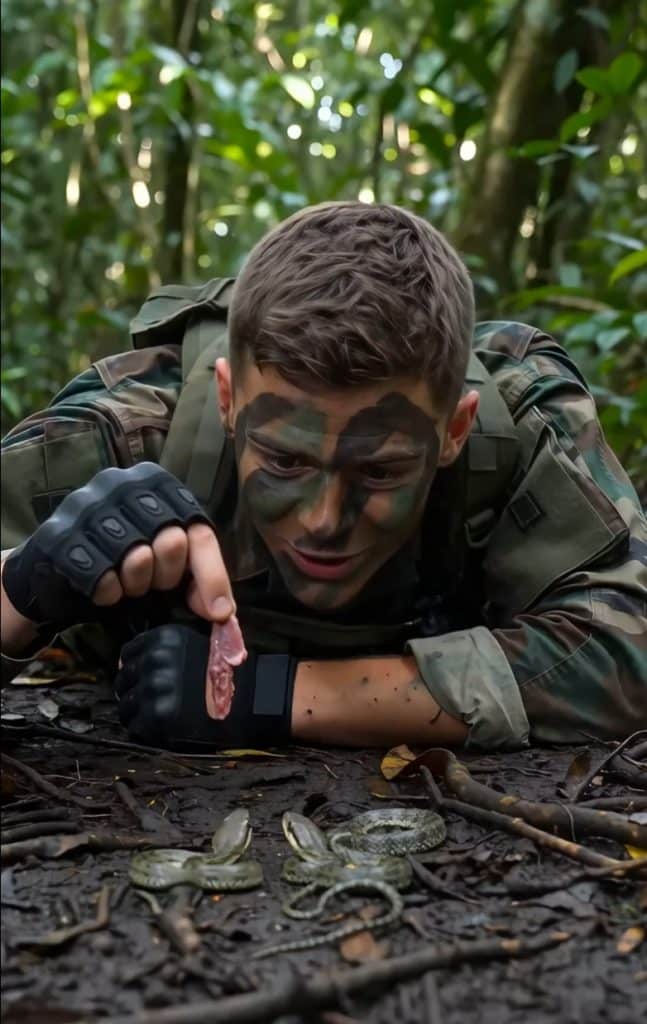
Not completely quiet. The insects still hummed somewhere in the wet green shadows, and leaves still shifted overhead as the noon heat pressed down through the canopy. But the world around him seemed to narrow until there was only his hand, the damp black earth, and three little snakes watching the raw meat pinched between his fingers.
“Eat, little ones,” he whispered.
Private Daniel Mercer had said it the way someone might speak to stray kittens behind a kitchen door. Gentle. Amused. Too soft for a man wearing camouflage paint and a tactical vest in a jungle where everything either hid, hunted, or waited.
He lay flat on his stomach with his chest pressed into his forearm, boots half-sunk in mud, cheek streaked green and brown. Sweat crawled down his temple and disappeared under his collar, but he barely noticed. His eyes were bright, almost boyish, fixed on the snakes coiled in front of him.
They were small. That was what made the whole thing feel harmless.
Each one was thin as a bootlace, greenish-gray, marked with darker bands that blurred against the leaf rot. Their heads lifted and lowered with slow, precise movements. Their dark eyes did not blink.
Daniel grinned wider.
Back home in Oregon, he had grown up rescuing injured birds from the roadside and slipping leftover ham to raccoons behind his mother’s diner. Animals had always come to him. His mother used to say he had a foolish kind of kindness, the sort that made him reach toward every frightened thing before asking whether it had teeth.
Here, thousands of miles from home, that same kindness had followed him into the wrong place.
He lowered the meat.
The snakes moved.
They did not rush like hungry pets. They struck like a single thought. Three bodies uncoiled across the damp ground, slick and quick, the meat landing with a wet sound before vanishing beneath their restless heads.
Daniel laughed under his breath.
Then one snake stopped eating.
Its narrow head lifted from the dirt.
The forked tongue flicked once. Twice. The motion was so quick it seemed almost mechanical. It tasted the air between them, then turned its face toward Daniel as though it had just realized the hand was more interesting than the food.
Daniel’s smile weakened.
He did not pull back.
That was his first mistake.
His second was thinking the snake was looking at him with curiosity.
In the jungle, curiosity was often just hunger with patience.
Behind him, somewhere along the trail, boots crushed wet leaves.
Daniel heard the sound a second before the voice tore through the trees.
“You must never feed snakes!”
The command hit so hard that Daniel flinched, his shoulder jerking against the mud.
Captain Elias Rowe came down the path like a man arriving too late to stop a disaster. He was older than Daniel by barely ten years, but war and command had carved the softness out of him. His olive-drab uniform was darker with sweat at the chest and underarms, his jaw tight, his eyes sharp enough to cut through the vines.
He stopped with his boots planted wide.
“It’s dangerous!” he barked.
Daniel raised his head slowly.
The grin had disappeared. What replaced it was not embarrassment at first. It was confusion. Then irritation. Then, as he saw the captain’s face, something colder.
Fear.
The snake in front of him stayed raised.
It did not retreat with the others.
It held perfectly still, its little head lifted inches from Daniel’s face, its tongue flicking toward the smear of meat scent on his glove.
Daniel’s breath shortened.
Captain Rowe did not move closer.
“Do not twitch,” he said.
The words came quieter now, and somehow that frightened Daniel more.
The jungle seemed to lean in around them.
Then Rowe saw the dark pattern just behind the snake’s head, three broken marks shaped almost like a crown.
His face changed.
And Daniel realized the captain was no longer angry.
He was terrified.
Act II
Daniel Mercer had joined the army for a reason he never told anyone straight.
He gave the usual answer when asked. College money. Structure. A chance to see the world. Something bigger than himself. All the clean little phrases recruiters loved and mothers repeated when they were trying not to cry at bus stations.
But the truth was uglier.
Daniel had joined because he had spent nineteen years being treated like a boy who could never become a man.
His father had been a legend in their small town. Sergeant Thomas Mercer, decorated, disciplined, the kind of man whose photograph still hung in the county veterans’ hall long after his funeral. He had died when Daniel was six, and everyone had spent the years afterward measuring the son against the ghost.
“You’ve got his eyes,” people said.
“You’ll be tough like him someday.”
“You’ll understand sacrifice when you’re older.”
Daniel had smiled through all of it.
He was not tough like Thomas Mercer. He was gentle like his mother. Too trusting, too quick to apologize, too likely to see loneliness where other people saw danger. At school, that had made him a target. In basic training, it had made him a joke.
Mercer the Mascot.
Mercer the Puppy.
Mercer, who once carried a beetle out of the barracks because he did not want anyone to step on it.
By the time he reached the tropical training zone with Echo Platoon, he was desperate to prove there was steel somewhere inside him.
The jungle did not care.
It swallowed confidence by the hour.
Men who had strutted through the transport plane grew quiet after the first night, when the dark filled with calls they could not name. Their skin blistered, their socks rotted, their nerves frayed. Every branch looked like a hand. Every vine like a tripwire. Every patch of green had something hidden behind it.
Captain Rowe taught them the jungle’s first rule on day one.
“Nothing here is decoration,” he said. “If it has color, it is warning you. If it is still, it may be waiting. If it looks harmless, assume it survived by tricking better men than you.”
Most recruits laughed nervously.
Daniel listened.
He truly did.
But listening and understanding were not the same.
Captain Rowe had a reputation that reached the recruits before he did. Some said he had survived two lost patrols. Others said he could smell rain before clouds formed. One corporal swore Rowe once carried a wounded man through seven miles of flooded jungle with a fever burning through his own body.
Daniel did not know what was true.
He only knew that Captain Rowe never wasted words.
He corrected posture with one look. He could silence an argument by stepping into view. He never praised loudly, but when a soldier did something right, he gave a small nod that somehow meant more than a medal.
Daniel wanted that nod.
More than he admitted.
That morning, Echo Platoon had been moving through a narrow trail cut between walls of green. The air felt thick enough to drink. Their uniforms clung to them. Their rifles grew slick in their palms. Mosquitoes orbited their ears like tiny engines.
Then the lead scout called for a halt.
A fallen tree blocked the path, and Captain Rowe ordered the squad to spread out while two men checked for a safe route around it.
Daniel found the snakes while crouching near a rotting stump.
Three of them, barely moving, curled in the leaf litter beneath a fern.
He should have called it out.
He should have stepped away.
Instead, he remembered the ration pouch tucked in his vest, the little piece of raw training bait they had used earlier to demonstrate scent tracking. It was stupid. He knew it even before he did it. But the others were distracted, and the snakes looked so small, and part of him wanted to prove he was calm enough in the jungle to be gentle.
Not scared.
Not helpless.
Not the puppy.
So he lay down in the mud and fed them.
Now Captain Rowe stood over him with rage in his eyes and fear beneath it, and Daniel understood that everyone who had laughed at him had been right about one thing.
He had mistaken softness for innocence.
The jungle had not.
“Mercer,” Rowe said slowly, “where did that meat come from?”
Daniel swallowed.
“My pouch, sir.”
“Which pouch?”
Daniel lifted his eyes just enough to see Rowe’s hand tightening near his belt.
“The tracking bait pouch.”
The captain’s face hardened.
A muscle jumped in his jaw.
Daniel did not understand.
Then the snake moved half an inch closer to his glove.
Rowe’s voice dropped.
“That pouch was marked.”
Daniel’s stomach twisted.
“What?”
“That bait was not for training.”
The words seemed to lose themselves in the humid air.
Daniel stared at the tiny snake, at its lifted head, at the faint crown-like markings behind it.
Captain Rowe looked past him into the trees, scanning the green wall as though the snakes were not the real problem.
“Who gave you that pouch?” he asked.
Daniel’s mouth went dry.
Because he suddenly remembered.
It had not come from supplies.
It had come from Sergeant Vale.
And Sergeant Vale had smiled when he handed it over.
Act III
Sergeant Martin Vale was the kind of man who always looked useful.
He was broad-shouldered, sun-browned, easy with jokes, and loud enough to fill any silence before suspicion could enter it. He slapped backs. He shared cigarettes. He called the younger recruits “kid” in a way that sounded friendly until it didn’t.
Daniel had liked him at first.
Most people did.
Vale was the first senior soldier who had not looked at Daniel like a disappointment. On the transport in, he had leaned across the aisle and asked where Daniel was from. When Daniel answered, Vale’s eyebrows had lifted.
“Oregon Mercer?” he said. “Any relation to Thomas Mercer?”
Daniel had gone still.
“My father.”
Vale had looked at him for a long moment.
Then he smiled.
“Well, I’ll be damned. Your old man was a serious soldier.”
It should have felt good to hear.
Instead, Daniel had felt something twist in his chest, the same old pressure. The same invisible uniform his dead father kept leaving behind for him to fill.
Vale must have noticed, because he softened his voice.
“Don’t worry, kid. You don’t have to be him.”
Daniel had remembered that.
By the second week, Vale had become almost protective. He corrected Daniel’s gear when straps were loose. He gave him extra water purification tablets. He told him which insects not to brush off with bare fingers. When the other recruits teased Daniel for flinching at a spider, Vale told them to shut up.
So when Vale pressed a small sealed pouch into his hand that morning, Daniel accepted it without question.
“Keep this on you,” Vale had said. “For the scent drill later. Captain forgets things when he’s busy playing jungle prophet.”
Daniel had laughed.
Vale had tapped the pouch twice.
“Don’t open it unless you’re told.”
Daniel had nodded.
But Daniel had always been too curious for his own good.
And too eager to turn small moments into proof that he belonged.
Now he lay in the mud with death watching his hand, and Captain Rowe was asking who had given him the pouch like he already knew the answer.
“Sergeant Vale,” Daniel said.
Captain Rowe’s eyes narrowed.
For the first time since Daniel had met him, the captain looked old.
Not weak. Not shaken.
Old.
As if a memory had stepped out of the jungle and placed a hand on his shoulder.
“Of course,” Rowe muttered.
The snake flicked its tongue again.
Daniel’s right hand cramped from holding still.
“Sir,” he whispered, “what did I do?”
Rowe crouched very slowly, keeping his movements smooth and wide. His eyes never left the snake.
“You fed them bait soaked in blood oil,” he said.
Daniel felt his pulse slam.
“Blood oil?”
“A local lure. Illegal. Used by poachers to draw predators and venomous snakes into traps.” Rowe’s gaze cut to the pouch clipped to Daniel’s vest. “And someone handed it to you in a sealed military bag.”
Daniel wanted to say that was impossible.
He wanted to say Vale would never do that.
But the jungle had stripped away the comfort of easy denial.
“Why?” Daniel breathed.
Captain Rowe did not answer right away.
Instead, he reached into one of his belt pouches and pulled out a small metal tin. He opened it with his thumb. Inside was a gray powder that smelled bitter even through the wet air.
“On my count,” he said, “you roll left. Not fast. Not dramatic. Left shoulder first. You keep your right hand low and open. Do not close your fist.”
Daniel’s throat tightened.
“What happens if I close it?”
“The snake may think you’re holding more meat.”
Daniel went pale.
Rowe’s voice sharpened.
“Look at me, Mercer.”
Daniel lifted his eyes.
“You are not going to die because of someone else’s cowardice. Understand?”
For a moment, Daniel did not feel like a private being scolded by an officer.
He felt like a frightened boy hearing a promise from a man who had already made it once before.
Rowe threw the powder to Daniel’s right.
The snake struck toward the movement.
“Now.”
Daniel rolled.
The world flipped into mud and leaves. A cold shape brushed his glove, then vanished. Rowe’s boot came down between Daniel and the snake, not crushing it, only blocking it with perfect timing. The captain swept Daniel backward by the back of his vest and shoved him behind a fallen root.
“Stay there.”
Daniel obeyed.
The other two snakes had disappeared into the leaves. The third lingered by the powder, head moving in sharp, irritated arcs before slipping beneath the fern.
Daniel’s whole body began shaking.
Rowe turned on him.
“What part of never touch the wildlife did you not understand?”
Daniel flinched.
“I’m sorry, sir.”
“Sorry does not pull venom out of your blood.”
“I didn’t know.”
“No,” Rowe said. “You didn’t think.”
That landed harder.
Daniel stared at his muddy gloves. His right one still smelled faintly of meat. He wanted to tear it off.
Then Rowe grabbed the pouch from Daniel’s vest and studied the seal.
His expression turned darker.
Not angry now.
Certain.
Pressed into the corner of the pouch was a small stamped mark, almost invisible beneath the mud: a black crown with three broken points.
The same shape Daniel had seen behind the snake’s head.
Captain Rowe’s fingers tightened around it.
Daniel looked from the pouch to the captain’s face.
“You’ve seen that before,” he said.
Rowe was silent.
“Sir?”
The captain closed the pouch and tucked it away.
“Your father saw it too,” he said.
Daniel stopped breathing.
Deep in the trees behind them, a branch snapped.
Act IV
The sound was too heavy to be an animal.
Captain Rowe turned at once, one hand lifting in a silent command. Daniel froze behind the root, heart hammering so hard he could feel it in his teeth.
Another branch moved.
Then Sergeant Vale stepped out from between two curtains of vines.
He wore the same easy smile.
Only now it looked wrong.
“Everything alright, Captain?” Vale called.
Rowe did not answer.
His body had shifted into something Daniel had not seen before. Not just command. Not just caution. This was the posture of a man facing an enemy he had expected for years.
Vale looked down at Daniel, mud-streaked and trembling behind the root.
His smile widened.
“Mercer. What happened to you, kid?”
Daniel’s voice came out thin.
“You gave me that pouch.”
Vale tilted his head.
“What pouch?”
Daniel stared at him.
The betrayal did not arrive all at once. It came slowly, like cold water filling a room.
“The bait pouch,” Daniel said.
Vale laughed, but it sounded forced.
“Captain, your private’s been eating jungle heat all morning. Maybe get him some water.”
Rowe held up the sealed bag.
The laughter died.
For one second, Sergeant Vale’s face emptied.
No joke. No warmth. No mask.
Then it returned.
But Daniel had seen enough.
“You recognize the stamp?” Rowe asked.
Vale shrugged.
“Supply marks all kinds of things.”
“That isn’t supply.”
“No?”
“It belongs to the Crown Line.”
Daniel looked between them.
The name meant nothing to him, but it hit Vale like a slap.
Captain Rowe took one slow step forward.
“Poachers used that mark near the border sixteen years ago. Smugglers, mostly. Animal skins. venom. Rare compounds. Then they got ambitious and started moving weapons through the same routes.”
Vale’s jaw flexed.
Daniel’s ears rang.
“Your father’s unit was sent to expose them,” Rowe continued. “They found the route. They found the ledgers. They found names.”
Vale said nothing.
Rowe’s voice roughened.
“Then half the patrol walked into a trap.”
The jungle seemed suddenly too still.
Daniel’s father had died in an accident.
That was what he had always been told. A hostile terrain incident. A wrong step. A bad storm. A body recovered days later, honored with folded flags and careful words.
His mother had never spoken about the details.
Whenever Daniel asked, her face closed like a door.
Captain Rowe turned slightly toward him, but his eyes remained on Vale.
“Thomas Mercer did not die because he was careless,” he said. “He died because someone sold his route.”
Daniel felt the ground tilt beneath him.
Vale’s smile was gone now.
“Careful, Captain.”
“I was there,” Rowe said.
Daniel stared at him.
The captain’s voice dropped, and suddenly the stern officer in front of him became a younger man, bleeding through an old memory.
“I was the radio operator attached to your father’s team. Twenty-two years old. Thought I knew everything.” His eyes flicked toward Daniel. “Your father pulled me out when the first blast hit. Took a hit meant for me before he ever reached cover.”
Daniel’s chest tightened until it hurt.
Rowe looked back at Vale.
“And before he lost consciousness, he gave me a page from the ledger. One page he tore out before the rest burned.”
Vale’s hand drifted slightly toward his sidearm.
Rowe noticed.
“So did I,” he said.
From the trees behind Vale came the click of safeties.
Two soldiers emerged from concealment, rifles low but ready. Then another. And another.
Vale froze.
Daniel’s mouth opened.
Echo Platoon had not been scattered.
They had been placed.
Captain Rowe had known something was coming.
“You used Mercer as bait,” Vale said, voice cold now.
“No,” Rowe replied. “You did.”
The words struck clean.
Vale’s eyes moved to Daniel.
For the first time, Daniel saw what had truly lived behind the friendly nicknames and fatherly advice. Not affection. Calculation.
“I don’t know what story he’s selling you, kid,” Vale said. “But your father wasn’t a saint.”
Daniel forced himself to stand.
His knees shook. Mud slid down his sleeves. His face was pale beneath the camouflage paint, but his eyes had changed.
“Tell me,” he said.
Vale blinked.
“What?”
“You wanted me dead or scared enough to fail. Maybe bitten. Maybe blamed for breaking protocol. So tell me why.”
Captain Rowe watched him with something almost like pride.
Vale’s mouth tightened.
“You think this is about you?”
“No,” Daniel said. “I think it’s about him.”
At that, Vale laughed once, bitter and sharp.
“Your father ruined men who were smarter than him. Men with families. Men with debts. He found names in a book and thought truth mattered more than survival.”
Daniel stepped forward despite Rowe’s warning glance.
“It does.”
Vale’s eyes hardened.
“That’s what he said.”
The admission landed like thunder.
A corporal moved behind Vale and took his weapon. Another pulled his wrists back. Vale did not fight at first. He only stared at Daniel as though the past had insulted him by growing a face.
Captain Rowe reached into his breast pocket and removed a folded plastic sleeve.
Inside was an old, water-stained scrap of paper.
He handed it to Daniel.
Daniel unfolded it with trembling hands.
The writing was faded but legible. Names. Payments. Coordinates. A symbol at the top: the broken crown.
And near the bottom, scrawled in a different hand, were four words.
If I don’t return.
Daniel knew the handwriting before his mind accepted it.
His father had written birthday cards in the same slanted letters. His mother kept them in a shoebox under her bed, tied with blue ribbon.
Daniel’s vision blurred.
Below the line was a final note.
Tell Daniel courage is not the absence of fear. It is choosing what is right while fear is still in the room.
Daniel pressed the paper to his chest.
For years, he had believed courage was something loud. Something hard. Something his father had and he lacked.
But Thomas Mercer had left him a different definition.
And in the middle of that ruthless green jungle, with the man who betrayed his father standing in front of him, Daniel finally understood.
The room fear occupied did not have walls.
Sometimes it had vines.
Sometimes it had mud.
Sometimes it had three little snakes staring back at you.
Act V
Sergeant Vale was taken back to base before sunset.
He walked in silence between two armed soldiers, his uniform still neat, his face still proud in the bitter way of men who believe guilt is only a problem when someone proves it.
But proof had finally found him.
The pouch, the stamp, the ledger page, and Captain Rowe’s testimony reopened a case the military had buried under careful language and sealed grief. By nightfall, messages were moving through channels Vale thought had gone cold. Names long protected began surfacing. Old accounts were frozen. Men who had built comfortable lives on silence started receiving calls they had spent sixteen years fearing.
Daniel did not see any of that at first.
He sat outside the medical tent while a corpsman checked his hands again and again, even though he had not been bitten. The glove had been burned. His uniform was bagged. His right hand still smelled like bitter powder no matter how many times he washed it.
Captain Rowe found him after dark.
The jungle beyond the floodlights pulsed with insect noise. Rain threatened but had not fallen. The air was heavy, waiting.
Rowe stood beside him for a while without speaking.
Daniel stared at the dirt.
“I was stupid,” he said finally.
“Yes,” Rowe answered.
Daniel almost laughed, but it broke before it became sound.
“I could’ve died.”
“Yes.”
Daniel swallowed.
“And you knew Vale might try something?”
Rowe looked out toward the tree line.
“I suspected he had followed the unit here under a false assignment. I did not know he would use you.”
“Because of my father.”
“Because you were his son,” Rowe said. “And because he thought kindness made you easy to manipulate.”
Daniel’s jaw tightened.
The words should have humiliated him.
Instead, they clarified something.
Vale had not seen weakness in Daniel. He had seen an opening. Those were not the same thing.
“My mom knew, didn’t she?” Daniel asked.
Rowe was quiet.
“She knew there were unanswered questions. She fought for years to get the file reopened. Doors closed on her. People told her grief was making her chase ghosts.”
Daniel nodded slowly.
That sounded like his mother.
Soft voice. Iron spine.
“She never told me.”
“She was trying to let you have a childhood.”
Daniel looked down at the plastic sleeve now resting in his hands.
His father’s note lay inside.
It did not feel like history. It felt alive. A hand reaching through time, not to burden him, but to steady him.
“I spent my whole life thinking I wasn’t like him,” Daniel said.
Rowe glanced at him.
“You aren’t.”
Daniel flinched before he could stop himself.
But Rowe continued.
“Your father was stubborn, reckless with his own safety, terrible at taking orders when his conscience got involved, and deeply annoying when he was right.”
Daniel blinked.
A small, unexpected smile moved across Rowe’s face and vanished almost at once.
“You are gentler than he was,” Rowe said. “That is not an insult.”
Daniel looked away.
For once, he did not know how to carry praise.
Rowe sat beside him on the bench. The wood creaked under his weight.
“Mercer, what you did today was foolish. Never romanticize wild things. Never assume small means safe. Never let your desire to prove something override training.”
Daniel nodded.
“I won’t, sir.”
“But when Vale tried to twist the truth in front of you, you stood up.”
Daniel remembered his knees shaking.
“I was scared.”
“I know.”
“I could barely breathe.”
“I know.”
Rowe’s voice softened.
“That is why it counted.”
The first drops of rain began to fall.
They struck the canvas roof above the medical tent, slow at first, then faster, building into a steady tropical roar. Men ran across the camp pulling gear under cover. Floodlights blurred in the silver curtain.
Daniel did not move.
For the first time since he had arrived in the jungle, the rain felt less like an enemy and more like something washing the day clean.
Two weeks later, he called his mother from a secure office with Captain Rowe standing outside the door.
At first, Daniel did not know how to begin.
He heard the familiar clatter of plates in the diner kitchen behind her, the murmur of customers, the bell over the front door. Home sounded impossible and ordinary.
“Danny?” she asked. “What happened?”
He closed his eyes.
“Mom,” he said, voice shaking, “they found out the truth about Dad.”
On the other end, there was no sound.
Then a breath.
Not surprise.
Recognition.
The kind of silence that comes when a wound you were told to stop touching is finally seen by someone else.
Daniel told her what he could. Not everything. Not names still under investigation. Not details that would only hurt. But enough.
When he read his father’s final note, his mother broke quietly.
Daniel cried too.
He did not apologize for it.
Afterward, he returned to training.
The men who had called him Mercer the Puppy stopped saying it. Not because Daniel became harder overnight. He still carried beetles off the path when no one was looking. He still spoke softly to nervous recruits. He still hated the idea of anything suffering for no reason.
But something in him had settled.
He no longer mistook gentleness for proof that he lacked courage.
And nobody else did either.
On the final day of jungle training, Echo Platoon moved through the same trail where Daniel had fed the snakes. The fallen tree had been cut and dragged aside. The damp earth had swallowed most of the old tracks. Green leaves glistened after morning rain.
Daniel paused near the rotting stump.
Captain Rowe noticed.
“Problem, Mercer?”
Daniel crouched, not too close, and studied the ground.
A thin greenish-gray snake slid between two leaves and disappeared into shadow.
Daniel stood slowly.
“No problem, sir.”
Rowe watched him.
Daniel adjusted his vest, checked his gloves, and stepped back onto the trail.
He did not smile at the snake.
He did not fear it either.
He simply gave the jungle the respect it had demanded from the beginning.
As they moved forward, sunlight broke through the canopy in scattered gold, catching for one brief second on the mud, the leaves, and the young soldier’s face.
The boy who had tried to feed danger was gone.
In his place walked a man who had finally learned the difference between kindness and carelessness.
And behind him, deep in the green, the jungle closed over its secrets.
This time, Daniel Mercer carried the truth out with him.