Act I
The coffin would not rise.
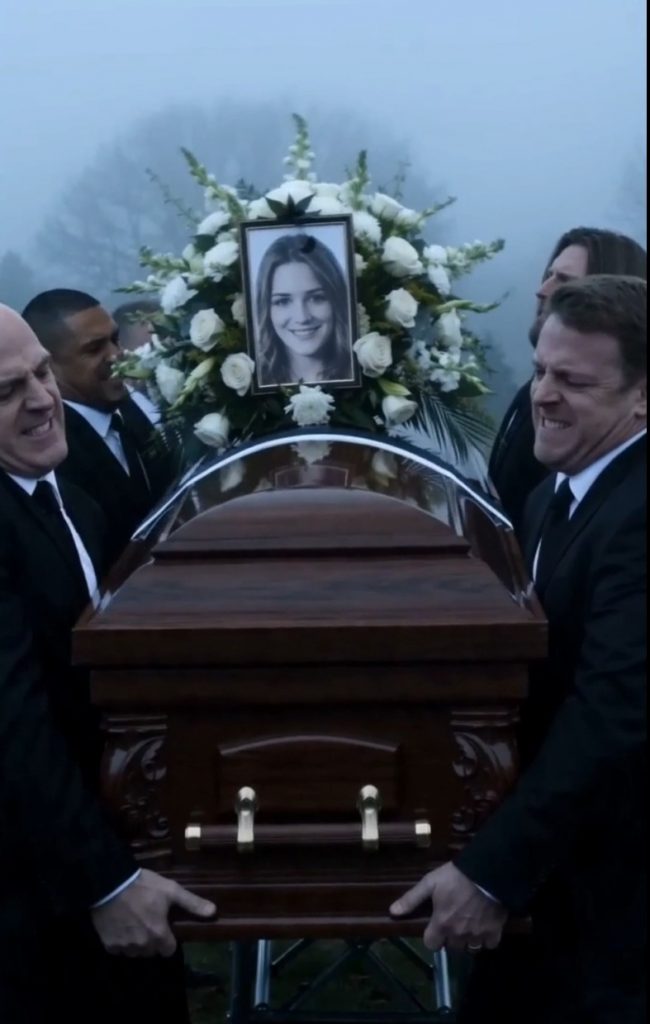
Four men in black suits bent their knees, tightened their grips, and tried again. Their polished shoes sank slightly into the damp cemetery dirt. Their faces twisted with effort beneath the gray, fog-heavy sky.
The wooden coffin lifted three inches.
Then it dropped.
A dull thud rolled across the funeral like thunder trapped underground.
The mourners flinched.
Near the open grave, a framed photograph of the dead woman rested inside a wreath of white flowers. In the picture, she was smiling gently, her dark hair tucked behind one ear, her eyes bright with the kind of warmth that made strangers trust her too quickly.
Her name was Evelyn Marrow.
Thirty-nine years old.
Beloved teacher.
Devoted wife.
Dead, according to everyone standing there, because of a sudden accident on a rain-slick road.
Her mother did not believe a word of it.
The pallbearers tried a third time.
One man groaned. Another cursed under his breath. The coffin tilted sharply to the right, toward the wreath and the photograph, as if whatever lay inside had shifted with intention.
The crowd murmured.
Evelyn’s husband, Julian, stood at the front in a black coat, dry-eyed and pale. His jaw tightened each time the coffin struck the ground. Beside him, his older brother Victor, bald and broad-shouldered, leaned toward the pallbearers with growing irritation.
“What’s inside,” Victor snapped, eyes fixed on the coffin, “stones?”
The words cut through the cemetery.
A few mourners gasped.
The funeral director went rigid.
Evelyn’s mother, Margaret, had been crying quietly until then. She stood near the front in a black coat, her long gray hair loose around her face, both hands clasped as though prayer were the only thing keeping her upright.
But when Victor said stones, Margaret’s crying stopped.
Her eyes moved to the coffin.
Then to Julian.
Then back to the coffin.
A memory rose inside her so sharply she nearly staggered.
Evelyn’s voice, three weeks earlier, whispering through a locked bathroom door.
Mom, if anything happens to me, don’t let them bury me too fast.
Margaret stepped forward.
“Open it,” she said.
No one moved.
The wind dragged fog between the gravestones. Somewhere behind the mourners, a woman sobbed into a handkerchief.
Victor turned toward Margaret. “This is grief talking.”
“No,” she said.
Her voice trembled, but it did not break.
“Open it.”
Julian finally looked at her.
For the first time that morning, fear crossed his face.
Only for a second.
But Margaret saw it.
And that second was enough to change the funeral forever.
Act II
Evelyn had always hated secrets.
Even as a child, she had been impossible to fool. Margaret used to hide birthday presents in the linen closet, and Evelyn would find them by noticing which towels had been folded in a different order. She could hear a lie in a pause, see guilt in a smile held too long.
That gift became her work.
She taught literature at a private academy on the edge of the city, where the children of judges, executives, and old families learned to speak softly while inheriting loudly. Evelyn loved the students, but she disliked the institution around them.
Too much marble.
Too many portraits.
Too many donations that arrived right before someone’s child escaped consequences.
Julian Marrow came from one of those families.
Charming, elegant, practiced. He was the kind of man who remembered everyone’s name in public and forgot kindness in private. When Evelyn first brought him home, Margaret tried to like him because Evelyn looked happy.
But mothers often hear what daughters are not ready to say.
Julian corrected Evelyn’s stories at dinner. He placed his hand on her back when she spoke too long. He smiled whenever Margaret asked direct questions, but the smile never reached his eyes.
Still, Evelyn married him.
For a while, she insisted she was happy.
Then she began calling her mother from strange places. The laundry room. Her car. Once, a grocery aisle, speaking so softly Margaret had to press the phone against her ear.
“I found something,” Evelyn said two months before her death.
“What kind of something?”
“A pattern.”
That was how it began.
A pattern.
At the academy, scholarship students were vanishing from enrollment lists after receiving large donor awards. On paper, they had transferred voluntarily. In reality, their families had been pressured, threatened with unpaid fees, or forced to sign documents they did not understand.
The scholarship money did not follow the students.
It went somewhere else.
Evelyn traced it through board minutes, payment records, and a foundation Julian’s family controlled. The Marrow Foundation had built its reputation on helping poor children enter elite schools. But behind the brochures and gala speeches, money was being redirected into shell companies tied to construction deals, private accounts, and political favors.
When Evelyn confronted Julian, he told her she was confused.
When she kept digging, he told her she was unstable.
When she made copies, he stopped pretending.
Margaret remembered the last time Evelyn came to her apartment. It was raining. Evelyn wore no makeup. A bruise of exhaustion sat beneath each eye.
She placed a small brass key in Margaret’s hand.
“Keep this,” she said.
Margaret closed her fingers around it. “Evie, you’re scaring me.”
“Good,” Evelyn whispered. “Then maybe you’ll listen.”
The key opened a safe deposit box, Evelyn said. Inside were copies of everything: ledgers, recordings, emails, names. But there was more.
She had also hidden one original document somewhere Julian would never destroy it because he would never think to look there.
“Where?” Margaret asked.
Evelyn looked away.
“If I tell you, you’ll try to get it, and he’ll know.”
Three weeks later, Evelyn was dead.
A car accident.
No witnesses.
No autopsy requested because Julian insisted she had suffered enough and deserved peace. The police moved quickly. Too quickly. The funeral was arranged within days. Too quickly. Julian chose a sealed coffin, saying the damage from the crash would upset her students.
Margaret was too shattered to fight every detail.
But she fought one.
She begged the funeral director to let her sit with Evelyn before the burial.
He refused gently.
“Mr. Marrow requested no viewing,” he said.
Mr. Marrow.
Not her mother.
Her husband.
Margaret went home that night and opened the envelope Evelyn had left in her kitchen drawer. She had not opened it before because Evelyn told her not to unless something happened.
Inside was one sentence.
If the coffin is heavy, make them open it.
Act III
The funeral director protested first.
“This is highly irregular,” he said, voice hushed and strained.
Margaret looked at him with eyes so raw that he stopped speaking.
Victor stepped forward. “We are not turning my sister-in-law’s burial into a circus.”
The bald man’s authority filled the air. He was used to people obeying him. He handled the Marrow family’s legal affairs, spoke for Julian when Julian preferred silence, and made unpleasant matters disappear beneath paperwork.
But the pallbearers were still breathing hard beside the coffin.
Their hands shook from trying to lift it.
The priest looked uncertain. The mourners whispered. Evelyn’s students, gathered in a small cluster behind their teachers, watched with frightened faces.
Margaret lifted her chin.
“My daughter told me to open it.”
Julian’s voice came soft and controlled. “Margaret, please. You’re in pain.”
“Yes,” she said. “And pain has made me less polite.”
A murmur passed through the crowd.
Victor took another step. “This burial is proceeding.”
“No,” said a new voice.
Everyone turned.
A woman in a charcoal coat walked through the fog between two rows of gravestones. She carried a leather folder under one arm. Her hair was pinned back, her expression calm in the way only very angry people can manage.
Margaret recognized her immediately.
Nadia Bell.
Evelyn’s closest friend.
An attorney.
Julian’s face hardened.
“Nadia,” he said. “This is a private funeral.”
“Not anymore.”
She held up her phone. “I have a court clerk on standby and a written statement from Margaret requesting immediate preservation of evidence.”
Victor laughed once. “Evidence? This is a coffin.”
Nadia looked at the pallbearers.
“No coffin carrying one woman should require four men to fail three times.”
The sentence landed heavily.
The funeral director swallowed.
Margaret stepped closer to the coffin. Her knees trembled beneath her coat, but she did not stop. She placed one hand on the wood.
It was cold.
Too cold.
“I am her mother,” she said. “Open it.”
For a moment, the cemetery held its breath.
Then one of the pallbearers, a young man with tears in his eyes, stepped away from Victor and moved toward the lid.
“I’m sorry,” he whispered.
Not to Victor.
To Evelyn.
The funeral director unlocked the first clasp.
Then the second.
Julian turned sharply as if to leave, but Nadia’s voice stopped him.
“If you walk away now, everyone here will remember it.”
He stayed.
The lid opened.
Several mourners looked down and immediately covered their mouths.
There was no horror inside. No terrible spectacle. Only something stranger.
The upper compartment held Evelyn’s sealed inner casket, untouched and draped in white. But beneath it, packed into a false base built under the coffin floor, were rows of flat gray stones.
And between the stones sat a steel lockbox.
Victor went white.
Margaret stared at the box.
Nadia whispered, “Oh, Evie.”
The funeral director backed away as if the coffin had accused him personally.
Julian said nothing.
That silence convicted him more than any scream could have.
Margaret reached into her coat pocket and pulled out the brass key Evelyn had given her.
Her hand shook as she held it up.
“This,” she said, “is what my daughter wanted buried with the truth.”
Act IV
The key fit.
Margaret did not open the lockbox herself. Her hands were too unsteady. Nadia took the key from her gently and knelt beside the coffin.
The click sounded small.
The effect was not.
Inside the box were three wrapped folders, a flash drive sealed in plastic, and a handwritten letter with Margaret’s name on the front.
The cemetery disappeared around her.
Margaret saw only the envelope.
Nadia opened it first, scanning quickly to make sure it was safe to read. Her face changed with every line.
“What does it say?” Margaret asked.
Nadia looked up.
“She knew they would try to bury the records with her.”
A sound moved through the crowd, half gasp, half disbelief.
Nadia read aloud, not all of it, only enough.
Evelyn had discovered that Julian and Victor were using the Marrow Foundation to steal scholarship funds, launder donations, and silence families who complained. She had confronted them. She had recorded them. She had given copies to Nadia and hidden originals where Julian would search only after her death.
The coffin.
Because Julian controlled the funeral home contract.
Because Victor controlled the family lawyers.
Because the Marrows owned the cemetery plot.
Because they believed burial would make evidence sacred, sealed, and untouchable.
But Evelyn had counted on one thing they had forgotten.
Her mother knew how heavy love was supposed to feel.
And this coffin was too heavy.
Julian stepped backward.
One of Evelyn’s students began crying openly.
Victor recovered first. “This is absurd. Anyone could have planted that.”
Nadia stood, holding the documents.
“In a coffin arranged by your office?”
Victor’s mouth closed.
The priest stepped away from him.
So did two board members from the academy who had been standing near the family out of habit, not loyalty.
Then the oldest pallbearer spoke.
His voice was low.
“They told us not to question the extra weight.”
Everyone turned toward him.
Victor’s eyes flashed. “Be quiet.”
The pallbearer shook his head. “No.”
It was a small word.
But it opened the ground under the Marrow family.
The man continued. He said Victor had arrived at the funeral home late the previous evening with two private security guards and a sealed crate. He said they claimed the crate contained “family mementos” Evelyn wanted buried with her. He said the funeral director objected, then received a phone call, after which he stopped objecting.
The funeral director’s face collapsed.
“I was threatened,” he said weakly.
Margaret looked at him.
“My daughter is dead,” she said. “You were uncomfortable.”
The shame of that sentence silenced him completely.
Sirens sounded faintly beyond the cemetery road.
Nadia had already called the police before opening the box.
Julian finally spoke.
“You don’t understand what she was doing,” he said, looking at Margaret as though she were the one who had betrayed him. “She was going to destroy lives.”
Margaret stared at the man her daughter had once loved.
“No,” she said. “She was going to stop you from destroying more.”
His face twisted. For one second, the grief mask fell away, and what stood underneath was not sorrow.
It was rage.
“You think Evelyn was innocent?” Julian snapped. “She signed things. She attended dinners. She benefited from the name.”
Margaret stepped toward him.
“She trusted her husband.”
The words struck him harder than accusation.
Because there was no defense for being trusted and choosing to turn that trust into a weapon.
By the time the police reached the grave, the mourners had formed a loose circle around the coffin. Not to trap Julian and Victor physically, but to make sure no one could pretend later that nothing had happened.
The officers took the lockbox.
Then the folders.
Then statements.
Victor demanded names, ranks, procedure, respect.
Julian said very little.
Margaret remained beside the coffin, one hand resting on the wood, her tears returning silently now that the truth had begun to breathe.
The burial did not happen that day.
Evelyn would not be lowered into the ground beside stones meant to bury her voice.
Act V
The first headline appeared before sunset.
At first, it was cautious.
Questions Raised at Funeral of Local Teacher.
By morning, it became impossible to soften.
Evidence Found Hidden in Coffin Links Prominent Foundation to Scholarship Fraud.
By the end of the week, Evelyn Marrow’s smiling photograph was no longer just a funeral portrait. It was on screens, newspapers, courthouse steps, and the academy gates where students placed flowers in jars and handwritten notes along the iron fence.
You believed us.
Thank you, Mrs. Marrow.
We are sorry we were afraid.
The investigation widened quickly.
The lockbox contained original ledgers, donor lists, wire transfer records, signed instructions, and recordings of Victor discussing how to pressure families into silence. The flash drive held videos Evelyn had made for Nadia, for Margaret, and for the students whose futures had been treated like loose change.
In one video, Evelyn sat at her kitchen table in a blue sweater, her face pale but steady.
“If you are watching this,” she said, “then I failed to stay alive long enough to say it in person.”
Margaret could not watch the rest the first time.
Or the second.
On the third, she sat beside Nadia and held a cup of tea that went cold in her hands.
Evelyn explained everything. Not dramatically. Not bitterly. Like a teacher making sure even the slowest person in the room could follow the lesson.
She named accounts.
She named dates.
She named Julian.
When she finally spoke to her mother, her voice softened.
“Mom, I know you’ll blame yourself. Don’t. You raised me to notice when something was wrong. You raised me to care. That is why I did this.”
Margaret pressed her fist to her mouth.
On the screen, Evelyn smiled sadly.
“And if they make my coffin heavy, please be difficult.”
Margaret laughed then.
A broken, aching laugh.
But a laugh.
Julian was arrested two weeks later after trying to move money through an account in Cyprus. Victor followed within days. The academy board collapsed under resignations. The Marrow Foundation was frozen, then placed under independent control. Families who had been forced out came forward one by one, some angry, some ashamed, all carrying stories Evelyn had tried to protect.
The police reopened her death investigation.
The word accident began to disappear from official language.
Margaret did not care for headlines. She cared for the small things. The students who came to her door with letters. The mother who called from three towns over to say Evelyn had saved her daughter’s scholarship. The boy who stood outside the academy holding a book Evelyn had given him and wept because he had never thanked her.
The burial happened a month later.
This time, the coffin was light enough for the pallbearers to carry without strain.
That nearly broke Margaret more than the first funeral had.
There was something unbearable about the right weight of it.
No stones.
No lockbox.
No lies hidden beneath polished wood.
Only Evelyn, flowers, and a mother’s final goodbye.
The cemetery was clear that morning. Still cold, but no fog. Sunlight moved weakly across the gravestones and touched the framed photograph near the wreath.
Nadia stood beside Margaret.
So did many of Evelyn’s students.
When the coffin was lowered, Margaret did not collapse. She had thought she might. Instead, she placed one white rose on top and whispered, “I was difficult, Evie.”
The wind moved through the grass.
For the first time since the accident, Margaret felt something loosen in her chest.
Not peace.
Not yet.
But room.
Months later, the academy renamed its scholarship program after Evelyn. Margaret agreed on one condition: the selection committee had to include parents, teachers, and former students, not only donors. The board resisted until Nadia reminded them that public memory was still very fresh.
They agreed.
At the dedication ceremony, people expected Margaret to give a soft speech about love and loss.
She did speak of love.
But not softly.
“My daughter was not brave because she was never afraid,” Margaret told them. “She was brave because she understood that fear is exactly what dishonest people depend on.”
The crowd listened in silence.
“She told the truth in life. When they tried to bury that truth with her, she found a way to speak from the grave without asking for miracles. She asked for witnesses.”
Margaret looked toward the students in the front row.
“So be witnesses.”
No one applauded immediately.
The words needed a moment to land.
Then the students stood first.
After that, everyone did.
In the years that followed, the story changed as stories do.
Some said the coffin was filled entirely with stones. Some said Evelyn had hidden the evidence herself the night before she died. Some said Margaret heard her daughter’s voice at the grave.
Margaret corrected people when she had the energy.
When she did not, she simply smiled sadly and let them have their drama.
The truth was dramatic enough.
Four men could not lift a coffin.
A cruel man made a joke.
A grieving mother remembered a warning.
And because she spoke when everyone else wanted the ceremony to continue, a buried crime was dragged into daylight.
On quiet afternoons, Margaret still visited Evelyn’s grave.
She brought flowers, sometimes roses, sometimes wild daisies, sometimes nothing but herself. She would sit on the stone bench nearby and tell her daughter ordinary things: the weather, the students, the scholarship, Nadia’s new haircut, the neighbor’s terrible dog.
Before leaving, she always touched the top of the headstone.
Not because Evelyn was there.
Because memory needed a place to rest.
One autumn morning, Margaret found a small note tucked beneath the vase.
It was unsigned.
Mrs. Marrow believed me when no one else did. I’m in college now because of her. Thank you for opening the coffin.
Margaret read it twice.
Then she folded it carefully and placed it in her coat pocket.
The cemetery was quiet around her. No crowd. No shouting. No heavy coffin refusing the earth.
Just wind, stone, and the lasting weight of a daughter who had refused to let the truth be buried.
Margaret looked at Evelyn’s name carved into the granite.
“I did what you asked,” she whispered.
Then she turned and walked slowly back through the rows of graves, leaving behind the woman the world had tried to silence.
But not the story.
Never the story.