Act I
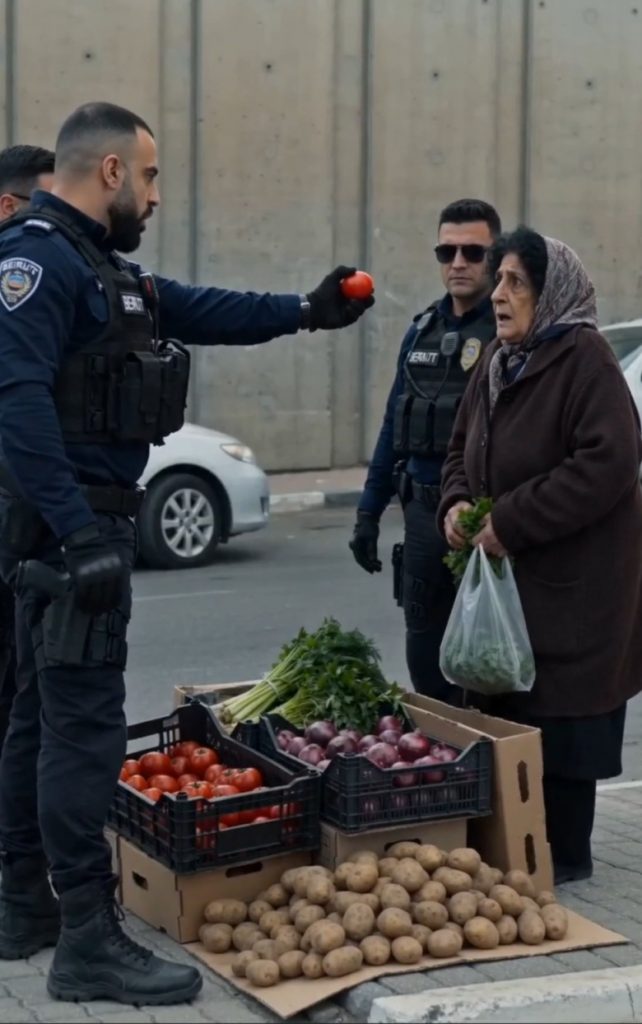
The tomato was still in his hand when he told her she was under arrest.
For a moment, the old woman did not understand him.
She stood behind her crates on the gray sidewalk, clutching a plastic bag of greens against her coat as if it could protect her. Around her feet, red tomatoes glowed dully under the overcast sky. Purple onions sat in black crates. Potatoes rested in worn cardboard boxes, their skins dusty from the morning market. Bundles of herbs leaned together in plastic bags, fresh and green against the concrete wall.
“I’m just selling vegetables here,” she said.
Her voice shook.
The officer with the groomed beard looked at her without blinking. His black tactical vest carried the word BEIRUT across the chest. A radio crackled near his shoulder. He had lifted one tomato from her crate, inspected it like evidence, and held it close to his nose.
Then he pointed it at her face.
“You are under arrest.”
The second officer stood beside him in sunglasses, silent and hard as a closed gate.
The old woman’s name was Mariam Haddad, though most people on that street only called her Teta Mariam. Grandmother Mariam. She had sold vegetables from that same corner for twenty-seven years, rain or heat, hunger or illness, funeral or holiday.
She had buried a husband.
She had raised two sons.
She had fed children whose parents could not pay and quietly slipped extra parsley into the bags of widows who pretended they were not struggling.
Everyone knew her.
That was why the sidewalk went silent.
A mechanic across the street stopped wiping his hands. A girl at the bakery door lowered a tray of flatbread. A young delivery driver slowed his scooter and stared.
Mariam looked from one officer to the other.
“Arrest?” she whispered. “For tomatoes?”
The bearded officer did not smile.
“For obstruction, illegal vending, and refusal to comply.”
“I did not refuse,” she said.
“You spoke.”
It was such a small sentence.
So cold.
So practiced.
Mariam’s fingers tightened around the plastic bag until the greens inside were crushed against her palm.
The officer tossed the tomato back into the crate. It landed too hard, splitting slightly at the skin. Red juice leaked onto the onions below.
Something in Mariam’s face changed when she saw that.
Not anger exactly.
Grief.
As if the tomato had been a living thing handled without respect.
“Please,” she said. “My permit is in the box. I have papers.”
The officer leaned closer. “Your papers are no longer your problem.”
Behind him, the second officer finally moved. He stepped around the stall, blocking the narrow path between the vegetables and the parked white car.
Mariam was trapped by her own crates.
The bearded officer reached for her arm.
That was when a boy shouted from the bakery.
“Don’t touch her!”
The officer turned.
The boy went pale and disappeared behind the door.
Mariam shook her head quickly. “No, no. Leave him. He is a child.”
The officer’s hand closed around her sleeve.
The sidewalk did nothing.
That was what she would remember later. Not the arrest. Not the tomato. Not even the humiliation.
The stillness.
People watched because fear had trained them to watch.
Then, as the officer pulled her away from the stall, Mariam looked down at the split tomato in the crate.
And beneath its torn red skin, something silver glinted.
Act II
Nobody knew that Mariam Haddad had once been the best bookkeeper in Hamra.
Before the headscarf, before the heavy brown coat, before her hands became knotted from winter mornings and wooden crates, she had worked in a shipping office near the port. She was young then, quick with numbers, quicker with lies other people tried to hide inside numbers.
Men underestimated her because she brought tea.
Then they feared her because she remembered everything.
Her husband, Elias, used to joke that Mariam could look at a receipt and hear who was lying.
They had built their life from small things. A rented room. A secondhand stove. A box of tomatoes sold from the back of Elias’s cousin’s truck. Later, when the economy tightened and jobs vanished, the vegetable corner became their survival.
Elias had charm. Mariam had discipline.
He called out prices with a singer’s voice. She counted coins, balanced debts, tracked which families needed credit, and knew exactly which officer came every Thursday expecting “street fees” that never appeared on official paper.
For years, she paid.
Not because she was weak.
Because she had children to feed, and the powerful often mistake a mother’s patience for surrender.
Then Elias died.
A heart attack at dawn, one hand still on a crate of potatoes.
After that, the city seemed to shrink around Mariam. Her older son left for work abroad and called when he could. Her younger son, Samir, stayed. He was gentle where Elias had been loud, stubborn where Mariam was careful, and dangerous in one way neither parent had planned.
He believed things should be fair.
Samir became a journalist.
Not a famous one. Not the kind with studio lights and polished suits. He worked for a small independent paper above a pharmacy, writing about evictions, missing public funds, fake permits, and redevelopment contracts that somehow always rewarded the same families.
Mariam begged him to be careful.
He always kissed her forehead and said, “I learned from you.”
She hated that answer.
Three months before the arrest, Samir came to her apartment after midnight. His shirt was damp with rain. His eyes were too bright.
He carried a cloth bag full of tomatoes.
“Mama,” he said, “I need your stall tomorrow.”
She stared at him. “For vegetables?”
“For truth.”
He told her then what he had found.
The city was preparing to clear several old sidewalk markets under the name of “beautification.” Officially, the streets would be cleaned, reorganized, made safer. Unofficially, the land had already been promised to a private development group tied to senior officials, police commanders, and businessmen who never appeared in public together but signed papers through the same lawyer.
The vendors would be removed first.
Then compensated badly.
Then forgotten.
Samir had names. Bank transfers. Videos. Recordings. A ledger copied from a contractor’s private account. But he did not trust phones anymore. He believed someone in the department was watching him.
So he hid the evidence where no one would look.
Inside the tomatoes.
Not all of them. Only three.
Each had been carefully hollowed through the stem, sealed again with wax the color of skin, and packed with a tiny metal capsule wrapped in plastic. One held a flash drive. One held a memory card. One held a key.
Mariam thought he had lost his mind.
Then she saw his hands shaking.
“Why me?” she asked.
“Because they don’t see you,” Samir said. “That is their mistake.”
The next morning, Samir vanished.
Not dramatically. Not with witnesses. He simply failed to arrive at the newspaper. His phone went dead. His apartment was searched before Mariam got there, but whoever searched it had been too neat. Too professional.
The police told her he was probably hiding.
People whispered he had fled.
Mariam knew better.
For three months, she sold vegetables with three tomatoes hidden in plain sight. She moved them from crate to crate, day after day, watching faces, waiting for the contact Samir had promised.
A woman with a blue scarf.
A man carrying a torn red notebook.
A phrase: Are the tomatoes sweet this season?
No one came.
Then, that gray morning, two officers in black vests stopped in front of her stall.
And one of them picked up the wrong tomato.
Act III
The officer did not know what he had cracked.
He only knew the old woman had looked down too quickly.
That was enough.
His name was Lieutenant Karim Nassar, and he had built a career out of noticing fear. He noticed when street vendors hid cash in flour sacks. He noticed when drivers lied about expired papers. He noticed when young men looked toward alleyways before answering questions.
He noticed Mariam looking at the tomato.
His fingers returned to the crate.
Mariam moved before thinking.
“No,” she said.
Karim froze.
The second officer turned his head.
The word had been small, but it carried everything she had spent three months hiding.
Karim smiled for the first time.
“There it is,” he said softly.
Mariam clutched the bag of greens tighter. “It is spoiled. Leave it.”
He reached for the split tomato.
Mariam knocked the crate with her knee.
Tomatoes rolled across the sidewalk.
Onions tumbled after them. A potato bounced into the gutter. People gasped and stepped back as red fruit scattered between shoes and tires.
For one wild second, the evidence disappeared into ordinary mess.
Karim swore.
“Pick them up,” he snapped to his partner.
The officer in sunglasses bent quickly, scanning the ground.
Mariam saw the split tomato roll beneath the parked white car.
So did Karim.
He grabbed her arm harder.
“What is in it?”
“Lunch,” she said.
The answer came before fear could stop it.
A few people in the crowd laughed nervously.
Karim’s face darkened.
He pulled her away from the stall, but Mariam dug her heels against the concrete. She was old, but a life of carrying crates had left strength in unexpected places. The plastic bag tore in her hand. Greens spilled onto the sidewalk.
Then someone stepped forward.
The bakery girl.
Her name was Leila, nineteen, thin, with flour on her sleeves and panic in her eyes. She crouched as if gathering the fallen herbs, but her hand slipped beneath the white car and closed around the split tomato.
Karim did not see.
Mariam did.
Their eyes met.
For a moment, Mariam saw Samir as a boy, hiding coins under the flour bin because he thought secret treasure should always be near bread.
Leila tucked the tomato into her apron.
Karim dragged Mariam toward the police vehicle.
The crowd finally began speaking.
“She has a permit.”
“She’s been here forever.”
“She did nothing.”
The second officer lifted one hand toward them, and the voices died.
Mariam was pushed into the back seat.
Through the window, she saw Karim return to the stall and search the crates himself. He crushed tomatoes with his fingers. He tore open herb bundles. He kicked through potatoes like a man angry at the earth for keeping secrets.
He found nothing.
Not then.
Leila had already slipped into the bakery kitchen.
Inside, her hands shook so badly she almost dropped the tomato into the sink. She peeled away the split skin and found the silver capsule hidden beneath the pulp.
She did not know what it was.
But she knew who might.
Samir had once come to the bakery to interview her father about rent increases. He had given Leila a card and told her, “If anything happens on this street, record first, cry later.”
She had thought he was joking.
Now she pulled out her phone.
By the time Karim’s vehicle turned the corner with Mariam inside, the first file from the capsule was already uploading.
And across Beirut, phones began to vibrate.
Act IV
They took Mariam to a small station with fluorescent lights and walls painted the color of old paper.
Karim placed her in a chair across from his desk and left her there for forty minutes. That was another kind of power. Not shouting. Not hitting. Just making an old woman sit under a buzzing light with no water, no coat removed, no explanation.
When he returned, he carried the split tomato in an evidence bag.
Empty.
He placed it on the desk.
“You are going to tell me who has it.”
Mariam looked at the tomato.
Its skin had collapsed. Its red flesh was bruised and torn. It looked absurd inside the plastic bag, almost pitiful.
She thought of Samir placing it carefully into the crate, his fingers gentle, his voice low.
Because they don’t see you.
Mariam raised her eyes.
“I sell vegetables,” she said.
Karim leaned over the desk. “Your son stole government documents.”
“My son wrote the truth.”
“Your son is gone.”
The words hit harder than she expected.
Karim saw it and smiled.
Mariam’s face remained still, but inside, something old and deep cracked open.
Gone.
Not hiding. Not traveling. Not confused.
Gone.
He had said it like a man who knew.
She folded her hands in her lap.
“Where is he?”
Karim straightened.
That was when the station door opened.
A younger officer entered, pale and breathless. He whispered into Karim’s ear.
Karim’s expression changed.
Just slightly.
But Mariam saw it.
Fear.
The young officer held out a phone.
Karim snatched it.
On the screen was Samir’s voice.
Not his face. His voice, playing over documents, transfers, maps, permits, photographs of meetings, and a scanned page with names Mariam had never seen but Karim clearly recognized.
The video had already been shared thousands of times.
Then tens of thousands.
Then too quickly to stop.
Samir’s recorded voice said:
If you are watching this, it means I was not able to publish it myself. The vegetable vendors of Beirut are not being removed for safety. They are being removed because their corners have already been sold.
Karim turned off the phone.
Too late.
Outside the station, voices rose.
At first, a few.
Then many.
By evening, the sidewalk outside was full. Vendors came with crates. Bakers came with bread. Mechanics came with oil on their sleeves. Mothers came with children. Students came with phones held high. Old men came carrying plastic bags of tomatoes like flags.
Leila stood at the front with her father.
In her hand was the second capsule.
She had found it after returning to Mariam’s stall with half the street watching. Another tomato. Another hidden piece of the truth.
This one held the key.
Not to a box.
To a locker near the newspaper office.
Inside that locker were printed copies of everything Samir feared would be deleted.
And one photograph.
Samir, bruised but alive, sitting in a bare room with that day’s newspaper in his lap.
On the back, in his handwriting, were five words.
If they arrest Mama, release everything.
Mariam did not see the photograph until later.
Karim did.
He stood inside the station as the crowd outside chanted her name, and for the first time in his career, he understood the danger of humiliating someone beloved by people he had never bothered to count.
A senior official called.
Then another.
Then someone from internal affairs.
Karim stopped answering.
At 8:12 p.m., the station commander walked into the room where Mariam still sat.
He no longer looked bored.
“Madame Haddad,” he said carefully, “there appears to have been a misunderstanding.”
Mariam stared at him.
Her coat was still buttoned wrong from the arrest. Her hands smelled faintly of crushed herbs. Her knees ached from the cold station chair.
“A misunderstanding,” she repeated.
“Yes.”
She leaned forward.
“My son is missing.”
The commander swallowed.
Outside, the crowd roared again.
Mariam stood slowly.
This time, no one touched her.
Act V
When Mariam stepped out of the station, the street erupted.
Not with celebration.
With relief.
Leila ran to her first, wrapping both arms around her as if Mariam were the one who needed holding. The bakery girl was crying openly now. Her father stood behind her with red eyes and flour still dusted across his collar.
“I took it,” Leila whispered. “I took the tomato.”
Mariam held her face between both hands.
“Good girl,” she said.
The crowd made a path.
Some people reached for Mariam’s sleeve. Others touched their hearts. A boy placed a tomato gently into her palm, not as food, not as payment, but as proof that the thing used to shame her had become something else.
A symbol.
By midnight, Samir’s files had reached every major newsroom that still dared to publish difficult things. By morning, the story had grown beyond one street, one vendor, one arrest.
The development contracts were exposed.
The forged permits were exposed.
The payments were exposed.
So was the quiet network of officers who had collected money from people too poor to fight back and called it order.
Karim Nassar’s name appeared in the documents more than once.
So did the name of the silent officer in sunglasses.
The city tried to deny what it could, soften what it could not, and bury the rest beneath official language. But the footage of Mariam’s arrest would not disappear.
Everyone saw it.
The old woman behind her vegetables.
The officer lifting the tomato.
The cold command.
You are under arrest.
Millions watched the moment without knowing, at first, that the tomato in his hand held the beginning of his own downfall.
Three days later, Samir was found.
Not by police.
By fishermen outside a coastal storage compound after an anonymous call led them to a locked service room. He was weak, dehydrated, and furious enough to refuse a stretcher until someone promised him his mother was safe.
When Mariam saw him in the hospital, she did not cry immediately.
She slapped his shoulder.
Not hard, but with all the terror of a mother who had spent months imagining graves.
“You hid evidence in tomatoes?” she said.
Samir smiled through cracked lips. “You always said vegetables feed people.”
Then she cried.
He reached for her hand.
For a long moment, neither said anything that mattered to anyone else.
The investigation moved slowly after that, because power never falls without grabbing at walls. But it moved. Officers were suspended. Contractors were summoned. Accounts were frozen. The market clearance order was halted pending review.
Mariam returned to her stall one week later.
People begged her to rest.
She refused.
At dawn, she stood behind her crates in the same brown coat, arranging tomatoes with careful hands. Leila helped her stack onions. The mechanic repaired one broken crate without asking for money. Someone painted a small sign and leaned it against the concrete wall.
TETA MARIAM’S CORNER
NO ONE IS INVISIBLE HERE
Mariam pretended not to like it.
Everyone knew she did.
Customers came all morning. Some bought one tomato and paid for ten. Some brought flowers. Some only stood there, ashamed, because they had watched her be taken and had done nothing.
Mariam served them all.
Not because she had forgotten.
Because a city cannot survive if every wound becomes a wall.
But she remembered.
When a young man apologized for staying silent, Mariam placed a bundle of parsley into his bag and said, “Next time, be loud sooner.”
He nodded.
So did everyone close enough to hear.
Months later, the sidewalk changed. Not into a luxury storefront. Not into the glass-front development promised in secret contracts. The vendors remained, but the city was forced to issue real permits, visible prices, and protections that could not be erased by a single officer’s mood.
Samir kept writing.
Leila started filming everything.
Mariam kept selling vegetables.
Every morning, she inspected her tomatoes with the seriousness of a jeweler. Customers joked that no tomato in Beirut was safer than hers. She would snort, wave them away, and add an extra onion if they made her laugh.
But sometimes, when the sky turned gray and a police vehicle slowed near the curb, her hand still tightened around the nearest crate.
Fear does not vanish just because truth wins once.
It simply learns that it does not have to stand alone.
One evening, after the market closed, Samir found his mother sitting on an overturned crate beside the wall. The last light of the day rested on her face. Her hands were folded in her lap.
He sat beside her.
“You could stop,” he said.
She looked at him.
“I am old, not finished.”
He smiled.
Across the street, Leila was showing two children how to record video without shaking the phone. The mechanic was arguing about football. A woman in a black coat was choosing potatoes carefully, weighing each one in her palm.
Life had returned.
Not cleanly.
Not perfectly.
But stubbornly.
Mariam reached into a crate and lifted a ripe red tomato. She turned it in her hand, checking the skin for bruises.
Then she held it out to Samir.
“Smell,” she said.
He laughed. “Why?”
“Because a good tomato tells the truth.”
Samir took it, humoring her, and breathed in.
It smelled of earth, rain, and the hands that had carried it there.
Mariam looked down the street where the officers had once taken her away.
“They thought I was only a woman selling vegetables,” she said.
Samir’s smile faded.
She placed the tomato back into the crate.
“That was their mistake.”
The city moved around them, loud, wounded, alive.
And on that small corner of concrete, beneath a plain wall and beside crates of tomatoes, onions, potatoes, and herbs, an old woman stood exactly where power had tried to erase her.
This time, everyone saw her.