Act I
The lilies were too white.
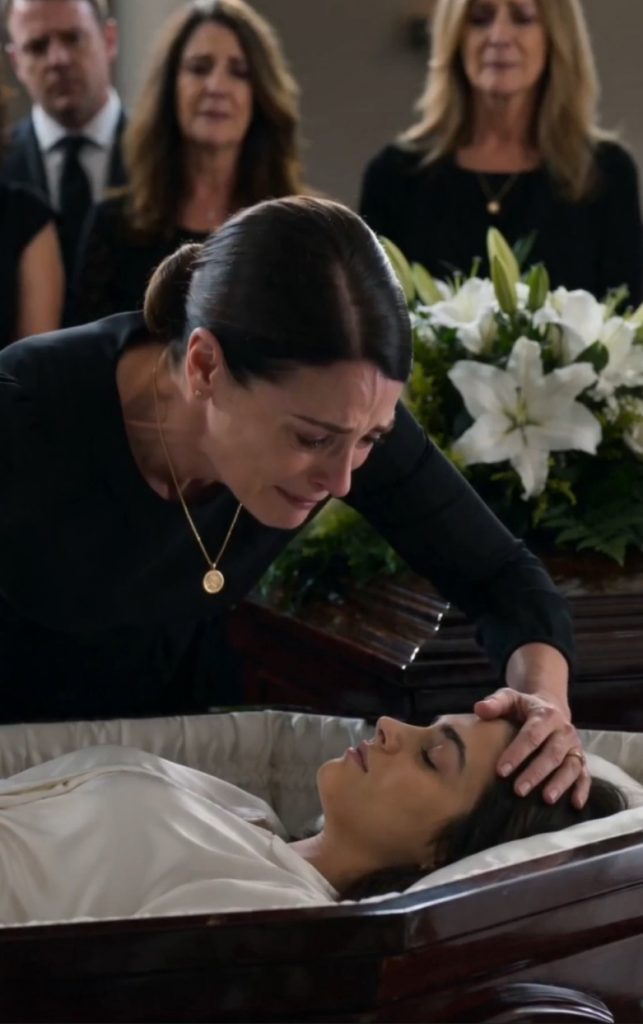
That was what Mara Whitcomb kept thinking as she leaned over the casket, one shaking hand resting on her daughter’s dark hair. The funeral hall was dim and soft around her, all polished wood, folded hands, and whispers that dissolved before they reached the ceiling.
Her daughter lay inside a dark mahogany casket lined with white silk.
Ava was twenty-two.
Too young for white lilies. Too young for a burial gown. Too young for the terrible stillness that made everyone in the room speak as if sound itself might be disrespectful.
Mara stroked her daughter’s hair with the tenderness of a mother trying to wake a child from a nightmare.
“Please,” she whispered, her voice breaking. “Please don’t take her from me.”
Behind the head of the casket stood four mourners: one man with short brown hair and three women in black. Their faces were blurred by tears, distance, and the heavy unreality of the room.
Mara barely saw them.
She saw only Ava.
The daughter who used to fall asleep with books open on her chest. The daughter who called every Sunday even when she was angry. The daughter who had been alive three mornings ago, standing in Mara’s kitchen with rain on her coat and fear in her eyes.
I found something, Mom.
Those had been Ava’s last real words to her.
Then came the call.
The hospital.
The doctor’s careful voice.
The phrase no mother should ever hear.
Now Ava lay beneath a soft wash of chapel light, her long dark hair brushed perfectly over one shoulder, her face composed by strangers who had not known how expressive it used to be.
Mara bent lower.
Her body shook with grief as she pressed a long kiss to Ava’s temple.
The room held its breath.
Then Ava’s eyelid twitched.
Barely.
A flicker so small it could have been candlelight moving across skin.
Mara froze.
She pulled back slowly, her lips still trembling, her eyes fixed on her daughter’s face.
Another flicker.
This time, there was no mistake.
Mara’s hands clamped onto the wooden edge of the casket so hard her knuckles turned white.
“Oh my God!”
The scream tore through the funeral hall.
The mourners flinched. One woman dropped her prayer card. The man near the flowers staggered back as if the floor had shifted beneath him.
Mara stared down into the casket, pale and shaking.
Ava’s lips parted by the smallest breath.
And the dead girl was not dead.
Act II
Three days earlier, Ava Whitcomb had arrived at her mother’s house just after midnight.
Mara remembered the sound before the sight. Three sharp knocks on the back door. Not the front. Never the front when Ava was afraid.
Rain had soaked through her daughter’s black coat. Her hair clung to her cheeks. In one hand, she held a leather folder pressed flat against her ribs.
“Mara,” she said, not Mom.
That was the first warning.
Ava only called her Mara when she wanted to be treated like an adult before Mara could become a mother and panic.
“What happened?” Mara asked.
Ava stepped inside and locked the door behind her.
“I found something at the foundation.”
The Whitcomb Foundation had belonged to Mara’s late husband, Henry. After his death, it became the family’s public face: scholarships, hospital donations, arts grants, all polished into a legacy that looked generous in photographs.
Ava had started working there after college.
Mara thought it would be safe. Meaningful. A way for Ava to feel connected to the father she had lost at twelve.
Instead, Ava began asking questions.
Why were scholarship funds being routed through consulting firms?
Why did one hospital wing receive donations on paper but never in its budget?
Why had Henry’s old signatures appeared on documents dated years after he died?
Mara had told her to be careful.
Ava had laughed then, too young to understand that powerful families did not fear good intentions. They feared proof.
That night, Ava was not laughing.
She opened the folder on Mara’s kitchen table and showed her copies of wire transfers, forged approvals, and one name appearing again and again.
Richard Hale.
Mara’s brother-in-law.
Henry’s former business partner.
The man who had stood beside Mara at every anniversary gala, steadying her elbow and telling donors that family was everything.
“He’s been stealing from the foundation,” Ava whispered. “For years.”
Mara sat down slowly.
“There has to be an explanation.”
Ava’s face twisted with pain. “There is. He thought nobody would check.”
Then she showed Mara the last page.
A private medical donation had been diverted from a children’s clinic into a shell company controlled by Richard. Ava had found the original authorization buried in an archive.
Henry had never approved it.
His name had been copied.
Mara felt something old and trusted crack inside her.
“Who else knows?”
Ava looked away.
“My fiancé.”
Mara closed her eyes.
Daniel Ross. The man with the short brown hair. The man who had cried beside Ava’s casket. The man who had asked Ava to marry him six months after joining Richard’s legal team.
Mara had never fully trusted him.
Not because he was rude. He was never rude. That was the problem. Daniel was always the correct temperature, the correct volume, the correct shape for every room.
“He told me I was overreacting,” Ava said. “Then tonight Richard called me and asked where the originals were.”
Mara stood. “You’re staying here.”
Ava shook her head. “No. If I disappear, he’ll know you have them.”
“Ava—”
“I hid the drive somewhere safe.”
“Where?”
For the first time that night, Ava smiled.
A small, brave, terrible smile.
“Somewhere he’d never look unless it was too late.”
By morning, Ava had collapsed at the foundation office.
By noon, Mara was told her daughter was gone.
By sunset, Daniel was arranging the funeral with startling efficiency.
And now, in the funeral hall, Ava had just moved.
Act III
Mara screamed until her throat felt raw.
“Call an ambulance!” she cried. “She’s breathing!”
For one horrible second, nobody moved.
The room had been prepared for grief, not reversal. People knew what to do with condolences, tissues, flowers, silence. They did not know what to do with a mother pointing into an open casket and insisting that the impossible had opened its eyes.
Then one of the women in black rushed forward.
It was Dr. Elise Monroe, Ava’s childhood pediatrician and Mara’s closest friend from the years before money made every friendship complicated. She had come to the funeral grieving, but the moment she reached the casket, something clinical sharpened in her face.
She leaned close to Ava.
Then she went pale.
“She has a pulse.”
The room erupted.
Someone shouted for emergency services. Someone else ran toward the doors. The funeral director appeared from the side hall, horrified, whispering, “This can’t be, this can’t be,” as though his disbelief mattered more than Ava’s breath.
Mara climbed half into the casket, gathering Ava’s cold hand in both of hers.
“Ava, baby, stay with me,” she whispered. “Stay with me.”
Daniel moved forward.
“Mara,” he said carefully. “Step back. Let the doctor handle it.”
The sound of his voice cut through her panic.
She looked at him.
He was too calm.
Everyone else in the room had shattered into motion. Daniel stood still, one hand at his side, his face drawn tight not with shock, but calculation.
Dr. Monroe noticed too.
“Daniel,” she said, “give us space.”
His jaw tightened.
“I’m just trying to help.”
“No,” Mara said.
The word came out low.
Daniel looked at her.
Mara rose from the casket slowly, still holding Ava’s hand.
“You were here early,” she said.
He blinked. “What?”
“You came before the service. The funeral director said you asked for time alone with her.”
Daniel’s face hardened by a fraction.
The funeral director stopped moving.
Mara turned to him. “Did he?”
The man swallowed. “He said he wanted to say goodbye privately.”
Dr. Monroe’s eyes flicked to Ava’s wrist.
There was a faint mark there. Small. Almost hidden beneath the silk sleeve.
Not proof on its own.
But enough to make the room colder.
Outside, sirens began to rise through the gray morning.
Daniel stepped back.
Just one step.
Mara saw it.
So did everyone else.
Ava’s fingers twitched inside her mother’s hand.
Mara bent close.
Her daughter’s eyelids fluttered again.
This time, a sound came from her throat. Weak. Broken. But real.
Mara pressed her forehead to Ava’s hand and sobbed with a kind of terror that had hope inside it.
Daniel turned toward the side exit.
Dr. Monroe pointed at him.
“Stop him.”
The man who had stood silently near the lilies grabbed Daniel’s arm before he reached the door.
For the first time that day, Daniel’s perfect mask slipped.
And underneath it was fear.
Act IV
Ava was taken from the funeral hall alive.
That sentence would later spread through the city in whispers, headlines, and horrified dinner conversations, but Mara did not hear any of it. She rode in the ambulance with one hand locked around her daughter’s, counting each shallow breath like a prayer.
At the hospital, the truth came in fragments.
Ava had been declared gone too quickly after arriving unresponsive at the emergency department. The physician who signed the release was not her usual doctor. The paperwork had been rushed. A transfer note had gone missing.
Dr. Monroe refused to leave.
Neither did Mara.
Within hours, specialists discovered what should have been caught immediately: Ava was in a rare, dangerous state that mimicked death closely enough for a careless system to fail her.
But carelessness was not the whole story.
By evening, security footage from the funeral hall showed Daniel entering the private viewing room alone before the service. He stayed for four minutes. Long enough to approach the casket. Long enough to touch Ava’s wrist.
Daniel claimed he had only held her hand.
The footage did not show clearly enough to prove otherwise.
But Ava woke before midnight.
Not fully. Not easily. Her voice was weak, her body exhausted, her mind surfacing through fog. Mara was beside her, one hand on her hair just as she had been at the casket.
Ava’s eyes opened.
Mara stopped breathing.
“Mom?” Ava whispered.
Mara broke.
She leaned over her daughter without crushing her, crying into the blanket, whispering her name again and again until Ava’s own eyes filled.
“You came back,” Mara said.
Ava swallowed. “I heard you.”
Mara lifted her head.
“I heard you at the funeral,” Ava whispered. “Like you were far away.”
Dr. Monroe wiped her eyes and turned toward the window.
Even doctors needed somewhere to put miracles.
Then Ava’s face changed.
Fear returned.
“Daniel,” she whispered.
Mara took her hand. “He’s being questioned.”
Ava’s eyes widened. “The box.”
“What box?”
“My burial gown,” Ava said, struggling for breath. “The seam.”
Mara stared at her.
Then she understood.
The drive.
Somewhere he’d never look unless it was too late.
Mara stood so quickly the chair scraped back.
The funeral director, still shaken by what had happened, agreed to release Ava’s belongings under police supervision. Inside the white silk gown, stitched carefully into the inner hem, they found a small black flash drive wrapped in clear plastic.
On it was everything.
Not just Richard Hale’s theft.
Daniel’s emails.
Messages showing he had been hired to get close to Ava after she began asking questions. Records of deleted files. A chilling exchange between Daniel and Richard after Ava collapsed.
Make sure the service happens quickly.
Mara read that line once.
Then again.
Something inside her went silent.
Not numb.
Focused.
Richard Hale was arrested the next morning at the airport with a packed leather bag and two passports. Daniel was taken into custody after contradicting his own statement three times. The hospital opened an internal investigation. The physician who released Ava’s body was suspended pending review.
But none of that mattered when Ava finally squeezed Mara’s hand with real strength.
Justice could wait outside the room.
For one night, Mara needed only to watch her daughter breathe.
Act V
The second service happened six months later.
Not a funeral.
A testimony.
Mara hated the word at first. It sounded too public, too polished, too close to the kind of event the Whitcomb Foundation used to host when it wanted applause for money it had not earned.
But Ava insisted.
“If they used the foundation to hide what they were doing,” she said, still thinner than before but stronger every week, “then we use it to tell the truth.”
So they returned to the same chapel.
The mahogany casket was gone.
In its place stood a simple wooden podium surrounded by white lilies, not as funeral flowers this time, but as a deliberate act of reclamation. The same mourners came. So did reporters, foundation employees, nurses from the hospital, and families whose scholarship money had vanished into Richard Hale’s accounts.
Mara sat in the front row.
Her gold pendant rested against her black dress. She wore black again, not for death, but for memory.
Ava walked slowly to the podium.
The room stood.
She paused, overwhelmed by the sound, then found her mother’s face and steadied herself.
“I was supposed to be buried because powerful people believed silence could be arranged,” Ava said.
No one moved.
Her voice trembled, but did not break.
“They counted on grief moving faster than questions. They counted on my mother being too devastated to notice what others missed. They were wrong.”
Mara covered her mouth.
Ava looked toward the back of the chapel, where Dr. Monroe stood with folded hands.
“I am alive because my mother loved me enough to look twice.”
The sentence moved through the room like light.
After that day, the Whitcomb Foundation changed completely.
The stolen funds were traced and returned. The board was dissolved and rebuilt under public oversight. Scholarships were restored in the names of the families harmed. The hospital, bruised by scandal, introduced stricter review procedures for end-of-life declarations and family notification.
Mara did not care about the public apologies.
She cared that no other mother would be asked to trust a signature more than her own eyes.
Daniel eventually admitted what he had done, though his confession carried the hollow tone of a man sorry only that the ending had escaped him. Richard blamed everyone but himself until the evidence left him no audience.
Ava never visited either of them.
She said survival had already taken enough of her time.
Instead, she healed.
Slowly. Unevenly. With nightmares, physical therapy, anger, laughter at inappropriate moments, and mornings when she sat in Mara’s kitchen drinking tea as if ordinary sunlight had become a luxury.
Sometimes Mara would stop in the doorway and just look at her.
Ava would sigh without turning around.
“I’m still here, Mom.”
“I know.”
“You’re staring again.”
“I’m allowed.”
Ava would roll her eyes, but she always smiled.
One rainy evening, nearly a year after the funeral, Mara found Ava in the attic with the blue storage box that held Henry’s old photographs. The flash drive case sat beside her, empty now, no longer hidden, no longer dangerous.
Ava held up a picture of herself at seven, missing two front teeth and wearing a crooked paper crown.
“I looked ridiculous,” she said.
“You looked perfect.”
“I looked like a tiny dictator.”
“You were a tiny dictator.”
They laughed until they cried.
Then silence settled, warm and bearable.
Ava leaned her head against Mara’s shoulder.
“I heard you,” she said quietly.
Mara knew what she meant.
In the casket. In the dark. In that place between goodbye and impossible.
Mara closed her eyes.
“I thought I was saying goodbye.”
“You were calling me back.”
Outside, rain tapped softly against the roof.
For months, Mara had replayed the funeral in fragments: the lilies, the white silk, the twitch of Ava’s eyelid, the scream that turned mourning into chaos. She used to wake shaking from the memory.
Now, for the first time, she let herself remember the end differently.
Not as the day she almost buried her daughter.
As the day love noticed what power tried to hide.
The chapel had been built for endings. The casket had been prepared for loss. The mourners had come dressed for farewell.
But one mother kissed her daughter’s temple and felt the smallest answer beneath her grief.
A flicker.
A breath.
A second chance.
And that was enough to pull the truth out of the grave before the lie could close over it.