Act I
The laughter started behind her like a small cruel fire.
At first, Evelyn Moore pretended not to hear it.
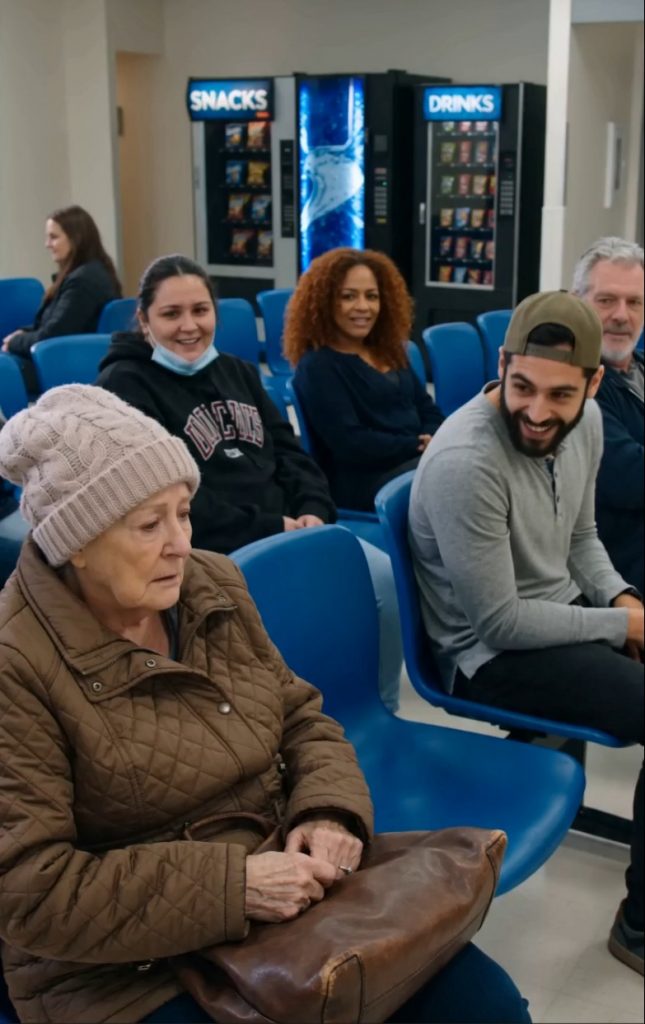
She sat in the front row of blue plastic chairs, both hands folded over the worn brown leather handbag in her lap. Her quilted brown coat was buttoned wrong at the top. A pale pink knit beanie covered most of her silver hair. The fluorescent lights made the waiting room look colder than it was.
Behind her, a young man in a gray shirt leaned forward and pointed.
He wore his baseball cap backward, as if immaturity had become a style choice. His beard was trimmed. His voice was loud. Every laugh bounced off the polished linoleum and came back sharper.
The young woman beside him giggled into her hand, her surgical mask pulled beneath her chin.
The curly-haired woman on his other side smirked.
Even the older man at the end of the row looked amused enough to be guilty.
Evelyn turned her head once.
Only once.
Not angrily.
Just slowly, with eyes that had seen too many hospital rooms to be surprised by human ugliness.
That made them laugh harder.
“Look, she heard you,” the young woman whispered.
The man in gray leaned back, grinning. “Relax. She probably thinks the vending machine is talking.”
The woman near the snacks machine lowered her eyes.
No one spoke.
Evelyn faced forward again.
She tightened her fingers around her handbag until the leather creaked softly. Inside it were three things: a hospital appointment card, a folded letter with her late husband’s name on it, and a small silver key she had kept hidden for twenty-nine years.
She had not come to this hospital for pity.
She had come to finish something.
The waiting room door opened at the far end of the hallway.
A doctor in a white coat walked fast enough that conversations died before he reached the chairs. He was middle-aged, broad-shouldered, with a stethoscope around his neck and a face that changed the air around him.
Dr. Samuel Reeves stopped directly in front of the mocking group.
His eyes moved over each of them.
The laughter fell apart.
“Is there a reason you’re all laughing?” he asked.
No one answered.
The man in gray shifted in his seat, suddenly fascinated by the floor.
Dr. Reeves stepped closer.
His voice dropped, but somehow became heavier.
“Do you even know who she is?”
The waiting room went silent.
Evelyn closed her eyes.
Because the secret she had carried in that old handbag had finally caught up with her.
Act II
Thirty-two years earlier, Evelyn Moore had entered St. Catherine’s Hospital through the back door wearing white nurse’s shoes and a coat with a broken zipper.
Back then, she was not old.
She was not invisible.
She was Nurse Moore.
People said her name like a promise.
If a child was crying, get Nurse Moore.
If an elderly patient was afraid, get Nurse Moore.
If a family had no money and no one wanted to say it out loud, get Nurse Moore.
She had worked the night shift for twenty-four years, long enough to know every sound a hospital made after midnight. The squeak of a medicine cart with one bad wheel. The soft panic of relatives walking in circles. The silence before bad news. The breath people took when hope returned.
Evelyn had no children of her own.
Not because she had not wanted them.
She and her husband, Walter, had tried for years. They had filled out adoption forms twice and lost both chances to couples with bigger houses and cleaner medical histories. After that, Evelyn poured all the unused mothering in her heart into every patient who needed someone to stay five minutes longer.
Walter used to tease her.
“You bring half that hospital home in your pockets,” he would say.
He was not wrong.
She brought home drawings from children. Thank-you notes from families. Buttons from coats she promised to sew back on. Names written on napkins because someone needed a ride, a meal, a social worker, a witness.
She kept everything.
Then came the winter the hospital nearly closed.
St. Catherine’s served the part of the city wealthy donors preferred to discuss at galas but not visit in daylight. The building was old. The elevators stuck. The heating failed in one wing so often that nurses brought blankets from home.
The board wanted to sell.
Developers wanted the land.
The official statement called it consolidation.
Evelyn called it abandonment.
Walter, who owned a small printing shop, began helping her organize. They gathered patient stories. They copied records. They collected signatures. Evelyn spoke at community meetings with her hands shaking and her voice steady.
“This hospital does not need to be saved because it is beautiful,” she said once. “It needs to be saved because people still come here when they have nowhere else.”
The city listened.
Then something strange happened.
A donor appeared.
Anonymous.
Quiet.
Enough money to keep the emergency department open, renovate the children’s wing, and create a fund for patients who could not pay.
No one knew the donor’s name.
The board took credit for finding them.
The mayor took credit for supporting them.
A few doctors took photographs under new lights and called it a new era.
Evelyn said nothing.
Walter died two years later.
Heart failure, sudden and merciless, in the kitchen of their tiny house while Evelyn was heating soup.
After the funeral, she disappeared from hospital life slowly.
First she retired.
Then she stopped attending ceremonies.
Then the thank-you notes stopped finding her because administrators changed, records moved, and people forgot the nurse with the broken zipper who had once stood between the hospital and a wrecking ball.
But St. Catherine’s did not close.
It grew.
New machines. New departments. New polished floors. New donors whose names appeared on plaques even when their gifts were smaller than their egos.
Evelyn’s name appeared nowhere.
That had been Walter’s wish.
“Do good where God can see,” he used to say. “People make too much noise around kindness.”
So Evelyn lived quietly in the small house they had shared, then in a smaller apartment when the taxes rose, then finally in a rented room above a laundromat after a cousin mishandled the last of her savings.
She never complained.
But every year, on Walter’s birthday, she took the bus to St. Catherine’s and sat for ten minutes in the lobby.
Just to see it still standing.
Just to know the sacrifice had mattered.
That morning, she had come for a different reason.
Her own health had started failing.
Her hands trembled. Her breath shortened on stairs. Some mornings, getting dressed took so much effort that she had to sit down afterward and gather courage for the rest of the day.
But the letter in her handbag had arrived from a law office two weeks earlier.
It said the anonymous fund was being reviewed.
It said old documents needed verification.
It said if no original trustee stepped forward, the remaining money might be absorbed into a private hospital partnership.
Evelyn knew what that meant.
The fund Walter had built from the sale of his printing shop, his inheritance, and every dollar he and Evelyn had saved for the children they never had could become another line in someone’s expansion plan.
So she put on her brown coat.
She found the silver key.
And she came back.
Not to ask for help.
To protect the people who still needed it.
Then the man in gray started laughing.
Act III
Dr. Samuel Reeves had not always been a doctor.
At seventeen, he had been a furious boy with no father, a sick mother, and a talent for making teachers give up.
He remembered St. Catherine’s before the renovations.
He remembered the cracked ceiling tiles above his mother’s bed.
He remembered pretending not to be afraid while doctors used words he did not understand.
Most of all, he remembered Nurse Moore.
She was the one who found him sleeping in the hallway because he refused to leave his mother alone. She brought him a blanket from the warmer and a sandwich from the staff fridge. When his mother’s medication was delayed over an insurance issue, Evelyn stayed after her shift and argued until the pharmacy released it.
“You’re not invisible here,” she told him.
Samuel did not believe her then.
But he remembered.
Years later, when he got into medical school, he wrote a letter to Nurse Moore.
It came back undelivered.
He kept looking.
Not constantly. Life got busy, as people say when they mean they let gratitude become inconvenient. But he asked old staff. He searched archived directories. He found traces, then dead ends.
That morning, he had been reviewing clinic charts when the receptionist called.
“Dr. Reeves,” she said, “there’s an elderly woman in the waiting room asking about the Moore file.”
He stood so quickly his chair rolled backward.
“What name?”
“Evelyn Moore.”
By the time he reached the waiting room, he heard laughter.
He saw the group.
He saw Evelyn sitting alone with her handbag held like armor.
And something in him snapped.
Now the waiting room waited for his answer.
The man in gray tried to recover with a shrug. “We weren’t doing anything.”
Dr. Reeves looked at him. “You were laughing at a woman sitting alone in a hospital.”
The man’s face reddened. “I didn’t know she was important.”
That was worse.
Dr. Reeves turned his head slightly.
“Mrs. Moore,” he said gently, “may I?”
Evelyn opened her eyes.
For a moment, she seemed tired enough to refuse the entire world.
Then she nodded.
Dr. Reeves faced the room.
“This woman helped save St. Catherine’s Hospital.”
The statement landed like a dropped instrument.
The group stared.
The background woman near the vending machine lifted her head.
“She was a nurse here for over twenty years,” Dr. Reeves continued. “When this hospital was about to close, she and her husband created the anonymous fund that kept the emergency department open.”
The young woman with the mask stopped breathing.
The silver-haired man sat up straighter.
The man in gray frowned, defensive even in confusion.
“So what?” he muttered. “I didn’t know.”
Evelyn finally spoke.
Her voice was soft, but every person heard it.
“No. You didn’t.”
She opened her handbag.
From inside, she removed the folded letter and the silver key.
Dr. Reeves recognized the seal on the envelope before she handed it to him.
The Walter Moore Charitable Trust.
His expression changed.
“What is this?”
Evelyn looked toward the hallway, where patients waited under bright lights.
“It is the proof they asked for.”
“Who asked?”
“The board attorney.”
Dr. Reeves went still.
The hospital board had been meeting that afternoon about restructuring charity care. He knew that much. He had opposed it loudly enough to be called emotional by men whose compassion lived only in annual reports.
Evelyn’s hand trembled around the key.
“They said if I could not verify the original trustee documents by today, the fund would be transferred.”
Dr. Reeves stared at the envelope.
Then he understood.
She had not come as a patient first.
She had come as the last barrier between the hospital’s poorest patients and a locked account full of money powerful people wanted to rename.
Act IV
The boardroom was two floors above the waiting room.
It had windows, bottled water, and chairs more comfortable than anything downstairs.
By the time Dr. Reeves walked in with Evelyn beside him, the meeting had already begun. Six board members sat around a long table. At the head was Richard Vale, the hospital’s chief administrator, a man with silver cufflinks and a voice designed to make cruelty sound reasonable.
He stopped mid-sentence when he saw them.
“Dr. Reeves,” he said tightly. “This meeting is closed.”
“Not anymore.”
Evelyn stood beside the door, both hands gripping her handbag.
The walk upstairs had exhausted her. Dr. Reeves had offered a wheelchair twice. She had refused twice.
She would not be rolled into the room where Walter’s promise was being threatened.
Richard Vale looked at her with polite annoyance.
“And you are?”
The question made Dr. Reeves’s jaw tighten.
Evelyn answered for herself.
“Evelyn Moore.”
The room changed.
Not enough for guilt.
Enough for recognition.
A lawyer at the far end of the table lowered his pen.
Richard’s smile grew careful. “Mrs. Moore. We were under the impression you were unable to attend.”
“No,” Evelyn said. “You hoped I was.”
No one spoke.
She placed the envelope on the table.
Then the key.
“This opens the safe deposit box Walter arranged before he died. Inside are the original trust documents, his letter of intent, and my appointment as lifetime trustee.”
Richard’s face remained calm, but his eyes hardened.
“We appreciate your concern, but the fund’s language is outdated. Our proposal would modernize its impact.”
Evelyn looked at him.
“By removing emergency bill forgiveness?”
A board member shifted.
“By limiting walk-in eligibility to insured patients?”
Another looked away.
“By changing Walter’s name to the Vale Community Access Initiative?”
Richard’s face flushed.
Dr. Reeves turned toward him. “You were going to name it after yourself?”
“It was a branding recommendation,” Richard snapped.
Evelyn’s laugh was small and sad.
“Branding.”
She sat slowly in the nearest chair. Not because she wanted to, but because her body demanded it. Still, when she spoke again, her voice gained strength.
“My husband sold his shop for that fund. We never had children, so he said the hospital could become the family we left behind. He did not give that money so men in suits could polish their names with it.”
The room was silent.
Then the door opened again.
The man in gray stood there.
His backward cap was gone now, clutched awkwardly in his hands. Behind him were the young woman with the mask, the curly-haired woman, and the silver-haired man. They had followed at a distance, drawn by shame and curiosity.
Richard frowned. “This is inappropriate.”
The man in gray ignored him.
He looked at Evelyn.
“My name is Tyler Vale,” he said.
The room shifted.
Richard’s son.
The ringleader from the waiting room was the administrator’s son.
Tyler swallowed hard.
“I was downstairs,” he said. “I laughed at her.”
Richard went pale with anger. “Tyler, leave.”
But Tyler did not move.
For the first time that day, arrogance failed him.
“She was sitting there with a bag and an old coat, and I thought…” His voice cracked. “I thought it made me better than her.”
Evelyn watched him quietly.
Tyler looked at his father.
“Were you really going to take the fund?”
Richard’s expression froze.
“That is not what this is.”
Tyler looked at the board.
No one corrected him.
That silence became the answer.
The silver-haired man from the waiting room stepped forward then. His name was Martin Ellis, a retired local reporter who had come for a cardiology appointment and joined the laughter only with a smirk. Now his face was pale with shame.
“I remember the Moore fund,” he said. “I wrote about it in 1994.”
Richard’s eyes narrowed.
Martin pulled out his phone.
“And I still know everyone who will write about what happened here today.”
That was when power began to move.
Not loudly.
Not dramatically.
But unmistakably.
The lawyer reviewed the documents. The board president demanded a recess. Dr. Reeves called two trustees who had served before Richard’s administration. Martin called a journalist. Tyler sat against the wall with his cap in his hands and looked like a boy seeing his father clearly for the first time.
Evelyn sat very still.
At one point, Dr. Reeves leaned close.
“Are you all right?”
She looked toward the window.
Below, through the glass, she could see the waiting room.
Rows of blue chairs.
Vending machines.
Patients waiting.
“I’m tired,” she said. “But I’m not finished.”
By sunset, neither was the hospital.
Act V
Richard Vale resigned three weeks later.
Officially, he cited health and family reasons.
Unofficially, everyone knew.
The investigation found emails, draft proposals, donor presentations, and legal memos describing how the Moore fund could be “repositioned” toward projects more attractive to private partners. Walter’s original language had been inconvenient because it named the exact people the money was meant to serve.
Uninsured patients.
Elderly patients.
Working families.
People who came through emergency doors without deposits, clean clothes, or anyone powerful to speak for them.
The fund survived.
More than survived.
It was restored.
Evelyn’s name was added beside Walter’s, despite her protests. Dr. Reeves insisted. So did the old nurses who came out of retirement just to tell stories about her until she finally stopped arguing.
A plaque was placed in the main lobby, not near the donor wall, but beside the waiting room doors.
The Walter and Evelyn Moore Patient Mercy Fund
No one is invisible here.
On the morning it was unveiled, Evelyn wore the same brown coat and pink beanie.
Not because she had no other clothes.
Because she wanted the hospital to remember exactly who it had almost ignored.
The waiting room was full.
Nurses stood along the walls. Patients watched from chairs. Martin Ellis stood near the vending machines with a notebook in his pocket, though he had promised not to turn the ceremony into a spectacle.
Tyler came too.
He stood in the back, wearing a plain blue shirt and no cap.
After the unveiling, he approached Evelyn carefully.
“Mrs. Moore?”
She turned.
He looked smaller than he had that first day.
Good, Evelyn thought.
Some people needed to become smaller before they could become human.
“I wrote you something,” he said.
He held out an envelope.
She did not take it right away.
“What is it?”
“An apology. A real one, I hope.”
Evelyn studied his face.
Then she accepted the envelope and placed it in her handbag.
Tyler looked at the floor.
“I started volunteering downstairs.”
“I heard.”
“I’m not telling you so you’ll forgive me.”
“Good,” she said.
His mouth trembled.
“I’m telling you because I didn’t know how much I didn’t see.”
Evelyn’s gaze softened, but only slightly.
“Then keep looking.”
He nodded.
Dr. Reeves watched from a few feet away, eyes shining.
Later, when the crowd thinned, he walked Evelyn to the same row of blue chairs where she had sat alone weeks before. She lowered herself into one carefully. He sat beside her.
For a while, neither spoke.
Then he said, “You once told me I wasn’t invisible here.”
Evelyn smiled faintly. “You were a very stubborn boy.”
“I became a stubborn doctor.”
“I noticed.”
He laughed softly.
Then his voice changed.
“I looked for you for years.”
“I know.”
He turned to her.
She opened her handbag and pulled out a bundle of old letters tied with string.
His letters.
Returned.
Unopened.
“I moved too often,” she said. “But the postman at my old street kept them when they came back. Gave them to me years later.”
Dr. Reeves took them with both hands.
“You kept them?”
Evelyn looked at the waiting room.
A young mother was filling out forms while bouncing a baby on her knee. An old man counted pills into his palm. A construction worker leaned back with his eyes closed, one boot wrapped in gauze. Ordinary people. Frightened people. The people Walter had called their borrowed family.
“Yes,” she said. “I kept everything that proved kindness had gone somewhere.”
Dr. Reeves lowered his head.
The hospital changed after that.
Not perfectly.
Hospitals are large places, and large places resist conscience unless people carry it room to room. But the Moore fund became harder to touch. Social workers received more authority. Billing staff were retrained. Waiting room volunteers were told to notice the quiet ones, the embarrassed ones, the people holding handbags too tightly because the papers inside them might be heavier than anyone understood.
Evelyn began coming every Thursday.
At first, only for her appointments.
Then for tea with Dr. Reeves.
Then to sit near the vending machines and talk to anyone who looked alone.
She never asked why they were there.
She simply said, “Waiting is easier if someone waits with you.”
Sometimes Tyler volunteered on those days.
He learned to push wheelchairs. He learned to refill water cups. He learned that people in waiting rooms carried entire lives beneath ugly coats, cheap shoes, tired faces, and silence.
One afternoon, months later, a man snapped at a woman struggling with forms.
Before Dr. Reeves could cross the room, Tyler stepped in.
“Hey,” he said firmly. “Don’t talk to her like that.”
Evelyn watched from her chair.
Tyler glanced back at her, unsure.
She gave one small nod.
Not forgiveness.
But encouragement.
That was enough.
Winter returned.
Snow gathered against the hospital windows, softening the city outside. Evelyn grew weaker, though she hid it badly. Dr. Reeves arranged care. Tyler brought groceries. Nurses checked on her apartment. She complained about all of it and accepted most of it.
On Christmas Eve, she came to St. Catherine’s one last time.
Not in an ambulance.
Not dramatically.
She arrived by taxi with her handbag, her pink beanie, and a tin of butter cookies she insisted were homemade even though everyone knew they came from the bakery downstairs.
The waiting room was crowded.
Flu season.
Bad weather.
Too many people with nowhere else to go.
Evelyn sat in her usual chair.
A little girl across from her stared at the pink beanie.
Evelyn smiled. “Do you like it?”
The girl nodded.
Evelyn took it off and placed it gently on the child’s head.
Dr. Reeves saw.
So did Tyler.
Neither said anything.
Some gifts were not meant to be interrupted.
Evelyn passed away quietly six weeks later.
The hospital lobby overflowed for her memorial.
Patients came.
Nurses came.
Families came who had never known her name but had survived because Walter’s money and Evelyn’s stubbornness had stood between them and despair.
Tyler spoke briefly.
He did not mention his apology.
He did not center himself.
He only said, “She taught me that the cruelest thing you can do in a waiting room is assume you know what someone is carrying.”
Then he stepped down.
Dr. Reeves stood last.
He looked at the plaque beside the waiting room doors.
“She saved this hospital twice,” he said. “First with generosity. Then by reminding us what it was for.”
Afterward, he placed Evelyn’s old brown handbag in a glass case beneath the plaque. Inside it was Walter’s letter, the silver key, and the envelope Tyler had given her.
She had opened it before she died.
On the last page, Tyler had written one line Evelyn had underlined in blue ink:
I laughed because I did not know how to look.
Beneath the case, Dr. Reeves added a small sign.
Look closer.
Years later, patients still sat beneath it.
Some were wealthy. Some were poor. Some were frightened. Some were rude because fear had made them sharp. Some were old women in worn coats with stories folded into handbags.
And every time laughter rose too cruelly in that waiting room, someone on staff would glance toward the plaque.
Toward Evelyn Moore’s name.
Toward the handbag that had carried a hospital’s conscience back through its own front doors.
Then the laughter would stop.
Because everyone at St. Catherine’s knew the lesson by then.
No one sitting alone is just sitting alone.
And no one becomes small because strangers fail to recognize them.