Act I
The old woman had counted the money three times before the nurse came back.
Not because the number changed.
Because hope sometimes makes people touch what little they have, as if coins can become dollars if you hold them long enough.
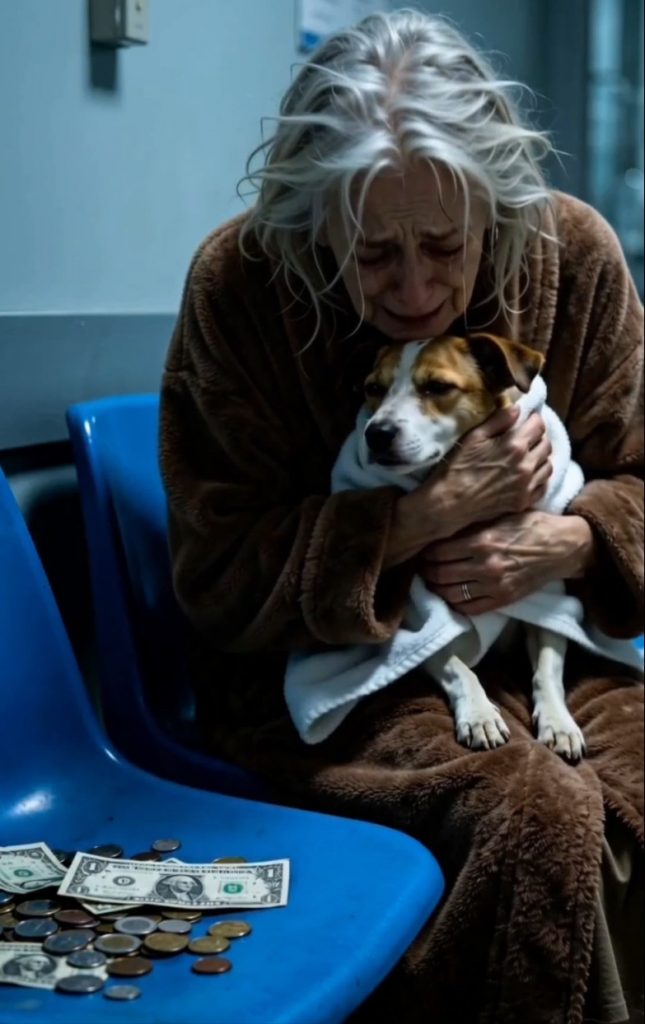
She sat hunched in the corner of the veterinary clinic waiting room, barefoot in a brown bathrobe, her red feet tucked beneath the plastic chair as if she had only just remembered they were exposed. The floor was cold grey linoleum. The fluorescent lights made everyone look sick. A vending machine hummed against the far wall.
Beside her lay the money.
Sixteen crumpled bills.
A handful of quarters.
Pennies, nickels, two dimes.
Everything she had been able to grab from the coffee tin, the kitchen drawer, and the pocket of her late husband’s winter coat before running into the freezing midnight air.
In her arms, wrapped in a white towel, was Buster.
He was a small Jack Russell mix with tired eyes, a spotted muzzle, and the kind of loyalty that made him seem older than his body. He barely moved now. His head rested against her chest, listening to the heartbeat that had been his whole world for twelve years.
“Stay with me,” the woman whispered into his fur. “Please, sweetheart. Stay with me.”
Her name was Ruth Bellamy, though the clinic intake form had only said Ruth B. because her hand was shaking too hard to finish writing.
The door to the treatment hall opened.
A young nurse in green scrubs stepped out.
Her name badge read Sarah.
Ruth lifted her head immediately.
Sarah looked at the money first.
That was how Ruth knew.
The young nurse sat on the edge of the chair beside the bills and coins. She did not gather them. She did not push them away. She only looked at them with the kind of regret that tries to be gentle and still lands like a closed door.
“Ma’am,” Sarah said softly, “his condition is critical.”
Ruth clutched Buster tighter.
Sarah swallowed.
“And this just isn’t enough to cover the surgery.”
The words moved through Ruth like cold water.
For a moment, she did not cry.
She only stared at Sarah, wide-eyed, as if some part of her mind had refused to translate what she had heard.
Then her face broke.
“Please,” she said. “He’s the only family I have left.”
Sarah’s eyes filled.
Ruth leaned forward, still holding the dog, her voice turning desperate and small.
“Please save him. I’ll pay the rest. I’ll clean. I’ll sign something. I’ll give you my wedding ring. Please.”
Buster stirred.
Weakly, slowly, he lifted his head.
Ruth looked down at him through tears. “No, no, don’t move, baby.”
But Buster stretched his neck toward her face.
With the last little strength he could gather, he licked the tear from her cheek.
Sarah covered her mouth.
Ruth let out a sound that was almost a sob and almost a prayer.
That was when a man’s voice came from the hallway.
“Who told her no?”
Ruth looked up.
Standing beneath the clinic light was Dr. Andrew Hale, the owner of the clinic, still wearing his surgical cap, his face pale with anger.
Sarah stood quickly. “Dr. Hale, the payment policy—”
He looked at Ruth.
Then at Buster.
Then at the pile of coins on the plastic chair.
His expression changed.
“Mrs. Bellamy?” he whispered.
Ruth blinked.
No one had called her that in years.
Dr. Hale took one step closer, staring not at her face now, but at the old brass tag hanging from Buster’s collar.
And suddenly, the clinic’s most powerful man looked like he was seeing a ghost.
Act II
Thirty years earlier, Ruth Bellamy had not been the woman counting coins under fluorescent lights.
She had been the woman people called when no one else answered.
Ruth and her husband, Henry, ran a tiny animal rescue from the back of their farmhouse outside Mill Creek. They took in dogs no shelter had space for, cats found half-frozen in barns, injured strays, abandoned litters, and old pets whose owners had died.
They were not rich.
They were not famous.
But they had a gift for showing up.
Henry built kennels from salvaged wood. Ruth learned how to give medicine, clean wounds, bottle-feed puppies, and sit all night beside frightened animals who had stopped trusting human hands. She had the kind of patience that made fear feel embarrassed and slowly leave the room.
People dropped animals at their gate in cardboard boxes.
Ruth always said the same thing.
“Well, come on then. Let’s get you warm.”
That was how she found Buster.
He was barely a year old then, soaked from rain, shivering under the Bellamys’ porch with one paw caught in a piece of wire. Henry said they were full. Ruth said they were always full. Then she wrapped the dog in a dish towel and carried him inside.
Buster healed.
Then he stayed.
Henry claimed the dog had chosen Ruth because she fed him bacon behind everyone’s back. Ruth claimed Buster stayed because he had excellent taste in people.
For years, the three of them were a family.
Then Henry got sick.
The rescue went quiet. Vet bills piled up. Ruth sold the old truck, then the extra acreage, then the silver tea set her mother had left her. She never complained. Henry had once sold his best fishing boat to pay for surgery on a dog he had known for only three days.
Love, in their house, had always been measured by what you were willing to give up.
Henry died in winter.
Two years later, their only son, Michael, died in a highway accident coming home to help Ruth repair the barn roof.
After that, Buster became more than a dog.
He became the last living witness.
He remembered Henry’s whistle. He slept beside Michael’s old boots. He followed Ruth from room to room as if he understood that grief could swallow a person if left alone too long.
When the rescue closed, Ruth kept the farmhouse as long as she could.
Then taxes rose.
Medical debt stayed.
The bank came with papers written in language that made loss sound polite.
Ruth moved into a one-bedroom rental at the edge of town with Buster, two suitcases, and Henry’s coffee tin full of coins.
The world forgot her quickly.
That was what hurt most.
Not poverty.
Not loneliness.
Forgetting.
People who once brought animals to her door now passed her in the grocery store and smiled vaguely, trying to place her. The county shelter changed directors. Young veterinarians arrived who had never heard of Henry’s midnight drives or Ruth’s kitchen full of warming blankets.
But one thing from those years remained.
A brass collar tag shaped like a small heart.
Henry had made it for Buster in the barn, engraving it by hand with a tool meant for metal hinges.
On the front: Buster.
On the back: Bellamy Rescue — No One Left Behind.
Ruth never replaced it.
Even when the edges wore smooth.
Even when the clasp bent.
Even when people told her microchips were modern and tags were old-fashioned.
That tag was not identification.
It was a promise.
The night Buster collapsed, Ruth did not think about pride.
She did not think about how she looked running barefoot through slush in a bathrobe. She did not think about the neighbors seeing her. She gathered the dog in a towel, took the coffee tin, and called the only taxi driver in town who still answered after midnight.
“Where to?” he asked.
“The emergency vet,” she said, holding Buster close. “Hurry.”
She thought money would be the problem.
She was right.
But she did not know yet that money was only the surface of something older.
Something hidden beneath the polished sign outside the clinic.
Act III
Dr. Hale crouched in front of Ruth slowly, as if approaching a wounded animal.
“May I see his tag?” he asked.
Ruth’s arms tightened instinctively.
Then she nodded.
He lifted the brass heart gently between two fingers.
His face changed again when he turned it over.
Bellamy Rescue — No One Left Behind.
Sarah watched him, confused.
“Dr. Hale?”
He looked at the nurse, then back at Ruth.
“When I was eight years old,” he said quietly, “I got lost in the woods behind County Road 12.”
Ruth stared at him.
A memory stirred, old and foggy.
Snow.
Flashlights.
A boy with blue lips.
Henry carrying blankets.
Dr. Hale’s voice trembled. “I followed my dog past the creek and fell into a ravine. Search teams couldn’t find me for hours. My parents thought I was gone.”
Ruth’s breath caught.
“Andrew?”
He nodded.
“You brought three rescue dogs that night. One of them found my mitten. Your husband climbed down before the fire department got there.”
Ruth remembered now.
A little boy wrapped in Henry’s coat.
His mother crying so hard she could barely stand.
Ruth kneeling in the snow, rubbing the boy’s hands between her palms.
“You were so small,” she whispered.
Dr. Hale gave a broken laugh. “You stayed at the hospital until morning. You gave my mother coffee. You told me animals save us all the time and the least we can do is return the favor.”
Sarah looked down at the coins again, shame flooding her face.
Ruth shook her head. “That was a long time ago.”
“No,” Dr. Hale said. “It was the reason I became a veterinarian.”
For the first time that night, Ruth’s composure cracked in a different way.
Not despair.
Astonishment.
Dr. Hale stood.
“Prep Surgery Two,” he told Sarah. “Now.”
Sarah moved immediately.
Ruth looked frightened. “But I can’t pay.”
Dr. Hale’s jaw tightened.
“You already did.”
Ruth shook her head, confused.
He looked toward the wall behind the reception desk.
There, mounted in a silver frame, was a small plaque Ruth had not noticed when she arrived. The letters were clean, modern, and cold under the fluorescent light.
The Hale Animal Emergency Center
Founded with support from the Bellamy Compassion Fund
Ruth stared at it.
“The what?”
Dr. Hale went still.
“You don’t know?”
Her face emptied. “Know what?”
Before he could answer, a man in a charcoal coat stepped through the front entrance, shaking snow from his sleeves. He was in his late fifties, polished and irritated, with a phone pressed to his ear.
“Andrew,” he snapped. “Why is a surgery team being called in without deposit authorization?”
Dr. Hale turned.
The warmth vanished from his face.
“Victor.”
Victor Bellamy.
Ruth’s brother-in-law.
Henry’s younger brother.
The man who had handled the rescue’s paperwork after Henry got sick.
The man who had told Ruth the donation fund had dried up.
The man who had urged her to sell the farmhouse before debt swallowed what little she had left.
Ruth looked at him now and saw something she had missed for years.
He was not surprised to see her poor.
He was only annoyed that she had appeared where someone might recognize her.
Victor’s eyes flicked to Ruth.
Then to Buster.
Then to the coins on the chair.
His expression hardened.
“This is a private medical decision,” he said. “The policy is clear.”
Dr. Hale’s voice dropped.
“The Bellamy Compassion Fund was created for cases exactly like this.”
Victor smiled thinly.
“That fund is restricted.”
Ruth whispered, “Henry made a fund?”
Victor did not look at her.
Dr. Hale did.
And the pain in his eyes told Ruth the answer before anyone spoke.
Henry had not left her nothing.
Someone had simply made sure she never knew what he left.
Act IV
Buster went into surgery within ten minutes.
Dr. Hale did not wait for Victor’s permission.
Sarah carried the little dog back herself, whispering apologies into his towel as if he could understand every word. Maybe he could. His eyes found Ruth one more time before the treatment room doors closed.
Ruth stayed standing until they shut.
Then her knees gave way.
Dr. Hale caught her before she hit the floor.
Victor stepped back, disgusted. “This is unnecessary drama.”
Ruth looked up at him.
For twenty years, she had been too tired to hate anyone.
That night, hatred came easily.
“What did Henry leave?” she asked.
Victor adjusted his coat. “You’re confused.”
“No,” she said, surprising even herself with the strength in her voice. “I am poor. I am tired. I am scared for my dog. But I am not confused.”
Dr. Hale turned to the reception desk.
“Sarah, pull the founding documents.”
Victor snapped, “You will do no such thing.”
Sarah froze.
Dr. Hale did not raise his voice.
“Pull them.”
She did.
The records were old, but not lost. Digital copies. Scanned signatures. Articles of incorporation. Donation agreements.
The truth appeared page by page.
Henry Bellamy had sold the last acres of the rescue property not to save himself, but to create a fund for emergency veterinary care for elderly owners, low-income families, and rescue animals. Ruth was named lifetime honorary trustee. Her pets were to receive care at no cost from any partner clinic funded by the trust.
Her signature appeared nowhere.
Because Henry had not wanted to burden her while he was dying.
Victor had been named temporary administrator.
Temporary.
That word became the knife.
For fifteen years, Victor had treated the fund as his own private charitable empire. He held fundraising dinners in Henry’s name. He took photographs with shelter puppies. He gave speeches about compassion and responsible care while quietly restricting access until almost no ordinary person could qualify.
The money had not vanished.
It had grown.
But Ruth Bellamy, the woman whose life had inspired it, had sat barefoot in the waiting room counting pennies.
Sarah read the documents with tears on her face.
“I’m so sorry,” she whispered.
Victor’s expression darkened. “You don’t understand nonprofit management.”
Dr. Hale laughed once, bitterly.
“No. But I understand theft dressed as management.”
Victor pointed at him. “Be careful.”
Dr. Hale stepped closer.
“I was careful when I let the board tell me the fund was complicated. I was careful when I signed off on denials because you said the criteria were strict. I was careful every time I trusted the Bellamy name on the letterhead.”
He looked at Ruth.
“I’m done being careful.”
Victor tried to leave.
Sarah locked the front door.
Not with violence.
With a key and a trembling hand.
“The police can decide what’s complicated,” she said.
Victor stared at her as if the world had lost all manners.
Ruth sat in the chair beside her pile of coins, holding Buster’s brass tag in both hands while the clinic moved around her. Phones rang. Files printed. Dr. Hale called an attorney. Sarah called the board president. Someone called the police.
For once, people in clean clothes were afraid.
Not her.
By dawn, Buster was out of surgery.
Dr. Hale came into the waiting room wearing fresh scrubs and exhaustion.
Ruth stood so fast the coins scattered.
“He made it,” he said.
Ruth covered her face.
“He’s not out of danger yet,” Dr. Hale added gently. “But he’s fighting.”
Ruth began to cry.
This time, no one told her money was not enough.
Act V
Buster came home four days later.
He wore a soft recovery collar and moved slowly, offended by every medication schedule and deeply suspicious of the bland food Dr. Hale prescribed. Ruth carried him into her apartment wrapped in the same white towel, now washed clean and warm from the dryer.
For the first time in years, her small living room was full of people.
Sarah brought groceries.
Dr. Hale brought a proper dog bed.
The taxi driver brought soup from his wife.
Ranger from next door brought nothing except enthusiastic barking through the wall, which Buster answered with one weak huff that made everyone cheer.
Ruth sat in her armchair with Buster asleep on her lap and looked at all of them like she was afraid to blink.
Loneliness had made the world feel locked.
Now doors kept opening.
The investigation into Victor Bellamy became public within a week.
At first, he denied everything. He called it an accounting dispute. He called Ruth elderly and emotional. He said Dr. Hale had misunderstood the fund’s structure and Sarah had violated procedure.
Then the records came out.
Denied applications.
Unspent reserves.
Board payments disguised as consulting fees.
Fundraising letters using photographs from Ruth and Henry’s old rescue without ever naming them fully.
The town did what towns often do when shame turns visible.
People claimed they had always wondered.
Always suspected.
Always felt something was wrong.
Ruth did not argue.
She had no energy left for people who became brave after evidence arrived.
The Bellamy Compassion Fund was frozen, audited, and rebuilt under new trustees. Victor resigned before he could be removed. Then he was charged after investigators found transfers even his lawyers could not polish.
But Ruth cared less about his punishment than about the first envelope she received after the hearing.
Inside was a restored copy of Henry’s original letter to the fund board.
My wife, Ruth, taught me that no animal should suffer because the person who loves them is poor. If this fund ever forgets her, it has forgotten me.
Ruth held the letter for a long time.
Then she placed it beside Henry’s photograph on the shelf.
“I didn’t know,” she whispered.
Buster, half-asleep in his bed, thumped his tail once.
Spring came late that year.
The clinic changed with it.
The plaque in the waiting room was replaced. The new one was larger, warmer, and placed low enough that children could read it.
The Henry and Ruth Bellamy Compassion Fund
No One Left Behind
Beneath it, Dr. Hale hung Buster’s old brass tag in a small shadow box. Ruth objected at first because Buster was still alive and deserved his jewelry. Dr. Hale solved this by having a new tag made for Buster and placing the old one on display with Ruth’s permission.
Sarah became the fund’s patient advocate.
Her job was simple and difficult: to sit with people who arrived afraid, ashamed, and short on money, and make sure no one confused poverty with lack of love.
She kept a jar on her desk filled with the coins Ruth had brought that night.
Not as payment.
As a reminder.
Whenever a new staff member asked about it, Sarah told the whole story. Not the easy version. Not the sentimental version where everyone was kind from the start. She told them about the old woman in a bathrobe. The barefoot panic. The dog in the towel. The policy that almost became cruelty.
And she always ended with Buster lifting his head to lick Ruth’s tear.
Because that was the moment Sarah said she understood.
Animals do not ask whether we can afford to be loved by them.
They simply love us.
One year later, the clinic held a small ceremony in the waiting room.
Ruth did not want one, which meant Dr. Hale planned it anyway but kept it modest. No reporters. No speeches from politicians. Just staff, a few families helped by the fund, and a table of cookies Sarah baked badly but proudly.
Ruth arrived in a pale blue dress and sensible shoes.
Buster arrived in a little red sweater and acted like the entire event was beneath him.
When Dr. Hale handed Ruth a framed copy of Henry’s letter, she cried before he finished speaking.
“I wish he knew,” she said.
Dr. Hale smiled gently.
“He did. That’s why he wrote it down.”
After the ceremony, Ruth sat in the same plastic chair where she had once counted her money.
This time, Buster sat beside her, alert and healthy enough to beg shamelessly for cookie crumbs.
Sarah sat on the floor at Ruth’s feet.
“I almost sent you away,” she said quietly.
Ruth looked at her.
“You were told to.”
“That doesn’t make it right.”
“No,” Ruth said. “It makes it something you learned from.”
Sarah nodded, eyes wet.
Ruth reached down and took the young nurse’s hand.
“Then learn well, dear.”
Outside, rain tapped against the clinic windows. Inside, the waiting room glowed softer than Ruth remembered. Maybe the lights had been changed. Maybe the room had.
Maybe she had.
For years, Ruth had believed she and Buster were the last pieces of a life the world no longer valued. An old woman. An old dog. A coffee tin of coins. A promise worn smooth on a brass tag.
But promises, she learned, can wait.
They can survive greedy men, locked files, cold rooms, and years of silence.
They can sit quietly beneath a dog’s collar until the right person finally looks closely enough to read them.
That night, when Ruth carried Buster home, she placed Henry’s letter beside the bed and left the lamp on low. Buster curled against her side, warm and breathing steadily.
Ruth pressed her cheek to his head, just as she had in the waiting room.
Only this time, she was not begging the world to spare the last family she had.
She was thanking him for bringing the rest of it back.