Act I
The car heater was dying when Elena begged him for the third time.
“Greg, please!”
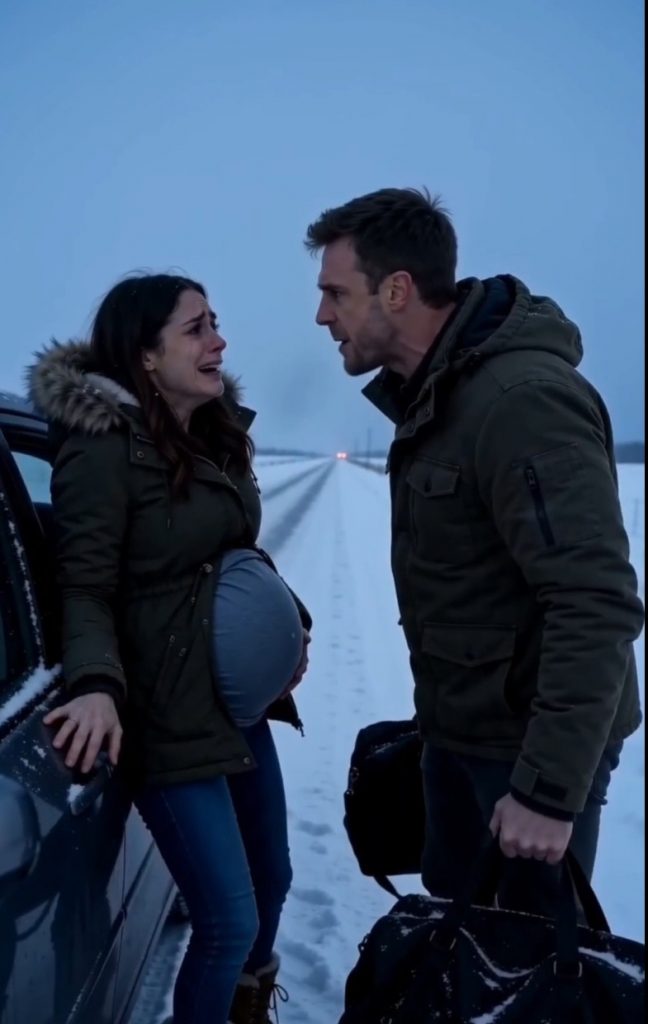
Her voice tore through the dim interior of the grey sedan. She was pressed against the passenger seat, both hands wrapped around her belly, her dark green parka open because every breath felt too tight. Snow swept across the windshield in pale ribbons, and the empty rural road ahead disappeared into a blue winter dusk.
Greg did not look at her.
He sat rigid behind the wheel, jaw clenched, fingers tight around the steering wheel as if her pain were an inconvenience he could outdrive.
Another contraction hit.
Elena bent forward with a cry.
“We have to go!”
The hospital was forty minutes away.
His mother’s estate was ten.
That was the entire problem.
Greg suddenly threw the car into park.
For one stunned second, Elena thought he had finally understood. She thought he was stopping to help her, to call an ambulance, to hold her hand and tell her she was safe.
Instead, he opened his door and stepped out into the snow.
Cold air rushed inside the car.
“Greg?”
He walked to the trunk with stiff, furious movements. The latch popped open. He pulled out the large black duffel bag she had packed weeks earlier for the hospital, slammed the trunk shut, and came around to her side.
Elena pushed the door open with shaking hands.
Snow bit through her jeans the moment her boots touched the ground.
Greg dropped the duffel near her feet.
“You knew how important today was!” he shouted.
Elena stared at him, unable to believe the sound of his voice.
“I can’t control this,” she cried. “This is your baby too!”
His face twisted.
“My mom comes first.”
Then he got back in the car.
Elena grabbed the door handle, but he pulled it shut before she could steady herself.
“Greg!”
The engine roared.
The tires spun once on the slushy road, then caught. The sedan lurched forward, red taillights shrinking into the falling snow until they became two tiny wounds in the distance.
Then they were gone.
Elena stood alone on the shoulder, one hand gripping her belly, the other pressed against the icy car tracks as if the road itself might answer her.
A new pain tore through her.
She gasped and looked down.
Her water had broken.
The cold wind moved around her like a living thing.
“Oh God,” she sobbed. “Someone… please help me.”
The black duffel sat beside her in the snow.
And inside it, hidden beneath a folded baby blanket, was the reason Greg had been willing to leave her there.
Act II
Elena Brooks had ignored too many signs because she wanted her child to have a father.
That was the truth she would admit only later.
At first, Greg Whitmore had seemed protective in a way that felt comforting. He called to make sure she got home. He handled mechanics, appointments, paperwork, anything that made life feel heavy. After years of taking care of herself, Elena mistook control for devotion because it arrived wearing concern.
His mother, Vivienne Whitmore, was harder to misunderstand.
Vivienne was the kind of woman who never raised her voice because she had spent a lifetime making other people raise theirs first. She wore pearls to breakfast, corrected waiters with a smile, and treated kindness as a habit of people without options.
From the first dinner, Vivienne disliked Elena.
Not openly.
Never openly.
She called her “sweet” in the way another woman might say simple. She asked whether Elena’s job at the county library was “fulfilling enough.” She referred to Elena’s late father’s farm as “that old place” even after learning it was the only home Elena had ever truly loved.
But everything changed when Elena became pregnant.
Then Vivienne’s interest sharpened.
She began asking about Elena’s father’s will. About the land outside town. About the Brooks Family Trust, which had sat mostly dormant since Elena’s father died.
Elena had not thought much of it.
The trust was sentimental more than grand. Sixty acres, an old farmhouse, a strip of timberland, and a bank account her father had built slowly over a lifetime of repairing tractors and refusing to sell to developers.
But there was one clause everyone underestimated.
If Elena had a child, the property would transfer into a protected family trust, with Elena as trustee until the child turned twenty-five. It could not be sold by a spouse. It could not be mortgaged by in-laws. It could not be touched by anyone except Elena for the child’s benefit.
Her father had written that clause after Elena’s mother left.
“Love can be real and still make you blind,” he told her once. “Paperwork is what protects you until your eyes come back.”
At the time, Elena had laughed.
Now she wished she had listened harder.
During the final month of pregnancy, Vivienne began pressuring Greg to bring Elena to family events, meetings, dinners with attorneys introduced as “friends.” Greg became tense whenever Elena refused to sign documents she did not understand.
“They’re just estate planning forms,” he said.
“I have my own lawyer.”
“My mother is trying to help us.”
But his mother had never tried to help Elena.
She had tried to access her.
The day Elena went into labor, Greg was supposed to drive her to the hospital. Instead, he insisted they stop first at Vivienne’s winter charity reception at the Whitmore estate.
“Just thirty minutes,” he said. “Mom has an announcement. It matters.”
Elena said no.
Then the contractions started.
And Greg’s mask fell off so fast it frightened her.
By the time he abandoned her on the road, she understood only one thing: whatever Vivienne wanted from him that night mattered more to Greg than the life of his child.
What Elena did not yet know was that Vivienne’s “announcement” was not about charity.
It was about the Brooks land.
And Greg was already late to the lie.
Act III
The man who found Elena was not supposed to be on that road.
His name was Owen Fletcher, and he drove a county snowplow on winter evenings because retirement had made him restless and his wife said he needed something to complain about besides television.
At 5:42 p.m., he saw a dark shape near mile marker 19.
At first, he thought it was a deer.
Then the figure lifted one arm.
Owen hit the brakes.
Elena barely remembered his face when he reached her. Only his voice.
Calm.
Steady.
Human.
“Ma’am, I’ve got you. You’re not staying out here.”
She tried to explain, but the words broke apart. Greg. Baby. Hospital. Snow. Please.
Owen wrapped his coat around her shoulders, called emergency services, and helped her into the heated cab of the plow. He brought the black duffel too, because Elena clutched for it when he moved away.
“That important?” he asked gently.
“It’s the baby’s bag,” she whispered.
At the hospital, everything became bright and urgent.
Nurses. Monitors. Warm blankets. A doctor with kind eyes asking questions Elena could barely answer. Owen stayed until someone told him he had to wait outside. Even then, he refused to leave the building.
“She was alone on County Road 6,” he told the charge nurse. “Her husband left her there.”
The nurse’s expression changed.
By 7:13 p.m., Elena’s daughter was born.
Small.
Furious.
Alive.
When they placed the baby against her, Elena cried so hard the nurse had to remind her to breathe.
“What’s her name?” the doctor asked.
Elena looked down at the tiny face, red and indignant beneath a knit hospital cap.
“Hope,” she said.
She had not planned that name.
It simply arrived before fear could argue.
For two hours, no one heard from Greg.
Then, just after nine, he appeared at the hospital with Vivienne Whitmore behind him.
Greg had changed his shirt. His hair was combed. His face carried the anxious expression of a man rehearsing concern for witnesses.
Vivienne looked flawless in a camel coat, pearl earrings, and leather gloves.
“Elena,” Greg said, stepping into the room. “Thank God.”
Elena turned her face away from him.
The nurse moved subtly closer to the bed.
Vivienne’s eyes went first to the baby.
Then to the duffel bag on the chair.
Not to Elena.
Not to her condition.
To the bag.
“Where did you find that?” Vivienne asked.
Elena’s blood went cold.
Owen, who had been allowed in after the birth because Elena asked for him, stood near the window with his arms crossed.
“Beside her in the snow,” he said.
Vivienne looked at him as if noticing a stain on the floor.
“And you are?”
“The man who did what her husband didn’t.”
Greg flushed.
“That’s not what happened.”
Elena finally looked at him.
“You left me.”
Greg swallowed.
“You were hysterical. I thought you needed space.”
Owen laughed once, sharp and humorless.
“In a snowstorm?”
Vivienne stepped forward.
“This family can discuss this privately.”
The nurse did not move.
Elena looked from Vivienne to the duffel.
Something about the woman’s eyes told her the bag mattered.
“Open it,” Elena said.
Greg’s face changed.
Vivienne’s did not, but one gloved hand closed slowly.
The nurse unzipped the black duffel.
Inside were diapers, a blanket, a tiny yellow sleeper, Elena’s robe, a folder of medical papers, and beneath them, a sealed legal envelope Elena had never seen before.
Across the front, in Vivienne’s handwriting, were four words.
For signature after delivery.
Act IV
Elena did not touch the envelope.
She was afraid if she did, rage would make her shake too hard to read.
Owen handed it to the nurse.
The nurse called hospital security.
Greg started talking too quickly.
“Mom handles paperwork for us. It’s nothing. Elena gets overwhelmed by legal language.”
Vivienne lifted her chin.
“This is a misunderstanding.”
But the room was no longer hers.
That was the first thing Elena noticed. Vivienne was used to entering spaces and having people bend around her. But hospital rooms belong to urgency, evidence, and witnesses. Pearls had no power there.
Security arrived first.
Then a hospital social worker.
Then, because abandonment during labor on a rural winter road was not a private family matter, a sheriff’s deputy.
The envelope was opened in front of them.
Inside were prepared documents naming Greg as temporary medical decision-maker in the event Elena was deemed “emotionally unstable following childbirth.”
There was a petition draft requesting emergency control over the Brooks Family Trust.
There was also a proposed authorization allowing Greg Whitmore to negotiate land-use agreements involving the Brooks property on behalf of his newborn child.
Elena stared at the pages.
Hope stirred against her chest, tiny and warm.
Vivienne’s voice remained smooth.
“These are protective measures. Elena has been under stress.”
The deputy looked at her.
“Ma’am, are you an attorney?”
Vivienne paused.
“No.”
“Then I suggest you stop explaining documents that appear to have been hidden in a hospital bag.”
Greg’s face had gone pale.
Elena looked at him.
“Did you know?”
He said nothing.
That was answer enough.
Owen stepped forward.
“You left her where I found her because of these papers?”
Greg snapped, “You don’t know anything.”
Elena’s voice came out quiet.
“Then tell me.”
Greg looked at the floor.
For one moment, she saw the man she had once loved trying to surface through the cowardice.
Then Vivienne spoke for him.
“Your father’s land is wasted sitting empty.”
Elena turned toward her.
Vivienne’s face hardened.
“My family has carried influence in this county for three generations. That property connects two development corridors. With proper management, it could secure all of our futures.”
“Our futures?” Elena whispered.
“You are Greg’s wife.”
“I am his partner,” Elena said. “Not his asset.”
Vivienne’s eyes narrowed.
“You have no idea what it takes to build a legacy.”
Elena looked down at Hope.
“She was born in a hospital because a stranger stopped in the snow. Not because your son loved her enough to turn the car around.”
The words struck Greg visibly.
But not enough to save him.
The deputy asked for Greg’s phone.
Greg refused.
Then Owen spoke.
“My plow has a dash camera.”
Everyone turned.
Owen looked at Greg.
“It recorded the road. Might’ve caught your car leaving. Might’ve caught more than that if you were yelling near the passenger door.”
Greg’s mouth opened.
No sound came out.
The deputy stepped closer.
“Mr. Whitmore, I’ll ask again.”
By midnight, the truth was no longer trapped in Elena’s memory.
Greg’s phone showed messages from Vivienne.
Get her here before the baby comes.
Do not let her go straight to the hospital.
If the child is born before the documents are signed, we lose leverage.
And one final message, sent minutes before Greg abandoned Elena.
Your mother comes first. Prove it.
Elena read that line once.
Only once.
Then she handed the phone back.
There are moments when love does not die dramatically.
It simply stands in a hospital room, sees the evidence, and stops making excuses.
Greg began to cry.
“Elena, I panicked.”
She looked at the man who had left her in the snow.
“No,” she said. “You chose.”
Act V
Greg was not arrested that night.
Not immediately.
The law moves carefully, even when the heart wants it to run.
But he was removed from the hospital. Vivienne was escorted out after trying to call the family attorney from the hallway loud enough for everyone to hear his name. Emergency protective orders followed. Investigations opened. The Brooks Trust attorney arrived before sunrise with a wool coat over her pajamas and fire in her eyes.
Hope slept through most of it.
That felt like mercy.
Elena watched her daughter breathe beneath the soft hospital blanket and understood, in a way she never had before, why her father had written the trust the way he did.
He had not distrusted love.
He had distrusted entitlement wearing love’s clothes.
By morning, snow had stopped falling. Pale light touched the hospital windows. Owen returned with coffee and a small stuffed rabbit from the gift shop, looking embarrassed by the purchase.
“Thought the little boss might need one,” he said.
Elena smiled for the first time since the road.
“She does.”
Owen placed the rabbit beside the bassinet.
Then he cleared his throat.
“I keep thinking about leaving that road five minutes earlier.”
“But you didn’t,” Elena said.
He nodded once.
“No, ma’am. I didn’t.”
Weeks later, the dashcam footage became part of the case. It showed the grey sedan speeding away. It captured enough audio to confirm what Elena remembered: her pleading, Greg shouting, the words that would follow him for the rest of his life.
My mom comes first.
Vivienne tried to deny the documents.
Then she tried to blame Greg.
Then Greg, facing consequences and abandoned by the mother he had chosen over everyone, told investigators exactly who had prepared the envelope.
Their empire did not collapse overnight.
Power rarely does.
But cracks opened.
The development company pulled out. Donors distanced themselves. The Whitmore name, once polished by charity boards and winter receptions, became attached to court filings and local headlines.
Elena did not attend the first hearing.
She sent her attorney.
She stayed home with Hope at the Brooks farmhouse, where the old radiators clanged, the nursery window faced the snowy fields, and the land outside belonged to a child who had entered the world despite every plan made against her.
Greg requested supervised visits.
Elena did not refuse out of spite.
She agreed only after the court required counseling, parenting classes, and a full safety plan. Hope would never be used as a bridge back to control. If Greg wanted to become a father, he would have to begin where he had failed: by showing up without demanding forgiveness as the price of his effort.
Vivienne was not allowed near the baby.
That order gave Elena more peace than she expected.
Spring came slowly that year.
Snow melted first along the fence lines. Then around the mailbox. Then in the low fields, where brown earth appeared beneath the white like something waking after a long silence.
Elena planted a small tree near the driveway.
Owen helped dig the hole because he insisted new mothers should not argue with old men holding shovels. Her attorney came too, still in office heels, carrying a thermos of tea. The nurse from the hospital sent a blanket. The doctor sent a card.
People came into Elena’s life quietly after that road.
Not all at once.
Not with speeches.
They came with casseroles, paperwork, diapers, snow tires, repaired porch steps, and the kind of help that asks permission before entering.
The black duffel bag stayed in Elena’s closet for a long time.
At first, she could not look at it.
Then, one night, after Hope had fallen asleep against her shoulder, Elena took it down and emptied it completely.
The legal envelope was gone, sealed away as evidence.
What remained were the things she had packed before fear entered the story.
A tiny sleeper.
A soft hat.
A receiving blanket.
A pair of socks so small they made her cry.
She washed the bag twice.
Then she repacked it for a different purpose.
Extra clothes. Bottles. A blanket. Emergency cash. Copies of important documents. A note in her own handwriting.
For Hope, if we ever need to leave quickly.
It was not paranoia.
It was wisdom.
Her father had taught her that love needs protection.
Her daughter had taught her that protection can begin again.
One year later, Elena drove down County Road 6 with Hope in the back seat, babbling at the stuffed rabbit Owen had bought her.
The road looked different in daylight.
Less endless.
Less cruel.
At mile marker 19, Elena pulled over.
For a moment, she sat with both hands on the wheel, watching wind move through the thawed grass where snow had once swallowed her footprints.
Then she got out and lifted Hope from the car.
“This is where everything changed,” she whispered.
Hope tugged at her scarf and laughed.
Elena laughed too, though tears came with it.
That was how healing worked sometimes.
Not by erasing the place of pain, but by returning with proof that pain did not get the final word.
A truck rumbled in the distance.
For one heartbeat, Elena saw it all again: the taillights fading, the duffel in the snow, the terrible cold, the cry for help disappearing into winter air.
Then Hope rested her head against Elena’s shoulder.
Warm.
Safe.
Alive.
Elena kissed her daughter’s hair.
“Your grandmother thought legacy was land,” she said softly. “Your father thought loyalty meant obedience.”
She looked across the fields her own father had protected with ink, stubbornness, and love.
“But this is what legacy really is.”
Hope yawned.
Elena smiled.
“It’s making sure the people who come after you don’t have to beg to be chosen.”
Behind them, the car waited with its heater running.
Ahead, the road stretched open beneath a pale blue sky.
This time, Elena was the one driving.
And she did not look back.