Act I
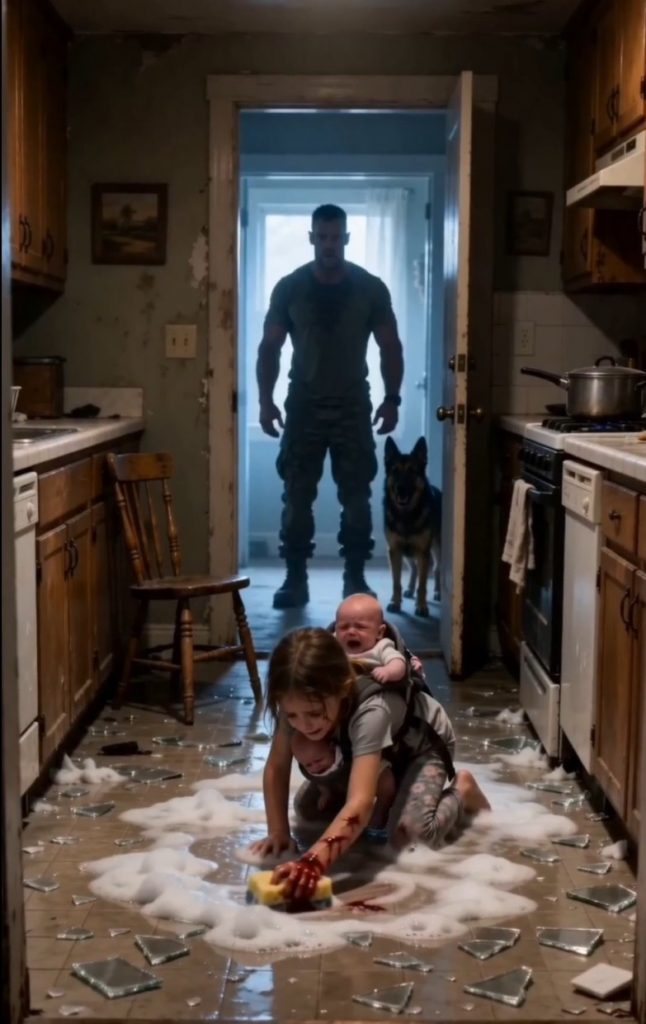
The kitchen smelled like bleach, soap, and fear.
Jason Walker stood in the open back doorway with one hand still on the knob, unable to move. Cold evening air pushed past him into the dim kitchen. Snow clung to the shoulders of his olive-green shirt, and his boots left wet marks on the floorboards behind him.
His German Shepherd, Ranger, stood at his side with his ears sharp and his body tense.
Neither of them entered at first.
Because in the middle of the kitchen, on both knees, was Harper.
His eight-year-old daughter was scrubbing the floor like her life depended on it.
Thick white soap suds covered the tiles. Beneath them, Jason could see sharp glints of broken glass catching the overhead light. A pot sat forgotten on the stove. A wooden chair was shoved crookedly against the counter. Cabinet doors hung open like someone had searched the room in a rage.
And strapped to Harper’s chest in a baby carrier was her infant brother, Noah, screaming so hard his tiny face had gone red.
Harper kept scrubbing.
Her brown hair stuck to her tear-streaked cheeks. Her gray T-shirt was damp at the sleeves. Her floral leggings were smeared with grime. In one hand, she clutched a foam sponge. Her other hand trembled as she pressed it against the floor, marked with fresh cuts from the hidden glass.
Jason’s throat closed.
He had seen bad things before.
He had pulled men from wrecked trucks on winter roads. He had served long enough overseas to know the sound a person made when fear had nowhere else to go. He had watched adults break under pressure.
But nothing had ever hit him like the sight of his little girl apologizing to a floor.
“Harper,” he whispered.
She stopped.
Only then did she turn.
The moment she saw him, her face changed from panic to terror. Not relief. Not joy. Terror.
She clutched the sponge to her chest as if she had been caught stealing.
“I’m sorry, Dad,” she sobbed. “I’m almost finished.”
Jason stepped into the kitchen.
Glass cracked under his boot.
Ranger barked once, sharp and distressed.
Harper flinched so violently that Noah screamed louder against her chest.
Jason moved fast then, crossing the floor without caring what was under his feet. He dropped to one knee in front of his daughter and reached for her carefully, as if one sudden movement might shatter whatever was left of her.
“Harper,” he said, his voice deeper now, shaking with rage he was trying to keep from frightening her. “Who made you do this?”
Her lips trembled.
She looked toward the back door.
Then toward the clock.
Then finally at him.
“Melissa said the house had to be perfect before she came home.”
Jason froze.
Melissa.
His wife.
The woman he had trusted with his children while he was gone.
The woman who had sent him cheerful texts all week saying everything was fine.
The woman who was supposed to love them.
Harper collapsed into his arms, still whispering, “I’m sorry,” even as he lifted her away from the glass.
And that was when Jason saw the note taped to the refrigerator.
Act II
Before Melissa, the Walker house had been messy in a way that meant people lived there.
Crayons under the table.
Tiny socks in the couch cushions.
Dog hair on clean laundry.
A crooked drawing of a blue house taped to the refrigerator with the words “Dad, Harper, Noah, Ranger” written in purple marker above four stick figures and one very large dog.
Jason had never minded the mess.
His first wife, Laura, used to say that a spotless home was often just a lonely one.
Laura had died giving birth to Noah.
Not suddenly enough to be merciful, and not slowly enough for goodbye to feel complete. She had held the baby once. She had touched Harper’s cheek once. Then the room filled with machines, doctors, and words Jason could not understand until they became the only truth left.
After that, the house changed.
Jason tried. He truly did.
He learned how to warm bottles, braid hair badly, sign school forms, wash tiny clothes, and cook scrambled eggs Harper pretended were good. Ranger slept outside Harper’s door every night. Noah cried often. Harper stopped asking when Mom was coming home after the third week.
Then came Melissa.
She arrived first as help.
A neighbor’s cousin. A woman from church. Kind, organized, soft-spoken, always carrying casseroles and saying, “You shouldn’t have to do this alone.”
Jason resisted at first.
But grief makes exhaustion feel normal, and exhaustion makes help look like salvation.
Melissa knew how to make a room feel calm. She folded laundry without being asked. She made Harper’s lunch into neat little sections. She rocked Noah until he slept. She told Jason he was a good father at a time when he felt like a man barely keeping the roof above his children.
Six months later, he married her.
Too quickly, his mother said.
Too desperately, Laura’s sister said.
Jason did not listen.
He wanted his children to have a mother figure.
He wanted the house to stop feeling like a memorial.
He wanted someone to stand beside him when night came.
At first, Harper tried to like Melissa.
She said thank you when Melissa brushed her hair too hard. She apologized when she spilled juice. She stopped asking for Laura’s old bedtime song because Melissa said sad songs kept children stuck in the past.
Small things changed.
Harper’s drawings disappeared from the refrigerator.
Ranger was no longer allowed in the kitchen.
Noah’s crying became “manipulation,” even though he was only a baby.
Jason noticed some of it, but not enough.
That would haunt him later.
Melissa was careful around him.
She smiled when he was in the room. She praised Harper for being “such a big helper.” She told Jason the girl needed structure, that grief had made her dramatic, that children sometimes lied for attention after losing a parent.
Then Jason’s job called him away.
A construction project upstate had gone wrong. Three weeks of emergency work became five. Snow delayed the roads. Cell service failed in the mountains. Melissa sent photos every evening: Noah sleeping, Harper at the kitchen table, dinner plates arranged neatly.
But the photos were always too neat.
Harper never smiled with her eyes.
Ranger never appeared in them.
Jason told himself he was tired.
Then, on the fifth week, Ranger escaped from the yard and showed up at the job site.
Somehow, the dog had traveled almost thirty miles, muddy, exhausted, and frantic.
He found Jason outside the workers’ barracks at dawn and nearly knocked him down.
Jason called Melissa immediately.
She sounded annoyed, not frightened.
“Dogs wander,” she said. “You know Ranger. He’s dramatic.”
But Ranger would not calm down.
He pulled toward the road, whining, turning back every few steps to make sure Jason followed.
So Jason left.
No warning.
No text.
No call.
He drove through the snow with Ranger panting in the passenger seat, a cold heaviness growing in his chest.
When he pulled into the driveway, Melissa’s car was gone.
The house was lit only in the kitchen.
And inside, his daughter was kneeling in glass.
But the note on the refrigerator told him the kitchen was only the beginning.
Act III
Jason carried Harper out first.
He did not ask more questions while she was shaking.
He unbuckled Noah from the carrier and placed him gently in the baby seat in the living room. Ranger immediately lay beside it, pressing his body between the baby and the kitchen, as if guarding a border no one else had seen clearly enough.
Then Jason wrapped Harper’s hand in a clean towel.
She kept whispering, “I didn’t mean to break it.”
“What broke?” Jason asked softly.
“The bowl.”
“What bowl?”
“The blue one.”
Laura’s blue mixing bowl.
The one she had inherited from her grandmother. The one Harper used to stand on a chair and stir pancake batter in on Saturday mornings. The one Jason had kept on the top shelf because he could not bear to use it after Laura died.
His stomach turned.
“Did you take it down?”
Harper shook her head quickly. “No. Melissa did. She said if I wanted to act like the lady of the house, I could clean like one.”
Jason’s face went still.
He looked back toward the kitchen.
The note on the refrigerator was written in Melissa’s perfect handwriting.
Kitchen. Laundry. Bottles. Floors. No excuses.
Beneath it, in smaller letters:
If it isn’t perfect when I get back, you know what happens.
Jason read the words twice.
The first time, he did not understand how a person could write that to a child.
The second time, he understood too well.
He checked the rest of the house.
The laundry room was piled with wet clothes Harper had clearly tried to move but could not lift. The sink was full of bottles. In the hallway closet, he found Ranger’s leash tied around the inside handle, as if someone had locked the dog away and he had torn himself free.
In Harper’s bedroom, he found the worst evidence.
Not bruises.
Not dramatic destruction.
Something quieter.
A notebook under her pillow.
At first, he thought it was a school journal. Then he opened it.
Each page was dated.
I was good today.
I didn’t let Noah cry too long.
I cleaned before dinner.
I forgot the towels. I will do better.
Please don’t tell Dad.
Jason sat on the edge of her bed and felt the world tilt beneath him.
Page after page, his daughter had recorded obedience like prayer.
Not because she wanted to remember.
Because someone had taught her she needed proof she was trying hard enough to deserve safety.
At the back of the notebook was a folded piece of paper.
It was a letter.
Not from Harper.
From Laura.
Jason recognized his late wife’s handwriting before he even unfolded it.
His hands shook.
My sweet Harper,
If Daddy gives you this one day, it means I’m not there to say it myself. You are not responsible for grown-up sadness. You are not responsible for the house, the baby, or anyone’s anger. You are a child. Your job is to be loved.
Jason stopped reading.
He had never seen this letter.
Laura must have written it before Noah’s birth, when the doctors warned them the delivery could be dangerous. She had written letters for Jason, for Noah, for Harper. Jason had put them all in a box after the funeral because opening them had hurt too much.
Someone had opened this one.
Someone had taken Harper’s.
At the bottom, beneath Laura’s words, Melissa had written in red pen:
Then start acting lovable.
Jason folded the paper slowly.
Something inside him went cold.
Not wild.
Not reckless.
Cold.
He took photographs of everything. The kitchen. The note. The notebook. The letter. Ranger’s torn leash. Harper’s hand. Noah’s carrier strapped to her tiny body.
Then he called 911.
Then he called Laura’s sister, Megan.
Then he called Melissa.
She answered on the fourth ring, bright and irritated.
“Jason? Why are you calling from home?”
He looked through the doorway at Harper sitting on the couch, wrapped in a blanket while Ranger rested his head against her knee.
“Because Ranger came to get me,” he said.
The silence on the other end was immediate.
Then Melissa said, “What did Harper tell you?”
Not, Is she okay?
Not, What happened?
What did Harper tell you?
Jason closed his eyes.
And that was the moment he knew his marriage was over.
Act IV
Melissa came home twenty-three minutes before the police arrived.
That was her mistake.
She pulled into the driveway fast, tires sliding on the snow, and marched through the back door carrying shopping bags like evidence of innocence. Her hair was perfect. Her coat was expensive. Her face had the tight, angry calm of someone who expected the room to obey her.
Then she saw Jason standing in the kitchen.
The glass was still on the floor.
The soap suds were drying into streaks.
Laura’s broken blue bowl lay in pieces near the base of the cabinet.
Melissa looked at it, then at him.
“Jason,” she said carefully. “I can explain.”
He did not move.
“No,” he said. “You can answer.”
Her eyes flicked toward the living room.
“Where are the children?”
“Safe.”
The word landed heavily.
Melissa’s face changed.
“Harper exaggerates,” she said. “You know how emotional she gets. I was trying to teach responsibility.”
“She’s eight.”
“She has to learn. You baby her because you feel guilty about Laura.”
Jason stepped closer.
Ranger appeared in the doorway, silent and watchful.
Melissa stopped talking.
For the first time, she looked afraid.
Not of Jason.
Of being seen.
He held up the notebook.
“What is this?”
Her jaw tightened. “A discipline tool.”
He held up Laura’s letter.
“And this?”
Melissa’s expression flickered.
Jealousy.
There it was.
After all the soft words, all the casseroles, all the false patience, the truth was ugly and small.
Laura had been dead, and Melissa had still been competing with her.
“You had no right keeping her alive in every room,” Melissa snapped. “That child worships a ghost. You all do.”
Jason stared at her.
“My daughter loved her mother.”
“She used that grief against me.”
“She was a child grieving.”
Melissa laughed, sharp and bitter. “She looked at me like I was temporary from the day I arrived.”
Jason’s voice dropped.
“You were.”
That was when the sirens appeared in the distance.
Melissa heard them.
Her face went pale.
“You called the police?”
“I called everyone.”
“Jason, think. Think about what this will do to us.”
“There is no us.”
She stepped toward him. “You don’t mean that.”
He looked past her at the kitchen floor.
At the place Harper had knelt.
At the soap hiding glass.
At the tiny bloody towel in the trash from where his daughter had tried to clean herself up so Melissa would not be angry.
“I mean it more than I’ve ever meant anything.”
The officers arrived with a paramedic.
Megan arrived three minutes after them, still wearing hospital scrubs from her shift, hair undone, eyes already full of fear. Harper cried when she saw her aunt. Not because she was scared.
Because someone safe had come.
Megan gathered both children in her arms and looked at Jason over Harper’s head.
The look said what words could not.
How did we miss this?
Jason had no answer.
The investigation moved quickly because Melissa had assumed children had no witnesses.
But Ranger had been a witness.
So had Harper’s notebook.
So had the neighbor’s doorbell camera, which showed Melissa leaving the house for hours while Harper was inside with the baby. So did the pharmacy receipt proving she had bought sleeping pills for herself while telling Jason she was too sick to care for Noah. So did the messages on her phone to a friend:
I did not sign up to raise his dead wife’s spoiled little saint.
If the girl wants to play mommy, let her.
By midnight, Melissa was gone from the house.
By morning, an emergency protective order was in place.
Jason did not sleep.
He sat on the living room floor between Harper and Noah while Ranger lay across the doorway.
At dawn, Harper woke and looked around in panic.
“The kitchen,” she whispered. “I didn’t finish.”
Jason’s heart broke all over again.
He pulled her gently into his arms.
“You never have to finish that,” he said. “Not ever.”
She leaned against him, stiff at first, then shaking.
“Is Melissa mad?”
Jason closed his eyes.
“She doesn’t get to be in charge of you anymore.”
Harper looked up at him.
“Are you mad at me?”
The question nearly destroyed him.
“No,” he whispered. “I’m mad I wasn’t here sooner.”
Act V
The house did not become happy overnight.
That was not how healing worked.
The kitchen floor was replaced first. Jason tore out every tile himself, even though Megan told him to hire someone. He needed to do it with his own hands. Needed to remove every place where Harper had been forced to kneel.
The blue bowl could not be repaired.
But Megan took the pieces to a local artist, an old woman who worked with broken pottery. Weeks later, she returned it as a mosaic set into a wooden frame.
Laura’s bowl was no longer useful.
But it was still beautiful.
Jason hung it above the kitchen table.
Harper stared at it for a long time.
“It’s still broken,” she said.
Jason nodded. “Yes.”
“But not thrown away.”
“No,” he said. “Never thrown away.”
That became something between them.
A language.
A promise.
Harper began therapy in a room with yellow chairs and shelves full of toys she did not touch for the first three sessions. Noah grew louder, stronger, and easier to soothe. Ranger refused to leave either child alone for more than five minutes and appointed himself supervisor of bath time, meals, and nightmares.
For weeks, Harper apologized for everything.
For dropping crayons.
For asking for water.
For crying.
For sleeping too late.
Each time, Jason answered the same way.
“You’re safe. You’re loved. You’re not in trouble.”
At first, she did not believe him.
Then, slowly, she began to test it.
She spilled juice and froze.
No one yelled.
She forgot to put away her socks.
No one punished her.
Noah cried for twenty minutes one evening, and Harper began shaking so badly Jason had to sit on the floor with her while Megan held the baby in another room.
“He’s allowed to cry,” Jason said gently.
Harper covered her ears. “But she said it meant I was bad.”
Jason waited until she looked at him.
“She lied.”
That word became hard medicine.
Melissa lied.
About chores.
About love.
About Laura.
About what a child owed adults.
In court, Melissa wore a pale dress and cried carefully. She said she had been overwhelmed. She said Jason’s grief had made the house impossible. She said Harper misunderstood discipline because she was emotionally fragile.
Then the attorney read Harper’s notebook aloud.
The courtroom changed.
Not dramatically.
Not with shouting.
With stillness.
People stopped seeing a custody dispute.
They saw an eight-year-old girl who had been taught to measure her worth in spotless floors and silent fear.
Jason testified last.
He did not make himself sound heroic.
He told the truth.
He said he had been absent. He said he had ignored unease because believing Melissa was easier than facing the possibility that he had chosen wrong. He said grief had made him vulnerable, but vulnerability was not an excuse for failing to listen to his daughter.
Then he looked at Harper, who sat beside Megan holding Ranger’s leash in both hands.
“I should have believed what I saw in her eyes before I had proof,” he said.
Melissa lost access to the children.
The criminal case continued, but Jason did not build their lives around waiting for punishment. He had already lost too much time to someone else’s darkness.
Spring came.
The snow melted from the backyard, revealing dead grass, muddy patches, and the crooked little garden Laura had once started behind the porch. Harper asked if they could plant something there.
Jason said yes.
They planted marigolds because Laura had loved them, basil because Megan insisted every home needed something edible, and sunflowers because Harper saw the seed packet at the store and whispered, “Those look brave.”
Noah sat in a baby seat on the porch while Ranger lay beside him like a soldier at his post.
One Saturday afternoon, Harper came into the kitchen carrying a sponge.
Jason went still before he could stop himself.
She noticed.
So did he.
“I want to help wash the table,” she said quickly. “Only the table. Because we made lemonade and it’s sticky.”
Jason crouched in front of her.
“You can help,” he said. “But you never have to earn your place here.”
Harper looked down at the sponge.
Then she set it on the counter.
“Can we do it together?”
Jason smiled through the ache in his chest.
“Always.”
They washed the table together.
Badly.
Noah banged a spoon against his high chair. Ranger stole a dropped piece of toast. Megan arrived with groceries and complained that the kitchen looked like a lemonade storm had passed through.
Harper laughed.
It was small.
Then bigger.
Then suddenly she was laughing so hard she had to lean against Jason’s side, and he realized he had not heard that sound in months.
He closed his eyes for one second.
Laura’s mosaic bowl caught the sunlight above the table.
Broken.
Saved.
Still here.
That evening, after Noah fell asleep and Ranger settled at the foot of Harper’s bed, Jason found his daughter sitting by the window, watching the last light fade over the yard.
“Dad?” she said.
“Yeah, sweetheart?”
“If Mom could see us, would she be mad the house is messy?”
Jason sat beside her.
“No,” he said. “She’d say it looks like people live here.”
Harper thought about that.
Then she leaned into him.
For the first time in a long time, she did not apologize.
Outside, the garden shifted in the spring wind.
Inside, the kitchen light glowed warm over fingerprints, crumbs, toys, and the ordinary, blessed mess of a home no longer ruled by fear.
And Jason understood then that saving his daughter had not begun when he stormed across broken glass.
It began the moment he decided the house did not need to be perfect.
It only needed to be safe.