Act I
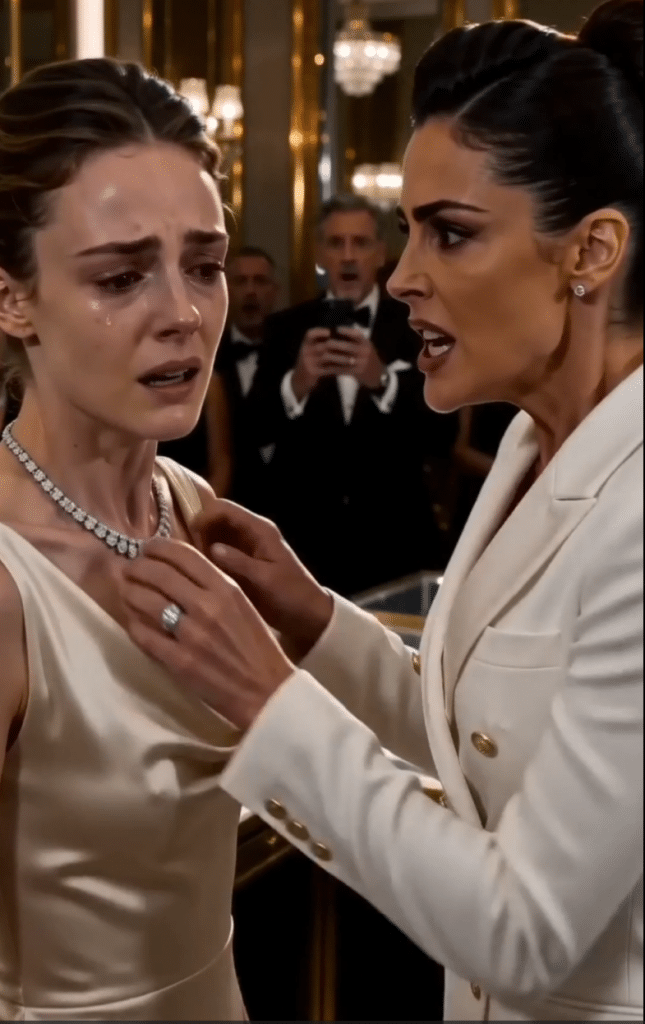
The slap silenced the boutique before the diamonds did.
One moment, the room was humming with champagne, camera flashes, and the soft music wealthy people used to make cruelty sound elegant. The next, every guest in the high-end bridal salon turned toward the woman in white standing with her hand still raised.
Camille Arden was dressed like a bride before the wedding had even begun.
White double-breasted blazer. Matching tailored shorts. Hair pinned high in a perfect twist. Diamond earrings catching the light every time she moved. She looked expensive, untouchable, and furious enough to forget there were phones pointed at her.
In front of her stood a young woman in a simple cream dress.
She had not arrived with an entourage. She had not spoken to anyone. She had simply stepped into the boutique wearing a silver necklace with a diamond pendant, and somehow that had been enough to turn Camille’s engagement celebration into a battlefield.
The woman’s cheek flushed from the impact. Her hand rose halfway, then stopped, as if even defending herself felt like asking for permission.
Camille grabbed her shoulders.
“Take off that necklace right now!”
The guests froze.
A few men in tuxedos lifted their phones higher.
The victim’s eyes glistened, but she did not answer.
Camille yanked at the chain, pulling the pendant forward until it flashed beneath the gold-trimmed mirrors.
“It was bought for my wedding,” she hissed. “Women like you always come back when there’s money involved.”
The young woman went pale.
Not with guilt.
With recognition.
At the back of the boutique, an elderly man in a black tuxedo lowered his champagne glass.
His name was Mr. Bellamy, and everyone in that room knew him as the jeweler no one could afford unless their family name had appeared on buildings for at least three generations. He had made crowns for royals, engagement rings for heiresses, and grief pieces for widows who wanted mourning to sparkle.
He moved slowly toward the two women.
Camille did not notice until he was beside them.
Then he reached out and took the pendant gently between trembling fingers.
The old man examined the setting.
His face changed.
The room seemed to lean in.
Camille snapped, “Tell her.”
Mr. Bellamy looked at her.
His voice was deep, calm, and devastating.
“Madam, this necklace was custom-made for the groom’s first bride.”
The boutique went utterly still.
Camille blinked.
“What?”
The young woman, who had stood trembling only seconds before, slowly lifted her eyes.
Her posture changed.
The fear did not vanish. It hardened into something colder.
She looked straight at Camille and whispered, “He never told you I was still alive?”
For the first time all afternoon, Camille Arden had nothing to say.
And behind the private showroom doors, the groom heard his dead wife’s voice and dropped the glass in his hand.
Act II
Her name was Elena Vale.
Three years earlier, every newspaper in the city had printed it beside a photograph of her smiling under a cathedral arch.
Elena Vale, the young pianist turned philanthropist, vanished days before her wedding to billionaire hotel heir Adrian Cross. The official story was tragic, elegant, and convenient. A late-night drive along the coastal road. A storm. A car found below the cliffs. No surviving passenger. No body recovered, but enough evidence for the court to declare her dead after the family pushed hard enough.
Adrian mourned in public beautifully.
He wore black. He canceled the wedding. He stood at a memorial beneath white roses and said Elena had been “the gentlest soul he had ever known.”
Everyone believed him.
Almost everyone.
Mr. Bellamy did not.
He remembered the day Adrian commissioned the necklace. Not because the pendant was expensive, though it was. Not because the diamonds were rare, though they were flawless. He remembered because Elena had come with him.
She had not cared about the size of the stones.
She had asked whether the pendant could open.
Adrian laughed and said she was sentimental.
Elena smiled politely, then waited until Adrian took a phone call near the window.
Only then did she lean toward Mr. Bellamy.
“Can you engrave something inside where no one will see unless they know how to open it?”
“What would you like it to say?” he asked.
Elena hesitated.
Then she wrote six words on the back of his business card.
If I disappear, ask why.
Mr. Bellamy looked up.
Her eyes were steady, but her hand shook.
He made the necklace exactly as requested.
Two weeks later, she was gone.
Adrian sent a man to collect the necklace after the memorial, claiming he wanted to keep it in the family vault. Mr. Bellamy refused. Custom bridal pieces, he said, could only be released to the named recipient or confirmed legal estate.
Adrian did not argue.
That bothered Mr. Bellamy more than if he had.
The necklace vanished from his locked safe one month later.
The police found no sign of forced entry. His own assistant disappeared the same week. Bellamy spent three years wondering whether age had made him careless or whether the Cross family had finally become what old money becomes when it no longer fears shame.
Then, that afternoon, Elena walked into his boutique alive.
Thinner. Quieter. Wearing the necklace.
She did not ask for help immediately. She only stood near the mirror, touching the pendant as if it were both armor and wound.
Mr. Bellamy recognized her before anyone else did.
So did Adrian.
That was why he disappeared into the private showroom and sent Camille out first.
Camille Arden did not know the full truth.
That did not make her innocent.
She was the daughter of a senator, raised in rooms where consequences were for staff and scandals were things to be managed before dessert. She had spent the past year telling society she had saved Adrian from grief, that Elena’s memory no longer haunted him, that their wedding would be the beginning of “a cleaner chapter.”
But Elena’s return threatened more than romance.
It threatened contracts.
Shares.
Inheritance.
And the secret Adrian had buried with an empty coffin.
Camille looked from the pendant to Mr. Bellamy, then back at Elena.
Her voice came out smaller.
“What is this?”
Elena touched the chain where Camille had pulled it.
“This,” she said, “is the necklace your fiancé gave me the week before he tried to have me declared dead.”
A murmur rippled through the boutique.
Phones rose higher.
Some guests looked toward the showroom doors.
Camille’s face tightened.
“You’re lying.”
Elena almost smiled.
It was not a happy expression.
“I spent three years being called dead. Lying would have been easier.”
Mr. Bellamy stepped beside her.
“Miss Vale,” he said softly, “shall I open it?”
Elena looked at the pendant.
Then at the doors where Adrian had still not emerged.
“Yes,” she said. “Let everyone see why he wanted it back.”
Act III
The pendant opened with a sound so delicate it felt wrong in such a tense room.
A tiny click.
That was all.
Mr. Bellamy held it carefully beneath the boutique lights. Inside the silver backing, behind a hidden hinge no ordinary buyer would ever notice, were two things.
The first was the engraving.
If I disappear, ask why.
The second was not original.
A sliver of folded paper had been pressed into the space behind the diamond setting, so thin and fragile it seemed impossible it had survived.
Elena took it.
Her fingers trembled once.
Then she unfolded it.
“This is from the clinic,” she said.
Camille stared at her.
“What clinic?”
“The private clinic Adrian sent me to the night before the wedding.”
A woman near the mirror gasped.
Elena lifted the paper.
“I was pregnant.”
The boutique went silent in a new way.
Not shocked.
Ashamed.
Camille’s face drained of color.
Elena continued, her voice steady only because breaking down would have given the room permission to pity her instead of listen.
“I found out Adrian had been moving money from my mother’s foundation through offshore accounts connected to his hotel projects. I confronted him. He cried. He apologized. He said we would fix it after the wedding.”
She looked toward the showroom door.
“He meant after he had legal access to everything.”
Mr. Bellamy’s expression hardened.
Elena’s voice dropped.
“That night, I woke up in a clinic room with no phone, no purse, and a doctor telling me I was unwell. They said I had signed myself in. They said the stress had made me unstable. Then Adrian came and told me if I fought, no one would believe a hysterical pregnant bride over the Cross family.”
Camille whispered, “No.”
Elena looked at her.
“Yes.”
The showroom door opened.
Adrian Cross stepped out.
He was handsome in the way dangerous men often are when good tailoring softens the damage. Dark suit. Perfect hair. Pale face. He looked at the crowd first, then at the phones, then at Elena.
Not like a man seeing a ghost.
Like a man seeing evidence.
“Elena,” he said softly. “You’re confused.”
Her eyes sharpened.
Camille turned toward him.
“You said she was dead.”
Adrian did not look at her.
“Elena has been through a great deal. Whatever she thinks happened—”
“Whatever I think?” Elena said.
She reached into her dress pocket and pulled out a second item.
A small hospital bracelet.
The letters were faded, but readable.
VALE, ELENA.
Beneath that was another line.
Twin pregnancy.
The room seemed to tilt.
Camille put one hand to her stomach.
Adrian’s jaw tightened.
Elena watched him carefully.
“You didn’t tell her that part either.”
Camille looked at Adrian slowly.
“Twins?”
His silence answered.
Elena’s composure cracked, but only for a heartbeat.
“I lost one before I escaped,” she said. “The nurse who helped me run saved the other.”
Mr. Bellamy closed his eyes.
The guests no longer looked entertained.
No one wanted the scandal now that it had a child inside it.
Camille took one step back from Adrian.
“There’s a child?”
Elena looked at her, and for the first time there was something almost like pity in her face.
“A daughter.”
Adrian finally moved.
“Elena, stop.”
That one word revealed him more than any confession.
Not please.
Not wait.
Stop.
The old command.
The clinic command.
The husband command.
The voice of a man who had once believed her fear belonged to him.
Elena lifted her chin.
“No.”
Mr. Bellamy turned the pendant over and pressed the hidden clasp again. A second compartment opened, so small no one in the room would have believed it existed unless they saw it.
Inside was a microdrive.
Camille whispered, “What is that?”
Elena’s voice became ice.
“The reason he didn’t just kill me.”
Act IV
The security guards moved too late.
They had been hired for exclusivity, not truth.
Adrian lunged toward the pendant, but Mr. Bellamy stepped back with surprising speed for a man in his seventies. One of the guests, a retired judge, placed himself between Adrian and Elena. A second guest, still filming, said loudly, “Don’t touch her.”
That was when the room turned.
Not because they were brave.
Because the story had become undeniable in public.
Adrian stopped, breathing hard, his mask slipping.
“Elena,” he said, lower now, “you have no idea what you’re doing.”
She looked at him.
“I know exactly what I’m doing. That’s why I waited until your engagement showcase, in front of your investors, your senator’s daughter, and every person who once sent flowers to my empty funeral.”
Camille flinched.
Adrian’s eyes cut toward her.
“Camille, don’t listen to this.”
She stared at him like he had become a stranger while standing three feet away.
“Where is the child?”
Adrian said nothing.
Elena answered.
“Safe.”
His eyes flashed.
There.
The truth again.
Not grief. Not surprise. Anger.
He had not known where his daughter was.
And he hated that.
Mr. Bellamy handed the microdrive to a woman near the counter.
“Miss Price,” he said, “your laptop.”
She was the boutique’s private client director, trained to handle celebrities, royals, and panic. Her hands shook as she connected the drive to the display screen usually reserved for showing custom bridal designs.
The screen lit up.
Documents appeared.
Clinic records.
Bank transfers.
Legal drafts.
Emails between Adrian Cross, a private physician, and a Cross family attorney.
One subject line froze the room.
Asset access after incapacity certification.
Elena stood beneath it like a woman finally facing the monster by its real name.
“They planned to declare me mentally incompetent after the wedding,” she said. “Once I was under medical control, Adrian would gain temporary authority over my foundation shares. When I became inconvenient, the accident would become permanent.”
Camille covered her mouth.
The next file opened.
A message from Adrian.
No body is better. Grief without closure keeps people obedient longer.
No one moved.
Adrian’s face hardened into something almost calm.
That was worse.
“You stole private records,” he said.
Elena nodded.
“Yes.”
His eyes narrowed.
“That’s your defense?”
“No,” she said. “That’s my confession. I stole evidence from the people who stole my life.”
Mr. Bellamy looked at the crowd.
“If anyone here has stopped recording, I suggest you begin again.”
Phones lifted.
Adrian turned on him.
“You old fool.”
Bellamy did not blink.
“I made the necklace for your first bride. I will not watch you bury her twice.”
Camille looked at Elena.
Her voice was small now.
“Why did you come wearing it?”
Elena touched the pendant.
“Because women like him count on us fighting each other before we ask why both of us were lied to.”
Camille’s face crumpled.
Only then did the first tear fall.
Not from humiliation.
From understanding.
She had slapped the wrong woman.
She had defended the wrong man.
And every person in that room had seen it.
The boutique doors opened.
Two detectives entered, followed by a woman in a navy suit carrying a sealed folder. Adrian turned sharply, and for the first time true fear crossed his face.
Elena exhaled.
The woman in navy approached her.
“Elena Vale?”
“Yes.”
“I’m Detective Mara Sutton. Your daughter is with the protection team. She’s safe.”
Elena’s eyes closed.
Her knees almost gave way, but Mr. Bellamy caught her arm.
Adrian stared.
“You found her?”
Elena opened her eyes.
“No,” she said. “She was never yours to lose.”
The detectives stepped toward him.
Adrian looked around the boutique, searching for allies among the same elite circle that had praised his resilience, admired his grief, and toasted his second chance.
But scandal changes loyalty quickly.
The crowd moved away from him.
Camille removed her engagement ring.
It slipped from her finger and hit the glass counter with a clear, final sound.
“You told me she was dead,” she said.
Adrian’s voice sharpened.
“Camille—”
“No.” Her face was pale, but her spine was straight now. “I hit a woman because you made me believe she was a grave robber at her own funeral.”
Elena looked at her cheek, then at Camille.
“I won’t forgive you today.”
Camille nodded through tears.
“I wouldn’t ask you to.”
Adrian laughed bitterly as the detectives reached him.
“You think this ends well for anyone? You think the public will love this? Two women, one rich man, stolen money, a hidden child? They’ll devour you.”
Elena stepped closer.
“Let them watch me survive.”
And as the detectives took Adrian Cross out past the diamond cases and gold mirrors, the woman he had declared dead stood in the center of the boutique wearing the necklace he had never deserved to give her.
Act V
The videos spread before midnight.
By morning, the world knew the slap, the necklace, and the question.
He never told you I was still alive?
It became the line people repeated in kitchens, offices, newsrooms, and group chats. But Elena refused to let the story become entertainment. She released one statement through her attorney.
“My daughter and I are safe. The violence seen in the boutique was the smallest part of what happened. Please pay attention to the documents, not the spectacle.”
For once, people did.
The investigation moved quickly because Adrian’s arrogance had done what fear could not. It had brought every witness into the same room. Investors cooperated to save themselves. The clinic doctor fled and was caught at the airport. The attorney who drafted Elena’s incapacity papers turned over emails within forty-eight hours.
Adrian Cross was denied bail after prosecutors argued he had already successfully made one woman disappear.
The wedding was canceled.
Camille vanished from public view for three weeks.
When she returned, she did not defend herself.
That surprised people.
She stood outside the courthouse in a plain black dress, no diamonds, no cameras invited, though they came anyway.
“I assaulted Elena Vale,” she said. “I did it because I believed a lie that benefited my pride. Being deceived does not excuse what I did. I have given my statement to police, and I will accept whatever consequences follow.”
Reporters shouted questions.
She answered only one.
“Do you blame Adrian Cross?”
Camille looked tired.
“Yes,” she said. “But blame is not a place to hide.”
Elena saw the clip from a quiet apartment three cities away.
Her daughter was asleep in the next room.
The child’s name was Clara, after Elena’s mother. She was two years old, with dark curls, serious eyes, and a habit of holding the necklace whenever Elena wore it, as if the pendant had always been part of their survival.
For months, Elena had rehearsed the moment she would expose Adrian.
She had imagined anger giving her strength.
It did not.
What gave her strength was breakfast.
Clara eating toast in a high chair.
Clara dropping a spoon and laughing.
Clara waking from a nap and calling for her mother, proving every time that Elena had not lost everything.
The trial lasted seven weeks.
Elena testified for two days.
She spoke about the clinic. The forged papers. The staged accident. The daughter she gave birth to under a false name while running from men who called themselves protectors. She did not cry until prosecutors played a recording from the necklace drive.
Adrian’s voice filled the courtroom.
“She’s more useful dead than difficult.”
The room went cold.
Elena looked at him then.
Not as a wife.
Not as a victim.
As a witness.
When the verdict came, she did not celebrate.
Guilty sounded too small for the years. But it was a legal word, and legal words mattered. They built doors where chaos had been. They put locks on men who thought locks were only for women.
Mr. Bellamy closed the boutique for one afternoon after the sentencing.
He invited Elena, Clara, and, to Elena’s surprise, Camille.
Elena almost refused.
Then she thought of what she had said in the boutique.
Women like him count on us fighting each other before we ask why both of us were lied to.
So she went.
Camille arrived carrying no purse, no jewelry, no performance. The mark from that day had long faded from Elena’s cheek, but the memory sat between them anyway.
Camille looked at Clara first.
“She’s beautiful,” she said softly.
Elena did not answer.
Camille swallowed.
“I’m sorry.”
“I know.”
“I was cruel before that day too.”
“Yes.”
“I thought being chosen by him meant I had won.”
Elena looked at her.
“And now?”
Camille’s eyes filled.
“Now I understand he chose women he thought he could turn into weapons.”
Elena considered that.
Then she nodded once.
It was not forgiveness.
It was the first brick in a bridge neither woman had to cross unless she chose.
Mr. Bellamy brought out the necklace in its original velvet case. It had been returned from evidence that morning. The silver had been cleaned, the clasp repaired, the hidden compartment preserved.
Elena looked at it for a long time.
“For years,” she said, “I thought this was the thing that proved I was hunted.”
Bellamy gently placed it on the table.
“It also proved you prepared.”
Clara reached for the blue velvet case.
Elena smiled faintly and moved it closer.
“Careful, darling.”
The child patted the pendant with one finger.
Camille watched, tears gathering again.
“I thought it was mine,” she whispered.
Elena’s voice was quiet.
“No. It was never his to give.”
That became the truth she kept.
Not the slap.
Not Adrian’s lies.
Not the headline.
The necklace had never belonged to the man who commissioned it with stolen tenderness. It belonged to the woman who turned it into proof.
Months later, Elena returned to music.
Not grand performances at first. Just small charity concerts for women leaving coercive marriages, for children in shelters, for legal defense funds that helped people without surnames powerful enough to make police listen quickly.
She wore the necklace only once onstage.
At the final concert of the year, she stood beneath soft lights with Clara sitting in the front row beside Mr. Bellamy. Camille sat farther back, unnoticed by most, hands folded in her lap.
Elena touched the pendant before she played.
Then she addressed the audience.
“This necklace was made for a bride,” she said. “But it became something else. A lockbox. A warning. A witness.”
The room was silent.
She smiled gently.
“I used to think survival meant proving I had not disappeared. Now I think it means choosing what remains visible.”
She began to play.
The melody was simple at first, then stronger, rising through the hall without apology. Clara clapped too early. People laughed softly. Elena laughed too, and for the first time, the sound did not feel like something stolen back.
After the concert, she lifted Clara into her arms.
The little girl touched the necklace.
“Mama pretty.”
Elena kissed her forehead.
“No, my love,” she whispered. “Mama free.”
Outside, the city shone after rain.
No gold mirrors.
No glass counters.
No woman in white screaming over diamonds.
Just Elena Vale walking into the night with her daughter on her hip and the necklace resting at her throat, no longer a reminder of the man who tried to erase her.
It was proof of the woman who came back.
Proof that the dead can return when they were never dead.
Proof that a lie, no matter how expensive, can still be broken by one quiet question in a room full of witnesses.
He never told you I was still alive?