Act I
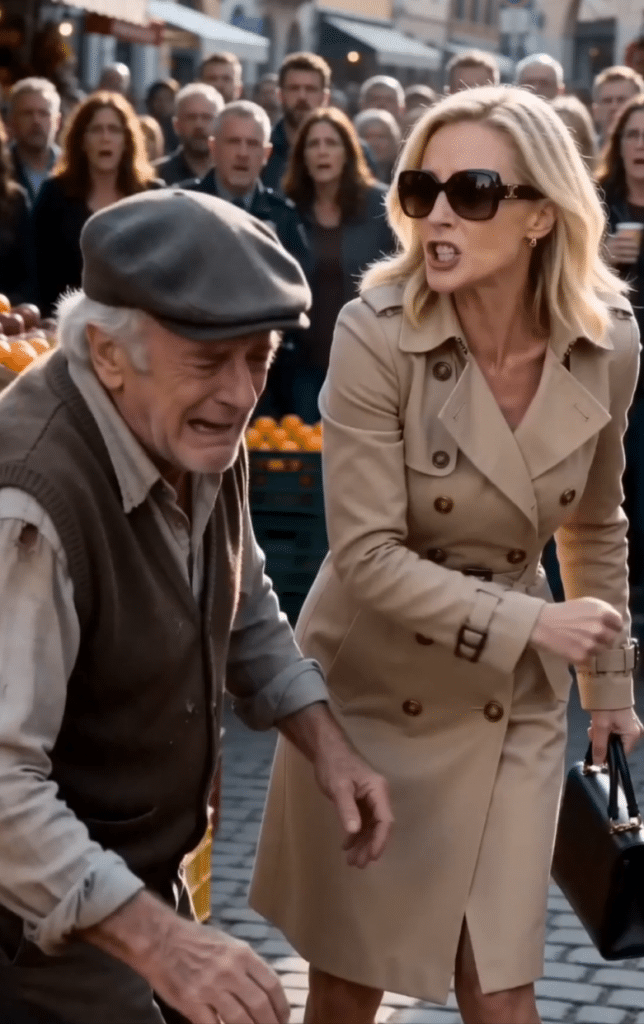
The slap cracked through the market before anyone saw the chain.
Oranges rolled across the cobblestones.
A wicker basket tipped over near the fruit stall. Apples scattered beneath polished shoes. Shoppers froze under the white awnings, their conversations dying in the bright afternoon sun.
The woman in beige stood over the old man like judgment itself.
Her blonde hair was smooth, her trench-style coat dress buttoned in gold, her dark sunglasses hiding her eyes but not the fury in her face. She looked too elegant for the violence of her own hand, too expensive to be screaming in the middle of a public market.
“You stole my chain!”
The old man stumbled backward, one hand pressed to his cheek. He was thin, gray-haired, wearing a brown sweater vest and a newsboy cap that had fallen crooked over his forehead. He looked like the kind of man people passed every day without wondering whether he had ever been young, loved, or trusted.
Now he was on his knees among the oranges.
His hands shook as he lifted a thick gold chain.
“Not mine!” he cried. “Not mine!”
The woman stepped closer.
A police officer pushed through the crowd.
“Madam, step back.”
But she did not step back.
“He had it in his basket,” she snapped. “Look at him. Of course he stole it.”
The crowd murmured.
That was how quickly a person could be judged.
A nice coat spoke louder than trembling hands. Designer sunglasses carried more authority than tears. The old man looked poor, so guilt found him easily.
Then a young man in a denim jacket moved forward.
He had been standing near the apple crates, watching like everyone else. Dark hair, early twenties, a canvas grocery bag hanging from one hand. At first, he looked like another bystander drawn in by the noise.
Then he saw the chain.
His face changed.
“Wait,” he said.
The officer held out an arm. “Sir, stay back.”
But the young man was already reaching down.
He took the gold chain carefully from the old man’s shaking hands and turned it over in the sunlight. His thumb traced the heavy links, then stopped at the clasp.
A tiny mark had been engraved there.
A crescent moon inside a rose.
The young man went pale.
“This was made for my mother.”
The market fell silent.
The woman in beige stopped breathing.
The officer placed a steadying hand on the young man’s shoulder. “Do you know this necklace?”
The young man looked up at the woman.
His voice came out strained, almost afraid of itself.
“My father designed it for her before she vanished.”
The old man began to sob harder.
The woman’s mouth parted, but no words came.
Because the chain had not simply been stolen.
It had returned to the street carrying a name everyone thought was dead.
Act II
The young man’s name was Gabriel Moretti.
He had been raised on half a story.
His father, Luca, was a jeweler before grief turned his hands useless. Not a famous one. Not a man who dressed windows for the rich or sold diamonds under velvet lights. Luca worked in a narrow shop behind the old train station, repairing broken clasps, resizing rings, and designing pieces for people who could not afford to be careless with love.
He made the chain for Gabriel’s mother when she was twenty-three.
Her name was Amalia.
At least, that was the name Gabriel knew.
Amalia had been a singer in the market square, a woman with a laugh people remembered even after she left the room. She wore secondhand dresses, red lipstick, and a gold chain her husband had built link by link from melted family rings.
At the clasp, Luca engraved his private mark.
A crescent moon inside a rose.
“For the woman who made night bloom,” he told her.
She laughed and called him dramatic.
Then she wore it every day.
In every photograph Gabriel had of her, the chain was there. Around her neck while she held him as a baby. Against her collarbone while she sang near the fountain. Glinting under kitchen light while she leaned over Luca’s workbench, teasing him for polishing the same ring three times.
Then one winter night, Amalia disappeared.
Gabriel was three.
Old enough to remember the smell of her hair.
Too young to understand why his father ran through the rain calling her name until his voice broke.
The official story was simple.
Amalia ran away.
She had been seen near the bus station. A suitcase was missing. Money was gone from the register. A witness claimed she left with a man in a dark car.
Luca never believed it.
“My wife did not leave her chain,” he said again and again.
But the chain was gone too.
That was what convinced everyone else.
A woman leaving her husband might take money.
A woman leaving her child might take shame.
But Amalia would never leave without the chain.
Years passed.
Luca searched until searching swallowed him. He followed rumors across cities, paid investigators he could not afford, argued with police who stopped taking his calls. Eventually, the jewelry shop closed. The sign faded. Luca kept only his tools and a small velvet display tray where the chain had once rested before he gave it to Amalia.
Gabriel grew up angry at absence.
Then protective of grief.
He studied old photographs like evidence. He learned his father’s engraving mark before he learned cursive. He hated strangers who said, “Maybe she wanted another life,” because another life did not explain why every trace of her had been scrubbed away.
Two months before the market incident, Luca died.
In the hospital, with machines beeping softly beside him, he pressed Gabriel’s hand and said the same sentence he had said for eighteen years.
“She didn’t leave.”
Gabriel promised he would keep looking.
But promises made to the dying can feel impossible once the room is empty.
Then, on a sunny market street lined with oranges, a wealthy woman in dark sunglasses slapped a frail old man over the very chain Gabriel had spent his whole life searching for.
The old man’s name was Tomas Ilyan.
And he knew more than he had ever dared tell.
Act III
“Where did you get this?” Gabriel asked.
The old man looked at the chain as if it had burned him.
“I didn’t steal it,” Tomas said. “I swear on my wife’s grave. I found it.”
The woman in beige snapped back to life.
“Liar.”
The officer turned to her. “Madam, let him answer.”
Her jaw tightened.
The loss of control seemed to frighten her more than the accusation.
Tomas wiped his eyes with the heel of his hand. “It was in the lining of the basket. I bought old things from an estate sale this morning. Blankets. frames. a sewing box. That chain was hidden under the wicker.”
“What estate sale?” Gabriel asked.
Tomas looked toward the woman, then away.
“The Laurent house.”
The woman in beige froze.
A whisper moved through the crowd.
Everyone in that district knew the Laurent name. Old money. Private gates. A villa above the river with stone lions at the entrance. The kind of family that appeared in society pages and never in police reports.
The officer looked at her. “Your name?”
She lifted her chin.
“Celine Laurent.”
The name meant nothing to Gabriel.
But the chain did.
He turned it over again, searching the links with shaking fingers. Luca had once shown him a secret hidden in the clasp.
“If she ever loses it,” his father had said, “the chain will still remember her.”
Gabriel pressed the crescent engraving with his thumbnail.
The clasp opened.
Not the normal latch.
A second compartment.
Tiny. Nearly invisible.
Inside was a folded strip of paper, browned with age.
The crowd leaned in.
Celine took one step backward.
Gabriel unfolded the paper.
The handwriting was faint but readable.
My name is Amalia Moretti. If this chain is found, I did not leave my son.
Gabriel’s knees nearly gave.
The officer tightened his hand on Gabriel’s shoulder.
Tomas crossed himself.
Celine removed her sunglasses slowly.
Her eyes were blue.
Terrified.
Gabriel looked at her properly for the first time.
The blonde hair was dyed. The makeup was expensive. The coat was immaculate. But beneath all that, beneath the cold posture and social polish, there was something familiar in the curve of her mouth.
Something from a photograph on his father’s workbench.
“No,” Celine whispered.
Gabriel’s voice broke.
“What was your name before Laurent?”
The woman looked at him like someone standing at the edge of a cliff inside her own mind.
“I don’t know.”
The answer silenced everyone.
Then Tomas began to tremble.
“I do,” he said.
Celine turned toward him.
The old man’s face crumpled.
“You were the girl in the car.”
The officer’s eyes sharpened. “What car?”
Tomas looked at Gabriel.
Then at the chain.
Then, finally, at the woman he had been too afraid to recognize for twenty years.
“The night she vanished,” he whispered, “I was driving for Laurent.”
Act IV
They took the statement in the market café because Celine refused to leave the chain.
The owner locked the front door. The officer called for detectives. Gabriel sat at a small table with the gold chain between his hands, feeling as if the entire world had narrowed to one impossible question.
Was this woman his mother?
Celine sat across from him, no longer wearing the sunglasses. Without them, she looked less powerful. Younger somehow. Not in age, but in fear.
Tomas spoke slowly.
He had been a driver for the Laurent family twenty years earlier. Not an important man. Not someone invited into rooms where decisions were made. He parked cars, carried bags, opened gates, and pretended not to hear things that could ruin him.
One night, he was ordered to drive to the old market district.
A woman was brought to the car.
Dark-haired. Struggling. Wearing a gold chain.
“She kept saying she had a son,” Tomas whispered. “She kept saying Gabriel.”
Celine flinched at the name.
Gabriel stopped breathing.
Tomas continued.
“I was told she was ill. That she was a danger to herself. Mr. Laurent said her husband had agreed to treatment.”
“My father would never,” Gabriel said.
“I know that now.”
“Where did you take her?”
Tomas swallowed.
“To the Laurent villa first. Then later to a private clinic in Switzerland. The family said she had no memory after the treatment. They said it was mercy.”
Celine pressed both hands to her temples.
“No. No, that isn’t true.”
But the denial sounded thin.
Because memory was moving behind her eyes now.
Not whole.
Not clear.
Fragments.
Rain against a car window.
A man shouting her name.
A baby crying somewhere far away.
The chain pulled from her neck by a woman with pearl earrings.
Gabriel’s voice was barely audible. “Why would they do that?”
The answer came from a woman standing outside the café window.
She was older, wrapped in a gray coat, face pale with the look of someone who had spent years waiting for a secret to rot through the door.
Celine saw her and stood.
“Aunt Elise?”
The woman entered slowly.
Her eyes went straight to the chain.
Then to Gabriel.
“I told them this would come back,” she said.
Celine backed away from her. “What did you do?”
Elise Laurent looked at the officer.
“My brother, Henri Laurent, was obsessed with bloodlines. His son was engaged to Celine before the accident.”
“What accident?” Gabriel asked.
Elise’s voice trembled.
“There was no accident. Amalia Moretti resembled Celine Laurent, who had died overseas before the wedding contracts were finalized. Henri found Amalia singing in the market and decided grief had given him an opportunity.”
The room went cold.
Gabriel stared at Celine.
Not Celine.
Amalia.
The woman in beige gripped the table.
“No.”
Elise cried softly. “He had doctors. Papers. Money. He said the mind could be corrected if the face was useful enough.”
The officer looked horrified.
Gabriel felt something inside him split between rage and pity so sharply he could barely speak.
“They stole my mother,” he said.
Elise nodded.
“And made her their daughter-in-law.”
Celine stumbled back against the chair.
“I was married?”
“To Laurent’s son,” Elise said. “After they gave you a new name.”
Celine’s face crumpled.
“Where is he?”
“Dead twelve years now.”
The silence that followed was not relief.
It was the sound of a woman realizing even her mourning had been assigned to her.
Gabriel pushed the chain toward her.
Her hand shook as she touched it.
The moment her fingers closed around the clasp, she began to sob.
Not like a rich woman embarrassed in public.
Like a mother hearing her child’s name from the bottom of a locked room.
“Gabriel,” she whispered.
He could not move.
Then she looked at him.
Really looked.
“My baby.”
Act V
The first embrace did not happen in the café.
That was not how stories like this healed.
Gabriel wanted to run to her.
He also wanted to run from her.
She was his mother. She was a stranger. She had slapped an old man in a market. She had worn another family’s name for twenty years. She had lived in wealth while he and his father folded grief into unpaid bills and unanswered questions.
None of that was her fault.
All of it still hurt.
So when Amalia reached for him, Gabriel stepped back.
Her face broke, but she stopped.
“I’m sorry,” she whispered.
He shook his head because sorry was too small and too large at once.
Detectives reopened the missing person case that evening.
By midnight, the Laurent villa was under search order.
By morning, the private clinic’s archived records had been requested. The first documents arrived three days later, and their language was worse than anyone expected because it was so calm.
Identity stabilization.
Memory intervention.
Protective relocation.
Consent obtained through family representative.
Every phrase was a clean sheet over a crime.
Henri Laurent was dead, but the empire he built was not. Former staff were questioned. Doctors were named. Payments traced. Other women’s names appeared in clinic files, raising questions no one in power wanted asked.
Tomas testified first.
He expected prison.
Gabriel expected to hate him.
Neither expectation survived the hearing easily.
Tomas had been a coward, yes. A poor man afraid of a rich family. A driver who followed orders when a woman cried in his back seat. But he had kept one thing all those years: a copy of the old route log from the night Amalia vanished.
“I thought if I ever became brave,” he told Gabriel, “I should have proof.”
Gabriel looked at him for a long time.
“You were twenty years late.”
Tomas bowed his head.
“Yes.”
That was the only answer Gabriel could bear.
Amalia’s recovery was not simple.
The woman called Celine did not disappear overnight. She had lived two decades inside that name. She knew its houses, its clothes, its signatures. She remembered charity boards and dinner parties before she remembered lullabies. Some mornings she woke speaking French and asking for people who had helped imprison her. Some nights she dreamed of a baby and woke screaming because the baby had aged without her.
Gabriel visited cautiously.
At first, only with a therapist present.
They sat in a quiet room at the clinic where she had checked herself in voluntarily after the truth came out. The gold chain rested on the table between them.
“I remember your father’s hands,” she said one afternoon.
Gabriel looked up.
“He had a scar near the thumb.”
“Yes.”
“He sang badly.”
Gabriel laughed despite himself.
“Terribly.”
Amalia smiled through tears.
“I loved him.”
“He loved you.”
Her smile collapsed.
“I didn’t come back before he died.”
The pain in her voice was unbearable because Gabriel had carried that accusation inside himself too, aimed at fate, at strangers, at her.
Now he had nowhere to put it.
So he placed it between them.
“He died believing you didn’t leave.”
Amalia covered her mouth.
That was the first time Gabriel reached for her hand.
Not forgiveness.
Not yet.
But contact.
Sometimes contact is where forgiveness begins negotiating with grief.
Months later, Gabriel brought her to Luca’s old jewelry shop.
The sign was faded. The windows dusty. The workbench still held tools arranged exactly as his father had left them. In the back drawer was the velvet tray where the chain had once rested.
Amalia stood in the doorway for a long time.
Then she walked to the bench and touched the engraving tool.
“I stood here,” she whispered.
Gabriel stayed quiet.
“She was crying,” Amalia said.
“Who?”
She turned, eyes wet.
“Me. I was crying because he kept filing the clasp over and over. I told him no one would see the mark. He said—”
Her voice faltered.
Gabriel finished softly.
“The chain would remember.”
She closed her eyes.
Outside, the market bells rang in the distance.
A year after the incident, the market held a small ceremony.
Not for the press, though some came anyway.
The fruit stall owner had replaced the smashed orange crates and insisted on giving Tomas a new wicker basket. The police officer attended in plain clothes. Elise Laurent came too, frail but determined, carrying files that would later help investigators identify other victims of the clinic.
Amalia wore simple clothes.
No designer sunglasses.
No beige armor.
Around her neck was the gold chain.
Gabriel stood beside her.
People watched them with the careful curiosity of a city learning shame in public. Some remembered the slap. Some remembered the old man crying on the stones. Some remembered the young man’s face when he said the chain had been made for his mother.
Amalia approached Tomas first.
The old man lowered his eyes.
“I have no right to ask—”
“No,” Amalia said gently. “You don’t.”
He nodded, accepting the wound.
She looked at the basket in his hands.
“But you told the truth when it cost you.”
“Too late.”
“Yes.”
The honesty settled between them.
Then she touched the chain.
“Late truth is not enough. But it is not nothing.”
Tomas cried.
Gabriel looked away, not because he felt nothing, but because he felt too much.
Later, mother and son walked through the market together.
At the fruit stall, Amalia bought oranges.
Gabriel almost laughed at the strange tenderness of it. The fruit that had scattered when violence opened the truth now sat neatly in a paper bag between them.
“Your father liked oranges,” she said suddenly.
Gabriel looked at her.
“He did?”
She smiled faintly.
“He said apples were too confident.”
Gabriel laughed then.
A real laugh.
Amalia watched him as if the sound was something holy.
They did not recover twenty years that day.
They never would.
But they found one small thing the stolen years had not destroyed.
A joke.
A chain.
A name.
A mother learning the shape of her son’s adult face.
As they reached the edge of the market, Amalia stopped near the place where the first orange had rolled across the cobblestones.
“I hit him,” she said quietly.
Gabriel knew who she meant.
“You were afraid.”
“That does not excuse it.”
“No.”
She looked at him, grateful he had not lied.
“I had become someone who thought fear gave me the right to be cruel.”
Gabriel looked at the gold chain at her throat.
“Then don’t be her.”
Amalia nodded.
“I’m trying.”
He picked an orange from the bag and handed it to her.
She took it.
They walked on beneath the market awnings, past the stalls, past the place where judgment had almost crushed an innocent man, past the corner where a stolen mother had been recognized by the son who refused to let a chain be just a chain.
For twenty years, gold had carried the truth quietly.
That afternoon, under the sun, it finally spoke loud enough for everyone to hear.