Act I
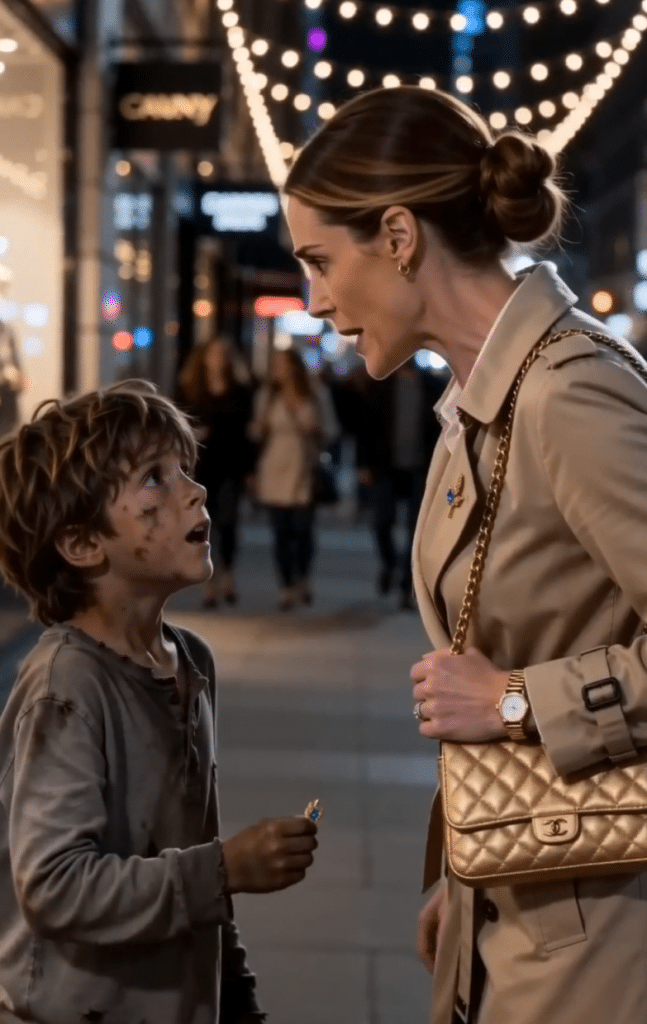
The boy grabbed the back of her trench coat just as Clara Whitmore stepped beneath the string lights.
“Excuse me!”
She spun around, clutching her gold-chain bag to her side.
“Don’t touch me!”
The words came out sharper than she meant them to. It was late, the sidewalk was crowded, and the city had taught her not to be soft with hands that reached from behind. Restaurants glowed warmly behind glass. Pedestrians moved past in dark coats, pretending not to see the small boy standing in front of her with soot on his face.
He was eight, maybe nine.
His hair was messy. His gray shirt was worn thin at the elbows. His cheeks were smudged with dirt, but his eyes were steady in a way that made Clara’s annoyance falter.
“I’m sorry,” he said quickly. “But you have the same pin.”
Clara frowned.
“What are you talking about?”
The boy lifted his hand.
Resting in his palm was a golden leaf-shaped pin set with tiny blue stones.
Clara’s breath caught.
Her own hand rose instinctively to her lapel, where an identical pin gleamed against the beige fabric of her trench coat. She had worn it almost every day since childhood, though no one in her family liked talking about it.
Her grandmother called it a keepsake.
Her uncle called it sentimental junk.
Her mother once cried when Clara asked why there had been two empty spaces in the velvet box where it came from.
The boy looked from the pin in his palm to the one on her coat.
“My mom has the same one.”
Clara stepped back.
“That’s impossible.”
The boy shook his head. “She said if I ever saw the woman with the other pin, I had to tell her.”
The city seemed to dim around them.
Clara stared at the child’s face, searching for the trick. A scam, maybe. A coincidence. A cruel little setup designed to reach the name Whitmore through the only piece of jewelry she never removed.
But the boy was not smiling.
He looked exhausted.
Hungry.
Scared of being disbelieved.
“What did your mother tell you?” Clara asked.
His fingers closed around the pin.
“She said the woman with the other pin is my mother’s sister.”
The sidewalk noise fell away.
A taxi horn blared somewhere behind her. Someone laughed outside a wine bar. A waiter carried candles to an outdoor table.
Clara heard none of it.
Because her only sister, Elise, had died twenty-two years ago.
At least, that was what Clara had been told.
And now a filthy boy on a winter street was holding the pin that had been buried in an empty grave.
Act II
Clara Whitmore grew up in a house where grief had its own bedroom.
It was the west nursery.
No one entered it. No one cleaned it except Mrs. Bell, the housekeeper, who unlocked the door once a month, dusted the shelves, and came out with red eyes no one mentioned. Inside were two small cribs, two faded blankets, and two framed baby photographs.
Clara had no memory of Elise.
They were twins, born seven minutes apart during a thunderstorm. Clara came first, loud and furious. Elise came second, quiet enough that nurses joked she was already the thoughtful one.
Their mother, Marianne, wore two golden leaf pins on the day the girls were christened. Family pieces, she said. Each leaf shaped from gold, each blue stone taken from their grandmother’s old sapphire necklace.
“One for each daughter,” she had whispered.
Then came the accident.
That was the family word.
Accident.
Clara was three years old when a fire broke out in the family’s country house. She survived because her father carried her down the back stairs. Elise did not. The flames had moved too quickly. The smoke had been too thick. By dawn, the newspapers called it a tragedy, and the Whitmore family locked its doors against the world.
Clara remembered almost nothing.
A flash of orange light.
A woman screaming.
A hand pulling her away from another small hand.
For years, that memory came back in dreams, but every adult told her dreams made monsters out of sorrow.
Her father died when she was twelve.
Her mother faded after that, drifting through the city house like someone listening to music no one else could hear. Clara’s uncle, Victor Whitmore, took control of everything: the estate, the foundation, the legal documents, the story.
Especially the story.
Elise was gone.
Elise had died in the fire.
Elise was not to be discussed because it upset Marianne.
The only rebellion Clara allowed herself was the pin.
Victor hated it.
“You look like a child wearing that thing,” he said when she was twenty-one.
Clara wore it to board meetings anyway.
She became polished because the world demanded it. Brown hair in a neat bun. pressed dresses. perfect coats. careful smiles. She learned charity speeches, donor dinners, and the cold art of surviving rooms where men twice her age treated her inheritance like a temporary inconvenience.
But beneath the polish, the west nursery remained.
And sometimes, late at night, Clara wondered why the grave had been sealed before her mother could say goodbye.
The boy’s name was Mateo.
He told her this while they stood under the string lights and strangers flowed around them.
“My mom said not to trust police first,” he said. “She said trust the pin first.”
Clara swallowed.
“What is your mother’s name?”
“Lena.”
Not Elise.
Clara felt both relief and disappointment strike at once.
Then Mateo added, “But she said that wasn’t her first name.”
Clara’s hands went cold.
“Where is she?”
Mateo looked down.
“At the clinic by the old bridge. She got sick after the men came to our room.”
“What men?”
He looked up at her with eyes too old for his face.
“The ones who said she should have stayed dead.”
Act III
Clara did not take Mateo to her car immediately.
Fear made her careful.
She brought him first into the lobby of the nearest hotel, bright with cameras, marble floors, and a doorman who recognized her name. She ordered soup, tea, and a clean towel. Mateo ate like a child who had learned food could disappear if he waited too long.
Only after he stopped shaking did Clara ask to see the pin again.
It was identical to hers.
Not similar.
Identical.
The same curved stem. The same three blue stones along the center vein. The same tiny engraving on the back.
E.W.
Elise Whitmore.
Clara turned her own pin over with trembling fingers.
C.W.
For the first time in her life, the initials felt less like decoration and more like evidence.
Mateo watched her closely.
“You believe me?”
Clara looked at his face, the bruise-dark shadow beneath one eye, the dirt caught under his fingernails, the way he held the soup bowl with both hands as if warmth itself might be stolen.
“I believe the pin,” she said. “I’m trying to understand the rest.”
He nodded as if that was fair.
From his backpack, he pulled a folded photograph.
It was creased nearly white at the edges. In it, a woman sat beside a small birthday cake in a dim apartment, one hand around Mateo, the other holding the golden leaf pin against her chest. Her hair was darker than Clara’s, shorter, but the face beneath the hardship was unmistakable.
Clara stared.
It was like seeing herself from a life that had gone wrong in every possible way.
She sank into the chair.
“Elise.”
Mateo whispered, “She cries when she hears that name.”
Clara pressed a hand to her mouth.
The hotel lobby blurred.
For twenty-two years, she had mourned a sister she had not been allowed to remember. For twenty-two years, Elise had been a portrait, a nursery, a grave, and a silence enforced by adults who claimed they were protecting her.
Now Elise had a son.
A room by a bridge.
Men looking for her.
And a life no one in the Whitmore house had tried to find.
Clara called the only person she trusted.
Mrs. Bell answered on the second ring.
Before Clara could explain, the old housekeeper heard something in her voice and said, “Where are you?”
“Mrs. Bell,” Clara said, staring at the photograph. “Did they ever find Elise’s body?”
Silence.
Long enough to become an answer.
Then Mrs. Bell began to cry.
“Oh, Miss Clara.”
The words entered Clara like a door opening beneath her feet.
“You knew?”
“I suspected,” Mrs. Bell whispered. “Your mother knew too, near the end. But Mr. Victor controlled everything. The doctors, the visitors, the letters. He said grief had made her confused.”
Clara closed her eyes.
Victor.
Always Victor at the center of locked rooms.
Mrs. Bell’s voice shook.
“There was a nurse. She said one child was taken from the house before the fire spread. Your father thought both girls were in the nursery. By the time he learned otherwise, your uncle had already buried the truth.”
“Why?”
“Because of the trust.”
Clara opened her eyes.
“What trust?”
Mrs. Bell lowered her voice.
“Your grandfather’s will. Whitmore Foundation control passed equally to both daughters when they turned twenty-five. If one died, the surviving daughter needed a guardian trustee until thirty. Victor became that guardian.”
Clara looked at Mateo.
The boy’s mother had not only lost her name.
She had been erased so a man could own what belonged to two sisters.
And the boy’s arrival meant Victor’s lie had an heir.
Act IV
The clinic by the old bridge smelled of rain, antiseptic, and boiled coffee.
Clara arrived with Mateo just after midnight, escorted by the hotel’s security director and a private attorney Mrs. Bell had called before Clara could even ask. They found Lena Moreau in a narrow room near the end of the hall, asleep beneath a thin blanket.
Mateo ran to her.
“Mom.”
The woman stirred immediately, fear waking before her body did. She reached for him, pulled him close, then saw Clara standing in the doorway.
Everything in her face stopped.
Clara could not move.
The woman in the bed looked like her reflection after years of hunger, running, and being told she did not exist.
“Elise,” Clara whispered.
The woman flinched.
“My name is Lena.”
Clara nodded quickly, tears rising. “Then Lena.”
That mattered.
She saw it in her sister’s eyes.
Mateo climbed onto the bed beside his mother and held up Clara’s pin.
“I found her.”
Lena closed her eyes.
A tear slipped down her cheek.
“I told you only if you had no choice.”
“I was scared.”
Lena kissed his hair. “You did right.”
Clara stepped closer slowly.
“I thought you were dead.”
Lena’s laugh was weak and bitter.
“So did everyone. That was the point.”
The story came in fragments.
A nurse carried Elise from the nursery before the fire reached the west wing. She had been told to take the child to a private car waiting by the service road. Victor arranged everything afterward: a false death certificate, a closed casket, a doctor paid to keep Marianne sedated, and a new identity for Elise through a foreign adoption broker.
But the plan did not remain clean.
Plans like that rarely do.
The woman paid to take Elise away grew afraid and abandoned her with a family outside Marseille. Elise became Lena. She grew up poor, half-loved, then not loved at all after her foster father died. She discovered the pin at fourteen in an envelope hidden under her mattress, along with one sentence written by the woman who raised her:
Your first family paid to make you disappear.
For years, Lena tried to find the Whitmores.
Every attempt led back to Victor.
Every letter returned.
Every phone call ended.
When Mateo was born, she stopped searching and started hiding.
“I didn’t care about the money,” Lena said. “I just wanted to know if anyone missed me.”
Clara could barely speak.
“I did.”
“You were three.”
“I missed you without knowing what was missing.”
Lena looked away.
The pain in that room was too large for easy comfort.
Then Mateo pulled something from under his mother’s pillow.
A small envelope.
“Mom said give this if the pin worked.”
Clara opened it.
Inside was a hospital bracelet, brittle with age, marked Elise Whitmore, and a page torn from an old legal file. At the bottom was Victor’s signature authorizing private transfer of a minor child under emergency protective custody.
Clara’s attorney took one look at it and went still.
“This is enough to freeze him tonight,” she said.
Lena grabbed Clara’s wrist.
“He has men looking for us.”
Clara looked down at her sister’s hand.
The same hand.
The same blood.
The same family history split in two and forced to crawl back together through a child’s courage.
“Then we stop running separately,” Clara said.
By dawn, Victor Whitmore would learn that the dead girl had returned with a son, a pin, and a sister who finally knew where to aim her grief.
Act V
Victor did not deny it at first.
He laughed.
That was what Clara remembered most from the emergency board meeting forty-eight hours later. Not his expensive suit. Not his polished cufflinks. Not the way the foundation attorneys avoided looking at Lena when she entered the glass conference room.
His laugh.
Soft. offended. amused that anyone would expect him to be ashamed.
“This is grotesque,” he said. “A street woman with a resemblance and a child trained to manipulate you.”
Lena stood beside Clara, pale but upright, the golden leaf pin fixed to her borrowed coat. Mateo sat in a chair near Mrs. Bell, holding a hot chocolate he had not touched.
Clara placed the hospital bracelet on the table.
Victor’s smile thinned.
Then she placed the transfer document beside it.
His face changed.
Only slightly.
Enough.
The attorney opened the file.
“We have petitioned the court for emergency suspension of Victor Whitmore’s trustee authority pending investigation into fraud, child trafficking, and estate misappropriation.”
Victor stood. “You ungrateful little fool.”
Clara looked at him.
For the first time in her life, she did not feel like a child in his shadow.
“You told me my sister was dead.”
“She was dead to this family.”
Lena flinched.
Clara’s voice dropped.
“No. You don’t get to decide that.”
Victor turned toward the board, trying to recover command.
“Think carefully. The foundation cannot survive this scandal.”
Lena spoke then.
Quietly.
“It survived stealing a child.”
The room went still.
Victor looked at her as if she were something that had crawled out of a locked basement.
“You have no idea what was at stake.”
Lena touched the pin on her coat.
“I do. A little girl.”
That ended him more completely than any legal threat.
The investigation took months.
Victor’s accounts were frozen. Doctors were questioned. Old staff came forward. The nurse who carried Elise from the nursery was found in a retirement home by the sea, still carrying guilt like a stone in her throat. She confirmed everything.
Marianne Whitmore, Clara and Lena’s mother, had left behind letters too.
Victor had hidden them.
Mrs. Bell found the box in a sealed cabinet behind the west nursery wall.
There was one for Clara.
One for Elise.
And one addressed to both my daughters, when the truth becomes stronger than the lie.
Lena could not open hers at first.
She held the envelope for three days.
On the fourth, she and Clara sat together in the nursery that had once held two cribs and one official ghost. The room smelled of dust, lavender, and returned breath. Mateo played quietly in the hallway with a wooden train Mrs. Bell had saved for twenty years.
Lena opened the letter.
My Elise,
If you are reading this, then some part of my heart was right and the world was wrong. I felt you alive. They called it grief. They called it madness. But mothers know the shape of absence.
Lena bent over the page and wept.
Clara wrapped her arms around her sister.
Not to erase the years.
Nothing could.
But to hold the space where the years should have been.
The Whitmore Foundation changed after Victor’s removal.
Not immediately. Institutions do not become honest just because one villain leaves. Clara and Lena rebuilt it slowly, painfully, under public scrutiny. They created a fund for children erased through illegal custody schemes. They opened old archives. They repaid stolen assets. They put Marianne’s name back on the family history where Victor had edited her into silence.
Lena refused to move into the mansion.
“I spent my life locked out of rich rooms,” she said. “I don’t want to live inside one just because the lock broke.”
So Clara bought the old town house next to hers and gave Lena the deed without ceremony.
Lena tried to refuse.
Clara said, “It’s not charity. It’s geography. I’m not losing you across a city again.”
Mateo loved the place immediately because it had stairs, a courtyard, and a bakery on the corner that gave him day-old rolls even after they learned he could now afford fresh ones.
He kept the original pin in a small wooden box beside his bed.
Sometimes he took it out and studied it.
“Do I have to call you Aunt Clara now?” he asked one evening.
Clara smiled. “Only if you want to.”
He considered this.
“What did I call you before I knew?”
“You called me the woman with the other pin.”
“That was too long.”
“It was.”
“Aunt Clara is shorter.”
So that was that.
A year after the night on the sidewalk, the city lit the same street with the same golden string lights.
This time, Clara walked there with Lena on one side and Mateo between them, holding both their hands. The restaurants glowed. Pedestrians hurried past. The broken places in the world remained, as they always do, but Clara no longer moved through them as if grief were a private room.
They stopped near the exact spot where Mateo had grabbed her coat.
He looked embarrassed.
“I shouldn’t have touched your bag.”
Clara squeezed his hand.
“I’m glad you did.”
Lena looked at the lights overhead.
“I almost told him not to go.”
“Why didn’t you?”
Lena touched the golden leaf pin on her coat.
“Because my mother wrote that truth gets stronger when someone carries it.”
Clara smiled through tears.
Mateo looked between them.
“So the pin was like a map?”
Clara knelt in front of him.
“No,” she said. “You were the map.”
He frowned, pretending not to be pleased.
“That’s dramatic.”
Lena laughed.
“You’re a Whitmore,” Clara said. “You’ll get used to it.”
Mateo made a face, but he did not let go of their hands.
Above them, the lights glowed warm against the dark sky.
And for the first time since childhood, Clara understood that the matching pins had never been only jewelry. They were not proof of wealth, or blood, or inheritance.
They were two halves of a promise.
One carried through privilege.
One carried through hunger.
Both waiting for a child brave enough to bring them back together.