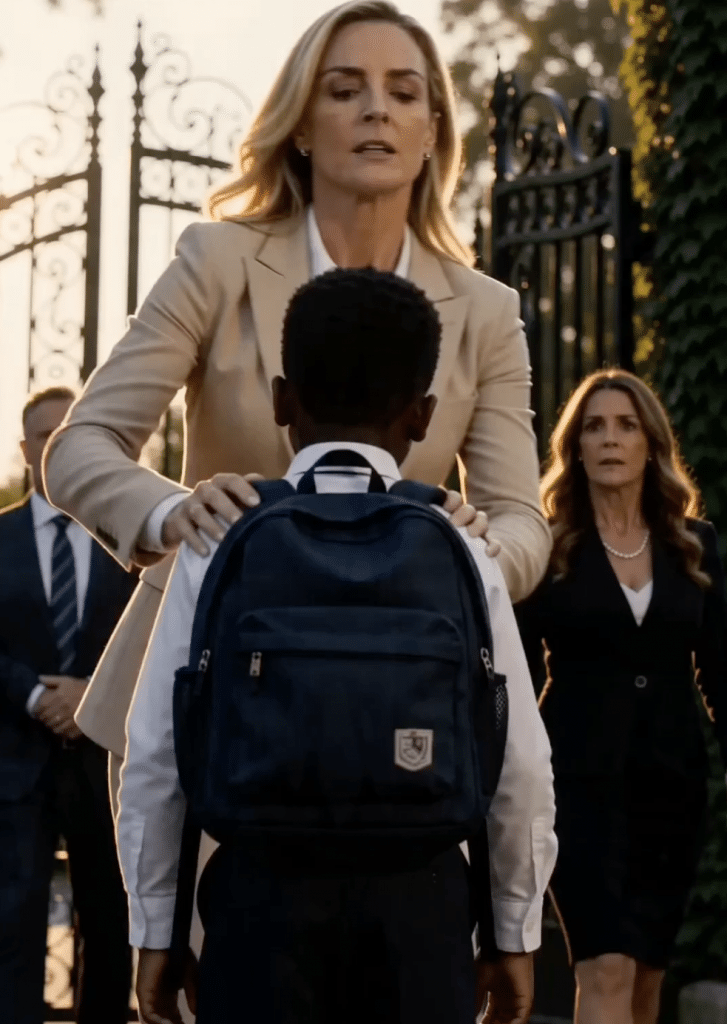
The wrought-iron gates of Hawthorne Crest Academy stood like a declaration—wealth, legacy, and quiet power forged into black steel. Ivy climbed the red-brick walls with curated perfection, and the polished stone driveway reflected the golden hue of late afternoon sunlight. It was the kind of place where futures were engineered long before adulthood, where last names often mattered more than first impressions.
On that particular afternoon, the calm elegance fractured in an instant.
Evelyn Carter did not raise her voice often. She didn’t have to. Her presence—tailored beige suit, diamond studs that caught the sun just right, posture sharpened by years of social dominance—was usually enough. But today, something had crossed a line she believed should never be crossed.
And so she shoved him.
The boy hit the pavement harder than anyone expected. His backpack slid from his shoulder, skidding across the stone with a hollow thud. Conversations stopped mid-sentence. The soft rhythm of heels clicking on the driveway faded into an uneasy silence.
Evelyn pointed down at him, her hand trembling not with fear, but with indignation.
“Don’t you even think about going near my son.”
Her voice cut clean through the air—controlled, but loud enough to command attention. Around her, other parents froze. Some glanced at each other. Others looked away, choosing silence over discomfort.
The boy—no older than twelve—pushed himself up slightly, wincing. His eyes were wide, glossy, but he swallowed whatever reaction tried to rise. He said nothing. Not a word.
Evelyn stepped closer, her shadow falling over him like a verdict.
“You’re nothing but trash,” she added, her tone colder now, sharper. “Kids like you don’t belong at this school.”
A faint murmur rippled through the crowd, but no one intervened. Not the fathers adjusting their cufflinks. Not the mothers gripping their designer handbags a little tighter. This was not their conflict. And in places like Hawthorne Crest, neutrality often masqueraded as civility.
The boy’s fingers curled slightly against the pavement. Not in anger—something else. Restraint.
Then came the sound.
Low. Smooth. Expensive.
A black SUV rolled through the gates with quiet authority, its tinted windows reflecting the golden light like polished obsidian. The engine’s hum cut through the tension like a blade, and instinctively, the crowd shifted. Space opened where there had been none.
The vehicle came to a precise stop beside the scene.
No one spoke.
The rear door opened.
A man stepped out—mid-fifties, composed, dressed in a black overcoat layered over a perfectly tailored suit. His presence was different from Evelyn’s. Where hers demanded attention, his commanded it without effort.
He didn’t look at her.
He didn’t look at anyone else.
His gaze was fixed entirely on the boy.
He walked forward with measured steps, the faint crunch of gravel beneath his shoes the only sound in the stillness. The closer he got, the more something shifted—subtle, but undeniable.
He stopped a few steps away.
Then, to the quiet astonishment of everyone watching, he inclined his head slightly.
“Young Master Castillo.”
The words landed like a crack in glass.
The boy looked up.
Gone was the fear. Gone was the hesitation. What remained was something far more unsettling—composure.
The man lowered himself just enough to meet the boy at eye level, his voice softening with genuine concern.
“Please forgive us for not arriving sooner.”
Silence swallowed the courtyard.
Not the polite silence of elite society—but something heavier. Something that carried realization.
The boy rose to his feet without rushing. He brushed the dust from his uniform with quiet dignity, then glanced briefly at the man.
“It’s alright, Mateo,” he said calmly. “You’re here now.”
Mateo nodded once, relief flickering across his otherwise controlled expression. He retrieved the boy’s backpack himself—personally—before handing it back with both hands.
Behind them, the shift became impossible to ignore.
Evelyn Carter’s world had just tilted.
Her lips parted slightly, but no words came out. The color drained from her face as pieces began falling into place—pieces she hadn’t even known existed.
Castillo.
The name echoed in her mind like a warning bell.
Not just any name.
A name tied to international banking empires. Private equity firms. Philanthropic foundations that quietly funded institutions like Hawthorne Crest itself. A name that didn’t just belong—it defined who truly held power behind the scenes.
Her eyes flicked toward the SUV. Toward the insignia subtly embedded near the rear door. Toward the driver who stood waiting—not impatiently, but attentively.
This wasn’t just wealth.
This was legacy on a scale she couldn’t compete with.
The boy—no, the young heir—adjusted his sleeve, then turned his gaze toward Evelyn.
Not angry.
Not vengeful.
Just… aware.
And that, somehow, was worse.
“You should be careful,” he said quietly.
His voice wasn’t loud, but it carried.
“About how you decide who belongs.”
Each word landed with precision.
Evelyn’s throat tightened. For the first time in years—perhaps ever—she felt exposed. Not judged by society’s standards, but by something deeper. Something she couldn’t deflect with status or influence.
Around her, the other parents had shifted again—but this time, it was distance. Subtle, but deliberate. Conversations resumed, but not with her. Eyes avoided hers now, not out of respect—but caution.
Reputation, in places like this, was currency.
And hers had just taken a hit no amount of money could immediately repair.
Mateo opened the car door once more.
The boy stepped inside, pausing only for a second before entering.
Then the door closed.
The SUV pulled away as smoothly as it had arrived, disappearing beyond the gates.
The golden light remained.
The silence lingered.
And Evelyn Carter stood exactly where she had been—only now, the ground beneath her felt very different.
Because in a world she thought she understood, she had made one critical mistake.
She had judged power by appearance.
And karma, as it turned out, didn’t need to raise its voice to make itself heard.